

Mindfulness can help executives steady their attention and soften their stress response. The evidence is real, but it is more modest and more conditional than most leadership blogs admit. It works best when it is structured, sustained over weeks, and supported by someone who knows what to do when difficult material surfaces. It works poorly as a five-minute patch on a job that is wearing you down.
If you lead people, carry decisions that other people live with, and rarely get to put any of it down, you may already be skeptical. Good. This article is written for intelligent adults who want the honest version: what the studies found, where mindfulness backfires, and what a sensible start looks like.
Key takeaways
- Workplace mindfulness programs show moderate effects on stress and anxiety, and the strongest manager studies use structured programs of about eight weeks, not occasional sessions.
- A leader’s practice helps their team mainly through changed behavior, such as how fairly and steadily they treat people, not through the practice itself.
- Meditation is not risk-free. In one U.S. survey, about one in three people with meditation experience reported at least one adverse effect.
- Mindfulness is a tool, not a burnout treatment. If the strain is systemic or rooted in trauma, you need more than an app.
- Education is not assessment. Reading this article cannot tell you what is happening with you. A clinician can.
Table of Contents
- What mindfulness actually asks of an executive
- What the research shows, and what it doesn’t
- Why high performers are a special case
- How leader mindfulness reaches your team
- Mindful leadership exercises you can start this week
- Why eight weeks beats a one-off session
- When mindfulness is not enough
- Our perspective: where Pursuit stands
- A mindfulness workshop for executives and leadership teams
- An emotionally accurate next step
- FAQ
- Sources
What mindfulness actually asks of an executive
Strip away the branding and mindfulness is a trained skill: paying attention to what is happening, in your body, thoughts and surroundings, without immediately reacting to it or judging it. That is all.
For an executive, the appeal is obvious. Your day is a stream of interruptions, each demanding a reaction. You are rewarded for speed. Somewhere in that, the gap between a stimulus and your response has shrunk to almost nothing, and you may have noticed the cost: a sharp email you wish you had not sent, a meeting where you were physically present and mentally three decisions ahead, a night where your body is in bed and your mind is still in the boardroom.
Mindfulness trains that gap back open. It does not make you calmer by decree. It makes you more aware of when you are not calm, earlier, while you still have options.
That distinction matters, because many executives try it once, feel nothing, and quit. They treated it as a switch. It is closer to a strength program.
What the research shows, and what it doesn’t
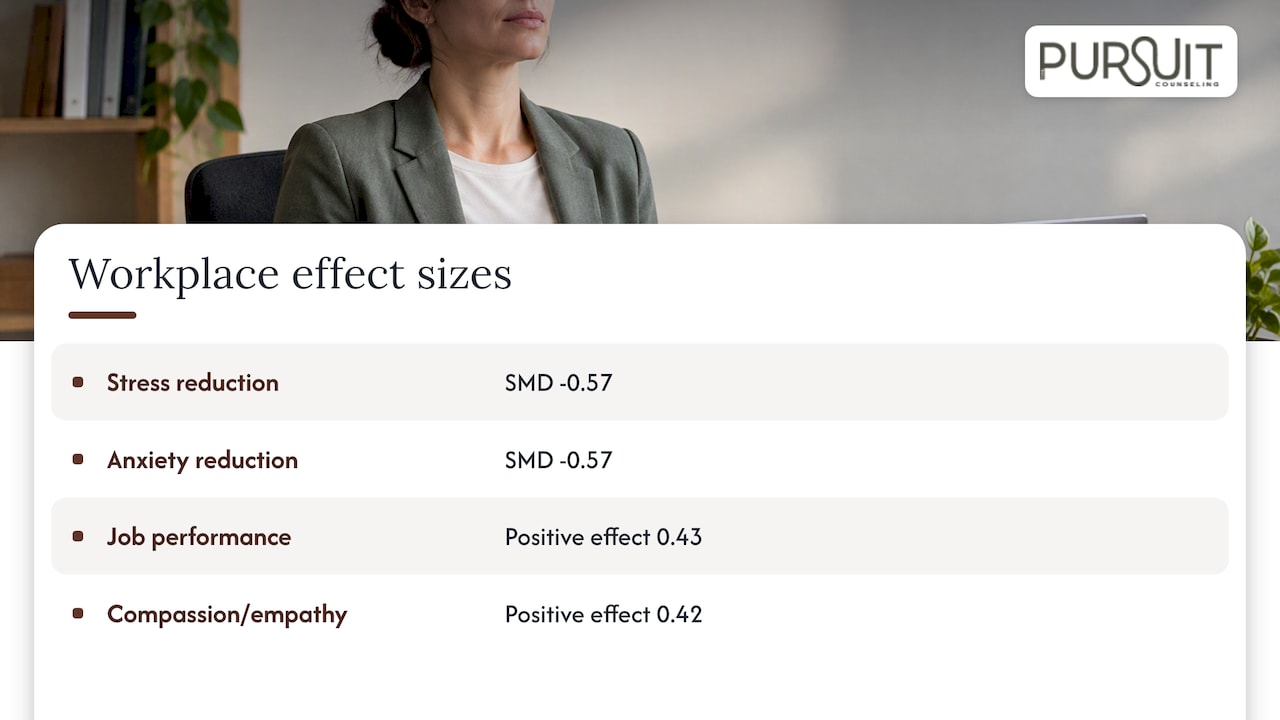
Start with the encouraging part. A synthesis of systematic reviews and meta-analyses of workplace programs reported moderate effect sizes for reducing stress and anxiety (both an SMD of -0.57), with smaller positive effects on job performance (0.43) and compassion or empathy (0.42). Those are working adults, not meditation retreat volunteers.
For managers specifically, a randomized controlled study of mindfulness-based stress reduction ran eight weeks and found a significant decrease in perceived stress and an increase in self-esteem compared with controls. Eight weeks is the number to remember. It is long enough to be a real commitment and short enough to fit a calendar.
Now the cautions, because a credible guide includes them.
One widely cited critique argues that the evidence for even the best-supported benefits of mindfulness is not consistent or conclusive. Study quality varies, and results do not always replicate. You can take mindfulness seriously and still hold the claims loosely.
There is also the question of harm. A review of harms in mindfulness-based programs concluded that the potential for harm has not been comprehensively studied. And the 2021 population-based survey of people with lifetime meditation exposure found that 32.3% reported at least one meditation-related adverse effect. The most common were anxiety, traumatic re-experiencing and emotional sensitivity. About 10.6% reported functional impairment, and about 10.4% reported symptoms lasting a month or longer.
Those numbers do not mean mindfulness is dangerous. They mean it is a real intervention, and real interventions have side effects.
Why high performers are a special case
High achievers tend to be good at suppressing. You learned early to function through pressure, push the heavy feelings down, and keep the machine running. Competence became armor.
Mindfulness asks you to sit still and notice. For someone who has spent twenty years not noticing, what surfaces can be a lot: old grief, the residue of a hard season, tension that has been quietly running the show. Researchers writing about this caution against a rosy view and note that when difficult emotions emerge, they can be overwhelming if the practitioner is unsupported. The same material that is productive inside a therapeutic relationship can become unmanaged distress when you meet it alone with a meditation app.
This is where we see executives get stuck. They are not failing at mindfulness. They are meeting something the app was never designed to hold. If you have a history of trauma, if sitting in silence makes your chest tighten, or if your mind gets louder rather than quieter, that is information. It is not a character flaw, and it is not a reason to push harder. It is a reason to bring in a clinician, ideally one who works in a trauma-informed way.
How leader mindfulness reaches your team
Here is the part most articles skip. Does your practice make your team better off?
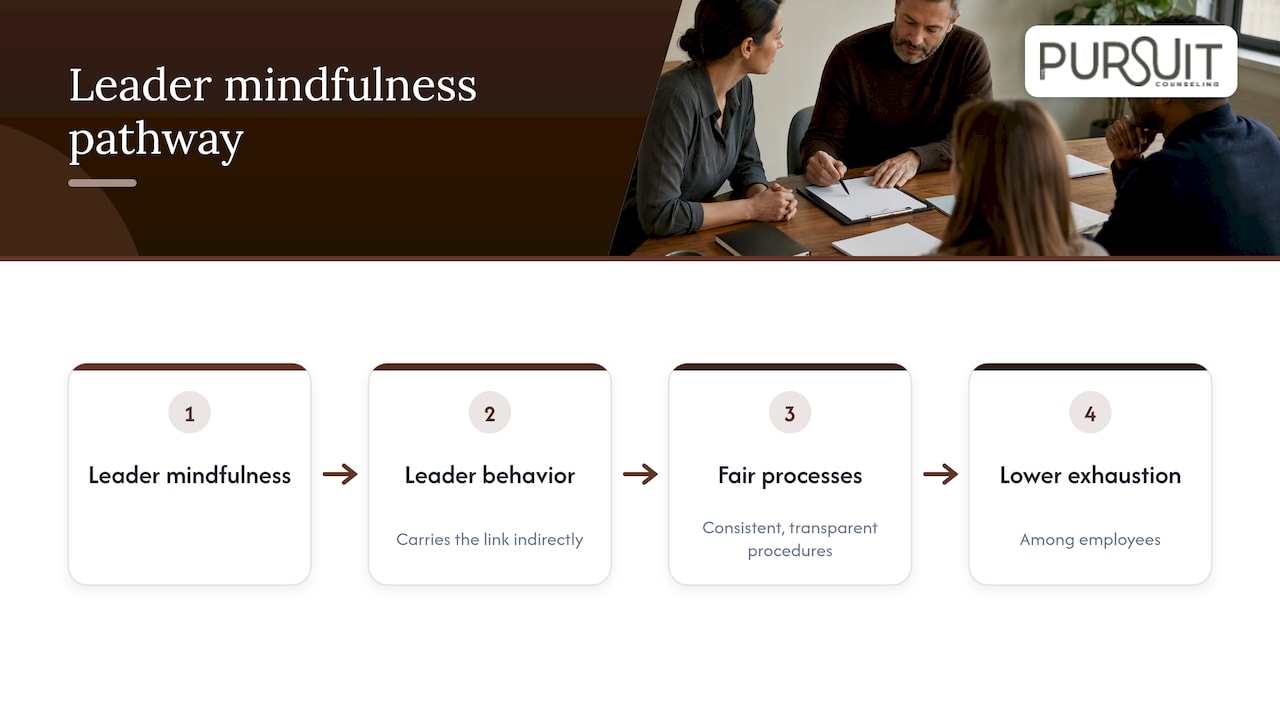
Research on the interpersonal side of leader mindfulness suggests the answer is yes, but indirectly. A serial mediation study found that the link between a leader’s mindfulness and lower employee exhaustion ran through the leader’s behavior, specifically how consistently they enacted procedural justice, meaning fair and transparent processes. Another line of work found that mindfulness is associated with less emotional exhaustion, and related research on leaders points to lower surface acting, the effort of displaying emotions you do not feel, as part of the mechanism.
Put plainly: your team does not benefit because you meditate. They benefit because you stop performing composure and start being steady. You become less reactive, more even-handed, and easier to bring bad news to.
That is also why the executives who see little from mindfulness often treat it as a task. Ten minutes, checked off, back to the same behavior. Research on CEOs and presidents links the benefits to psychological resources such as hope, efficacy, resilience and optimism, which are built by changing how you operate, not by scheduling a break.
Mindful leadership exercises you can start this week
These are small, deliberate, and honest about their limits. If any of them stirs up something heavy, stop and talk to a professional rather than pushing through.
The pause before the reply
Before you answer a message that irritates you, take three slow breaths and notice where the irritation sits in your body: jaw, shoulders, stomach. Then answer. You are not suppressing the feeling. You are choosing when it speaks.
The transition minute
Between meetings, stop for sixty seconds before opening the next thing. Feel your feet on the floor. Name what you are carrying out of the last conversation. This keeps one hard meeting from bleeding into the next five. If your stress spikes mid-day and you want a short, clinician-designed technique, we outline one in our 60-second protocol for leadership anxiety.
The one-on-one presence check
In your next one-on-one, put the phone face down and notice the moment your attention drifts to your own agenda. Come back without scolding yourself. Do it once or twice, and people notice the difference faster than you would expect.
The evening unload
Before leaving work, write down the three things your mind would otherwise rehearse at 2 a.m. Then close the notebook. Rumination is often unfinished business that has nowhere to go.
For a wider look at how everyday practices fit together, this overview of mindfulness practices for stress relief covers several approaches you can compare with the ones above.
Why eight weeks beats a one-off session
Most executives want a fix by Friday. The research does not offer one. The manager trial above used an eight-week structure, and the broader pattern in the literature is that sustained engagement drives results, especially when there is a group or an expert behind you. Sporadic practice rarely retrains a stress response that took years to set.
There is a practical reason for this too. A web-based, eight-week mindfulness stress program in a corporate call center was studied specifically to test the added value of group support, which tells you the field itself treats accountability as part of the intervention, not an extra.
If you try this alone, give it eight weeks, ten to fifteen minutes most days, and keep a short log of what you notice: sleep, irritability, how quickly you recover after a hard call. If nothing shifts, or if you feel worse, that is a signal to change the approach, not to blame yourself.
When mindfulness is not enough
Mindfulness is sometimes asked to carry weight it cannot. CDC’s NIOSH notes that reducing burnout among high-performing professionals takes more than personal practice. It calls for systemic changes, such as dedicated support teams and fewer barriers to seeking mental health care. A breathing exercise will not fix a workload that cannot be done by one person.
Watch for these signs that you need more than a practice:
- You feel flat, cynical or detached from work you used to care about.
- Anxiety shows up as physical symptoms: racing heart, tight chest, broken sleep.
- Silence or stillness feels threatening rather than restful.
- You are drinking more, or working more, to avoid feeling anything.
- The strain is spilling into your marriage or your team.
None of that is a diagnosis. Only an assessment with a licensed clinician can tell you what is going on. If this list sounds familiar, our pages on what causes burnout in leadership positions and counseling for burnout and workplace stress are a good next read. If you are a business owner, this clinician’s checklist is written for your situation.
Our perspective: where Pursuit stands
We work with executives, pilots, founders and other people who are very good at carrying things. Most do not walk in asking about mindfulness. They walk in saying they are tired in a way sleep does not touch, or that they are short with the people they love, or that they cannot turn off.
Here is what we have come to believe.
First, mindfulness is worth learning, and the point is not serenity. The point is to feel what is actually there. High performers often call that the pain cave: the place you are trained to push through rather than look at. Looking is uncomfortable. It is also where the cracks show, and the cracks tell you what needs attention.
Second, looking works better with company. We would rather you meet difficult material with a clinician who can slow things down, adjust the pace and screen for trauma than meet it alone at midnight with a timer. That is not a knock on self-guided practice. It is a recognition that some people need more structure, and that needing it is not weakness.
Third, we do not promise outcomes. Nobody honest can. What we offer is a collaborative process built around you, with evidence-based tools like EMDR and neurofeedback where they fit, and the willingness to understand complicated people rather than process them.
Fourth, mindfulness is one tool among several. Sometimes the right move is skills work. Sometimes it is a hard conversation about workload. Sometimes it is looking at what you have been carrying since long before the job.
— Adam Glendye LPC, CPCS
A mindfulness workshop for executives and leadership teams
If you want to bring this to a team rather than start alone, we offer organizational workshops for teams and leadership at ,500 per three-hour workshop. For leaders who want something deeper and more personal, The Executive Experience is a ,950 one-off program. And if what you need is a steady, one-to-one place to work through the strain, individual therapy is available in Fayetteville, Georgia and online, at 5 to 0 per hour.
We are private-pay, which means we are not set up around insurance billing. Sessions are in person for people in Fayetteville, Peachtree City, Senoia, Tyrone and South Atlanta, or online.
An emotionally accurate next step
You do not have to decide today that you need therapy. You do need an honest answer to one question: is what you feel a skills gap or a signal?
If it is a skills gap, try the exercises above for eight weeks and see what changes. If it is a signal, meaning the exhaustion, the numbness, the edge in your voice, or the dread on Sunday night, it deserves a conversation with someone trained to listen. Reaching out is not a concession. It is the same judgment you apply to every other high-stakes problem: get the right expertise in the room.
If anxiety is the loudest part, start with our page on anxiety therapy for leaders. If you want to talk to us directly, our home page is the place to begin.
FAQ
Does mindfulness actually work for managers and executives?
It can help. A randomized study of managers found that an eight-week mindfulness-based stress reduction program significantly lowered perceived stress compared with controls. The evidence overall is mixed in quality, so treat it as a useful tool, not a guarantee.
How long should an executive practice before judging results?
Give it about eight weeks of regular practice, since that is the length used in the strongest manager studies. Ten to fifteen minutes on most days is a reasonable starting point. Keep brief notes on sleep, irritability and recovery time so you are judging evidence, not mood.
Can mindfulness make anxiety worse?
For some people, yes. In a U.S. population survey, anxiety and traumatic re-experiencing were among the most commonly reported adverse effects of meditation. If practice makes you feel worse, stop and talk with a licensed mental health professional, especially if you have a history of trauma.
Is mindfulness enough for executive burnout?
Usually not on its own. Occupational health experts point to systemic fixes such as better support structures and easier access to care. Mindfulness can be one part of a plan, but a clinician can help you work out the rest.
Sources
- Mindfulness-based interventions in workplace settings: systematic reviews and meta-analyses
- Mindfulness-based stress reduction for managers: a randomized controlled study
- Prevalence of meditation-related adverse effects in a population-based sample in the United States
- Has the science of mindfulness lost its mind?
- Doing no harm in mindfulness-based programs
- The Interpersonal Benefits of Leader Mindfulness
- Mindfulness and emotional exhaustion (APA PsycNET)
- Leader mindfulness and psychological resources (APA PsycNET)
- A web-based mindfulness stress management program in a corporate call center
- NIOSH/CDC on worker burnout