


The most effective leadership stress management isn’t about toughing it out. It’s about regulating your nervous system deliberately, before the cracks spread into your team. Chronic workplace stress physically manifests as shallow breathing, muscle tension, and impaired planning, often without you noticing until the damage is done. The good news: science gives us a clear map.
Here’s what the research points to as the core pillars of managing stress as a leader:
-
Regulated pauses: 5–10 minute breaks each hour reduce cortisol and restore decision-making clarity.
-
Sleep as a non-negotiable: 7–9 hours prevents the reactivity and poor judgment that derail high-stakes calls.
-
Emotional regulation: Modeling calm under pressure shapes your entire team’s stress response.
-
Delegation: Protecting your cognitive energy for decisions that actually require you.
-
Professional support: Coaches, counselors, and peer networks that keep you from carrying it alone.
Pro Tip: When you visibly pause, name tension, and regulate in front of your team, you aren’t showing weakness. You’re building the psychological safety that makes your people more resilient too.
What does evidence-based leadership stress management actually look like?
The real shift in stress management techniques for leaders isn’t adding more habits. It’s moving from reactive coping to intentional nervous system regulation.
Most leaders default to sensory outlets: a hard run, a glass of wine, a venting call. Those aren’t wrong, but true resilience requires techniques that directly modulate cortisol, like breathwork, body scans, and structured reflection. The difference is the difference between draining a flooded room with a cup versus fixing the pipe.

Sleep sits at the foundation. Sleep deprivation increases reactivity, erodes cooperation, and makes leaders less aware of how their behavior is affecting others. No breathwork routine compensates for chronic sleep debt.

Emotional regulation is the leadership skill most people underestimate. Leaders who fail to model psychological safety amplify team-wide stress and reduce engagement. Pausing before a difficult conversation, naming the tension in the room, and staying grounded under pressure aren’t soft skills. They’re organizational levers.
Two practices worth building into your week:
-
Transition rituals: A 2-minute breathwork reset between meetings clears emotional carryover and resets your nervous system state before the next interaction.
-
Energy auditing: Leaders routinely confuse time management with energy management. Delegation isn’t just efficiency; it’s preserving your cognitive resources for the decisions only you can make.
Pro Tip: Start your morning with 5 minutes of reflection before email. John Ryan, former president of the Center for Creative Leadership, credits this “white space” routine with staying focused and in charge through demanding days.
Top leadership stress management providers in Florida
Florida leaders have real options when it comes to specialized support. These four providers cover different needs, from organizational coaching to clinical neuroscience.
| Provider | Service Specialization | Client Focus | Location & Accessibility | Rating |
|---|---|---|---|---|
| Community Management Professionals, Inc. | Community and organizational management support | Leaders in Florida community organizations | Florida, in-person | 4.2★ (397 reviews) |
| iiiiiivvivii Executive Coaching | Health-focused executive coaching, stress and performance | Executives seeking personalized coaching | Florida, serves surrounding area | 5★ (57 reviews) |
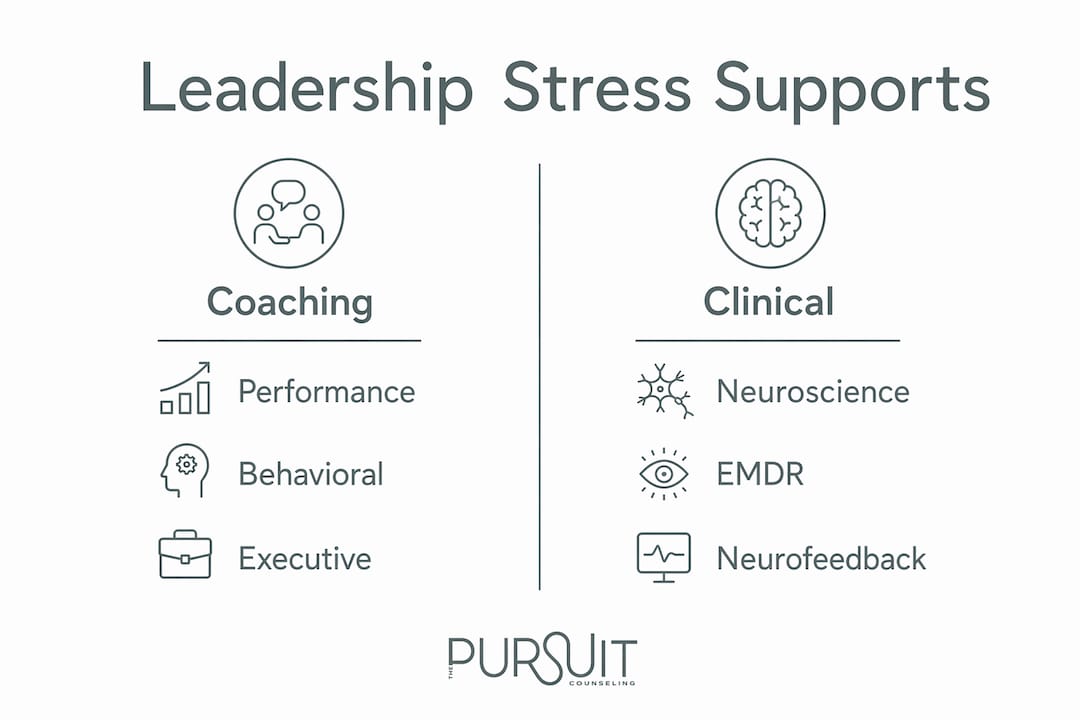
| The Pursuit Counseling | Neuroscience-informed therapy, EMDR, neurofeedback, executive coaching | High-performing leaders, executives, professionals | Florida, online | 5★ (21 reviews) |
| National Center for Performance Health | Performance health support | Leaders seeking performance-oriented health services | Florida | — |
iiiiiivvivii Executive Coaching focuses specifically on the intersection of health and executive performance. For leaders whose stress shows up physically, as fatigue, poor recovery, or declining physical output, this coaching model addresses the body as a leadership asset.
Community Management Professionals, Inc. suits leaders operating within Florida’s community association and organizational management space. Its strength is breadth of local presence and organizational support, not clinical stress treatment.
National Center for Performance Health positions around performance health broadly. Public details on specific credentials and program structure are not listed on its site, so leaders should contact them directly to assess fit.
The Pursuit Counseling is the strongest choice for leaders who need clinical depth alongside coaching. The combination of neurofeedback, EMDR, and executive coaching is specifically designed for high performers carrying chronic stress, trauma history, or burnout. That’s a different category of support than coaching alone.
How do you choose the right stress management support as a leader?
Start with your stress profile, not a provider’s marketing.
Ask yourself three questions before you book anything:
-
Is my stress primarily cognitive (decision fatigue, rumination, focus loss) or physiological (sleep disruption, physical tension, chronic activation)?
-
Do I need clinical treatment, performance coaching, or both?
-
What does my schedule actually allow, and will I sustain it?
Once you have honest answers, evaluate providers on these criteria:
-
Credentials and specialization: Look for licensed clinicians, certified coaches, or both. Vague “wellness” framing without verifiable credentials is a red flag.
-
Method fit: Cognitive-behavioral approaches, peer network support, and neuroscience-based interventions each address different stress mechanisms. Know which one matches your need.
-
Accessibility: Online availability matters for executives with unpredictable travel. Confirm whether the provider offers remote sessions.
-
Program customization: A generic stress course and a personalized plan built around your role are not the same thing. Ask specifically how they tailor their approach.
Pro Tip: Request a consultation before committing. Most reputable providers offer one. Use it to assess whether they understand leadership context, not just stress in general. A counselor who has never worked with executives will miss half the picture.
Build a personal board of advisors around your stress management plan: a coach, a peer in a similar role, and a clinician if needed. Shared experience reduces isolation and keeps coping strategies grounded in reality rather than theory.
What The Pursuit Counseling’s neuroscience approach reveals about leadership stress
Most stress management programs treat the mind and body as separate problems. The Pursuit Counseling’s model starts from a different premise: your nervous system is the leadership instrument, and regulating it is the work.
The Pursuit Counseling integrates neurofeedback for stress regulation, EMDR for processing the accumulated weight of high-stakes decisions and past stress events, and executive coaching that connects nervous system awareness to leadership behavior. These aren’t parallel tracks. They work together.
For a leader carrying years of unprocessed pressure, EMDR addresses the physiological imprint that breathwork alone won’t touch. Neurofeedback trains the brain toward calmer baseline states, which changes how you respond under pressure before the pressure even arrives. The coaching layer translates those neurological shifts into concrete leadership practice.
| Approach | Mechanism | Leadership Benefit |
|---|---|---|
| Neurofeedback | Trains brainwave patterns toward regulation | Calmer baseline, faster recovery from stress spikes |
| EMDR | Processes stored stress and trauma responses | Reduces reactivity rooted in past high-pressure events |
| Executive coaching | Builds behavioral strategies from neurological awareness | Connects inner regulation to team presence and decisions |
How to build a personalized stress management plan
A personalized plan works because it accounts for your specific triggers, not a generic executive archetype.
Start with a stress audit: track for two weeks where your energy drops, when your reactivity spikes, and what situations leave you depleted versus energized. That data tells you more than any assessment tool. From there, build a plan with three layers: daily regulation practices (breathwork, sleep hygiene, transition rituals), weekly recovery (exercise, reflection, connection), and periodic professional support calibrated to your clinical needs.
The burnout patterns in leadership that derail careers rarely arrive suddenly. They accumulate in the gap between what you’re carrying and what your recovery practices can absorb. A personalized plan closes that gap deliberately.
What training programs and workshops actually build leadership resilience?
The most effective programs combine psychoeducation with practiced skill, not just information delivery.
Look for workshops that teach nervous system regulation directly, not just stress awareness. Programs grounded in APA-backed evidence and peer-reviewed research give you techniques with a track record. The best formats include small cohorts where leaders practice emotional regulation in real time, receive feedback, and build peer accountability. One-day seminars rarely produce lasting change. Programs that run across multiple sessions, with between-session practice and check-ins, consistently outperform single-event formats.
For Florida leaders, anxiety-informed approaches that integrate cognitive-behavioral frameworks with somatic awareness are particularly well-suited to the high-activation demands of executive roles. The goal isn’t stress elimination. It’s building the capacity to move through stress without it accumulating into chronic dysregulation.
The Pursuit Counseling offers a different kind of leadership support
If the providers compared above feel like coaching or organizational management, The Pursuit Counseling is something else entirely.
It’s clinical depth built specifically for high performers. Where most coaching programs address behavior, The Pursuit Counseling works at the neurological level, using EMDR therapy and neurofeedback alongside executive coaching to address the stress that has already gotten under your skin. Leaders who have tried coaching and still feel stuck, reactive, or depleted often find that the missing piece was clinical, not strategic. The Pursuit Counseling serves Florida leaders in person and online, with programs designed around your schedule and your specific demands. If you’re ready to work at the level where real change happens, this is where to start.
Key Takeaways
Effective leadership stress management requires nervous system regulation, not just behavioral habits, and the most durable results come from combining daily practices with professional clinical support.
| Point | Details |
|---|---|
| Regulated pauses reduce cortisol | Taking 5–10 minute breaks each hour lowers cortisol and restores decision-making under pressure. |
| Sleep is foundational | Leaders need 7–9 hours to prevent the reactivity and poor judgment that compound stress. |
| Emotional regulation shapes team culture | Leaders who model calm and psychological safety reduce stress across their entire organization. |
| Delegation protects cognitive resources | Confusing time management with energy management leads to burnout; ruthless delegation preserves capacity for high-stakes decisions. |
| The Pursuit Counseling addresses root-level stress | Neurofeedback, EMDR, and executive coaching work together to regulate the nervous system, not just manage symptoms. |