


Leadership anxiety narrows judgment before you notice it slipping, and it moves through a team faster than most leaders realize. It can be interrupted, though, starting in the next sixty seconds: take two to five slow diaphragmatic breaths before your next decision, then name a confidential check-in with a trusted peer or clinician within 48 hours. Seeking that support early is not a failure of leadership. It is what leadership maturity actually looks like.
TL;DR:
- Taking two to five diaphragmatic breaths and consulting a peer within 48 hours can interrupt anxiety before it affects decision-making.
- Chronic leadership anxiety often manifests as control behaviors, overworking, and distorted risk stories that go unnoticed despite high performance.
- Anxiety narrows attention, leading to defaulting on familiar solutions, and spreads emotional tension throughout teams, reducing overall psychological safety.
- Daily habits like deliberate sleep routines, decision protocols, and regular peer calibration help lower baseline anxiety, preventing frequent spikes.
- Seeking professional therapy or coaching early, especially when sleep loss or self-doubt persists, supports underlying causes and prevents escalation affecting team health.
Table of Contents
- What Leadership Anxiety Looks Like Day to Day
- Why Leadership Anxiety Costs More Than It Seems
- The 60-Second Toolkit for High-Pressure Moments
- Building a Lower Baseline: Daily Habits That Actually Move the Needle
- Leading a Team While You’re the One Who’s Anxious
- When It’s Time to Get Real Support
- The Clinician Behind This Framework
- A Clinician’s Perspective on Acting Early
- Confidential Support for Leaders Carrying the Weight Alone
- Sources
- FAQ
What Leadership Anxiety Looks Like Day to Day
Leadership anxiety rarely announces itself. It shows up as a pattern of small behaviors that look, from the outside, like conscientiousness. That is exactly what makes it hard to catch in yourself and easy to miss in someone you manage.
The behavioral signs cluster around control. A leader under chronic anxiety starts rewriting a direct report’s email instead of trusting the draft. Meetings that used to run 30 minutes stretch to 90 because every decision gets revisited three times. Overwork becomes the default setting, not because the work demands it, but because staying busy quiets the noise.
Cognitively, anxiety distorts the stories leaders tell themselves about risk. A single client complaint becomes evidence the whole account is walking. A missed number in Q3 becomes proof the entire strategy is wrong. This is catastrophizing, and it pairs with tunnel vision: the leader fixates on the threat and stops registering the five things going right. Rumination follows, along with the compulsive urge to check email, Slack, or the dashboard one more time, as if checking will produce a different answer.
The physical signs are often the first that a spouse or executive assistant notices, even before the leader does:
- Trouble falling asleep or waking at 3 a.m. replaying a conversation
- A locked jaw or shoulders pulled up toward the ears during calls
- Shallow, high chest breathing instead of full breaths
- A tired, wired feeling that caffeine papers over but never resolves
What makes leadership anxiety especially tricky is how well it hides inside high performance. This is high-functioning anxiety, and it lets someone deliver a flawless board presentation while their nervous system stays in a low-grade state of alarm the entire time. Performance and physiology are not the same instrument, and one can look fine while the other is falling apart. Research on high-functioning anxiety in leaders points to exactly this gap: the outward reliability masks a body that never gets the signal it is safe.
Picture a VP who reads every Slack message twice before responding, who has rewritten the same slide deck four times the night before a board meeting, and who has not slept past 4:30 a.m. in three weeks. None of this shows up on a performance review. All of it is leadership anxiety, working quietly under the surface.
Why Leadership Anxiety Costs More Than It Seems
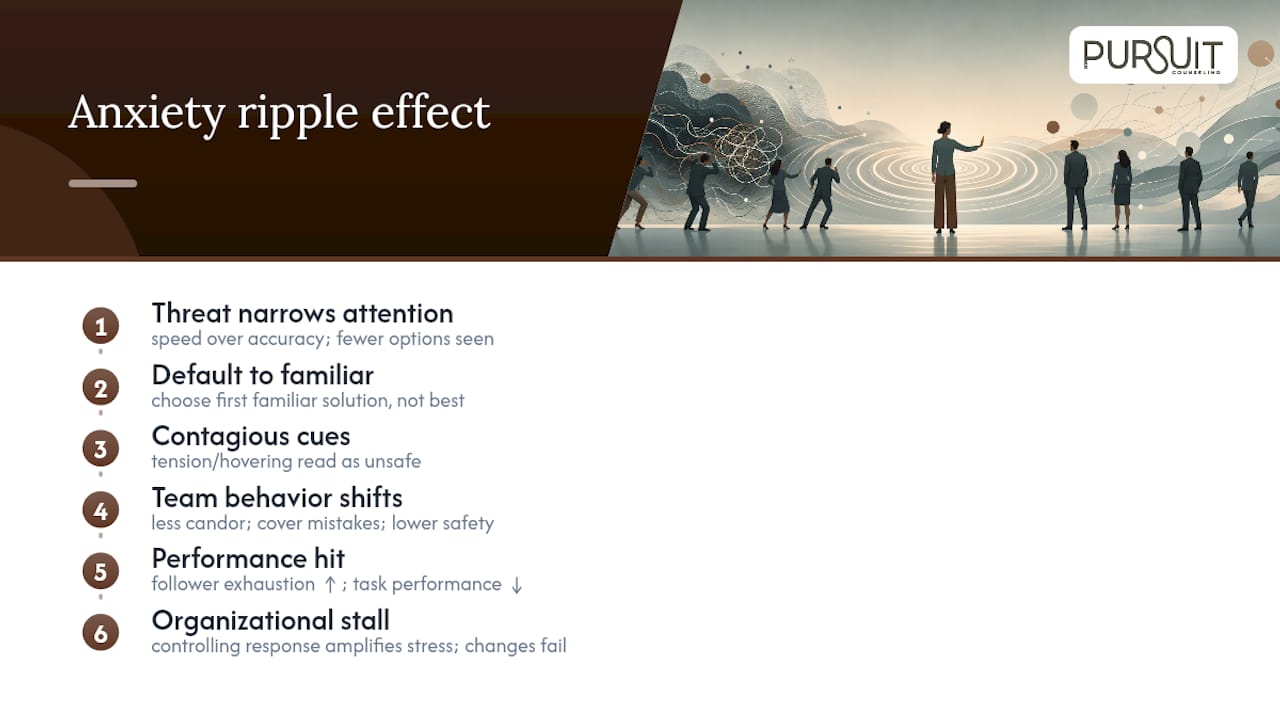
Anxiety narrows attention. Under threat, the brain prioritizes speed over accuracy and shrinks the range of options a leader can even see, let alone weigh. A leader scanning for danger tends to default to the first familiar solution instead of the best one, which is precisely why anxious decision-making so often looks like doubling down on what already isn’t working.
That narrowing does not stay contained to the person experiencing it. Emotional states move through teams the way a cold moves through an office, and a leader’s anxiety is one of the most contagious states in any organization. When a manager is visibly tense, curt, or hovering, team members read those cues as data about how unsafe the environment is, and they adjust their own behavior accordingly. That means less candor in meetings, more covering up of mistakes, and less psychological safety overall.
The data on this is not speculative. Leader workplace anxiety is positively linked to follower emotional exhaustion and negatively linked to follower task performance, according to research on the ripple effect of leader anxiety. In plain terms, an anxious boss produces a more exhausted, less productive team, measurably.
There is also a structural piece specific to senior roles. As leaders climb, the stakes attached to any single decision grow, but their internal capacity to absorb that weight does not automatically grow with it. That mismatch is part of what makes executive-level anxiety intensify with promotion rather than ease with experience, contrary to what most people assume happens as leaders get more senior.
Unmanaged anxiety also shows up at the organizational level during change efforts. Leaders under chronic stress tend to default to controlling, confrontational behavior exactly when a transformation needs the opposite: openness, delegation, and tolerance for ambiguity. According to MIT Sloan Management Review’s research on leaders and team stress, leaders often amplify stress through this kind of controlling response, and that amplification is a major reason change initiatives stall or quietly die. A merger integration, a new product launch, a restructuring, all of it depends on people feeling enough safety to take risks. Anxious leadership removes that safety first, and the strategy fails second.
Harvard Business Review makes the flip side of this clear: leaders who acknowledge and actively manage their own anxiety tend to lead more effectively and build psychological safety rather than erode it. The anxiety itself is not the disqualifying factor. What you do with it is.
The 60-Second Toolkit for High-Pressure Moments
You do not need thirty minutes and a quiet room to interrupt an anxiety spike. You need a sequence you have practiced enough times that it works under pressure, because the moment you actually need it, thinking clearly is the one thing you will not be able to do reliably.
- Run the regulated pause. Before you respond to the tense email, walk into the tense meeting, or answer the hard question from the board, take two to five diaphragmatic breaths: in through the nose for a count of four, a brief hold, then a longer exhale for a count of six. Feel your feet on the floor. This activates the parasympathetic nervous system and buys your prefrontal cortex a few extra seconds of control before the amygdala takes over.
- Use a 3-3-3 style grounding check. Name three things you can see, three sounds you can hear, and move three parts of your body, your fingers, your ankles, your jaw. This is a fast way to pull attention out of a spiraling thought and back into the present physical moment. It works in an elevator, a bathroom stall, or the thirty seconds before you unmute yourself on a call.
- Run a micro body scan. Jaw, shoulders, breath, in that order. Unclench the jaw. Drop the shoulders half an inch. Slow the breath down by even one full cycle. Each of these releases a small amount of physical tension that anxiety has been storing without your permission.
- Buy time out loud, without over-explaining. If you need a beat before answering a hard question in a meeting, a simple script works: “Good question. Give me a second to think that through properly.” Nobody in the room will register this as weakness. Most will register it as someone who takes decisions seriously.
These practices sit inside a broader, non-diagnostic framework sometimes called See, Sort, Solve, or the Un-Stressing method, which encourages leaders to name what is happening, sort it by what is actually within their control, and then act on the sortable piece. The Center for Creative Leadership’s research on the stress of leadership frames daily body scans and regulated pauses exactly this way: not as therapy, but as functional tools that keep a leader’s judgment intact when the stakes are highest. A Forbes feature on the See-Sort-Solve method describes the same three-step logic as a way to categorize stressors before choosing which ones deserve real intervention.
Pro Tip: Practice the regulated pause when you are calm, not just when you are panicking. A breathing pattern you have rehearsed twenty times in low-stakes moments is one your body can access automatically in a high-stakes one. Waiting until the crisis to try it for the first time rarely works.
None of this requires performing vulnerability in front of your whole team. A regulated pause looks, to everyone else in the room, like a leader who is thoughtful rather than reactive. You do not have to announce what you are doing for it to work.
Building a Lower Baseline: Daily Habits That Actually Move the Needle
Short-term tactics manage the spike. Daily systems lower the baseline so fewer spikes happen in the first place, and this is where most leaders underinvest, because none of it feels urgent until the absence of it becomes a crisis.
Sleep is the first lever, and it is a leadership tool, not a luxury. Chronic stress dysregulates the nervous system and measurably reduces executive function, and sleep is one of the few interventions that restores it reliably. A hard email cutoff, even 90 minutes before bed, does more for next-day judgment than most leaders give it credit for.
The second lever is delegation, specifically the kind that breaks reassurance loops. Anxious leaders tend to build informal systems where every decision routes back through them for a final check, which trains a team to stop trusting its own judgment and trains the leader to never fully rest. A clear decision-ownership protocol, where a defined category of choices belongs entirely to a direct report without a check-in, does more to lower a leader’s chronic anxiety than almost any relaxation technique.
- Set a hard cutoff for email and Slack at least an hour before sleep
- Define at least three categories of decisions that direct reports own outright, no sign-off required
- Run brief postmortems on decisions, comparing your forecast to the actual outcome, to recalibrate your risk radar over time
- Find one peer, ideally outside your own company, for a regular sanity-check conversation
- Schedule movement daily, even 15 minutes, and treat it as a fixed calendar item, not an optional one
Calibration deserves its own mention because it is the most underused tool on this list. Anxious leaders tend to trust their gut’s threat assessment without ever checking it against reality. Peer sanity-checks do the same thing socially: a trusted colleague outside your reporting chain who will tell you honestly whether a threat is as large as it feels.
Pro Tip: Replace your instinct to seek instant reassurance, texting a colleague at 11 p.m. for a gut check, with structured testing instead. A weekly 20-minute call with a peer where you both review your recent calls against outcomes builds real calibration. An anxious 11 p.m. text just buys temporary relief and reinforces the anxious loop.
Body-based anchors round this out. A daily body scan, even 90 seconds at your desk, trains you to notice tension before it becomes a full-blown spike. Non-sleep deep rest or basic heart-rate-variability practice gives the nervous system a recovery window during the day, not just at night. Small, repeatable habits woven into the actual workday tend to outperform occasional retreats or once-a-quarter wellness days, according to Psychology Today’s coverage of stress and leadership, because consistency trains the nervous system in a way that infrequent intensity cannot.
Leading a Team While You’re the One Who’s Anxious
Your team does not need you to be anxiety-free. They need you to be honest about it in a way that is brief, framed, and bounded, and they need to watch you regulate in real time rather than pretend nothing is happening.
There is a real distinction between naming anxiety productively and unloading it. “I’m feeling the pressure on this deadline, and I want us to talk through the plan together” is bounded and useful. It gives your team information without making them responsible for managing your emotional state. Venting about how scared you are of losing the account, in detail, in front of the team, is not leadership disclosure. That belongs in a private conversation with a peer, a coach, or a clinician, not in the all-hands meeting.
When you do feel the spike in real time, in a meeting, on a call, model the regulated response instead of hiding it or exploding through it. Pause. Say out loud, “Let me think about that for a second.” Invite input: “What am I missing here?” State next steps clearly, even if the next step is just “let’s regroup tomorrow morning.” Teams read the how far more than the what. A leader who visibly regulates under pressure teaches their whole team that pressure is survivable.
Build structured ways for concerns to surface before they become crises:
- A weekly check-in question, “What’s one thing worrying you that we haven’t talked about?”, asked consistently enough that it becomes routine rather than alarming
- A standing rule that bad news reported early gets a different response than bad news that surfaces late
- Regular one-on-ones that are not just status updates, but include space for “how are you actually doing”
Watch for the signal that your anxiety has started leaking into outcomes rather than staying contained to you: your team starts hedging their updates instead of giving you the real picture, turnover ticks up on your team specifically, or people start going around you to get decisions made faster. Each of those is a sign the anxiety has stopped being your private experience and started shaping how your team functions, which is exactly the point where unmanaged leadership stress starts driving burnout across a whole team, not just its leader.
When It’s Time to Get Real Support
Some signals mean it is time to move past self-management and get professional input, not eventually, but this week. Persistent sleep loss that does not respond to basic sleep hygiene, anxiety that is now interfering with daily functioning at work or home, or any thoughts of self-harm are urgent signals that call for clinical care immediately, not a wait-and-see approach.
Short of that threshold, the choice between therapy, executive coaching, and peer support depends on what is actually driving the anxiety.
- Therapy fits when the anxiety has roots that predate the current job: a pattern of perfectionism traced back to childhood, a trauma history, or anxiety that shows up across every area of life, not just at work. A licensed clinician can address the underlying nervous system patterns coaching is not equipped to touch.
- Executive coaching fits when the anxiety is largely situational, tied to a specific role transition, a new level of scope, or a skills gap that is generating the stress. Coaching is future-focused and performance-oriented in a way therapy is not designed to be.
- Peer support fits as an ongoing supplement to either, or on its own for leaders whose anxiety is mild and mostly about isolation. A trusted group of peers in similar roles can normalize what you are experiencing and offer calibration you cannot get from your own team.
Whichever path you pick, ask direct first-contact questions: What are your credentials, and do you specifically have experience working with executives or high performers? Do you offer telehealth, and how does confidentiality work given my role? A good clinician or coach will answer these clearly and will understand why a leader needs privacy protected carefully, without treating the question as a red flag.
The Clinician Behind This Framework
Adam Glendye, LPC, CPCS, is a licensed clinician whose practice centers on anxiety in high performers, including executives, physicians, pilots, and other professionals whose roles carry outsized decision weight. That clinical focus shapes every recommendation in this piece: the regulation tools are drawn from approaches used in session, adapted for the sixty seconds a leader actually has between one decision and the next.
Specialized counseling services are available for individuals dealing with anxiety, including secure teletherapy for those who travel or cannot always attend in person, and leadership-focused programs designed to support the pressures of managing people and making consequential decisions. Clinical work goes further than any short-term tactic can, because it addresses the underlying drivers, a perfectionistic thought pattern, an old trauma response, a nervous system that has been in overdrive for years, rather than just managing the symptom in the moment. A body scan can interrupt a spike. Therapy can change why the spike keeps happening.
The practical tools in this article work well as a starting point. For leaders whose anxiety is chronic, worsening, or already affecting their team, they work best paired with actual clinical support rather than as a permanent substitute for it.
A Clinician’s Perspective on Acting Early
The leaders who come to me earliest, before the sleep loss becomes chronic, before the team starts noticing, before a single bad quarter turns into a spiral, are the ones who preserve the most of their own capacity. Anxiety does not resolve on its own just because a leader is competent enough to keep performing through it. Competence and regulation are different systems entirely, and I have watched capable people run the second one into the ground while the first one looked fine from the outside.
Treat the decision to get support the same way you would treat any other high-stakes call: gather information, act before the cost compounds, and stop waiting for a crisis to justify the conversation. Seeking help while you are still functioning well is not overreacting. It is the clearest sign of leadership maturity I see in this work, and it is available to you now, not after things get worse.
— Adam Glendye LPC, CPCS
Confidential Support for Leaders Carrying the Weight Alone
The tools in this article can interrupt a spike, but they cannot rewire a nervous system that has been running on high alert for years, and that deeper work is where a licensed clinician makes the real difference. The Pursuit Counseling offers individual counseling for anxiety built specifically around high performers, along with secure teletherapy for leaders whose schedules make in-person sessions hard to keep, and structured leadership stress management programs for executives who need more than a single tactic.

Confidentiality is a core part of the counseling process, and the clinical team works with executives, pilots, physicians, and other high-stakes professionals requiring therapists who understand the demands of their roles. If you are weighing whether to make the call, read through questions to ask your therapist in a first session to know exactly what to expect, then reach out to schedule a confidential consultation and take the next step before the pressure compounds further.
Sources
These sources informed the research behind this article and offer deeper reading for leaders who want the full clinical and organizational picture:
- Stress of leadership (Center for Creative Leadership)
- Leading Through Anxiety (Harvard Business Review)
- The ripple effect: How leader workplace anxiety shapes follower outcomes (PMC/NCBI)
- How leaders help teams manage stress (MIT Sloan Management Review)
Common workplace stress also plays out in other high-pressure fields worth understanding for comparison, including how unmanaged stress affects nurses on the front lines of healthcare settings.
This article is general information, not a substitute for advice from a qualified doctor. Consult a qualified healthcare professional about your own circumstances before acting on anything here.
FAQ
What Is the 3-3-3 Rule for Anxiety?
The 3-3-3 rule is a grounding technique where you name three things you can see, identify three sounds you can hear, and move three parts of your body. It interrupts a spiraling thought pattern by redirecting attention to the present physical moment, which is especially useful in a tense meeting or right before a high-stakes call.
What Is the Worst Habit for Managing Anxiety?
Avoidance, specifically checking behavior that feels like control but actually reinforces anxiety, tends to be the most damaging habit for leaders. Repeatedly checking email, re-reading the same report, or seeking constant reassurance from others trains the brain to treat uncertainty as more dangerous than it actually is, rather than building tolerance for it.
What Are Effective Ways to Manage Leadership Anxiety?
Diaphragmatic breathing before high-stakes decisions, daily body scans, consistent sleep routines, delegation protocols that break reassurance loops, and regular peer calibration all reduce chronic anxiety in leaders. Professional support through therapy focused on high-functioning anxiety addresses the underlying patterns these daily tactics cannot fully resolve on their own.
What Is “Leadership Syndrome”?
There is no single clinical diagnosis called “leadership syndrome.” The term is generally used informally to describe the cluster of behaviors, controlling decision-making, overwork, difficulty delegating, that emerges when a leader’s unmanaged anxiety starts shaping how they run their team.
Can Leadership Actually Cause Anxiety?
Leadership roles can generate anxiety through the specific mismatch between rising decision consequences and a leader’s capacity to absorb that weight, a pattern that tends to intensify with each promotion rather than ease with experience. Leaders with an existing predisposition toward anxiety often find that high-stakes roles amplify symptoms that were previously manageable in lower-pressure positions.