
For most high-performing adults and executives, emotional intelligence coaching is not just worth it — it’s the missing variable in an otherwise optimized life. You’ve built the skills, the credentials, the track record. But something in the room still shifts when conflict surfaces, when feedback lands wrong, or when the pressure compounds and your best self goes quiet. EQ coaching addresses exactly that gap.
- Measurable gains executives care about: stronger leadership presence, fewer conflict incidents, clearer decision-making under pressure, and improved team engagement scores
- When to consider therapy first or alongside coaching: if unresolved trauma, persistent anxiety, or functional impairment is driving the pattern, psychotherapy (or a combined approach using EMDR, DBT skills, or neurofeedback) will reach deeper than coaching alone
Pro Tip: Before your first consultation, ask the provider which validated assessment tool they use at intake. A coach who cannot name one — EQ-i, MSCEIT, or structured 360-feedback — is working without a map.
Table of Contents
- What is emotional intelligence, really?
- What does the research say about EQ and leadership outcomes?
- Coaching vs. therapy: which one do you actually need?
- Evidence-based methods that actually build EQ
- What does a typical EQ coaching program look like?
- How to choose an EQ coach: questions, credentials, and red flags
- Key Takeaways
- Why integrated care changes what’s possible
- Work with The Pursuit Counseling on your EQ development
- Selected sources and further reading
What is emotional intelligence, really?
Emotional intelligence, in the Mayer–Salovey ability model, is a four-branch capacity: perceiving emotions accurately, using emotions to support thinking, understanding how emotions shift and blend, and managing emotions in yourself and others. It is not a personality type. It is not “being nice.” And it is not fixed. EQ predicts success in relationships, work, and wellbeing — and it responds to targeted practice.
The five competencies executives should track are:
- Self-awareness: recognizing your emotional state before it drives behavior
- Self-regulation: choosing your response rather than reacting from the pressure
- Motivation: sustaining effort through setbacks without external validation
- Empathy: reading what others feel, even when they don’t say it
- Social skills: navigating conflict, influence, and collaboration with precision
Common misconceptions trip people up here. EQ is not the same as agreeableness or warmth. A high-EQ executive can be direct, even demanding — they just know when and how. EQ also differs from IQ; the two are largely independent, which is why brilliant people sometimes leave wreckage in their interpersonal wake.
Pro Tip: Watch for these workplace signals that suggest an EQ gap: the same conflict recurring with different people, feedback that never seems to land, or a team that goes quiet in your presence. These patterns are data, not character flaws.
What does the research say about EQ and leadership outcomes?
The evidence is clear enough to act on. EQ is trainable and predicts outcomes across workplace performance, relationship quality, and mental health. A rigorously designed online EI training program produced medium effect-size gains on both ability-based and self-report EI measures, with improvements sustained at six-month follow-up.

Emotion regulation training, specifically, shows targeted gains in clinical RCT settings. A randomized controlled trial of a seven-session emotion regulation skills program reported significant improvements in emotional clarity and reduced alexithymia. Short programs produce real gains in specific domains; broader or more durable change tends to require longer engagement or booster sessions.
For executives, the practical translation looks like this:
- Fewer escalating conflicts after structured emotion-regulation skill sprints
- Higher 360-feedback scores in empathy and communication within 3–6 months
- Better decision quality under pressure, partly because emotion labeling reduces limbic reactivity and supports prefrontal regulation
One nuance worth knowing: EQ measures vary. Ability-based tools like the MSCEIT and trait-based tools like the EQ-i capture different things. A good program uses validated instruments at baseline and follow-up, not self-report alone.
Coaching vs. therapy: which one do you actually need?
EQ coaching is goal-focused, skills-based, and oriented toward performance outcomes. Psychotherapy addresses diagnosis, trauma processing, and deeper symptom work. The distinction matters because choosing the wrong one wastes time and, in some cases, leaves the real problem untouched.
Choose coaching when: your functioning is solid, your goals are specific (leadership presence, conflict reduction, team communication), and no clinical diagnosis is driving the pattern.
Choose therapy first when: anxiety or depression is interfering with daily performance, there is a trauma history that surfaces under pressure, or functional impairment is present. EMDR therapy is particularly relevant when past experiences are coloring present reactions in ways that coaching alone cannot reach.
Choose combined care when: you want skill-building and performance gains and there is clinical material underneath. A licensed clinician who also provides executive coaching can hold both simultaneously.
Red flags that suggest referral to psychotherapy rather than coaching alone:
- Persistent functional impairment at work or home
- Untreated trauma that surfaces under stress
- Suicidal ideation or self-harm
- Substance use as a primary coping strategy
When evaluating providers, credentials matter. Look for licensed clinicians: LPC, LMFT, or PhD-level practitioners who use validated EI assessments and document outcomes. A coach-only certification without clinical licensure is appropriate for some goals — but when clinical issues exist, a clinician-coach is the safer and more effective choice.
Pro Tip: Ethical blending of coaching and therapy is possible when goals are shared, consent is explicit, and the clinician holds both roles or coordinates care transparently. Ask any provider directly: “How do you handle it if clinical material comes up during a coaching session?”
Evidence-based methods that actually build EQ
The methods with the strongest evidence and clearest application for executives:
- Emotional literacy and emotion labeling: Expanding your emotion vocabulary is foundational. Gottman’s guidance positions emotional literacy as the skill underlying empathy and self-awareness. In practice: naming what you feel with precision (not just “stressed” but “ashamed that I missed the signal”) activates prefrontal regulation and damps amygdala reactivity.
- Cognitive reappraisal: Reframing the meaning of a stressor without suppressing the emotion. Neuroscience research confirms that reappraisal training strengthens prefrontal-amygdala circuits over time.
- DBT-derived emotion-regulation skills: The UCSF emotion regulation skills manual covers emotion identification, reducing vulnerability, and increasing positive states — with worksheets and behavioral steps that translate directly to between-session homework. These skills are part of DBT-based therapy at The Pursuit Counseling.
- 360-feedback and structured coaching plans: Behavioral data from peers, direct reports, and supervisors creates accountability and specificity that self-report alone cannot.
- Role-play and behavioral rehearsal: Practicing a difficult feedback conversation or a high-stakes negotiation in session builds the neural pathways before the real moment arrives.
- Mindfulness and attention training: Sustained attention is the prerequisite for self-awareness. Brief daily practice compounds over weeks.
- Online EI training programs: The validated online program showing six-month gains makes blended delivery (online modules plus clinician coaching) a practical option for busy executives. Secure delivery platforms matter here; practice management tools designed for mental health providers support compliant online program delivery.
- Neurofeedback and EMDR: Clinical adjuncts for clients where attention dysregulation or trauma is part of the picture. Neurofeedback trains brain-wave patterns associated with regulation and focus; EMDR processes the stored experiences that hijack present-moment responses.
Pro Tip: EQ development works best as a literacy and practice regimen, not a one-time workshop. Small, repeated exercises — an emotion vocabulary log, a daily reappraisal note — drive more change than a single intensive.
What does a typical EQ coaching program look like?
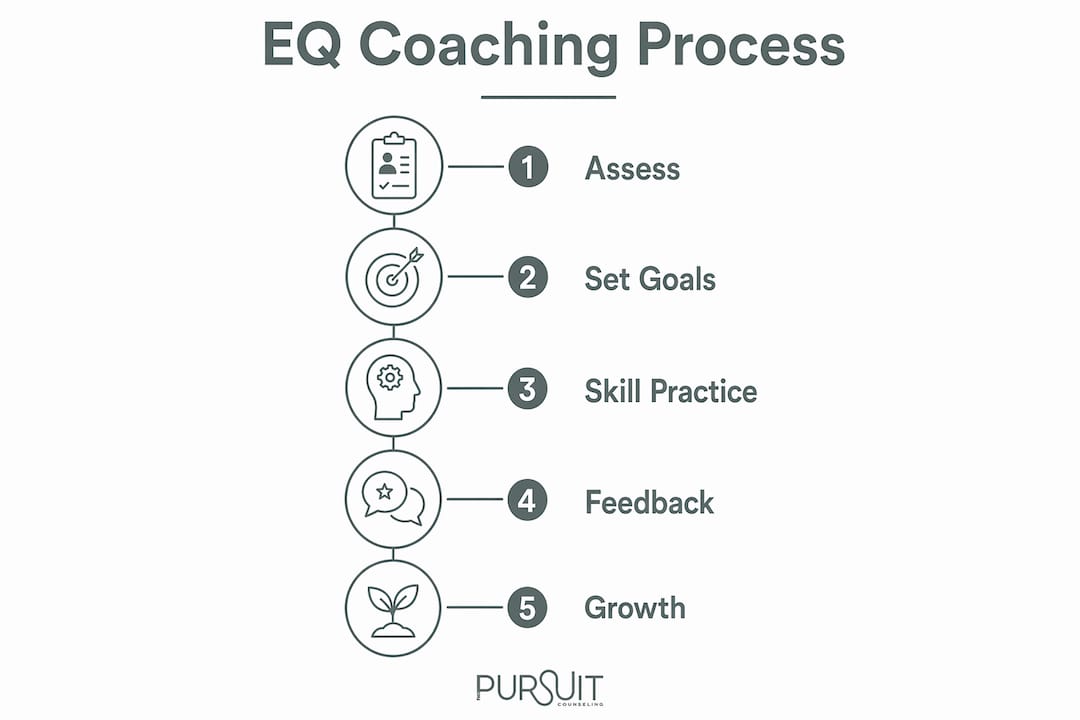
A well-structured program moves through four stages:
- Intake and baseline assessment (weeks 1–2): validated tool (EQ-i, MSCEIT, or structured 360-feedback) plus goal-setting conversation
- Skill sprints (weeks 3–10): focused 4–8 week modules targeting one or two competencies, with session homework and between-session practice
- Consolidation phase (months 3–6): integrating skills into real leadership contexts, reviewing 360 data, adjusting goals
- Follow-up measurement (month 6+): re-administration of baseline tools, qualitative feedback from stakeholders, decision on continuation
A typical coaching session includes a check-in on recent emotional data, a skill practice exercise such as reappraisal scripting, role-play, or emotion labeling, homework review, and brief measurement. Outcomes to track include 360-feedback, self-report EI scales, conflict incidents, and team engagement. Re-assessment is recommended periodically to monitor progress.
How to choose an EQ coach: questions, credentials, and red flags
Ask these questions on any vetting call:
- What validated assessment tool do you use at intake and follow-up?
- Can you describe a typical outcome for an executive client at three months?
- How do you handle clinical material if it surfaces during coaching?
- What is your licensure, and does your practice carry professional liability insurance?
- How is confidentiality managed, especially for employer-sponsored programs?
Pricing shape: Individual sessions typically run in the range of $150–$300 per session for licensed clinician-coaches; structured executive programs or intensives are priced as packages. Corporate programs vary by scope. These are decision-relevant ranges, not guarantees — always confirm directly with the provider.
Red flags to walk away from:
- Guarantees of rapid or permanent change after a single program
- No clear measurement plan or refusal to name assessment tools
- Vague confidentiality policy or no written consent process
- Avoidance of clinical referral when clinical symptoms are present
The Pursuit Counseling integrates clinical licensure, validated assessments, and neuroscience adjuncts (neurofeedback, EMDR) within its executive therapy and leadership counseling programs — a combination that most coach-only providers cannot offer.
Key Takeaways
Emotional intelligence coaching produces measurable gains in leadership presence, conflict reduction, and decision clarity when it is grounded in validated assessments, evidence-based methods, and licensed clinical oversight.
| Point | Details |
|---|---|
| EQ is trainable | Validated programs show medium effect-size gains sustained at six-month follow-up. |
| Assessment first | Request EQ-i, MSCEIT, or structured 360-feedback at intake and at the three- and six-month marks. |
| Coaching vs. therapy | Choose therapy first when trauma, anxiety, or functional impairment is driving the pattern. |
| Methods that work | Emotion labeling, cognitive reappraisal, DBT skills, 360-feedback, and role-play have the strongest evidence base. |
| The Pursuit Counseling | Offers integrated executive therapy, leadership counseling, neurofeedback, and EMDR for high performers in Georgia. |
Why integrated care changes what’s possible
Most EQ coaching misses the clinical layer. A coach can teach reappraisal scripts and emotion vocabulary — and those tools work. But when the pattern runs deeper, when the same reaction keeps surfacing despite genuine effort, the question is no longer about skill. It’s about what the nervous system learned a long time ago.
That’s the gap that integrated clinical coaching fills. Combining licensed psychotherapy with executive coaching means you’re not choosing between performance and healing. You’re doing both. The mental fitness principles that strengthen leadership also strengthen relationships — and the clinical tools that process old wounds free up the cognitive and emotional bandwidth that high performance actually requires.
The conventional wisdom says: hire a coach for performance, see a therapist for problems. That framing is too narrow. The executives who grow fastest are the ones willing to look at both simultaneously, with a provider who can hold both with skill and care.
Work with The Pursuit Counseling on your EQ development
High performers in Georgia don’t need a generic coaching package. They need a clinician who understands the pressure, knows the neuroscience, and can move between coaching and therapy as the work requires.
The Pursuit Counseling offers executive therapy and leadership counseling built specifically for CEOs, founders, pilots, lawyers, and high-achieving professionals. A typical engagement starts with a validated EI assessment, moves through targeted skill-building sessions, and integrates clinical adjuncts — neurofeedback, EMDR, DBT emotion-regulation skills — when the work calls for them. Both in-person and online sessions are available, and the practice operates on a private-pay model with no insurance gatekeeping. Schedule a consultation directly through the website to start with a baseline assessment and a clear plan.
Selected sources and further reading
- Building Emotional Intelligence: A Practical, Evidence-Based Guide | Simply Psychology — Covers the Mayer–Salovey ability model, EQ’s predictive value, and practical development strategies.
- How to Improve Emotional Intelligence (the Gottman Way) — Positions emotional literacy and attunement as foundational skills for EQ development.
- Development and validation of an online emotional intelligence training program | Frontiers in Psychology — RCT evidence for online EI training with six-month sustained gains; useful for evaluating scalable program formats.
- Emotion regulation skills training RCT | Child and Adolescent Psychiatry and Mental Health / Springer — Randomized trial showing targeted gains in emotional clarity and alexithymia from a structured skills program.
- Emotion regulation skills manual | UCSF — Practical clinical manual covering emotion identification, vulnerability reduction, and behavioral skill steps.
- From Surviving to Thriving: The Emerging Science of Emotion Regulation Training | PMC — Reviews behavioral and brain-imaging evidence for reappraisal and cognitive control training; strong foundation for understanding why these methods work.
Recommended
- Executive Therapist for CEOs, Founders & High Achievers | Adam Glendye
- Leadership Counseling for Executives and High Performers: What Makes The Pursuit Counseling Different?
- Emotional Regulation Therapy Peachtree City GA: DBT Skills (2026) – The Pursuit Counseling
- Mental Fitness Strengthens Relationships and Leadership – The Pursuit Counseling