


If you feel worn down, detached from work you used to care about, and less sharp than you used to be, you may be experiencing business owner burnout, which the World Health Organization defines through three features: exhaustion, cynicism, and reduced professional efficacy. The next move is simple: pause long enough to assess honestly, or reach out to a clinician if the exhaustion feels entrenched.
Key Takeaways
Owners face unique burnout risks from structural workplace stressors, making proactive management and professional support essential for recovery and resilience.
| Point | Details |
|---|---|
| Burnout signs are subtle | Early burnout symptoms include fatigue, cynicism, decision slowdown, irritability, and withdrawal, often overlooked until advanced. |
| Workplace stressors are structural | Excess demands, low decision-making power, and role conflict, common in ownership, amplify burnout risk. |
| Focus on short-term stabilization | Prioritize sleep, micro-breaks, task triage, delegation, and tech boundaries to build a foundation for recovery. |
| Organizational redesign helps | Redesign work demands and decision latitude first, then incorporate individual coping strategies for effective relief. |
| Seeking professional help is crucial | Persistent thoughts of hopelessness, severe dysfunction, or mental health issues require consultation with qualified clinicians. |
Table of Contents
- Warning Signs Business Owners Should Watch For
- Why Business Owners Are at Special Risk
- Practical Strategies to Manage, Reduce, and Prevent Burnout
- When to Seek Professional Help and What Options Look Like
- Clinician Tips: A Practitioner’s Checklist for Stabilizing Owner Burnout
- The Role of Work-Life Balance and Setting Boundaries
- The Influence of Leadership Style on Burnout Risk
- Long-Term Effects of Burnout if Left Unaddressed
- How to Foster Resilience and Mental Wellness Proactively
- Case Studies or Personal Stories Illustrating Burnout and Recovery
- A Clinician’s Note to Business Owners
- Support Options at The Pursuit Counseling
- FAQ
- Sources
Warning Signs Business Owners Should Watch For
Burnout rarely announces itself. It creeps in through small defaults: the client call you used to enjoy now feels like a chore, the quick decisions that once took seconds now stall for an hour. The WHO’s ICD-11 framework names exhaustion, increased mental distance or cynicism toward your work, and reduced professional efficacy as the three markers to track, and all three tend to show up together rather than alone.
Physically, you may notice persistent fatigue that sleep doesn’t fix, tension headaches, or a shorter fuse with your team or customers. Cognitively, concentration slips, creative problem solving dries up, and small annoyances start to feel personal. Owners often show two signs employees rarely do: they stop delegating even when delegation would help, and they keep chasing adrenaline-driven tasks (the fire to put out, the deal to close) because stillness feels worse than the stress itself.
What to watch for:
- Fatigue that doesn’t lift after a full night’s sleep or a weekend off
- Growing cynicism or detachment toward clients, staff, or the business itself
- Noticeably slower decisions or a drop in creative thinking
- Irritability with people who don’t usually bother you
- Withdrawing from friends, family, or activities outside work
- Refusing to delegate tasks you know someone else could handle
A peer-reviewed review of burnout syndrome describes the condition as a combination of emotional exhaustion, physical fatigue, and cognitive weariness that builds over time rather than arriving all at once, which is part of why owners often miss it until it’s advanced.
Why Business Owners Are at Special Risk
Burnout is classified by the WHO as an occupational phenomenon, tied specifically to chronic workplace stress that hasn’t been successfully managed, not a general response to life’s difficulties. For owners, the workplace stressors are structural. The NIOSH and CDC identify excessive demands, low decision latitude, and role conflict as core psychosocial hazards, and owners frequently carry all three simultaneously: the decisions never stop, the authority to delegate rarely gets used, and the roles of operator, hirer, and visionary collide daily.
A few dynamics make ownership distinct from employment:
- One person absorbs responsibility that would normally be spread across a team.
- The line between “work” and “home” often doesn’t exist, which removes natural recovery windows.
- Owners report fewer true recovery experiences than employees in comparable roles, because stepping away can feel like risk rather than rest.
- Venture stage matters too: businesses in a stagnant or plateaued phase and those in high-pressure growth phases both appear to raise psychological strain, just through different pressures.
Practical Strategies to Manage, Reduce, and Prevent Burnout
Recovery for owners doesn’t start with stepping away from the business. It starts with regaining some control over how the day is structured. Research on owner-operated businesses finds that building predictable, controlled recovery schedules protects owners better than simply trying to mentally detach from work, which is often impossible when your name is on the door.
Start with stabilizers you can apply this week:
- Protect sleep first. Fatigue compounds every other symptom, so a consistent sleep window matters more than almost anything else on this list.
- Build in micro-breaks. Short breaks with movement, even five minutes between calls, interrupt the stress response before it stacks up.
- Triage your task list. Separate what truly needs you today from what can wait or move to someone else.
- Delegate one high-stress task this week. Not everything, just one thing that’s been sitting on your shoulders.
- Set tech boundaries. A defined stop time for email and Slack protects the recovery window you just built.
Once the short-term stabilizers hold, shift toward structural changes: outsourcing recurring low-value work, automating what can be automated, and removing obligations that drain time without moving the business forward. A helpful guide to recovering revenue through missed charges audits can assist in identifying operational improvements that reduce stress by capturing missed income. Brief CBT-informed practices, like naming the thought that’s driving your stress and testing whether it’s accurate, paired with short grounding exercises, can interrupt the spiral before it becomes a pattern. If you want a fuller walk-through of operating while you recover, our piece on recovering from high-functioning burnout while still showing up every day covers that in more depth.
At an organizational level, NIOSH recommends applying a hierarchy of controls to psychosocial hazards, meaning the first move is redesigning the work itself (reducing demands, increasing decision latitude) before turning to individual coping tools. For a solo owner, that might mean restructuring your week before adding another wellness habit on top of an unsustainable schedule.
Pro Tip: If you can only change one thing this week, change your wake and sleep time to something consistent, seven days a week. Nearly every other recovery tactic works better once sleep stabilizes.
When to Seek Professional Help and What Options Look Like
Some signs need more than a schedule adjustment. Persistent thoughts of hopelessness or suicidal ideation, severe impairment in your ability to function, or depression and anxiety that don’t lift after a few weeks of deliberate rest are red flags that call for a clinician, not a productivity hack.
Treatment options vary by what’s driving the burnout:
- Individual therapy, often CBT-based, for restructuring the thought patterns feeding exhaustion and cynicism
- EMDR when past trauma is contributing to the current stress response
- Intensive programs for owners who need concentrated, focused work rather than weekly sessions spread over months
- Neurofeedback for owners whose focus and regulation issues predate the burnout itself
A first session usually involves mapping out your symptoms, history, and current demands, then deciding together whether ongoing weekly therapy or a more concentrated format fits better. You can read more about counseling options for burnout and workplace stress before reaching out.
Clinician Tips: A Practitioner’s Checklist for Stabilizing Owner Burnout
Clinicians distinguish burnout from major depression largely by scope: burnout symptoms cluster around work and tend to ease somewhat on days off, while depression touches every domain of life, including activities you’d normally enjoy.
A simple two-week stabilization approach we recommend to owners:
- Stabilize sleep and wake times, even on weekends.
- Add three short movement breaks daily.
- Delegate one high-stress task immediately.
- Cut every nonessential meeting from the calendar.
- Schedule an initial consult with a clinician before the two weeks end.
Therapy or an intensive program adds something a schedule fix alone can’t: a structured place to process why stepping back feels so hard. Ask any therapist you’re considering how they typically work with business owners and what a realistic time frame looks like for your situation.
Pro Tip: Bring your actual calendar to the first session. A clinician working from your real week, not a hypothetical one, can spot the structural problems faster.
The Role of Work-Life Balance and Setting Boundaries
For employees, work-life balance often means leaving the office and closing the laptop. For owners, the boundary has to be built on purpose, because nothing closes it for you. The business doesn’t end at 5 PM, and there’s no one above you enforcing a stop time.
That’s exactly why boundaries matter more for owners, not less. A defined end to the workday, even an imperfect one, gives your nervous system a signal that recovery time has started. Without it, the exhaustion and cynicism that define burnout have nowhere to resolve.
Practical boundaries worth setting: a hard stop for checking email and messages, at least one full day a week without business decisions, and a clear line between “my business” conversations and “my relationship” conversations at home. None of these require stepping back from the business. They require deciding, in advance, when you’re in it and when you’re not, and holding that line even when a notification tempts you otherwise.
Boundaries also protect the people around you. Owners who never switch off tend to bring the day’s stress home in ways that spill into partners, kids, and friendships, often without realizing it until the relationship itself starts to strain.
The Influence of Leadership Style on Burnout Risk
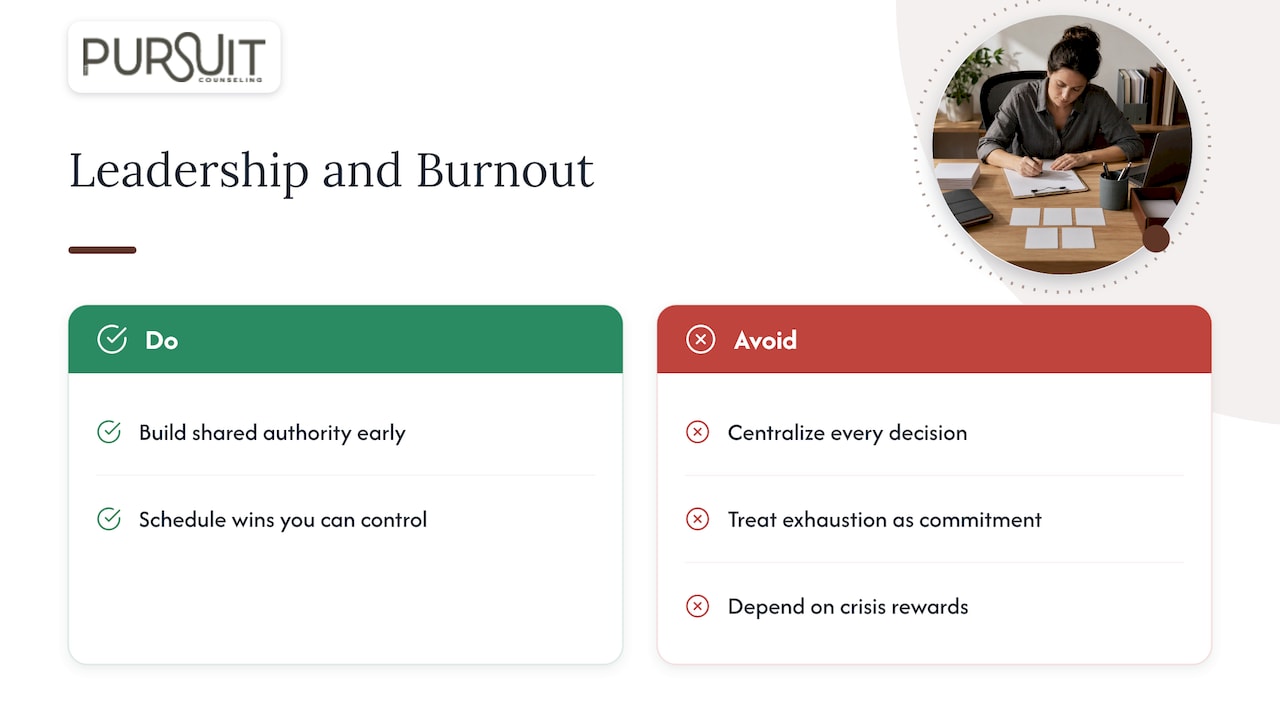
How you lead shapes how burned out you get, and not just because of workload. Owners who centralize every decision, who can’t tolerate delegation, or who treat their own exhaustion as proof of commitment tend to burn out faster than owners who build in shared authority from the start.
NIOSH and workplace mental health authorities point out that managers and leaders have outsized influence over the mental health of everyone around them, which cuts both ways for an owner: the habits that stress you also tend to stress your team, and a team under strain adds more back onto you.
Some owners describe something closer to a success addiction, where the adrenaline of closing deals or solving urgent problems becomes the primary reward, and anything slower starts to feel unbearable. Research on this pattern suggests the fix isn’t willpower. It’s replacing the adrenaline reward with scheduled wins you can control: a finished project, a clean inbox, a completed training, something that satisfies the same drive without requiring a crisis to deliver it.
A leadership style built on control and crisis response isn’t a personal flaw so much as a pattern that got reinforced early and never got challenged. Recognizing it is the first step toward leading in a way that doesn’t cost you your own capacity.
Long-Term Effects of Burnout if Left Unaddressed
Burnout that goes unaddressed doesn’t plateau. It tends to deepen, and the consequences extend well past how you feel at your desk.
Physically, chronic unmanaged stress is linked to persistent sleep disruption, weakened immune response, and a higher baseline of tension that shows up as headaches, gut issues, or chronic fatigue. Cognitively, the decision fatigue and reduced efficacy that mark early burnout can harden into a genuine drop in business performance, the kind that’s hard to reverse once clients or staff notice.
Left long enough, burnout’s cynicism and exhaustion can bleed into clinical depression or anxiety, conditions that call for different treatment than burnout alone. The peer-reviewed review on burnout management notes that combining personal coping strategies with workplace or organizational changes produces better outcomes than either approach alone, which matters most precisely at this stage, when neither a vacation nor a new app is going to undo months of accumulated strain.
Relationships absorb a disproportionate share of the damage. Partners and children often notice the shift in an owner’s mood and availability long before the owner does, and the detachment that burnout produces at work has a way of following you home.
How to Foster Resilience and Mental Wellness Proactively
The best time to build resilience is before you need it, and the habits that prevent burnout look remarkably similar to the ones that treat it, just applied earlier and with less urgency.
Protecting recovery time on your calendar, before the business demands otherwise, is the single most reliable habit owners can build. That means scheduling it the same way you’d schedule a client meeting, not leaving it to whatever time happens to be left over.
Build in regular check-ins with yourself, weekly if possible, where you honestly assess exhaustion, cynicism, and efficacy rather than waiting for a crisis to force the question. Keep at least one outlet that has nothing to do with the business, whether that’s a physical activity, a hobby, or time with people who don’t ask about work.
And consider structured support before you’re in crisis. Workshops aimed at leadership teams, like our organizational workshops, can help owners and their leadership build these habits together rather than carrying the responsibility alone.
Case Studies or Personal Stories Illustrating Burnout and Recovery
The pattern we see most often starts quietly. An owner who used to answer every email within the hour starts letting them sit for days, not from laziness but because each one now feels heavier than it should. A founder who once thrived on the chaos of a growing team starts dreading the Monday check-in. A business partner who used to celebrate wins starts noticing nothing feels like enough anymore.
What tends to turn things around isn’t a single breakthrough. It’s a sequence: recognizing the exhaustion for what it is, making one structural change (often delegation or a sleep fix), and then bringing in outside support to address what the schedule change alone couldn’t touch, usually the underlying beliefs about what it means to slow down. Owners who try to white-knuckle through burnout without addressing those beliefs tend to relapse once the next busy season hits.
Recovery, when it holds, usually looks less dramatic than people expect. It’s a founder who finally takes a real day off and doesn’t check their phone. It’s a business owner who hands off a task they’d clung to for years and discovers the business didn’t fall apart. Small, deliberate shifts, repeated consistently, tend to outperform any single dramatic intervention.
A Clinician’s Note to Business Owners
If you feel isolated under the weight of decisions only you can make, that’s common among owners, not a sign something is uniquely wrong with you. Reaching out for support is a leadership decision, not a concession. The next step is straightforward: try the two-week stabilization checklist above, or schedule a consult if the exhaustion feels beyond what a schedule change can fix.
— Adam Glendye LPC, CPCS
Support Options at The Pursuit Counseling

We work with business owners who recognize themselves in everything above, and we built our services around the reality that owners rarely have the luxury of stepping fully away from work to get well. Our individual therapy, trauma therapy, and related services range from 125 to 500 dollars per hour depending on specialty, giving you a starting point whether you need weekly support or a focused session on a specific issue.
For owners who need something more concentrated than weekly sessions, our Executive Experience Program is a one-time, 9,950 dollar program built for founders and high performers who need intensive, focused work rather than months of gradual sessions. We also offer a Neurofeedback Brain Map for owners whose attention and regulation challenges existed well before the burnout started.
- Individual therapy for ongoing support and coping strategies
- The Executive Experience Program for concentrated, high-intensity work
- Neurofeedback for attention and regulation concerns
- Intensives for owners and couples who need a condensed format
A first consult focuses on understanding your situation, not diagnosing you on the spot. If any of this sounds like where you are, you can review our services and reach out to schedule a first conversation.
This article is general information, not a substitute for advice from a qualified doctor. Consult a qualified healthcare professional about your own circumstances before acting on anything here.
FAQ
What is the 42% rule for burnout?
There is no established clinical “42% rule” for burnout recognized by the WHO or major peer-reviewed research, and we’d caution against treating it as a verified statistic. If you’ve seen this figure referenced, it likely comes from an informal source rather than the WHO’s ICD-11 criteria, which define burnout by exhaustion, cynicism, and reduced efficacy rather than a percentage threshold.
What do business owners struggle with the most?
Business owners most often struggle with the concentration of responsibility that comes from being the final decision-maker on nearly everything, combined with blurred boundaries between work and personal life. NIOSH and CDC guidance points to excessive demands and low decision latitude as core drivers, and owners frequently experience both at once, even though they technically hold more authority than employees.
What are the five stages of burnout?
Burnout is commonly described as progressing through stages, from an initial honeymoon phase of high motivation, through onset of stress, chronic stress, burnout itself, and finally habitual burnout if left unaddressed, though the exact staging varies across sources. The WHO’s ICD-11 definition itself focuses on three core dimensions, exhaustion, cynicism, and reduced efficacy, rather than a formal five-stage model.
How to reverse burnout?
Reversing burnout typically combines personal coping strategies, like stabilizing sleep, setting boundaries, and delegating high-stress tasks, with changes to the work itself rather than relying on willpower alone. A peer-reviewed review on burnout management finds that combining individual coping strategies with workplace changes produces better outcomes than either approach alone, and clinical support such as therapy becomes useful when workplace changes alone aren’t enough.
Sources
- Burn-out an occupational phenomenon — WHO
- An urgent call to address work-related psychosocial hazards and improve worker well-being | NIOSH Science Bulletin | CDC
- Narrative review: burnout syndrome and management (PMC article)
- Entrepreneur recovery experiences research (working paper)