
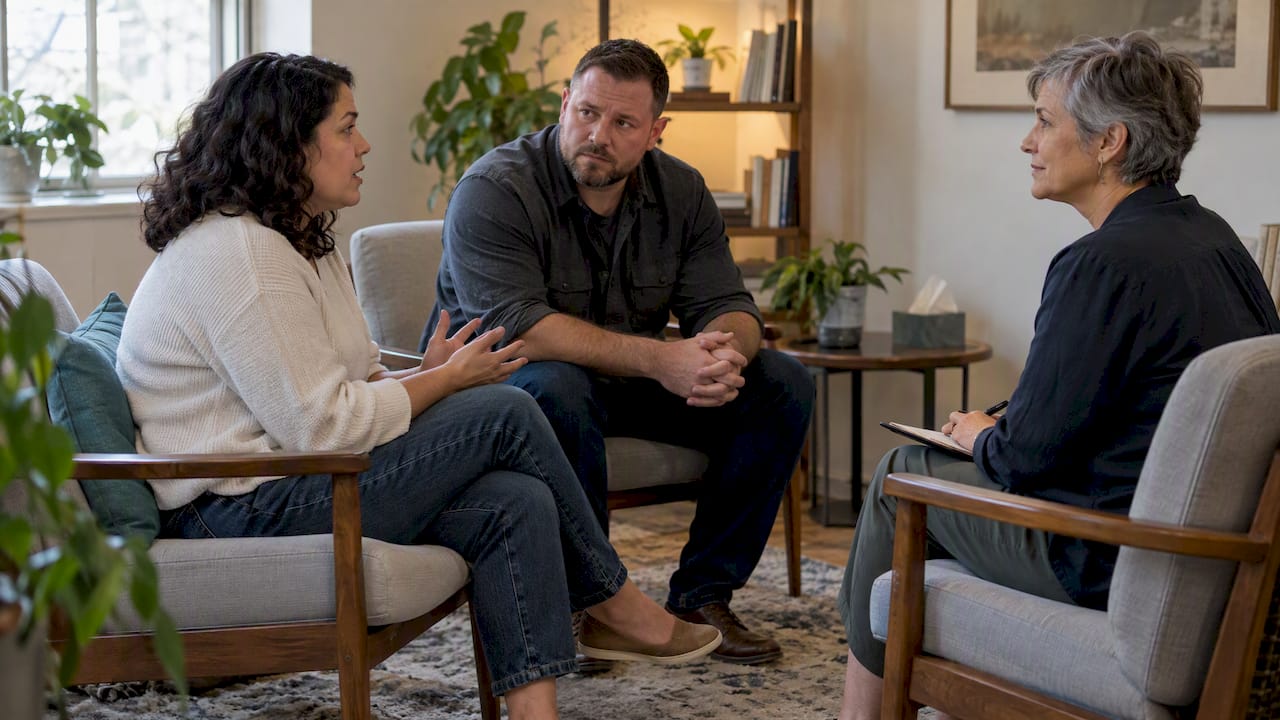
The same argument on repeat. A silence that's gotten louder. A trust that cracked and hasn't been repaired. You still care about each other. You just can't seem to find your way back on your own.
Couples counseling for married, engaged, and partnered couples, in person at our Fayetteville, GA office and online across Georgia. Our team brings EFT-informed, Gottman Method, DBT-informed, and narrative approaches, with weekly sessions or a concentrated nine-hour Couples Intensive when you need more than an hour a week.
Free 15-minute consult · In person in Fayetteville · Telehealth in Georgia · Couples Intensive
Most couples who call us aren't asking whether they love each other. They're asking why loving each other isn't enough to stop the same painful moments from happening again.
If several of these landed, you're not a bad couple. You're caught in a pattern, and patterns can be named, slowed down, and changed with the right help.
Underneath most repeated fights is a cycle that both partners get pulled into. One of you protests the distance, the other protects themselves from the criticism, and each reaction confirms the other's worst fear. Before long the fight isn't really about the topic. It's about whether you can count on each other.
Couples counseling at The Pursuit starts by mapping that cycle together, without blame. When you can both see the pattern, you can stop fighting each other and start interrupting it, then practice new ways of reaching for each other, repairing after hard moments, and rebuilding the trust that got worn down.
There's no one-size-fits-all model of couples therapy, and our counselors don't pretend there is. Each brings a different, well-researched approach, and after a free consult we help you find the right fit.
Drawing on Emotionally Focused Therapy, you slow down the cycle, find the softer fears and needs under the anger or shutdown, and practice turning toward each other. How EFT works.
Research-based tools for conflict, repair, friendship, and shared meaning: coached conversations, love maps, and repair attempts you can use at home. About the Gottman Method.
Adam's framework for weekly couples work and intensives: name the Pattern, build Presence, understand the Purpose behind each partner's reactions, and leave with a written Plan. He also draws on Gottman Method principles alongside the Four P's.
When emotions escalate fast, DBT-informed skills help both of you pause, stay regulated, and come back to the conversation instead of blowing it up or shutting it down.
Sometimes old wounds drive today's fights. Some of our counselors are EMDR trained and can help connect individual healing with the work you do as a couple.
Most of the work happens with both of you in the room. Your counselor may also meet with each of you individually so you can each be fully honest about what's going on.
Couples counseling isn't two people taking turns venting while a counselor nods. It's structured, active work, and your counselor will guide the conversation, slow it down when it escalates, and help each of you say what's actually underneath.
Tell us what's going on and what you're hoping for. We'll suggest the counselor and format, weekly or intensive, that fit you best.
Early sessions cover how you met, what a hard moment looks like for each of you, what you've already tried, and a check on safety, often with a short individual conversation for each partner.
You practice new ways of talking, listening, and repairing, in session and between sessions, with your counselor coaching the conversations that usually go sideways.
We check in on your goals along the way. If you'd benefit from individual counseling, an intensive, or another kind of support, we'll tell you directly.
Neither format means your relationship is "more broken." It's about what fits your situation and your calendar right now. Many couples combine them: an intensive to break through a stuck point, then weekly sessions to keep the momentum going.
Married to a pilot or flight attendant? Trips, reserve days, and commutes make weekly sessions hard to keep. See our couples intensives and counseling for aviation families.



Communication that keeps breaking down, criticism, defensiveness, or the silent treatment. Fair fighting rules.
Stabilizing the crisis, understanding what happened, and rebuilding trust through consistent action. Infidelity recovery.
Not in crisis, just disconnected. Rebuilding friendship, fun, and intimacy before the distance hardens.
Premarital counseling to talk through expectations, money, family, and conflict before they become patterns. Premarital counseling.
When drinking, substances, or compulsive behavior have worn away trust, and both partners want a way forward. Addiction & recovery.
Stepfamilies, a new baby, a move, a career change, retirement, or grief that's changed how you relate.
If there is physical violence, threats, or one partner feels afraid of the other, joint sessions can make things less safe. In that case we start with individual support and safety planning. You can also reach the National Domestic Violence Hotline anytime at 1-800-799-7233 or by texting START to 88788.
We are not a crisis service. Our Jane client portal is for scheduling and non-urgent questions and isn't monitored evenings, weekends, or holidays.
Most couples we see come to our Fayetteville office, a short drive from Peachtree City, Tyrone, Newnan, Senoia, and Sharpsburg. Sitting in the same room, away from the kids and the phones, is part of what makes the work feel different from another conversation at the kitchen table.
Your first step is a free 15-minute consult. You'll talk about what's going on and what you're hoping for, and you can decide whether working together feels like the right next step.
When you can't make the drive, secure telehealth is available when both partners are located in Georgia. We are licensed in Georgia only, so we cannot see clients who are located outside the state. Couples counseling is for adult couples, and individual counseling at The Pursuit is for teens 14 and up and adults. For kids under 14, we offer neurofeedback and brain maps only, through The Pursuit Neurofeedback.
Your first session is mostly about understanding the two of you: what brought you in, how the relationship started, what a hard moment looks like from each side, and what you each hope will change. Your counselor will also check on safety and may schedule a short individual conversation with each partner. You don't need to prepare a speech or agree on what the problem is.
Our counselors draw on several evidence-based approaches. Daniel Bashta's couples work is EFT-informed, drawing on Emotionally Focused Therapy. Jason Collins is trained in the Gottman Method. Adam Glendye draws on Gottman Method principles alongside the Four P's framework (Pattern, Presence, Purpose, Plan) and a narrative approach in his weekly couples work and intensives. Erika Stoll brings DBT and EMDR training for couples where strong emotions or past trauma keep taking over. After a free consult, we help you find the best fit.
Weekly counseling fits most couples: steady, ongoing work while life keeps happening. A couples intensive is three 3-hour sessions, nine hours in total, with Adam Glendye, LPC, CPCS. It can make sense after a major rupture, when you feel stuck at a decision point, or when travel and work schedules make weekly sessions hard to keep. Some couples start with an intensive and continue weekly afterward. A free consult usually makes the right pace clear.
That's common, and it doesn't have to stop you. Partners are often hesitant at first. You can book a free consult on your own, and some people start with individual counseling to sort out what they want and how to invite their partner in. Couples work does need both partners to show up, but it doesn't require both of you to feel equally sure on day one.
Many couples come to us after an affair or another betrayal, such as hidden spending, secret porn use, or lying about drinking. The work usually moves from stabilizing the crisis, to understanding what happened, to rebuilding trust through consistent action over time. We can't promise how it will turn out, but we can give both of you a structured, honest place to do the work, with accountability and compassion in the same room.
You can still come in. Plenty of couples start counseling with one partner leaning out and the other leaning in. Part of the early work can be getting clear on what each of you wants and what would need to change, without pressure to decide in the first session.
No. We also see couples who aren't in crisis but feel distant or keep repeating the same argument, engaged couples who want premarital counseling, blended families finding their footing, and couples adjusting to a new baby, a move, recovery, or retirement. You don't have to wait for things to get worse.
Yes, if you want it to be. Jason Collins spent more than 25 years in pastoral ministry before becoming a counselor, and Daniel Bashta brings a background in ministry as well. If faith matters to you, it's welcome in the room. If it doesn't, nobody will bring it in.
Yes. Most couples meet with us in person at our Fayetteville office, and secure telehealth is available when both partners are located in Georgia at the time of the session. Our counselors are licensed in Georgia only, so we can't see couples who are located outside the state.
If there is physical violence, threats, or one partner feels afraid of the other, joint sessions can make things less safe. In that case we start with individual support and safety planning, and we can connect you with domestic violence resources. If anyone is in immediate danger, call 911. For a mental health crisis, call or text 988.
It depends on what you're working on and how often you meet. Research on Emotionally Focused Therapy, for example, often describes a course of about 8 to 20 sessions, but every couple is different. We review goals and progress with you along the way, and we'll be honest with you about what we're seeing.
Guides from our journal on the cycles couples get stuck in and the approaches our counselors use to help.
The cycle, the feelings underneath it, and the three stages of emotionally focused work.
Read the article
Love maps, repair attempts, and the research-based tools behind Gottman couples work.
Read the article
What a counselor asks, what you can bring, and how to get ready together.
Read the article
Why one of you pushes, the other pulls away, and how couples step out of the loop.
Read the article
Atonement, attunement, and attachment: a roadmap for the long work after betrayal.
Read the article
What to do when one of you has a foot out the door and the other wants to try.
Read the articleStart with a free 15-minute consult at our Fayetteville office, or begin on our Start My Pursuit page and we'll help you find the right couples counselor and the right pace for the two of you.
Start my pursuit →Free 15-minute consult · No commitment · Book with Jason · Book with Daniel · Book with Adam · In crisis? Call or text 988