


Executive function skills are the mental management tools adults use to turn plans into results — and you can start improving them today with three small, evidence-based steps. These skills, which include working memory, inhibitory control, and cognitive flexibility, govern everything from finishing a work project to remembering a friend’s birthday. If you recognize yourself in the struggle to start tasks, manage time, or stay organized, you are not lazy or broken. You are dealing with a real, trainable set of brain-based skills.
Three things you can try right now:
- Calendar-first scheduling trial: For one week, put every task on a calendar block before you do it. Nothing lives on a mental to-do list. This single habit externalizes your working memory and reduces the cognitive load of deciding what to do next.
- Timed work blocks with a start ritual: Set a timer for a moderate length of time suitable to your energy and focus levels, say a brief phrase out loud (“I’m starting now”), and begin. The ritual signals your brain that execution mode is on. Adjust the block length to your energy pattern.
- Pick one observable behavior to track: Count completed work blocks per week with a simple tally. Numbers beat feelings when you are trying to measure real change.
If daily functioning is significantly impaired — missed work deadlines, strained relationships, unpaid bills piling up — self-help strategies alone may not be enough. A clinician can administer structured assessments like the Barkley Deficits in Executive Functioning Scale (BDEFS) or use Goal Attainment Scaling (GAS) to map your specific profile and build a targeted plan. The Pursuit Counseling, based in Georgia, offers executive coaching, an ADHD program, and neurofeedback for adults who need guided, measurement-driven support.
Table of Contents
- What are the core executive function skills adults need?
- How executive function difficulties show up in work, home, and relationships
- Evidence-based strategies you can put to work today
- What the research actually says about improving executive function
- What coaching, therapy, medication, and neurofeedback each do
- How progress is measured, realistic timelines, and what it costs
- How to pick a coach or clinician: eight questions to ask
- Key Takeaways
- What we see at The Pursuit Counseling
- The Pursuit Counseling’s approach to executive function support
- Selected sources and further reading
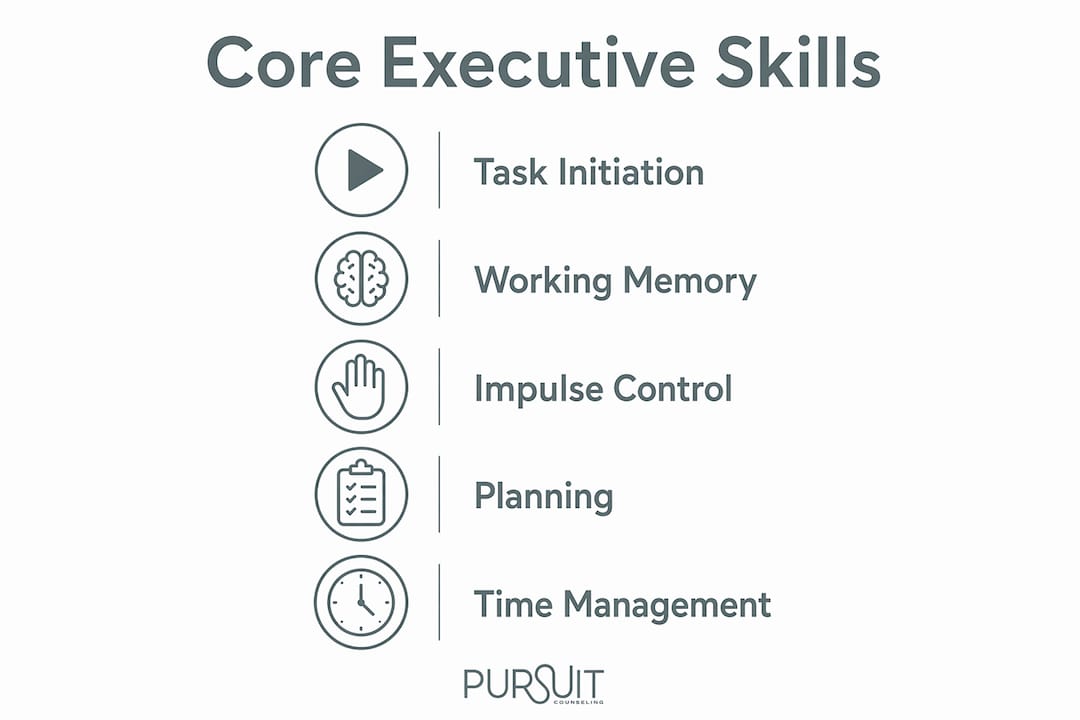
What are the core executive function skills adults need?
Executive functioning is not one skill. It is a cluster of distinct mental capacities, and most adults have a unique profile: strong in some areas, genuinely challenged in others. Knowing your profile is the first step toward fixing the right thing.
- Working memory: Holding and using information in real time. Example: keeping the three steps of a meeting agenda in mind while taking notes on what someone just said.
- Inhibitory control: Resisting impulses, distractions, and automatic responses. Example: staying on a report instead of checking your phone every four minutes.
- Cognitive flexibility: Shifting between tasks, rules, or perspectives without getting stuck. Example: adapting your plan when a client changes the brief at the last minute.
- Planning and prioritization: Deciding what matters most and sequencing steps toward a goal. Example: working backward from a project deadline to set daily milestones.
- Organization: Structuring information, space, and time so things are findable and usable. Example: maintaining a filing system that actually gets used.
- Task initiation: Starting a task without excessive delay, especially when it feels aversive or unclear. Example: opening the document and writing the first sentence instead of circling it for an hour.
- Sustained attention and prospective memory: Staying on task long enough to finish it, and remembering to do something at a future point. Example: remembering to send a follow-up email at 3 PM without a reminder.
Different people carry different profiles. One person may struggle almost exclusively with task initiation while their planning is solid. Another may plan beautifully but fall apart at execution because inhibitory control is the weak link. Recognizing your specific pattern matters because targeting one high-leverage domain with focused practice produces faster, more functional gains than trying to fix everything at once.
How executive function difficulties show up in work, home, and relationships
The gap between knowing what you should do and actually doing it — that is where executive function challenges live. And they show up differently depending on the domain.
At work:
- Missed deadlines despite good intentions
- An inbox that becomes a source of dread rather than a tool
- Difficulty starting complex projects until the pressure is extreme
- Losing track of where you left off after an interruption
At home:
- Unpaid bills not because of money problems but because the task never got initiated
- Clutter that accumulates because putting things away requires a decision chain that stalls
- Forgetting appointments or commitments that felt solid in the moment
In relationships:
- Missing plans or arriving late repeatedly, which reads as disrespect even when it is not intentional
- Emotional reactivity when cognitive load is high — snapping at a partner because the brain is already overwhelmed
- Difficulty following through on commitments, which erodes trust over time
Pro Tip: State factors are as important as skill gaps. Stress, sadness, and fatigue significantly impair executive-function performance on any given day. Before blaming a skill deficit, check the basics: sleep quality, stress load, and emotional state. Managing these is not a soft add-on to skills training. It is a prerequisite. If you are running on five hours of sleep and high cortisol, no strategy will perform at its best.

Evidence-based strategies you can put to work today
Strategy-based interventions produce more meaningful real-world improvements than isolated computerized brain-training. Here is how to build a practical system, starting with the highest-leverage moves.
The calendar-first workflow (step by step)
- Collect: At the start of each day, write down every task you intend to do — no exceptions.
- Break it down: Split any task that takes more than 30 minutes into single next actions (not “finish report” but “write introduction paragraph”).
- Block it: Assign each action to a specific calendar slot. Tasks should be assigned a specific time slot on a calendar to externalize planning and aid working memory
- Add a start ritual: Before each block, say or write one sentence: what you will do and when you will stop.
- Schedule a review: Set a 10-minute end-of-day review to move anything incomplete and note what worked.
This workflow externalizes your planning system so your working memory does not have to hold it all. For a structured short-cycle approach that pairs well with this, the 12-week year method is worth exploring.
Other high-impact strategies
- Implementation intentions: Instead of “I’ll exercise more,” write “When I sit down at my desk at 8 AM, I will open the project file first.” The “when-then” format dramatically increases follow-through.
- Timed work windows: Use timed work blocks matched to your energy and focus levels; adjust length and transitions to what feels manageable Adjust until the block length feels doable, not heroic.
- Body doubling and accountability: Work alongside another person, virtually or in person. The social presence reduces avoidance and increases task initiation without requiring conversation.
- Visual cue systems: A whiteboard with today’s three priorities, a sticky note on the monitor, or a color-coded calendar. External visual cues reduce the working-memory demand of remembering what matters.
Pro Tip: Start with one domain, not five. Pick either task initiation or time management as your first target. Nail one system before adding another. Breadth feels productive; depth actually is.
Pro Tip: Pair every strategy with an external accountability cue — a phone alarm, a check-in text to a friend, or a scheduled coaching call. Internal willpower is the least reliable cue you have.

For low-tech options, an analog planner and a kitchen timer work as well as any app. For digital options, a calendar app with notifications and a simple checklist template cover most needs. The tool matters far less than the consistency of use.
What the research actually says about improving executive function
The answer-first version: adaptive and multidomain training programs produce the broadest real-world gains. Isolated computerized drills improve performance on the trained tasks but rarely transfer to planning, organization, or daily functioning on their own.
A systematic review of randomized trials from 2018–2025 found that adaptive and multidomain programs produced the broadest transfer effects, with reported effect sizes ranging from moderate to large (Cohen’s d = 0.6–1.7) for working memory and inhibitory control gains in several trials. That is a meaningful signal. But effect sizes on cognitive tests do not automatically mean your calendar gets managed better — which is why pairing training with behavioral strategies matters.
What the research recommends: Use Goal Attainment Scaling (GAS) or BDEFS-based tracking rather than relying solely on computerized test scores to judge whether real-world functioning has improved.
Key findings worth knowing:
- Movement-based mindfulness practices — tai chi, taekwondo, martial arts — show among the most consistent results for improving executive functions across studies. They combine physical challenge, attention demands, and emotional regulation in a single activity.
- Computerized working-memory drills reliably improve performance on the trained tasks (near transfer) but do not consistently produce broad real-world improvements in planning or organization unless paired with behavioral strategies.
- Executive function skills can be strengthened across the lifespan — neuroplasticity is real, and adults who combine cognitive challenge with emotional safety and environmental supports see the best outcomes.
The practical implication: build a behavioral system first, then add cognitive challenge (movement, mindfulness, structured training) as a complement. Do not wait for brain training to fix what a calendar and a timer can address faster.
What coaching, therapy, medication, and neurofeedback each do
These are not interchangeable. Each serves a different function, and the best outcomes usually come from combining two or more.
- Executive coaching: Targets skills and implementation. Sessions focus on building specific workflows, rehearsing tools, and holding accountability. Best for adults whose primary challenge is translating good intentions into consistent action.
- Therapy (CBT/DBT-informed): Addresses the underlying mood, anxiety, or trauma patterns that impair executive functioning. DBT skills are particularly useful for emotional regulation, which is a major driver of task avoidance and impulsivity.
- Medication: For adults with biologically significant ADHD, stimulant or non-stimulant medication can raise the baseline capacity for inhibitory control and sustained attention. Medication does not teach skills — it creates a window in which skills can be practiced more effectively.
- Neurofeedback: A brain-based intervention that trains neural regulation through real-time feedback. Useful for attention, emotional regulation, and arousal modulation, and it integrates well with coaching and therapy.
Sample 6-session coaching/therapy block
| Session | Focus | Measurable homework |
|---|---|---|
| 1 | Baseline mapping: identify one target behavior and set GAS anchors | Track target behavior daily with a tally |
| 2 | Teach and rehearse calendar-first workflow | Complete calendar blocks 4 of 5 workdays |
| 3 | Add implementation intention to the workflow | Write one “when-then” plan each morning |
| 4 | Introduce body-doubling or accountability structure | Log one body-double session per week |
| 5 | Review GAS progress, troubleshoot obstacles | Adjust workflow based on what broke down |
| 6 | Mid-course BDEFS snapshot, set next 6-week target | Define one new measurable goal |
Pro Tip: Combining structured skills practice with environmental scaffolds and periodic GAS/BDEFS measurement gives the best chance of real-world transfer. Measurement is not bureaucracy — it is the feedback loop that keeps the work honest.
How progress is measured, realistic timelines, and what it costs
Subjective feeling is the worst measure of executive function progress. “I feel like I’m doing better” is not the same as completing four more work blocks per week. Use objective methods.
Measurement tools that work:
- Goal Attainment Scaling (GAS): Set a specific, observable behavioral target with five anchor points (from “much worse than expected” to “much better than expected”). Rate it weekly. This gives you a number that reflects real-world function, not just test performance.
- BDEFS short clusters: A clinician-administered or self-report tool that tracks deficits across EF domains over time. Useful for baseline and mid-course comparison.
- Calendar timestamps and work-block logs: Passive digital traces — how many calendar blocks were completed, how many tasks were initiated on time. Combining these with GAS ratings gives the best balance of objectivity and feasibility.
- Weekly one-line functional rating: One sentence each Sunday: “This week I initiated tasks on time X out of Y days.” Simple, consistent, and honest.
Realistic timeline
| Phase | Timeframe | What to expect |
|---|---|---|
| Early gains | 4–8 weeks | Improvement on a single, well-targeted behavior (e.g., task initiation rate) |
| Broader functional change | 3–6 months | Improvements across multiple domains; reduced daily friction |
| Maintenance | Ongoing | Periodic check-ins, GAS resets, and strategy refreshes as life demands shift |
On cost: Executive coaching and therapy sessions in a private-pay model typically range from 0–0 per session depending on provider credentials, session length, and program structure. The Pursuit Counseling operates primarily as a private-pay practice. Insurance coverage for executive coaching is generally not available; therapy sessions may qualify for out-of-network reimbursement depending on your plan, and a clinician can provide documentation to support that process.
What influences cost and timeline:
- Severity of EF deficits and presence of comorbidities (ADHD, anxiety, depression)
- Whether medication evaluation is needed alongside skills work
- Session frequency (weekly vs. biweekly)
- Whether you pursue an intensive program or standard weekly sessions
How to pick a coach or clinician: eight questions to ask
The wrong provider can waste months. Ask these before you commit.
- What are your credentials and clinical background? Look for licensed clinicians (LPC, LCSW, psychologist) or certified coaches with specific training in adult ADHD and executive functioning.
- How much experience do you have with adult ADHD and neurodiversity? General coaching experience is not the same as expertise in executive dysfunction.
- Do you use measurable outcomes like GAS or BDEFS? If a provider cannot name a measurement tool, that is a problem.
- What does a typical session look like? You want to hear: baseline mapping, skill rehearsal, homework with a metric, and regular progress review.
- What are your expectations for between-session homework? Real change happens between sessions, not during them.
- Do you offer telehealth, in-person, or both? Flexibility matters for consistency.
- Do you coordinate with prescribing providers if medication is part of the picture? Siloed care produces siloed results.
- Can you describe an outcome a past client achieved? Not a testimonial — a functional description of what changed and how it was measured.
Red flags to avoid:
- Vague outcome claims (“you’ll feel more focused and organized”) with no measurement plan
- No structured homework or between-session accountability
- One-size-fits-all scripts that do not adapt to your specific EF profile
- Pressure to buy long-term packages before any short-term measurable goals have been set
A script you can use: “How will we know if this work is helping me in six weeks?” A good provider will answer with a specific metric. A provider who deflects or gives a vague answer about “feeling better” is telling you something important.
Key Takeaways
Adults who target one specific executive function domain with structured, measurable practice and environmental supports make faster, more lasting gains than those who try to improve everything at once.
| Point | Details |
|---|---|
| Start with one domain | Pick task initiation or time management first; focused practice beats broad effort every time. |
| Use calendar-first scheduling | Assign every task to a calendar block for one week to externalize your planning system. |
| Measure with GAS or BDEFS | Objective metrics like Goal Attainment Scaling reveal real-world change that subjective feeling misses. |
| State factors matter | Sleep, stress, and mood significantly affect daily EF capacity; stabilize these alongside skills work. |
| The Pursuit Counseling | Offers executive coaching, an ADHD program, and neurofeedback in Georgia with measurement-driven, short-program options for adults. |
What we see at The Pursuit Counseling
At The Pursuit Counseling, we work with executives, professionals, pilots, and high-performing adults across Georgia who know something is getting in their way but cannot quite name it. Most of them are not failing — they are exhausted from compensating. Our approach is neuroscience-informed and measurement-driven: we start with a baseline mapping session, identify one high-leverage behavioral target, and build a GAS-anchored plan from there. We use a combination of executive coaching, evidence-based therapy (CBT, DBT skills, EMDR when trauma is part of the picture), and neurofeedback for clients who need brain-level regulation support alongside skills work. We track progress with BDEFS snapshots and GAS ratings so that “feeling better” becomes something we can actually verify. We see clients in person in Georgia and via telehealth for those outside our immediate area.
The Pursuit Counseling’s approach to executive function support
If you have read this far and recognize yourself in these pages, the next step is not another strategy article. It is a conversation with someone who can map your specific EF profile and build a plan around it.

The Pursuit Counseling offers a structured pathway for adults dealing with executive dysfunction: an ADHD program that combines coaching, skills training, and measurement-based care; neurofeedback for attention and regulation challenges; DBT-informed emotional regulation work; and intensive short programs for adults who want faster, concentrated progress. At intake, you get a baseline mapping session, one clear measurable target, and a 6-week GAS plan — not a vague promise to “work on focus.”
We serve clients in person in Georgia and via telehealth for those who need flexibility. To request a consultation, visit thepursuitcounseling.com and book directly online.
This article is general information, not professional advice. For a personalized assessment of your executive function profile, consult a licensed clinician or qualified coach.
Selected sources and further reading
- Cleveland Clinic: Executive Function Overview — A thorough clinical summary covering EF domains, state factors, and lifespan development; a reliable starting point for understanding the basics.
- Harvard Center on the Developing Child: Guide to Executive Function — The most cited academic resource on EF development; includes practitioner guides for building adult capabilities.
- ADDitude Magazine: How to Improve Executive Function in Adults with ADHD — Practical, clinician-reviewed strategies including movement-based mindfulness evidence; written specifically for adults with ADHD.
- Therapy for Adulting: Cognitive Training for Executive Functioning — A clinician toolkit covering GAS-based measurement, session flow, and the limits of standalone brain training; useful for both clients and providers.
- Systematic Review: Cognitive and Neural Outcomes of Executive Function Training in Healthy Adults (preprint) — The most current review of randomized trials (2018–2025); covers effect sizes, transfer effects, and what adaptive training actually produces.
- Effective U / University of Minnesota: Executive Functioning Skills — A clear breakdown of EF skill clusters (regulation, initiation, completion) with ADHD-specific context; useful for self-identification.
- NIH/PubMed: Executive Function and Self-Regulation — Peer-reviewed research on the neural basis of EF and self-regulation; supports the neuroplasticity argument for adult skill development.