


When anxiety hijacks a decision, name it out loud in one sentence, run a 60-second grounding routine, then return to the next concrete task on your list. That is the whole verdict. Everything else, from breathing mechanics to when a licensed therapist should get involved, is detail. This article gives you the exact scripts, the clinical evidence behind them, and a path to longer-term care when the 60-second version stops being enough.
TL;DR:
- Leaders should name anxiety aloud and use a four-by-four breathing routine to quickly reduce physiological arousal before making decisions.
- Monitoring physical and cognitive signs like shallow breathing, catastrophizing, or over-preparing helps detect anxiety early in oneself.
- Short-term tactics such as timeboxing worries and micro-exposing oneself to feared conversations can manage sustained stress and prevent anxiety from spiraling.
- Clinical approaches like cognitive behavioral therapy, acceptance and commitment therapy, and workplace mindfulness are most effective for chronic anxiety, especially when combined with daily grounding routines.
- Professional support from therapists, coaches, and trusted peers is essential when anxiety significantly impacts sleep, health, or decision-making, or if symptoms persist beyond a few weeks.
Table of Contents
- Leadership Anxiety Help: A 60-Second De-Escalation You Can Use Right Now
- Recognizing Anxiety in Yourself Before It Runs the Meeting
- Short-Term Tactics for Coping With Leadership Stress
- What the Research Says About Treating Leadership Anxiety
- How Unmanaged Anxiety Shapes Your Team and Your Decisions
- Building the Support System That Keeps You Steady
- When to Get Professional Help and How to Choose the Right Clinician
- A Clinician’s Protocol for Leaders: The Pursuit Counseling Approach
- Why Working Through Anxiety Can Make You a Better Leader
- How The Pursuit Counseling Supports Leaders Managing Anxiety
- Sources
- FAQ
Leadership Anxiety Help: A 60-Second De-Escalation You Can Use Right Now
Anxiety spikes fast and it recedes fast, if you interrupt it correctly. The mistake most leaders make is trying to think their way out of a fight-or-flight response before the body has had a chance to settle. Physiological regulation comes first because breathing and movement reduce amygdala reactivity, which is exactly the brain function you need calm before you can do the harder cognitive work of a tough call.
Here is the sequence to run the next time your chest tightens before a board update, a layoff conversation, or a client call that could go sideways.
- Name it. Say silently or under your breath, “This is anxiety, not danger.” Labeling the state creates distance between you and the feeling instead of fusing you to it.
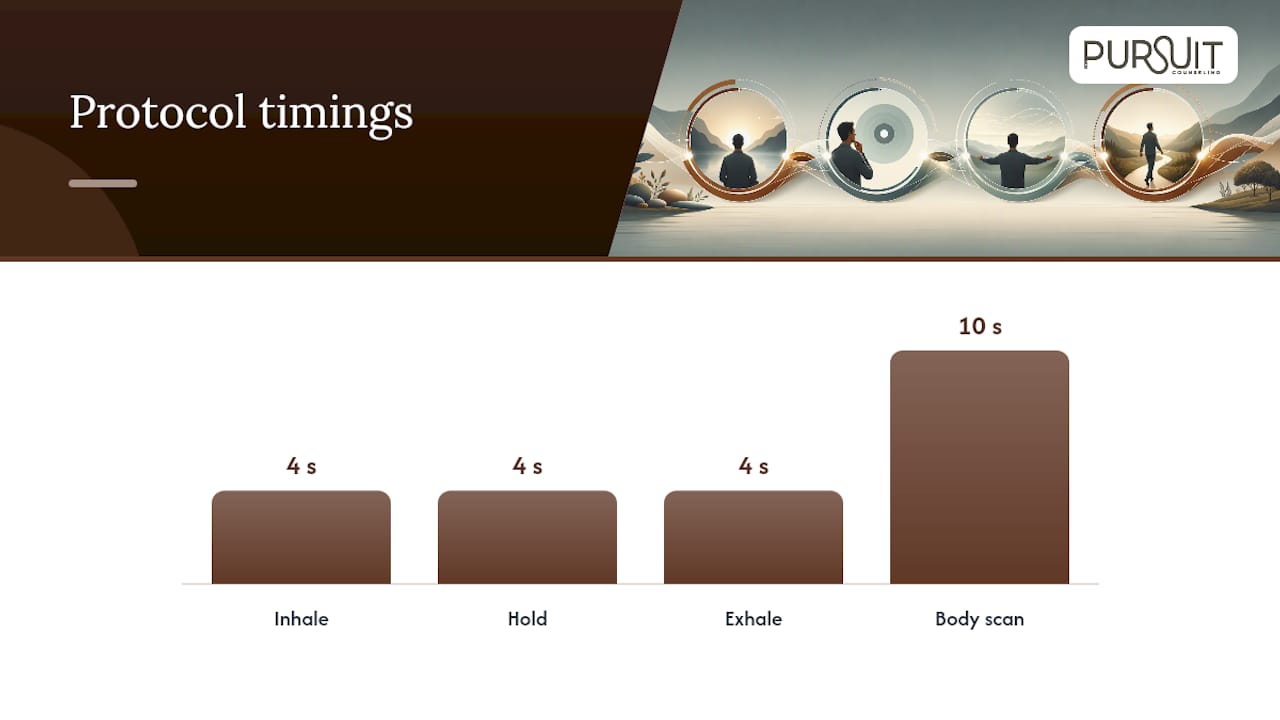
- Ground with 4-4-4. Inhale for four seconds, hold for four, exhale for four. Repeat four times. This isn’t a suggestion to “calm down.” It’s a mechanical reset for your nervous system.
- Scan your body for ten seconds. Unclench your jaw, drop your shoulders, plant both feet flat on the floor. Tension you’re not tracking leaks into your voice and your decisions.
- State the next concrete action out loud. Not the whole plan. Just the next step: “I’m going to open with the revenue number.” Anxiety thrives on abstraction; specificity starves it.
If this routine doesn’t bring your heart rate and thinking back to baseline within a few minutes, or if you find yourself running it five or six times in a single day, that’s a signal worth paying attention to rather than pushing through.
Pro Tip: Keep the script physically on you, a sticky note on your monitor or a phone lock-screen note. In the moment, anxious brains struggle to recall even simple sequences. Reading it beats trying to remember it.
Recognizing Anxiety in Yourself Before It Runs the Meeting
Leadership anxiety rarely announces itself as anxiety. It shows up disguised as thoroughness, urgency, or high standards, and that disguise is exactly what makes it dangerous. Most executives can identify anxiety in a direct report within minutes. Spotting it in themselves takes longer, because the same behaviors that signal anxiety also look like conscientiousness on a resume.
Watch for signals across three categories:
- Somatic: shallow breathing, jaw clenching, a racing heart before routine meetings, tension headaches by mid-afternoon, disrupted sleep the night before big decisions.
- Cognitive: catastrophizing (“if this quarter misses, we’re finished”), rumination that loops the same worry for hours, difficulty concentrating on anything beyond the perceived threat.
- Behavioral: over-preparing for low-stakes conversations, avoiding a difficult decision by researching it endlessly, micromanaging a task you’d normally delegate, snapping at people over minor missteps.
Two quick self-checks help you catch this early. First, a body scan: pause for 60 seconds and notice where you’re holding tension, jaw, shoulders, stomach. Second, a decision checklist: ask whether you’re gathering information because it will genuinely change the outcome, or because gathering more information delays having to act.
That second question doubles as a litmus test between productive urgency and anxiety-driven overpreparation. A leadership coach’s take on managing executive anxiety makes the same point: leaders often mistake control for strength, when the rehearsal has stopped adding value and started just delaying the decision.
Short-Term Tactics for Coping With Leadership Stress
The 60-second routine handles the acute spike. These tactics handle the hours and days around it, the sustained pressure of a leadership role that doesn’t let up just because one meeting ended.
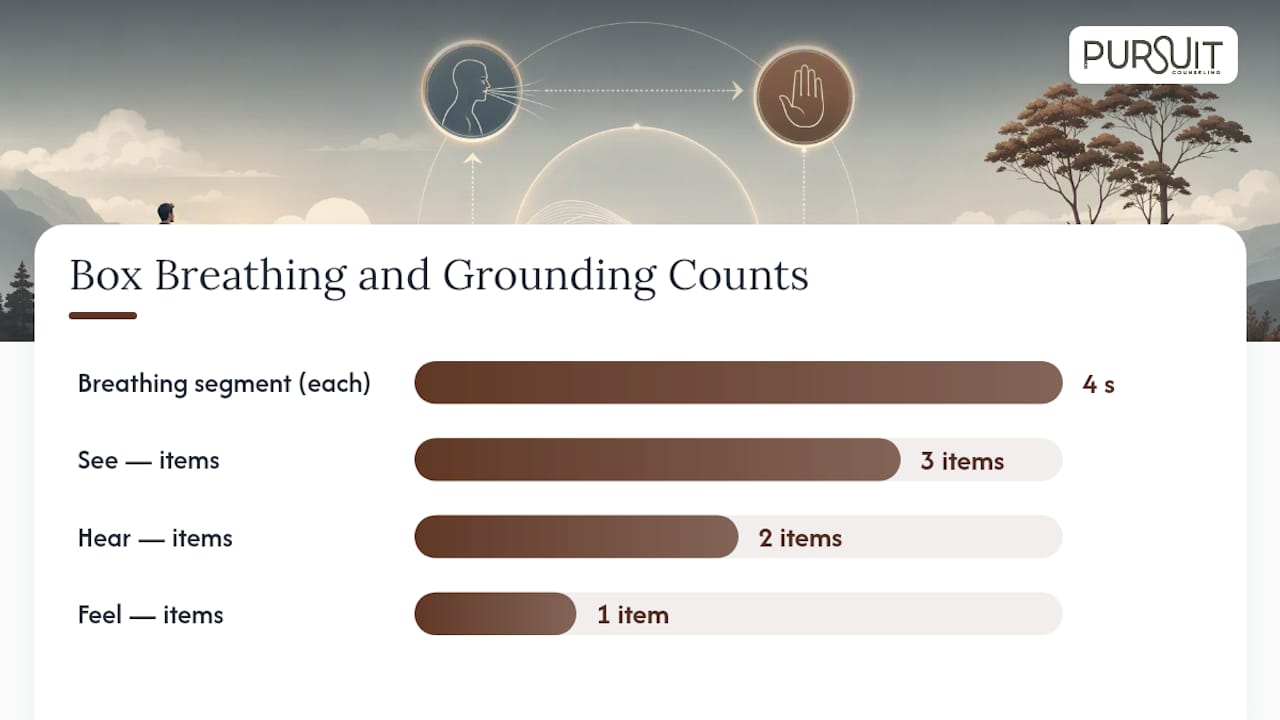
Breathing and grounding, done right. Box breathing (four seconds in, four hold, four out, four hold) works better than a generic “take a deep breath” because the counting itself occupies the ruminating part of your brain. Pair it with a sensory grounding technique: name three things you can see, two you can hear, one you can physically feel. This is a variation of the widely used 3-3-3 rule. It works because it forces your attention out of the anxious loop and into your immediate environment.
Cognitive distancing. The move here is to observe the thought rather than argue with it. Instead of “I’m going to fail this presentation,” try “I’m having the thought that I’ll fail this presentation.” That small linguistic shift, backed by acceptance-based approaches to executive coaching, creates enough space to act despite the discomfort instead of waiting for the discomfort to disappear first.
From thought to action. Once you’ve named the thought and created distance, immediately identify one values-linked action you can take in the next five minutes. Anxiety loses power the moment you’re moving toward something instead of just reacting.
Three behavioral tactics round this out:
- Timeboxing. Give a worry or a decision a fixed window, fifteen minutes, not the whole afternoon, then move on regardless of whether you feel “ready.”
- Exposure micro-steps. If a specific conversation triggers dread, rehearse the opening line only, then send the calendar invite. Small steps toward the feared action reduce its grip faster than avoidance ever will.
- The worry hour. Set aside one scheduled block each day to process leftover anxious thoughts, rather than letting them intrude on every meeting between now and then.
Pro Tip: Say the anxious thought out loud to a trusted colleague before a big decision. Vocalizing it, even briefly, reduces its intensity more than silently replaying it does.
What the Research Says About Treating Leadership Anxiety
Short-term tactics manage a bad afternoon. They don’t resolve anxiety that has become chronic, and leaders who rely on grounding scripts alone while ignoring a persistent pattern are treating a structural problem with a band-aid. Three approaches carry the strongest evidence, and a fourth deserves a mention leaders often skip.
- Cognitive behavioral therapy (CBT) remains the clinical standard for anxiety disorders. It works by identifying the specific thought patterns and avoidance behaviors that sustain anxiety, then systematically restructuring them through exposure and cognitive work.
- Acceptance and commitment therapy (ACT) takes a different angle, less about eliminating anxious thoughts and more about building the capacity to act on your values despite them. For leaders who must make decisions under uncertainty regardless of how they feel, ACT’s emphasis on committed action tends to translate directly into the boardroom.
- Workplace mindfulness training has real, measured effects. A meta-analysis of 23 studies found that workplace-delivered mindfulness programs reduced anxiety with a Hedge’s g of 0.62 and reduced stress with a g of 0.56, effect sizes that fall in the moderate-to-large range for behavioral interventions.
That single data point matters because it validates something leaders often dismiss as too soft to work: a brief, structured mindfulness practice measurably changes anxiety and stress levels, not just self-reported mood.
The mechanism behind that effect isn’t mysterious. Mindfulness practice appears to build psychological capital, hope, efficacy, resilience, and optimism, and that reserve of psychological capital is what mediates lower anxiety and burnout in managerial populations.
Medication enters the picture when anxiety is severe, persistent, or paired with panic symptoms that don’t respond to therapy and behavioral change alone. For performance-specific anxiety, like a public speaking spike that has nothing to do with your broader mental health, short-term interventions such as beta-blockers or targeted exposure work can be appropriate. That decision belongs to a prescribing clinician working alongside your therapist, not something to self-diagnose from a leadership blog.
How Unmanaged Anxiety Shapes Your Team and Your Decisions
Anxiety doesn’t stay contained to the person feeling it; it can seriously impact organizations by stalling change initiatives as shown in case research on leadership anxiety and transformation. It leaks into the organization through a pattern researchers call defensive organizing: excessive process, redundant approvals, micromanagement, and change initiatives that quietly stall because no one wants to be the one who moves first. Case research on leadership anxiety and transformation documents this pattern repeatedly. A leader who is anxious about a restructuring adds three extra sign-off steps “to be safe.” A leader anxious about being blamed for a miss starts reviewing every deliverable personally. The anxiety hasn’t gone anywhere; it’s just been converted into bureaucracy.
The antidote is naming the anxiety before it metastasizes into policy. Leaders who acknowledge uncertainty directly, rather than papering over it with control, reduce the contagion effect and preserve the psychological safety a team needs to surface problems early.
A few scripts make this concrete in a meeting:
- “I’m feeling some real uncertainty about this rollout, and I want us to name that instead of pretending it isn’t there.”
- “What am I not seeing here? I’d rather hear the hard version now than the polished version later.”
- “Let’s take five minutes before we decide. I want us thinking clearly, not just fast.”
Curiosity, courage, and care, naming the anxiety, inquiring into what’s actually driving it, then responding with reassurance rather than control, is the sequence that keeps anxiety from calcifying into the kind of organizational stiffness that stalls change initiatives for months.
Building the Support System That Keeps You Steady
No leader manages chronic anxiety alone, and the ones who try to tend to burn out faster and lead worse in the meantime. A workable support infrastructure has three components, each doing a different job.
- A therapist or executive-focused clinician for the clinical work: diagnosis, treatment planning, and the deeper cognitive and emotional processing that a peer conversation can’t substitute for.
- A coach for translating insight into leadership behavior, how the anxiety shows up specifically in your role, your meetings, your decisions.
- Two or three trusted peers, a “safe team,” for the confession-level honesty that’s hard to access anywhere else. This is the group you tell “I almost walked out of that board meeting” to, not your direct reports.
Each piece serves a distinct function. Your therapist handles confession and clinical treatment. Your coach handles feedback on how the anxiety translates into your leadership style. Your peers handle accountability, the gentle check that catches you drifting back into avoidance before it becomes a pattern.
Build in structure around this. Schedule a recurring “worry hour,” even fifteen minutes weekly, to process what’s accumulated. Set a monthly check-in with your safe team specifically to ask how you’ve been showing up, not just how the business is doing.
Pro Tip: Pick your safe team deliberately. The instinct is to lean on whoever’s available. The better move is choosing two or three people who will tell you the truth even when it’s inconvenient for you to hear.
When to Get Professional Help and How to Choose the Right Clinician
Some signals mean it’s time to move past self-managed tactics and get a professional evaluation. According to NIMH, anxiety disorders are common and can significantly impair daily functioning, and when symptoms interfere with work or relationships, professional evaluation is the appropriate next step, not a last resort.
Watch for these red flags specifically:
- Anxiety that’s affecting your sleep, appetite, or physical health for more than a few weeks
- Panic symptoms: racing heart, chest tightness, a sense of impending doom that arrives without warning
- Persistent avoidance of decisions, meetings, or conversations that your role requires
- Any thoughts of self-harm or suicidal ideation, which warrant immediate professional attention
If you’re evaluating clinicians or programs, a short checklist keeps the search efficient:
- Credentials. Look for licensure (LPC, LCSW, PhD, PsyD) and specific experience working with executives or high performers.
- Modality fit. Ask whether they practice CBT, ACT, EMDR, or offer neurofeedback, and whether that matches what you’re dealing with.
- Logistics. Telehealth availability, scheduling flexibility around a demanding calendar, and transparent fees.
Before your first session, it helps to walk in with a short list of questions, covering treatment approach, session structure, and what progress actually looks like. The Pursuit Counseling’s guide on questions to ask your therapist is a useful starting point if you’ve never done an intake before and aren’t sure what’s reasonable to ask.
A Clinician’s Protocol for Leaders: The Pursuit Counseling Approach
Adam Glendye is a licensed professional counselor with experience in clinical training and supervisory oversight, contributing to the approach used for executive anxiety treatment.
Here is a simple four-step protocol worth trialing for one week:
- Recognize. Once daily, pause and name whatever anxious state is present, out loud or in writing.
- Micro-anchor. Run the 60-second grounding sequence immediately after naming it, before deciding what to do about the underlying issue.
- Values-linked action. Choose one small action that day that reflects who you want to be as a leader, not just what the anxiety is demanding.
- Review with your safe team. At week’s end, talk through what you noticed with a trusted peer, coach, or therapist.
Anxiety that goes unnamed doesn’t disappear. It gets rerouted into extra meetings, extra approvals, and extra hours that never quite resolve the discomfort driving them.
,
Why Working Through Anxiety Can Make You a Better Leader
Anxiety isn’t a character flaw to hide from your team. It’s information, a signal that something in your environment, your workload, or your decision-making warrants closer attention. Leaders who treat it that way, rather than suppressing it until it leaks out as micromanagement, tend to make sharper calls and build more trust.
The compounding effect comes from small, repeated habits: a daily grounding anchor, a standing check-in with your safe team, a therapist who knows your specific pressures. None of these fix anxiety in a week. Together, over months, they shift how you lead.
Consider clinical support not as an admission of weakness but as a leadership investment, the same category as executive coaching or a graduate degree. The leaders who ask for help early usually need less of it later.
— Adam Glendye LPC, CPCS
How The Pursuit Counseling Supports Leaders Managing Anxiety
Reading about grounding scripts and CBT is useful. Working through the specific pressures of your role with someone trained for it is different. The Pursuit Counseling offers services to executives, business owners, and high performers in the Fayetteville, Peachtree City, and surrounding South Atlanta areas, providing both in-person and telehealth options to accommodate busy schedules.

Services built for exactly this situation include:
- Anxiety therapy and life-transitions counseling for the ongoing clinical work of understanding and treating what’s driving the anxiety
- The Executive Experience, an intensive format for leaders who want concentrated, focused work rather than a slow weekly cadence
- EMDR and neurofeedback for leaders whose anxiety has roots in earlier stress or trauma that talk therapy alone hasn’t resolved
If you’ve never sat down with a therapist before, what to expect in a first session is worth a quick read, since most of the anxiety about starting therapy has nothing to do with the therapy itself. Full details on services and specialties are available if you want to see the full range before booking. Scheduling is private and confidential, and the first step is simply reaching out to set up a consult that fits your calendar.
Sources
- Workplace mindfulness meta-analysis (PubMed entry)
- How leadership anxiety derails transformation (MIT Sloan Review)
This article is general information, not a substitute for advice from a qualified doctor. Consult a qualified healthcare professional about your own circumstances before acting on anything here.
FAQ
What is the 3-3-3 rule for anxiety?
The 3-3-3 rule is a grounding technique where you name three things you can see, three things you can hear, and three things you can feel or move. It interrupts anxious spinning by redirecting attention to your immediate physical environment, similar in principle to the 4-4-4 breathing sequence covered earlier in this article.
What is the most damaging habit for anxious leaders?
Avoidance, delaying a hard conversation, decision, or piece of feedback because it feels uncomfortable, tends to be the most damaging pattern for leaders specifically. It provides short-term relief but reinforces the anxiety long-term and often shows up disguised as “waiting for more information.”
What are effective strategies for managing anxiety at work?
The strongest evidence supports cognitive behavioral therapy, acceptance and commitment therapy, and workplace mindfulness training, which one meta-analysis found reduces anxiety with a moderate-to-large effect size. Pairing these clinical approaches with short daily tactics, like the 60-second grounding routine, covers both the acute moment and the longer pattern.
What are common signs of anxiety in the workplace?
Common signs include physical tension and disrupted sleep, catastrophic thinking or rumination, and behavioral patterns like micromanaging, over-preparing, or avoiding decisions. Leaders often mistake these behaviors for conscientiousness rather than recognizing them as anxiety.
Does The Pursuit Counseling offer anxiety-specific support for executives?
Yes. The Pursuit Counseling offers individual anxiety therapy along with The Executive Experience, an intensive format designed for leaders who need concentrated, flexible support rather than a standard weekly schedule.