

A good relationship check-in is a short, planned conversation where you each say how the relationship is going before small things turn into big ones. The questions matter less than the order: start with what is working, move to how each of you is doing, then take on one concern, then decide what happens next week. Below are more than 30 questions sorted by purpose, plus a format that keeps the conversation from becoming a trial.
If you are reading this, you may be two capable people who run a household, a career, maybe a business, and still find that the two of you only talk about logistics. Or you talk plenty, but the real things slide. That is common, and it is fixable with structure more than willpower.
Key Takeaways
- Keep it short: 20 to 30 minutes, at a time you both pick, with phones put away.
- Open with appreciation and end with one concrete commitment. Hard topics go in the middle, and only one at a time.
- Use questions that ask for something specific (“What would help this week?”) rather than verdicts (“Why do you always…”).
- A check-in is maintenance. If the same fight returns every week or one of you dreads the conversation, that is information worth bringing to a counselor.
- Nothing here is an assessment of your relationship. It is a way to start talking.
Table of Contents
- How to Set Up a Check-In That Doesn’t Feel Like a Performance Review
- A Simple Order for the Conversation
- Appreciation Questions to Start With
- Questions About How You Are Each Doing
- Questions About Connection and Intimacy
- Questions for a Concern, a Conflict or an Unmet Need
- Questions About the Week Ahead and What You Are Building
- Weekly or Monthly: Which Questions Go Where
- When the Questions Get Hard to Answer
- Our Perspective
- Working With a Couples Therapist
- FAQ
- Sources
How to Set Up a Check-In That Doesn’t Feel Like a Performance Review
The setup decides whether the questions land. Most couples who try a check-in once and quit made one of three mistakes: they picked a bad moment, they tried to solve everything, or one person felt ambushed.
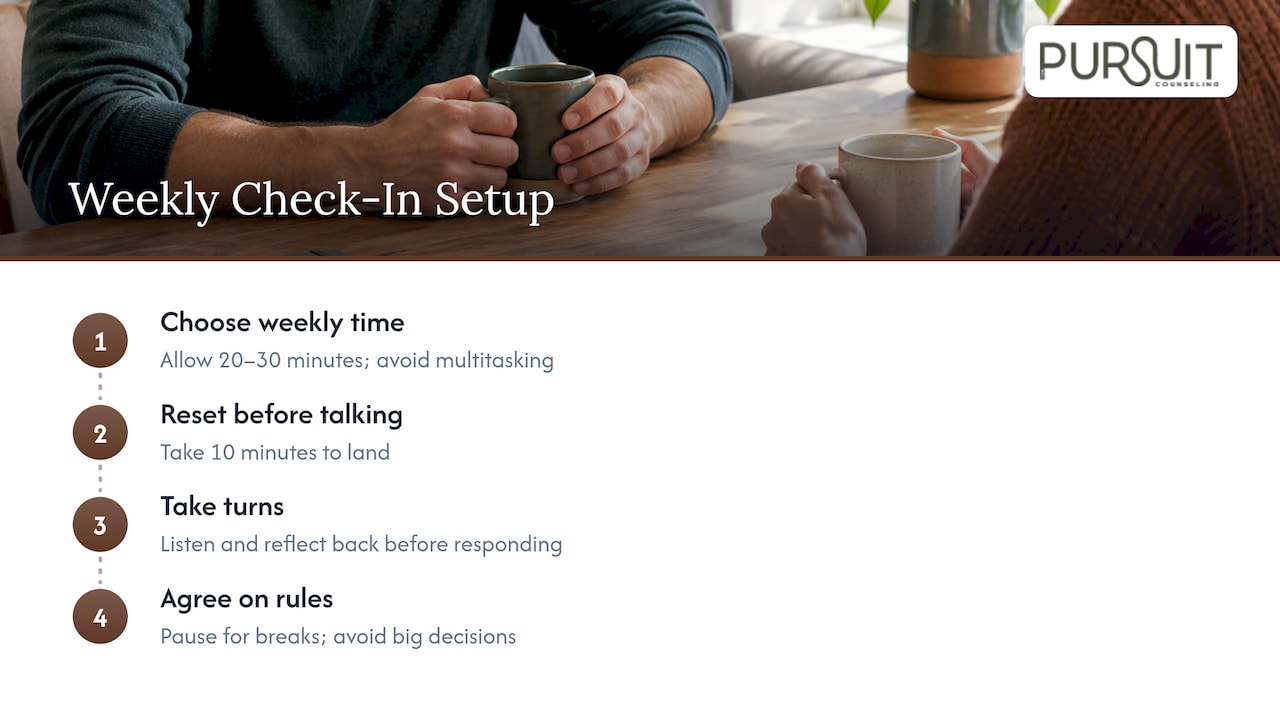
Pick a rhythm and a time. Weekly works for most couples because it is frequent enough that nothing festers. A licensed professional counselor writing in Psychology Today recommends keeping check-ins to roughly 20 to 30 minutes, choosing a time that works for both of you and not multitasking. Sunday evening and a weeknight walk are common choices. Avoid the moment either of you is hungry, rushed or already irritated.
Come in off the day first. If you walk in straight from a hard shift, a flight, a board call or bedtime with the kids, you will bring that body into the conversation. Give yourselves ten minutes to land. A short reset, whether a walk, a shower or some simple ways to unwind after work, makes the first question easier to answer honestly.
Take turns. One person speaks, the other listens and reflects back what they heard before responding. It feels slow at first. It is also what keeps a check-in from becoming two people defending themselves at once.
Agree on the rules before the first one. Something like: we stop if either of us asks for a break, we do not bring up past fights as ammunition, and we do not use this hour to decide anything big.
A Simple Order for the Conversation
Research and clinical guides vary on the details, but the shape is consistent. Here is the sequence we suggest to couples.
- Arrive (2 minutes). Each of you names your current state in a sentence.
- Appreciate (5 minutes). Specific, recent, true.
- Connect (5 to 8 minutes). How each of you is actually doing, and how close you have felt.
- Address one thing (8 to 10 minutes). One concern, framed around a need.
- Commit (2 minutes). One or two small actions, and the time of the next check-in.
Starting with appreciation is not a trick. It reminds both nervous systems that you are on the same side before you touch anything tender. The Gottman approach to a weekly meeting works the same way, and we walk through it in our step-by-step guide to the Gottman State of the Union meeting.
Appreciation Questions to Start With
These are simple on purpose. The skill is being specific. “You’re great” gives your partner nothing to hold. “You took the late call with my mother and didn’t make me feel guilty about it” does.
- What is one thing I did this week that you noticed and appreciated?
- When did you feel most loved by me in the past seven days?
- What is something about us you are grateful for right now?
- What did we do well together this week?
- What is something you admire in how I handled a hard moment lately?
Amy Smith, a licensed marriage and family therapist, suggests an opener worth borrowing: ask how you loved your partner best since the last check-in. It asks your partner to share something specific they noticed, and it teaches you what actually lands as love for them, which is often different from what you assume. Utah State University Extension also recommends opening a couple’s check-in with what you love about each other, with prompts about what your partner is doing now that you like.
Questions About How You Are Each Doing
This is where many high-performing couples skip ahead. You know the calendar. You may not know that your partner has been carrying something for three weeks. Naming it is not a complaint. It is information.
- How are you feeling overall this week, in your body and in your head?
- What has taken the most energy from you?
- What is one thing causing you stress right now that I may not see?
- Is there anything on your mind you haven’t said yet?
- What are you looking forward to next week?
- Where do you feel stretched thin, and where do you feel steady?
Try a temperature check
Smith also describes a quick scale: rate how the relationship is trending from 1 to 10, where 1 means things feel close to a breaking point and 10 means one of your best seasons. Say your numbers at the same time, then ask each other what moved it up or down. If your numbers differ by several points, do not argue about who is right. Get curious about the gap. Two people can live in the same week and experience it very differently.
Questions About Connection and Intimacy
These are the ones people skip because they feel exposed. Ask them anyway, gently, and only when the earlier part of the conversation went well.
- How connected have you felt to me this week, on a scale of 1 to 10?
- When did we feel like a team, and when did we feel like roommates?
- What would make you feel more wanted, or more at ease, with me?
- Are we each getting enough affection, touch and play in our days?
- Are we both content with how often we connect physically and with the quality of it?
That last prompt comes from the same Utah State University Extension list of relationship checkup questions, which also asks whether partners feel securely attached. If sex or closeness is a loaded topic for you, treat it as a monthly question instead of a weekly one, and go slowly. Pressure shuts the conversation down faster than silence does.
If you want things to try between check-ins, our list of rituals of connection couples can test over two weeks pairs well with this section.
Questions for a Concern, a Conflict or an Unmet Need
Pick one. Not the entire backlog. The point of this part is to say something true without turning it into a prosecution.
Start with the softened version. The Gottman Institute teaches a softened start-up: describe how you feel about the situation, not what is wrong with your partner, then say what you need in positive terms. “I feel overwhelmed when the week fills up without us talking, and I need twenty minutes together on Wednesday” is a different sentence from “You are never around.”
Questions that open the door:
- Did anything this week leave you feeling hurt, dismissed or unheard?
- Is there anything that felt unresolved between us?
- What is something you need more of, or less of, from me?
- What would help you feel supported by me this week? (A Psychology Today piece on a simple tool for easing conflict suggests a version of this question.)
- Do we have any fresh wounds that still need attention?
- What can I do this week to help you feel loved or supported?
Smith’s version of the last question explains why it works: it sets an expectation out loud, so nobody has to guess or read minds.
After an argument
If a specific fight is the topic, slow it down with questions that separate what happened from what it meant:
- What happened, from your side?
- What feeling or need was underneath it for you?
- What part of my behavior do I own?
- What would repair look like now?
- If this comes up again, what could we try differently?
You are not trying to settle who was right. You are trying to understand each other well enough that the next version of the argument is shorter. Our guide to Gottman repair phrases that can stop fights gives you words to reach for in the moment, and the section on getting the timing and rhythm of repair right is useful if one of you tends to need space first.
Questions About the Week Ahead and What You Are Building
The last stretch turns feelings into something you can act on. Keep it practical and keep it small.
- What is one thing that would make next week easier for you?
- What is on the calendar that we should protect or move?
- What is a date or an hour together we should plan soon?
- Who needs our attention outside the two of us: kids, parents, friends?
- What is one goal for the two of us over the next few months?
- What one or two actions are we each committing to before the next check-in?
The Knot’s list of weekly check-in questions includes planning prompts about a fun date and goals for the year, which suit this closing stretch. End by choosing the time of the next check-in. A check-in without a next time is a one-off conversation, and one-offs do not build the habit.

Weekly or Monthly: Which Questions Go Where
You do not need to ask everything every week. Most couples settle into a split.
| Rhythm | Best for | Example questions |
|---|---|---|
| Weekly (20 to 30 minutes) | Appreciation, stress, logistics, one concern, one commitment | What did we do well this week? What is one thing that would help you next week? |
| Monthly (45 to 60 minutes) | Communication patterns, intimacy, money, bigger goals | How did we handle conflict this month? Are we each getting what we need from our physical connection? |
| After a hard event | Repair and understanding | What was underneath the argument for you? What would repair look like? |
If a weekly rhythm feels like too much, begin with every other week. Consistency beats ambition here.
When the Questions Get Hard to Answer
A check-in can bring up things you did not expect. A few situations are common, and each has a reasonable response.
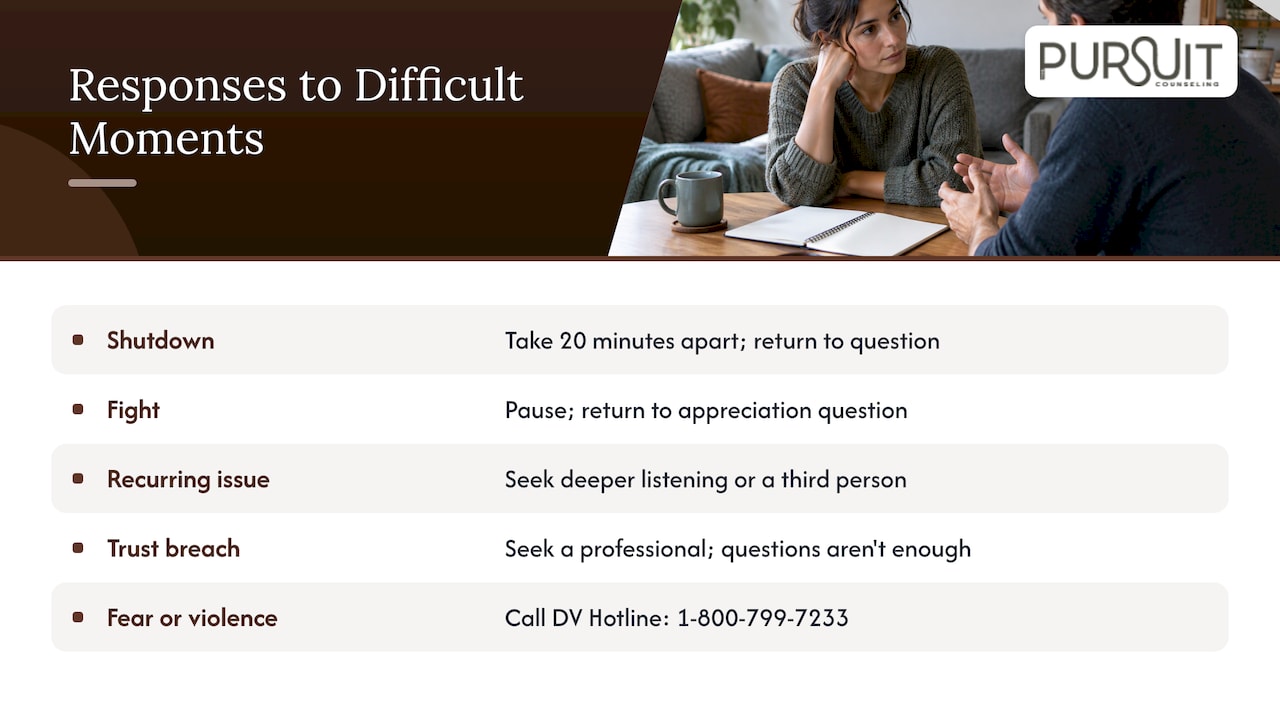
One of you shuts down. Silence is often overwhelm, not indifference. Agree on a signal for a break, take twenty minutes apart, and come back to the same question. Do not use the break to rehearse your rebuttal.
It turns into a fight. Stop, name it (“We’re getting loud, I want to pause”), and return to the appreciation question. You are not failing. You are practicing the part that matters, which is stopping before the damage.
One of you keeps raising the same issue. A concern that returns every week is not a check-in problem. It usually means something underneath has not been heard, or that the two of you need a third person in the room to slow the pattern down.
Trust has been broken. After an affair, a major financial secret or any serious breach, a weekly list of questions is not enough and can feel like pressure. This is the time for a professional, not a template. Our page on when repair attempts fail and what red flags to watch for explains what to look for.
There is fear, control or violence at home. A check-in is not appropriate if you are afraid of how your partner will react. Reach out to a licensed professional or the National Domestic Violence Hotline (1-800-799-7233) before attempting a structured conversation like this.
And a note on what this article is. It offers questions for conversation. It is education, not an assessment, and it cannot tell you whether your relationship is healthy, struggling or in danger. Only a conversation with a licensed clinician who knows you both can begin to do that.
Our Perspective
We work with people who are very good at pushing through. Pilots, founders, executives, parents who hold a household together. Many of them walk into our office with a relationship that has quietly become another task list. They are not careless. They are tired, and they have been solving problems in a way that works at work and fails at home.
What we see again and again is that couples do not need more questions. They need a conversation that is slow enough to hear the answers. The pain cave is real in a marriage too: the stretch where it is easier to go numb and keep moving than to say what is true. A check-in gives you a small, regular, low-stakes place to do the hard thing before it gets heavier.
We would add this. Some patterns do not move on a weekly 25-minute conversation, and that is no verdict on you. When the same cracks keep opening, a longer, guided block of time can do what ten Sunday check-ins cannot. That is why we offer couples intensives alongside regular sessions, and why we adapt the work to the two people in front of us rather than a script. We cannot promise an outcome. We can promise to take both of you seriously.
Adam Glendye LPC, CPCS
Working With a Couples Therapist
If your check-ins keep stalling, or you want a guide while you build the habit, we can help. We are in Fayetteville, Georgia, serving Peachtree City, Senoia, Tyrone, Brooks and the rest of South Atlanta, with in-person and online sessions.
It gives you room for the conversations that an ordinary hour leaves half finished. You can read what a couples intensive involves or see how to book a couples therapy intensive.

You can see everything we offer on our services and specialties page.
FAQ
How often should we do a relationship check-in?
Weekly suits most couples, because issues stay small and appreciation stays fresh. Keep each one to about 20 to 30 minutes. If weekly feels heavy, start every other week and add a longer monthly conversation for bigger topics like intimacy, money and long-term plans.
What is the difference between a check-in and a fight?
A check-in is planned, time-limited and takes turns. You choose the moment, start with appreciation, take up one concern and end with a small commitment. A fight is reactive and open-ended. If a check-in becomes heated, pause it, take a break and return to it later.
Who should bring up the idea of a marriage meeting?
Either of you can, but frame it as something you want for both of you, not a complaint. Something like: “I’d like us to have a regular time to talk about how we’re doing, before things pile up.” Offer a time, a short length and the first question so it feels easy to say yes.
What if my partner refuses to do check-ins?
Start smaller: one appreciation each, five minutes, no hard topics. Resistance often comes from past conversations that felt like criticism. If the refusal continues or you feel unable to raise anything at home, a couples therapist can help structure the conversation. Individual counseling is also an option.
Is a check-in the same as couples therapy?
No. A check-in is maintenance you do together at home. Couples therapy involves a licensed clinician who helps you understand patterns, repair injuries and practice new ways of relating. Many couples use both, with check-ins keeping the gains between sessions.
Sources
- Psychology Today: The Formula for a Successful Relationship Check-In
- Psychology Today: Simple Relationship Tool to Ease Conflict
- Utah State University Extension: 10 Relationship Checkup Questions
- The Knot: 20 Relationship Check-In Questions for Couples
- How to Unwind After Work: Calm Routines That Work