


The State of the Union is a weekly conversation of about an hour in which you and your partner review the relationship on purpose, instead of waiting for it to come up at 10:47 p.m. over the dishes. Dr. John Gottman’s research found that one hour a week spent on areas of concern changes how partners handle conflict. This guide covers the four parts, how to run each one, where capable people tend to go wrong, and when a weekly check-in is no longer enough.
This is education, not assessment. Reading it will not tell you what is wrong in your marriage, and it does not replace sitting with a clinician who can.
Key takeaways
- The meeting has four parts: appreciations, what went well, one issue worked through with the A.T.T.U.N.E. model, and a closing question about feeling loved.
- It is a work session, not a date. Keep it separate from your date nights, and keep the same time and place each week.
- The most common failure is jumping to solutions before your partner feels understood.
- The goal is not to end conflict. It is to handle conflict in a way that leaves you closer rather than further apart.
- If the meetings keep ending in contempt, shutdown or fear, that is information, and it is a good moment to bring in a therapist.
Table of Contents
- What the State of the Union meeting is
- Before you start: set the room
- The four parts of the meeting
- The A.T.T.U.N.E. model, in plain terms
- Where capable people get stuck
- A first meeting you can run this week
- Our perspective
- When a weekly meeting is not enough
- Working on this with us
- FAQ
- Sources
What the State of the Union meeting is
Gottman built the ritual around a plain observation: couples who do well are not the ones who never fight. They are the ones who have a regular, protected place to say what is bothering them before it hardens into resentment.
It is one piece of what the Gottman Institute describes as a six-hour weekly formula. The State of the Union takes one hour. The rest is made up of small daily habits and time together, such as date nights. That is a modest amount of time, roughly 5% of waking hours for someone sleeping eight hours a night.
The Institute also says the aim is not to eliminate conflict, which it treats as inevitable and necessary. The aim is to move away from the patterns Gottman calls disaster patterns (criticism, contempt, defensiveness, stonewalling) and toward attunement.
If you have been carrying a low hum of “we need to talk” for months, this structure may feel like relief. A fixed slot means the conversation has somewhere to live.
Before you start: set the room
The meeting works better when the logistics are boring and predictable.
- Same time, same place, every week. Gottman’s own guidance frames it as a standing ritual. That removes the dread of wondering when the hard talk will finally happen.
- Keep it apart from date night. Romance and problem-solving tend to spoil each other. Have the meeting, then do something easy afterward if you like.
- Phones away, kids asleep or elsewhere. Pilots on the road, executives with back-to-back calendars and parents in the thick of school pickups all need this protected on purpose, because it will not survive as an “if we get to it” item.
- Agree on a stop signal. If either of you is flooded (heart racing, jaw tight, unable to take in words), pause for at least twenty minutes and come back. Do not use the pause to rehearse your argument.
The four parts of the meeting
The structure below follows the Gottman Institute’s description. Plan on about an hour in total, though the third part is where most of the time goes.

1. Share five appreciations
Take turns naming five things your partner did this past week that you appreciated. Go past the task and name the trait behind it. “Thanks for picking up the dry cleaning” becomes “I appreciated how considerate you were when I ran out of time.”
This part feels awkward for people who spend their days finding problems. Do it anyway. It sets the tone for what follows, and it reminds both of you that you are on the same side of the table.
2. Talk about what went well
Next, name what is working in the relationship. Maybe you handled a stressful week as a team. Maybe you both kept a date night promise. Saying so out loud gives the effort you are both making some credit.
3. Work through one issue
Here you take turns bringing a concern from the past week or processing a regrettable incident. Pick one. Not the whole backlog.
The speaker uses a soft start: describes how they feel and what they need, without a verdict on the other person’s character. The listener’s only job is to understand. This is where the A.T.T.U.N.E. model comes in.
4. Ask what would help this week
Close by asking each other: “What can I do to make you feel loved this coming week?” Make the answers small and doable. “Text me when you land” is better than “be more present.”
The A.T.T.U.N.E. model, in plain terms
The Institute’s acronym stands for Awareness, Tolerance, Turning Toward, Understanding, Non-defensive listening, and Empathy. Here is how it looks in the room.
| Letter | What it asks of you | What it sounds like |
|---|---|---|
| Awareness | Notice your own state and your partner’s | “I think I’m tense. Give me a second.” |
| Tolerance | Accept that two accounts of the same event can both be real | “I didn’t see it that way, and I can hear that you did.” |
| Turning toward | Respond to your partner rather than away from them | Put the phone down and face them |
| Understanding | Ask until you can say what matters to them | “Tell me more about what that was like.” |
| Non-defensive listening | Hold your rebuttal | Let the sentence finish without a “but” |
| Empathy | Feel with them, not about them | “That would have worn me down too.” |
On turning toward, the numbers are worth knowing. In a six-year study of newlyweds, couples who stayed together turned toward their partner’s bids for connection 86% of the time, compared with 33% for those who later divorced. A bid can be as small as a sigh or as direct as a request for help. We wrote more about this in our guide to bids for connection.
Where capable people get stuck
Fixing too soon
This is the one we see most with high performers. You are used to hearing a problem and solving it in ninety seconds. At home, that reflex can land as dismissal.
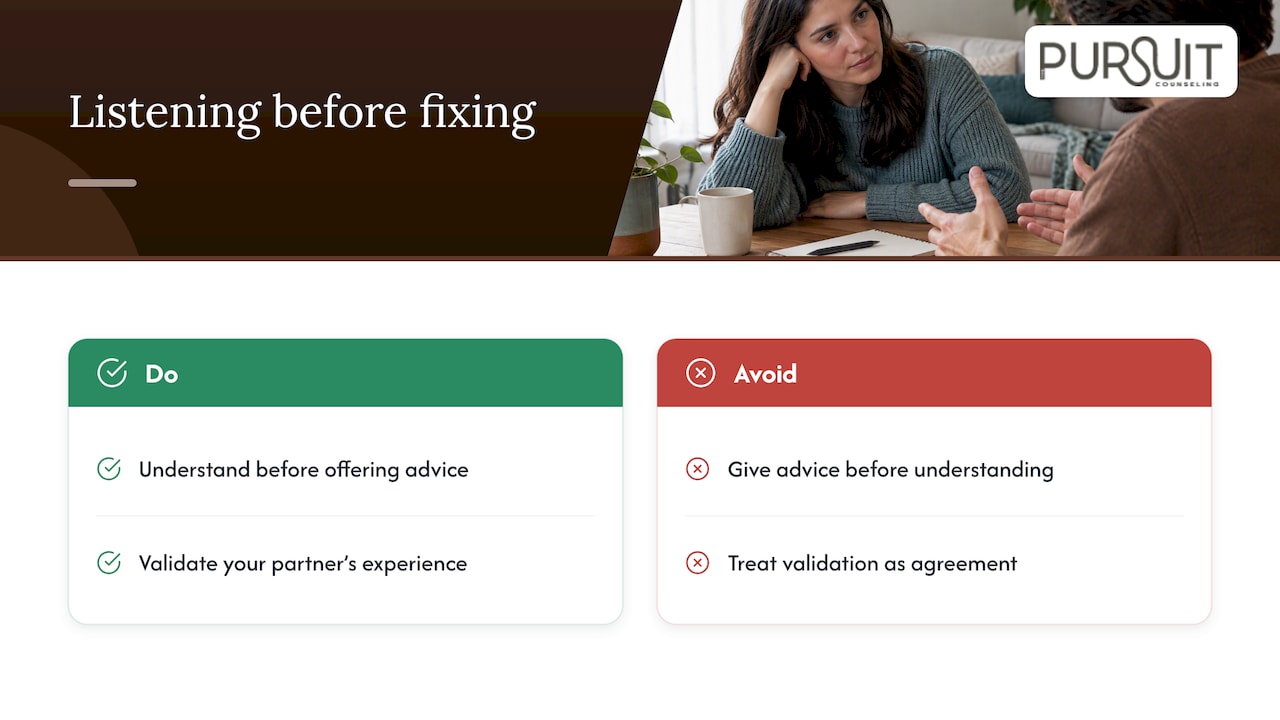
The Institute’s guidance is that understanding has to come before advice, and that validation is not agreement. You can think your partner’s read of the facts is off and still say, “I can see why that felt awful.” You are respecting their experience, not signing a statement.
A useful test: has your partner said some version of “yes, you get it”? If not, you are not ready for solutions.
Skipping to compromise
Gottman’s second stage of the meeting is about reaching a compromise, and it only works after both people feel understood. Start with each person’s core needs, then look for what you can both live with. Pushing for a deal while one of you is still hurt tends to produce a deal nobody keeps.
Turning it into a trial
If the meeting becomes a place to present evidence, people stop showing up honestly. Bring one issue, use “I” statements, and keep the appreciations real. When the first two parts feel fake, the third part usually goes badly.
Letting it slide
A missed week is not a failure. Three missed weeks usually means the meeting has become something one of you dreads. Say that out loud and adjust the format instead of quietly dropping it.

A first meeting you can run this week
- Pick a time and write it in both calendars. Sixty minutes, same slot each week.
- Open with five appreciations each. Be specific.
- Name two or three things that went well.
- Choose one issue only. Decide who goes first. The speaker has about five minutes. The listener reflects back what they heard until the speaker says it is accurate.
- Swap roles if the second person has something to raise.
- Close with the question about feeling loved this coming week. Write the answers down.
If an argument breaks out mid-meeting, that is a cue to slow down, not a sign you are doing it wrong. Our piece on repair attempts offers phrases you can use when things heat up.
Our perspective
We like this ritual because it is unglamorous. Most of the couples we meet are not in crisis because of one dramatic event. They are tired, and they have been managing each other like a shared calendar for a long time. A pilot gone four days a week, an executive who comes home with nothing left, a mom who has been the household’s project manager for a decade: each has a version of the same quiet problem. Nobody has had a protected hour to say how things really are.
The meeting does not fix that on its own, and we would not promise you it will. What it does is create a rhythm where hard things get said earlier and smaller. Some couples find it works with just a printed page and a kitchen table. Others find that every attempt falls apart in the same spot, and that spot is worth looking at with someone in the room. Neither is a failure. It is information about where the two of you need support.
What we watch for is the emotional accuracy of the conversation, not the format. Is the listener really inhabiting the other person’s experience, or waiting for their turn? Does the speaker feel heard enough to soften? Those moments matter more than whether you hit all four parts in order.
— Adam Glendye LPC, CPCS
When a weekly meeting is not enough
A structured check-in assumes two people who are both able to take part safely. It is not the right tool in every situation.
- Meetings repeatedly end in contempt, name-calling or one of you shutting down completely. A therapist can slow the pattern down and teach you to interrupt it.
- There has been an affair or a major breach of trust. The rebuilding that follows needs more than a weekly hour. Our page on infidelity recovery counseling describes how we approach it.
- One of you is afraid of the other. Do not use a self-help ritual here. Contact the National Domestic Violence Hotline at 1-800-799-7233 or reach a licensed professional directly.
- Past trauma, ADHD or anxiety keeps hijacking the conversation. The meeting may be fine. What is getting in the way may be something that needs its own treatment.
If you are not sure which category you are in, a consult is a reasonable next step. You do not need to be in crisis to ask.
Working on this with us
We offer couples therapy in Fayetteville, Georgia, and online, and we serve Peachtree City, Senoia, Brooks, Tyrone and the rest of South Atlanta. Our work with couples draws on Gottman-informed practice, and our page on Gottman therapy in Georgia explains what to expect.
For couples who cannot find a sustainable weekly hour, or who want to move through a lot in a short time, we run a Couples Intensive: a 3-hour session priced at ,500. You can read how that format works on our couples therapy intensive page. If you would rather start with a regular rhythm, you can see our couples counseling services and book a first session.
FAQ
What is the Gottman State of the Union?
It is a weekly one-hour conversation where partners share appreciations, review what went well, work through one concern, and ask what would help them feel loved in the coming week. Gottman designed it so small issues get addressed before they pile up.
What is the Gottman 6-hour rule?
It is the Gottman Institute’s observation that happy couples invest about six extra hours a week in the relationship. That includes small daily habits, date time and the one-hour State of the Union. It describes patterns in couples who do well, not a guarantee of any result.
What is the Gottman 777 rule?
It is a scheduling rhythm: a weekly date, a getaway every couple of months and a longer trip twice a year. The Institute notes that the quality of how you respond to each other’s bids matters more than the calendar itself.
Can we do a State of the Union without a therapist?
Many couples do, using the four parts above. If the meetings keep ending in contempt, shutdown or fear, or if one of you does not feel safe, bring in a licensed couples therapist rather than pushing through alone.
Sources
- 6 Hours a Week to a Better Relationship, Gottman Institute
- How to Have a State of the Union Meeting, Gottman Institute
- State of the Union Meetings Will Strengthen Your Relationship, Gottman Institute
- The 777 Rule for Marriage, Gottman Institute
- Understanding Must Precede Advice, Gottman Institute
- Stop Trying to Fix Your Partner’s Feelings, Gottman Institute
- Reaching a Compromise: The Second Part of the State of the Union Meeting, Gottman Institute
- National Domestic Violence Hotline