


A couples therapy intensive is a condensed, clinician-led multi-day program that can produce measurable relationship movement in days rather than months. If you and your partner are stuck in the same painful loop, recovering from betrayal, or simply can’t carve out an hour every week for the next year, an intensive may be the most direct path forward. The short version: most couples dealing with infidelity, entrenched conflict, or emotional distance are good candidates. The Pursuit Counseling offers a Couples Intensive program with evidence-based modalities including Gottman Method, EMDR, and neurofeedback for couples in Georgia and online.
Quick fit signals:
- You need movement now, not in six months of weekly sessions
- One or both partners travel frequently or have unpredictable schedules
- You’re recovering from infidelity and need structured, safe space to begin rebuilding trust
- You’ve tried weekly therapy before and stalled out
Contraindications to know upfront:
- Active substance abuse that is untreated
- Active intimate partner violence or safety concerns
- One partner is unwilling to engage or has a hidden agenda
The rest of this guide covers exactly what happens inside an intensive, what it costs, how to prepare, and what questions to ask before you book.
Pro Tip: If you’re unsure whether an intensive or discernment counseling fits better, schedule a 20-minute consultation call first. A good clinician will tell you honestly which path makes sense.
Table of Contents
- What is a couples therapy intensive, and how does it differ from weekly therapy?
- Who benefits most from a couples therapy intensive?
- What do typical formats and session schedules look like?
- What actually happens during an intensive, and what outcomes can you expect?
- What does a couples intensive cost, and what logistics should you plan for?
- How should you prepare before your intensive begins?
- How do you choose the right intensive program and clinician?
- What does the research say about how effective intensives actually are?
- Key Takeaways
- Why intensives deserve more honest conversation than they usually get
- The Pursuit Counseling’s Couples Intensive is built for couples who are ready to move
- Useful sources and further reading
What is a couples therapy intensive, and how does it differ from weekly therapy?
A couples therapy intensive is a private, clinician-led program where one couple works with a therapist across multiple consecutive hours or days, rather than one 50-minute session per week. The format is clinical and individualized. There is no group curriculum, no other couples in the room, and no generic workshop content. As The Therapy Group describes it, an intensive focuses exclusively on the couple and a clinician, unlike retreats which are group-oriented.
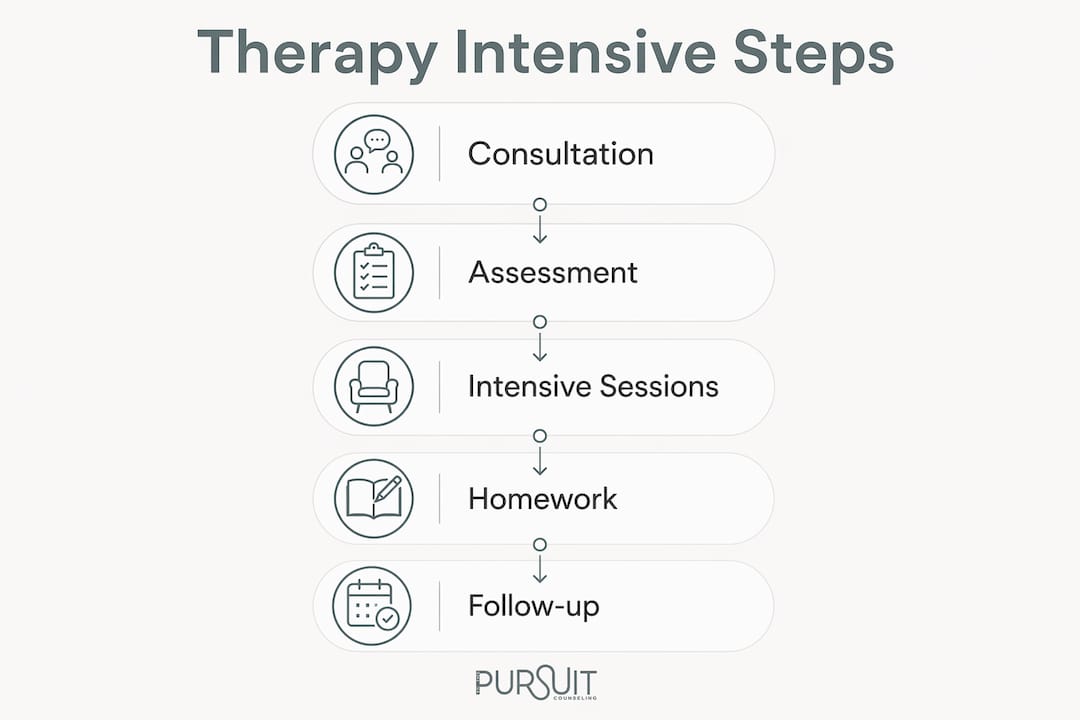
The clinical rationale is straightforward. Weekly therapy spends a meaningful portion of each session on re-establishing context: what happened since last week, where we left off, what’s urgent today. An intensive removes that overhead entirely. The Gottman Institute’s Marathon format compresses diagnostic and therapeutic work across one to three days specifically to maintain emotional momentum and reach conflict cycles faster. You don’t lose the thread between sessions because there is no gap.
The difference from a retreat matters too. A relationship therapy retreat is typically a group experience, often structured around workshops, keynote-style content, and shared exercises with other couples. An intensive is a private clinical engagement. Think of it as the difference between attending a seminar and hiring a specialist.
How the formats compare:
- Weekly therapy: 50 minutes per week, slow build, good for maintenance and mild-to-moderate distress
- Couples intensive: 4–8 hours per day across 1–4 days, sustained focus, designed for acute distress or accelerated progress
- Relationship retreat: Group workshop format, educational content, less individualized clinical depth
Who benefits most from a couples therapy intensive?
Most couples who choose an intensive aren’t in a casual rough patch. They’re in the kind of pain that makes waiting another six months feel impossible. Common situations that bring couples to intensives include infidelity and trust repair, recurring conflict cycles that haven’t responded to weekly therapy, emotional distance or disconnection, premarital concerns, and relationship gridlock around major life decisions.

Busy professionals and executives are another strong fit. If your schedule makes weekly appointments nearly impossible to protect, a concentrated two or three-day block is often more realistic than 40 weekly sessions spread across a year. The executive therapy approach at The Pursuit Counseling is built around exactly this reality.
Situations that are typically a strong fit:
- Recovering from infidelity or a significant betrayal
- Repeated conflict cycles that feel unsolvable
- Emotional shutdown or chronic disconnection
- Impending major decisions (divorce, relocation, family changes)
- Scheduling constraints that make weekly therapy impractical
Situations where an intensive may not be appropriate:
- Active, untreated addiction in either partner
- Active domestic violence or safety concerns
- One partner is attending under pressure with no genuine willingness to engage
- Significant individual mental health crises requiring stabilization first
Providers consistently note that when partners have mixed agendas or active safety risks, alternatives like discernment counseling or individual therapy are the better starting point.
Pro Tip: Discernment counseling is designed for couples where one partner is leaning out of the relationship. If you’re not sure you both want to stay together, start there before committing to an intensive.
What do typical formats and session schedules look like?
Intensives come in several configurations, and the right length depends on the complexity of what you’re working through.
| Format | Duration | Best fit |
|---|---|---|
| Single-day | 6–8 hours | Specific issue, tune-up, or premarital focus |
| Weekend | 2 days | Moderate distress, conflict cycles, reconnection |
| 3-day | 18–24 hours total | Infidelity recovery, entrenched patterns |
| Marathon (4–5 day) | 30–40 hours total | Deep trauma, severe disconnection, last-resort work |
The Center for Relationships describes a common structure: a 2-hour assessment and consultation first, followed by one or two intensive days of 6 hours each, and a 60-minute follow-up session at the six-week mark. That’s a useful baseline to compare against any program you’re evaluating.
Sample 2-day intensive itinerary:
- Day 1, Morning (9 AM–12 PM): Joint session, relationship history, identifying core conflict cycles, assessment debrief
- Day 1, Afternoon (1 PM–4 PM): Individual sessions with each partner, attachment exploration, emotional processing
- Day 1, Evening: Integration break, assigned reflection exercises
- Day 2, Morning (9 AM–12 PM): Joint session, repair work, new interaction scripts, skill practice
- Day 2, Afternoon (1 PM–3 PM): Joint session, forward planning, post-intensive roadmap, follow-up scheduling
Some programs, like Hope Restored, extend to 3–5 days and include structured aftercare and ongoing coaching support. The length you choose should match the depth of the work, not just your schedule availability.
What actually happens during an intensive, and what outcomes can you expect?
Inside a well-run intensive, the clinical work moves fast. There’s no five-minute check-in, no catching up from last week. Practitioners note that intensives bypass repeated session recap time and keep emotional momentum for deeper work. That sustained focus is the mechanism behind the speed.
Common therapeutic approaches used during intensives include:
- Emotionally Focused Therapy (EFT): Identifying attachment patterns and restructuring emotional responses between partners. A solid overview of EFT for couples explains the core framework.
- Gottman Method: Structured assessment, conflict management skills, and rebuilding friendship and trust
- EMDR: Targeted trauma processing when past wounds are driving current relationship patterns. The Pursuit Counseling integrates EMDR therapy when indicated
- Relational Life Therapy (RLT): Direct feedback on relational dynamics and accountability work
The emotional experience is real and sometimes uncomfortable. Clinicians are clear that couples should expect fear, sadness, anxiety, or other heightened emotions during an intensive. These responses are expected and managed within a therapist-led safety framework. You’re not left to process alone. The therapist is present to hold the space, slow things down when needed, and guide repair in real time.
Typical outcomes after a well-executed intensive include:
- Naming and interrupting the core conflict cycle
- Beginning trust repair with a structured framework
- New communication patterns and interaction scripts
- A concrete post-intensive plan with follow-up sessions or referral to ongoing weekly therapy
The work doesn’t end when the intensive does. Most programs build in follow-up sessions, homework assignments, and communication exercises to consolidate what was gained. Without that follow-through, the momentum fades.
What does a couples intensive cost, and what logistics should you plan for?
Cost varies significantly by program length, clinician credentials, and location. Published examples give a useful range: the Gottman Institute’s Marathon program cites four-day programs at ,000–,000, while a 3-day intensive example from the same source is listed at ,300. The Center for Relationships publishes a one-day intensive at ,500 and a two-day intensive at ,900–,900 depending on the clinician. These figures reflect private-pay rates; most intensives are not covered by insurance.
Scheduling and travel considerations:
- In-person intensives require travel and lodging if the provider isn’t local; budget for 2–4 nights depending on format
- Virtual intensives are available from many providers, including The Pursuit Counseling, and eliminate travel cost entirely
- Block your calendars completely for the intensive days and at least one recovery day after
Privacy and format:
- All reputable intensives are private, one-on-one clinical engagements. You will not be in a room with other couples.
- Sessions are typically private-pay; some providers offer superbills for out-of-network reimbursement, but coverage is not guaranteed
Questions to ask before you book:
- What is the total fee, and what does it include?
- What is the cancellation and rescheduling policy?
- Is a deposit required, and is it refundable?
- What happens if we need to reschedule after the deposit is paid?
- Is a virtual option available if travel becomes impossible?
Pro Tip: Ask for the cancellation policy in writing before you pay any deposit. Reputable programs will give it to you without hesitation.
How should you prepare before your intensive begins?
Arriving prepared makes a real difference. The clinical work moves quickly, and couples who show up having done their pre-work get more out of every hour.
Pre-intake steps:
- Complete all intake paperwork and relationship history forms before your first session
- Participate honestly in any safety screening your provider requires
- Sign any commitment or confidentiality agreements your clinician sends in advance
- Review any pre-reading or assessment results your therapist shares
Practical logistics:
- Prioritize sleep in the days before the intensive; emotional processing is harder when you’re depleted
- If attending virtually, test your technology setup at least 24 hours in advance: camera, microphone, stable internet, and a private space
- Arrange childcare and work coverage for the full duration plus a buffer day
- Plan simple meals and limit alcohol in the days surrounding the intensive
Communication and goal-setting before you arrive:
- Agree on two or three shared goals you both want to work toward
- Identify topics that feel non-negotiable versus topics you’re willing to explore
- Discuss any personal limits or sensitivities your therapist should know about upfront
Pro Tip: Write down your goals individually before comparing them with your partner. The gaps between your lists are often exactly where the most important work lives.

How do you choose the right intensive program and clinician?
Not all intensives are built the same. The clinician’s training, the program’s structure, and the follow-up plan matter as much as the format length.
What to evaluate:
- Credentials: Look for a licensed clinician (LMFT, LPC, LCSW, or PhD) with specific training in couples work and at least one evidence-based modality (Gottman, EFT, EMDR, RLT)
- Program structure: Is there a clinical intake before the intensive? Are individual and joint sessions both included?
- Follow-up plan: What happens after the intensive ends? Is a follow-up session included or available?
- Location and availability: In-person in your area, or virtual? What are the scheduling lead times?
Questions to ask on a consultation call:
- What modalities do you use, and how do you decide which approach fits our situation?
- Have you worked with couples recovering from infidelity specifically?
- How do you handle safety concerns or emotional crises that arise during the intensive?
- What does your cancellation and rescheduling policy look like?
- What follow-up support do you offer after the intensive ends?
Red flags to watch for:
- No clinical intake or screening before the intensive begins
- Pressure to sign or pay before any consultation
- Blanket guarantees about outcomes (“we’ll save your marriage”)
- No clear safety planning or crisis protocol
- Vague or nonexistent follow-up plan
The Pursuit Counseling’s Couples Intensive includes a pre-intensive consultation, evidence-based modalities (Gottman Method, EMDR, neurofeedback where indicated), and a post-intensive follow-up plan. Both in-person (Georgia) and online options are available.
What does the research say about how effective intensives actually are?
The clinical case for concentrated formats is grounded in how emotional processing actually works. The Gottman Institute’s Marathon format was developed specifically because sustained therapeutic contact accelerates the identification and shifting of conflict cycles. The mechanism isn’t magic; it’s momentum. When couples stay in the emotional experience long enough, patterns become visible and workable in ways that weekly sessions rarely allow.
Practitioners also emphasize that success depends heavily on the couple’s commitment to the process and their willingness to accept direct feedback. Readiness to engage, not the severity of the problem, is the strongest predictor of productive intensive work.
What the evidence and clinical experience support:
- Concentrated formats reduce the time lost to session warm-up and re-establishing context
- Emotional momentum builds across consecutive hours, allowing deeper access to attachment wounds
- Couples who complete intensives with a structured follow-up plan tend to consolidate gains more effectively than those without one
Limitations and risks to know:
- Intensives are not appropriate for active addiction, active intimate partner violence, or severe individual psychiatric crises
- The emotional intensity can temporarily increase distress before it decreases; this is clinically normal but requires skilled management
- Without post-intensive follow-up, gains can erode
The therapy intensives explained resource from The Pursuit Counseling walks through the clinical rationale in more depth if you want to go further.
Key Takeaways
A couples therapy intensive works because it removes the weekly warm-up overhead, sustains emotional momentum across consecutive hours, and pairs that depth with a structured post-intensive follow-up plan.
| Point | Details |
|---|---|
| Intensives accelerate progress | Concentrated formats eliminate session recap time and maintain emotional momentum for deeper clinical work. |
| Strong fit situations | Infidelity recovery, entrenched conflict cycles, emotional disconnection, and scheduling constraints are the most common reasons couples choose intensives. |
| Cost range varies widely | Published examples range from ,500 for a single day to ,000–,000 for a four-day Marathon program; most are private-pay. |
| Preparation matters | Completing intake paperwork, arranging logistics, and agreeing on shared goals before arrival significantly improves outcomes. |
| The Pursuit Counseling option | The Pursuit Counseling’s Couples Intensive offers Gottman, EMDR, and neurofeedback modalities in Georgia and online, with a pre-intensive consultation and post-intensive follow-up plan. |
Why intensives deserve more honest conversation than they usually get
There’s a version of the intensives conversation that oversells the format as a relationship rescue mission, and that framing does couples a disservice. An intensive is not a reset button. It’s an accelerant. What it accelerates is the clinical work, and that work still requires two people willing to be honest, uncomfortable, and open to changing how they show up.
What I’ve seen clinically is that the couples who get the most from an intensive are rarely the ones in the worst shape. They’re the ones who arrive with the clearest commitment to the process, even when they’re terrified of what they’ll find. The pain is real. The cracks in the relationship are real. But the willingness to stay in the room, to hear hard feedback, and to try something different is what actually moves the needle.
The other thing worth saying plainly: the follow-up matters as much as the intensive itself. Couples who walk out of a three-day intensive and return to the same environment, the same patterns, and no structured support often find the gains fade within weeks. The intensive opens the door. What you do after determines whether you walk through it.
For couples in Florida and across the Southeast, the combination of in-person depth work and online follow-up sessions makes it possible to do the intensive in a focused block and maintain momentum from home. That’s the model worth looking for.
The Pursuit Counseling’s Couples Intensive is built for couples who are ready to move
Most couples who reach out to The Pursuit Counseling have already tried the slow route. They’ve done the weekly sessions, read the books, and had the same argument enough times to recite each other’s lines. What they need isn’t more time. They need concentrated, skilled clinical work with a clear path forward.
The Pursuit Counseling’s Couples Intensive program draws on Gottman Method, EMDR, and neurofeedback to address both the relational patterns and the underlying neurological responses that keep couples stuck. Sessions are private, clinician-led, and structured around your specific situation, not a generic curriculum. In-person sessions are available in Georgia; online intensives are available for couples across Florida and beyond.
The process starts with a pre-intensive consultation to confirm fit, complete intake screening, and build your session plan. From there, scheduling, onboarding forms, and logistics are handled directly. If you’re ready to stop circling the same pain and start doing something about it, schedule your consultation today.
Useful sources and further reading
- Gottman Institute: Marathon Couples Therapy — Clinical rationale and format description for the Marathon intensive model
- The Therapy Group: Intensive Couples Therapy — Overview of the private, one-on-one intensive format and provider workflow
- The Marriage Intensive — Common use cases and issues addressed in couples intensives
- Center for Relationships: Intensive Couple Therapy — Sample itinerary, pricing structure, and contraindications
- Mallin Counseling: Marriage Intensives — Contraindications and alternative recommendations
- McNulty Counseling: Couples Weekend Intensive — Emotional expectations and safety planning guidance
- Hope Restored (Focus on the Family) — 3–5 day intensive model with aftercare and coaching support
- California Couples Counseling: Therapy Intensives — Clinical efficiency mechanism and practitioner observations
- The Pursuit Counseling: Couples Intensive — Program details, modalities, and booking
- The Pursuit Counseling: Infidelity Recovery Counseling — Clinical approach to affair recovery within an intensive framework
- The Pursuit Counseling: Therapy Intensives Explained — Background on why concentrated healing formats are gaining traction
This article is general information, not professional advice. For guidance specific to your relationship and situation, consult a licensed mental health professional.
Recommended
- Couples Intensive – The Pursuit Counseling
- Therapy Intensives Explained: Why More People Are Choosing Concentrated Healing Over Staying Stuck – The Pursuit Counseling
- Couples and Relationship Counseling Services – The Pursuit Counseling
- The 3 Toxic Relationship Patterns You Keep Repeating | The Pursuit Counseling