


A Gottman repair attempt is any short statement or action meant to stop escalation and reconnect during a disagreement. It can be a joke, a touch on the arm, or a simple “can we start over?” Couples who make these small moves, and accept them from their partner, weather conflict without letting it curdle into contempt. The fix is rarely dramatic. It’s a pause, a phrase, a little willingness to soften.
TL;DR:
- Frequent, small repair attempts are more effective than rare, perfect ones, especially given that couples are only emotionally available to each other about 9% of the time during interactions.
- Building a personalized repair checklist with phrases like “I need a minute” or “What part of this can we agree on?” prepares couples to diffuse tension quickly and effectively during conflicts.
- Nonverbal repair efforts, such as a genuine smile or a comforting touch, can work just as well as verbal phrases, especially when the emotional climate is conducive.
- Repair attempts are more successful when couples have established a foundation of friendship and positive interactions, which act as an emotional buffer during disagreements.
- When repair efforts repeatedly fail, especially with patterns like criticism or stonewalling, seeking outside help through couples therapy or intensives is recommended.
Table of Contents
- What Counts as a Repair Attempt in Gottman Couples Therapy?
- Why Repair Attempts Work (and Why They’re Not Optional)
- How to Build and Use Your Own Gottman Repair Checklist
- Real Examples of Repair Attempts You Can Try Tonight
- Getting the Timing and Rhythm of Repair Right
- When Repair Attempts Fail: Red Flags to Watch For
- Exercises That Turn Repair Into a Habit
- A Therapist’s Take on Practicing Repair
- Ready to Practice Repair With Support Instead of Guesswork?
- Sources
- FAQ
What Counts as a Repair Attempt in Gottman Couples Therapy?
John Gottman defines it plainly: a repair attempt is any statement or action, verbal, physical, or otherwise, intended to diffuse negativity and prevent conflict from escalating out of control. That definition is wider than most people expect. A repair attempt doesn’t have to sound like an apology. It can be a raised eyebrow, a hand offered across the couch, or a request to slow down before things spiral.
Repair attempts generally take three shapes. Verbal ones include phrases like “I’m getting defensive, help me out here.” Nonverbal ones include a touch, a look, or even walking to the kitchen to get your partner water mid argument. Behavioral ones are planned pauses, like agreeing beforehand to take a break when voices rise.
The Gottman Institute organizes these into a practical framework: the Gottman Repair Checklist, sorted into categories couples can pre-select from together. The main groups include:
- I feel statements that name emotion without blame (“I feel scared right now”)
- Sorry language that owns a piece of the problem, even a small one
- Get to yes phrases that search for common ground instead of “winning”
- Stop action signals that call a pause before things get worse
Knowing these categories exist is the first step. Using them on purpose, before you need them, is what actually changes how a fight ends.
Why Repair Attempts Work (and Why They’re Not Optional)
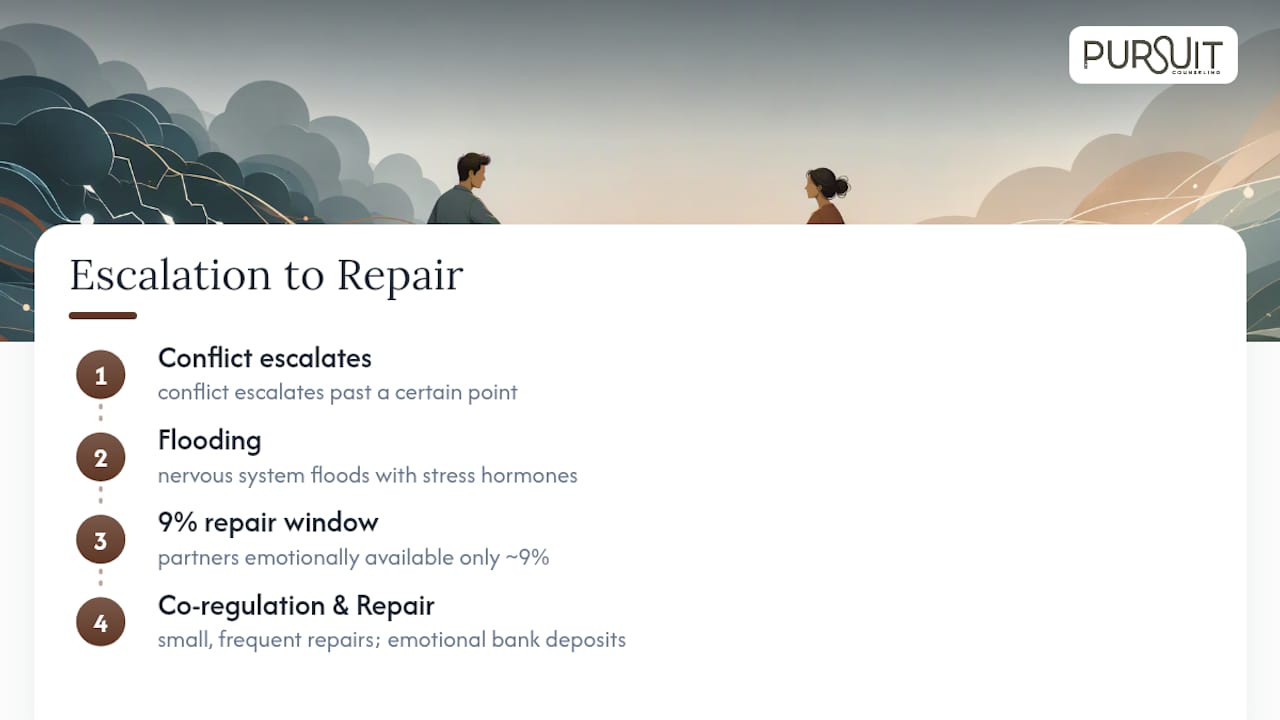
Here’s the finding that reframes everything: Gottman’s research shows partners are emotionally available to each other only about 9% of the time during a given interaction. That’s a narrow window. It means most attempts at connection, repair included, happen in a climate that isn’t naturally primed for warmth.
The 9% window: If emotional availability between partners is that limited, waiting for the “right moment” to repair a fight is a losing strategy. Small, frequent repairs beat rare, perfect ones.
That statistic explains why couples who repair well don’t wait for grand gestures. Frequency matters more than eloquence.
Repairs also don’t happen in a vacuum. Gottman’s practice guidance is direct: repairs succeed more often when couples already have a foundation of friendship, appreciation, and frequent positive interactions. Think of it as an emotional bank account. Couples who bank small deposits, compliments, curiosity, physical affection, can make withdrawals during conflict without going broke. Couples running a deficit find that even a good repair attempt bounces.
There’s a physiological layer too. When conflict escalates past a certain point, the body enters what Gottman calls flooding, a state where the nervous system floods with stress hormones and rational thought becomes difficult. Peer-reviewed research on relationship functioning backs this up, showing that effective conflict regulation depends on co-regulation, soft startups, and repair behaviors that calm the nervous system before logic can return. That’s why a repair attempt made ten seconds too late often lands flat. It’s not that the words were wrong. The body wasn’t ready to hear them.
How to Build and Use Your Own Gottman Repair Checklist
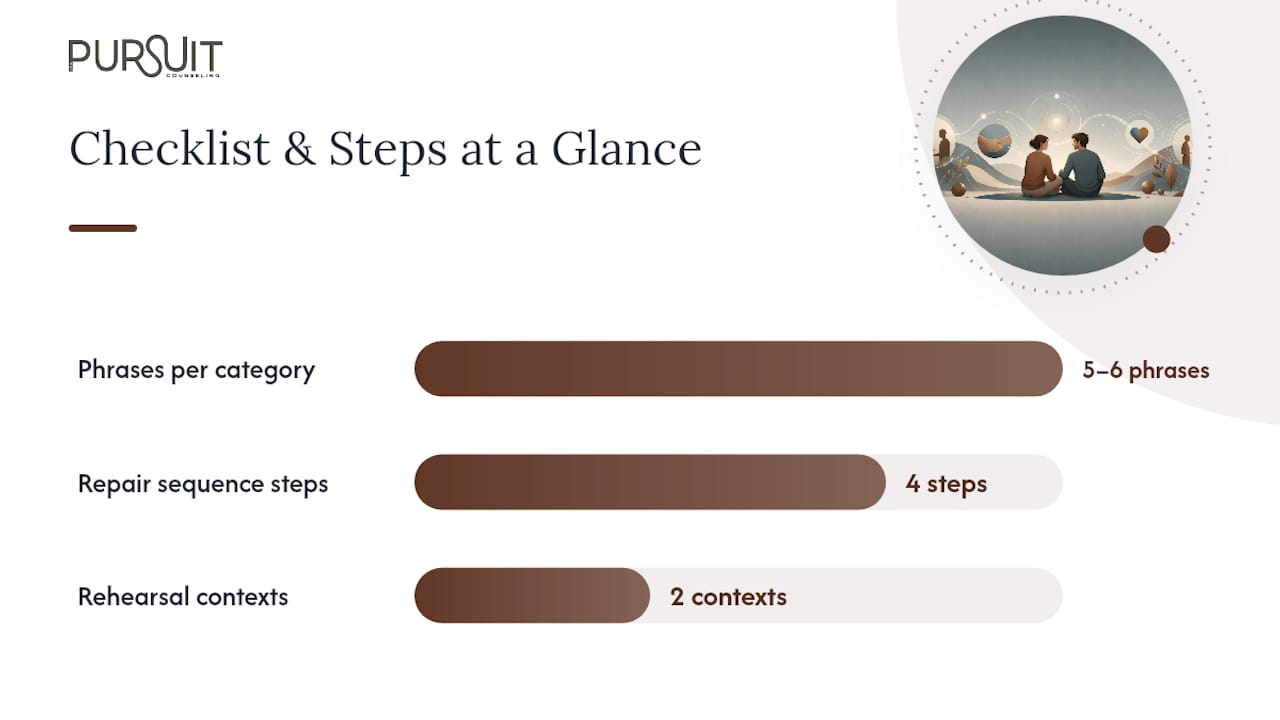
The checklist works best when it’s personalized, not memorized from a worksheet. Sit down together during a calm moment, not mid-argument, and pick five or six phrases from each category that actually sound like you. “I need a minute” might work for one partner; another might prefer “Can we try that again?” There’s no universal script. There’s only the one you’ll both actually use.
Once you’ve built your shortlist, the sequence during real conflict looks like this:
- Notice the shift. One of you feels the tone sharpen, a voice rise, or a wall going up.
- Attempt the repair. Use a pre-agreed phrase or gesture rather than improvising under stress.
- Watch the receiver’s response. A genuine repair attempt needs someone willing to receive it, not deflect it.
- Return to the issue, calmer. Once the temperature drops, come back to what actually needs solving.
A few dos and don’ts make this land better. Don’t say “calm down.” It rarely works and often reads as condescension dressed as concern. Do lead with reassurance before explanation. Trying to justify yourself before your partner feels heard tends to backfire, because they’re still bracing for the fight, not evaluating your logic. Practicing scripts during low-stakes moments, not just real fights, reduces the odds of flooding and improves acceptance later, because the phrase already feels familiar instead of foreign.
Pro Tip: Rehearse your checklist during a boring car ride or a quiet dinner, not during an actual disagreement. A repair phrase you’ve said out loud before feels far less awkward when you need it under pressure.
For more on softening how conflict starts in the first place, see how to communicate effectively during disagreements.
Real Examples of Repair Attempts You Can Try Tonight
Here’s what the checklist categories sound like in an actual living room, not a therapy worksheet.
- I feel: “I feel unheard right now, and I don’t want to shut down.”
- Sorry: “I raised my voice. That wasn’t fair to you.”
- Get to yes: “What part of this can we agree on right now?”
- Stop action: “I need five minutes, and then I’ll come back.”
Nonverbal repairs count just as much. A silly grin in the middle of a tense moment can defuse more than a paragraph of explanation. Gottman’s own research notes that repair attempts can be clumsy or beautiful, delivery matters less than the relational climate around it, which means a “big, stupid grin” genuinely works in a couple with a healthy emotional bank account. Leaving the room to cool off, then returning with a hand on your partner’s back, is a repair attempt with zero words attached.
Test these in low-stakes moments first, a disagreement about dishes or plans, before trusting them in a high-heat fight. That’s how a phrase moves from awkward to automatic.
Getting the Timing and Rhythm of Repair Right
Not every couple repairs on the same clock, and that mismatch causes almost as much friction as the original fight. Gottman’s practitioner insight is straightforward: couples often have different repair rhythms, one partner wants to reconnect immediately, the other needs space first, and neither instinct is wrong on its own.
- Agree in advance on a timeout signal, a word or gesture that means “I need space, not silence.”
- Set a maximum timeout length, twenty minutes, an hour, so the pause doesn’t get mistaken for stonewalling.
- Make a re-contact plan: who initiates the return, and roughly when.
- Use the “three tries” rule: if you’ve offered three genuine repair attempts and none landed, stop repeating yourself and consider outside support instead.
Immediate repair keeps momentum but risks re-escalation if either person is still flooded. Delayed repair lowers that risk but only works if both partners trust the other will actually come back.
When Repair Attempts Fail: Red Flags to Watch For
Some patterns predict that repair attempts won’t work, no matter how well-phrased they are. Chronic imbalance is one: if one partner is always the one initiating repair, that pattern predicts erosion of relationship health over time, because repair requires a willing receiver, not just a willing initiator.
- Repeated eye-rolling, sarcasm, or dismissiveness in response to a genuine attempt
- One partner consistently stonewalling instead of engaging, even briefly
- Criticism or contempt (two of Gottman’s Four Horsemen) showing up faster than repair attempts can counter them
- The same unresolved issue resurfacing fight after fight with no real movement
Pro Tip: If your three genuine repair attempts in a row get rejected, that’s not a sign to try harder alone. It’s a sign the pattern needs a third party who can slow the process down enough to see what’s actually happening.
When repair repeatedly fails despite good faith effort, that’s usually the point to consider structured couples therapy or a more concentrated format like a couples intensive.
Exercises That Turn Repair Into a Habit
Repair attempts improve with repetition, the same way any skill does. Two exercises from the Gottman Method give couples structured practice outside the heat of an actual fight.
- Aftermath of a Fight debrief. After things have cooled, sit down and walk through what happened without re-litigating who was right. Ask: What was I feeling? What triggered it? What could I have done differently? What do I need from you now?
- Weekly State of the Union. A scheduled, low-stakes check-in, once a week, where you name what’s working and what’s straining, before small issues calcify into big ones.
- Role-play scripts. Pick two or three checklist phrases and practice saying them out loud together, even about a fake disagreement, so the words feel familiar under real pressure.
The Gottman Method includes structured interventions like these precisely because repair skills, like any skill, fade without practice.
Couples don’t fail because they never learned to fight. They struggle because no one ever taught them how to come back together afterward.
When these exercises feel too hard to do alone, or old wounds keep resurfacing mid-repair, that’s usually when clinician support, whether ongoing couples sessions or a couples therapy intensive, makes the difference between insight and actual change.
A Therapist’s Take on Practicing Repair
Good repairs aren’t graceful. They’re clumsy, half-finished, sometimes a little late, and they work anyway when both partners keep showing up for them. Consistency beats polish every time. Couples ready to practice this with real guidance can explore couples therapy or a couples intensive for concentrated, hands-on work.
— Adam Glendye LPC, CPCS
Ready to Practice Repair With Support Instead of Guesswork?
Reading about repair attempts is useful. Practicing them with a therapist watching your real patterns, not a hypothetical script, is what actually changes how you fight. The Pursuit Counseling builds sessions around your specific relationship rhythm rather than a generic worksheet, whether that means weekly couples therapy sessions to build the habit gradually or a concentrated couples intensive when you need faster traction before old patterns calcify further.

Both formats are available in person from the Fayetteville, Georgia office and online, so distance or a packed schedule doesn’t have to delay the work. If your repair attempts keep landing flat and you’re ready for a therapist to help you both figure out why, book a couples therapy consultation and start practicing with real feedback instead of another round of guessing.
Sources
- How to Make Repair Attempts So Your Partner Feels Loved
- NCBI — relevant peer-reviewed research on relationship functioning and repair dynamics
FAQ
What does the Gottman 7-7-7 rule recommend for couples?
The 7-7-7 rule isn’t a core Gottman Institute concept; it’s a popularized shorthand for scheduling regular check-ins. The Gottman Institute’s own structured version of this idea is the weekly State of the Union meeting, which serves a similar purpose with clearer, therapist-tested steps.
What are the red flags of the Gottman method?
The clearest red flags are the Four Horsemen: criticism, contempt, defensiveness, and stonewalling, especially when they show up faster than either partner can offer a repair attempt. Chronic one-sided repair, where only one person ever initiates reconnection, is another warning sign worth taking seriously.
What is the 3-3-3 rule for marriage?
Like the 7-7-7 rule, the 3-3-3 rule is an informal concept, not an official Gottman Institute framework, and definitions vary depending on the source. What is well documented is the “three tries” heuristic used in repair practice: if several genuine repair attempts in a row get rejected, that’s a signal to pause and consider outside support rather than repeat the same attempt again.
How do I use the Gottman Repair Checklist?
Sit down with your partner during a calm moment and choose five or six phrases from each checklist category, I feel, sorry, get to yes, and stop action, that feel natural to say out loud. Practice them in low-stakes disagreements first, then use them mid-conflict once the phrases feel familiar rather than forced.
What does couples therapy at The Pursuit Counseling cost?
Current pricing for couples therapy and couples intensives is available directly on The Pursuit Counseling’s website, since costs depend on session format and length. Both in-person and online options are offered for couples in and around Fayetteville, Georgia.