


Rituals of connection are repeated, shared acts that carry symbolic meaning and that both partners protect on purpose. The most useful prescription we know is to pair short daily micro-rituals with one deeper weekly check-in, the rhythm behind the Gottman six-hours-a-week approach. We offer couples counseling for people who want clinical support while they build it.
Key Takeaways
Pairing daily micro-rituals with weekly check-ins significantly enhances relationship satisfaction by fostering deliberate, meaningful connection routines.
| Point | Details |
|---|---|
| Start with one ritual | Choose one daily and one weekly ritual, set a concrete time, and name its meaning to build consistency. |
| Build shared meaning | Ensure each ritual has a clear significance for both partners to transform habits into meaningful connections. |
| Protect rituals easily | Use reminders, calendar blocks, or cues related to daily routines to maintain rituals even during busy times. |
| Use personalized rituals | Tailor rituals to your relationship’s needs, schedules, and cultural background for lasting impact. |
| Seek professional support when needed | Couples counseling can help design and reinforce rituals, with options like intensive sessions for focused growth. |
Table of Contents
- 1. Which rituals of connection can you start this week?
- 2. What does the research say about why rituals work?
- 3. How do you build a ritual that actually lasts?
- 4. What do you do when rituals keep falling apart?
- 5. How do rituals of connection support your own mental health?
- 6. Can rituals help with trauma recovery and anxiety?
- 7. What do rituals look like for friends, family and couples?
- 8. How can personalized rituals support therapy and neurofeedback?
- 9. How should you adapt rituals during life transitions or crises?
- 10. How do culture and background shape rituals of connection?
- 11. Why we believe rituals matter more than most couples realize
- 12. How we help couples make rituals stick
- FAQ
- Sources
1. Which rituals of connection can you start this week?
Think of this as a menu, not a mandate. Pick one daily ritual and one weekly ritual, and leave the rest for later. Each entry below notes what it signals, what it costs in time, and how to keep it from fading.
- A lingering kiss. It says “I’m glad you’re here” without a single word. Keep it brief enough to feel easy to repeat, and tie it to a moment that already happens, such as one of you walking through the door. Tie it to a moment that already happens, such as one of you walking through the door.
- An undistracted check-in. Phones down, eyes up, one question: “How was today, really?” It signals that your partner outranks the screen. Set it right after you both get home, before anyone starts on dinner or email.
- A daily appreciation. Name one specific thing your partner did and what it meant to you. “Thank you for handling the pharmacy run, it took a weight off my afternoon” lands better than “thanks for everything.” Keep it brief. Say it at the same time each day so it becomes automatic.
- A morning “what’s one thing?” question. Ask what one thing would make today easier for your partner. It signals that you are on their team before the day pulls you apart. Ask it while the coffee brews.
- A hand-hold or cuddle before sleep. A brief moment of physical closeness, with no agenda attached. It signals that the day ends with the two of you, not with a feed. Keep it simple enough to survive a bad night.
- A goodnight ritual. A phrase, a touch, a song, whatever is yours. Its power comes from repetition. Pick words you would both notice if they went missing.
- “Best part, worst part.” Each of you shares the best and worst moment of the day, and the listener asks one follow-up question before offering any advice. It signals that your inner life is welcome here. Keep it brief.
- One device-free meal a day. It doesn’t have to be dinner. Breakfast works if your evenings are chaotic. Park the phones in another room, not just face down on the table.
- A weekly one-hour state-of-the-union. Start with appreciations, move to what went well, then bring up one concern gently. It signals that problems get a scheduled home instead of leaking into every evening. Put it on the calendar and treat it like an appointment with someone you love.
- A weekly date night. Two hours together, aimed at curiosity rather than logistics. Bring a few open-ended questions, such as “What are you looking forward to this month?” Rotate who plans it so neither of you carries it alone.
- A shared weekly plan. A brief moment on Sunday to look at the week together: who needs what, where you will be apart, where you will overlap. It signals that you are running a life as a team.
- A monthly overnight away. Even a night away in a nearby town can change the air. Book it before the month fills up.
- A monthly mini-project. Plant something, repaint a shelf, cook a recipe neither of you has tried. Shared effort toward a visible result builds a story you both remember.
- Gratitude letters. Once a month, or on an anniversary, write a short letter and read it aloud. It signals that you notice the whole arc of the relationship, not just this week’s friction.
- Ritualized celebrations. Mark small wins on purpose: a promotion, a finished semester, a hard month survived. A toast, a favorite dessert, the same restaurant every time.
Pro Tip: Attach every new ritual to something you already do every day, like the coffee maker, the car door or the toothbrush. A cue you don’t have to remember does most of the work for you.
2. What does the research say about why rituals work?
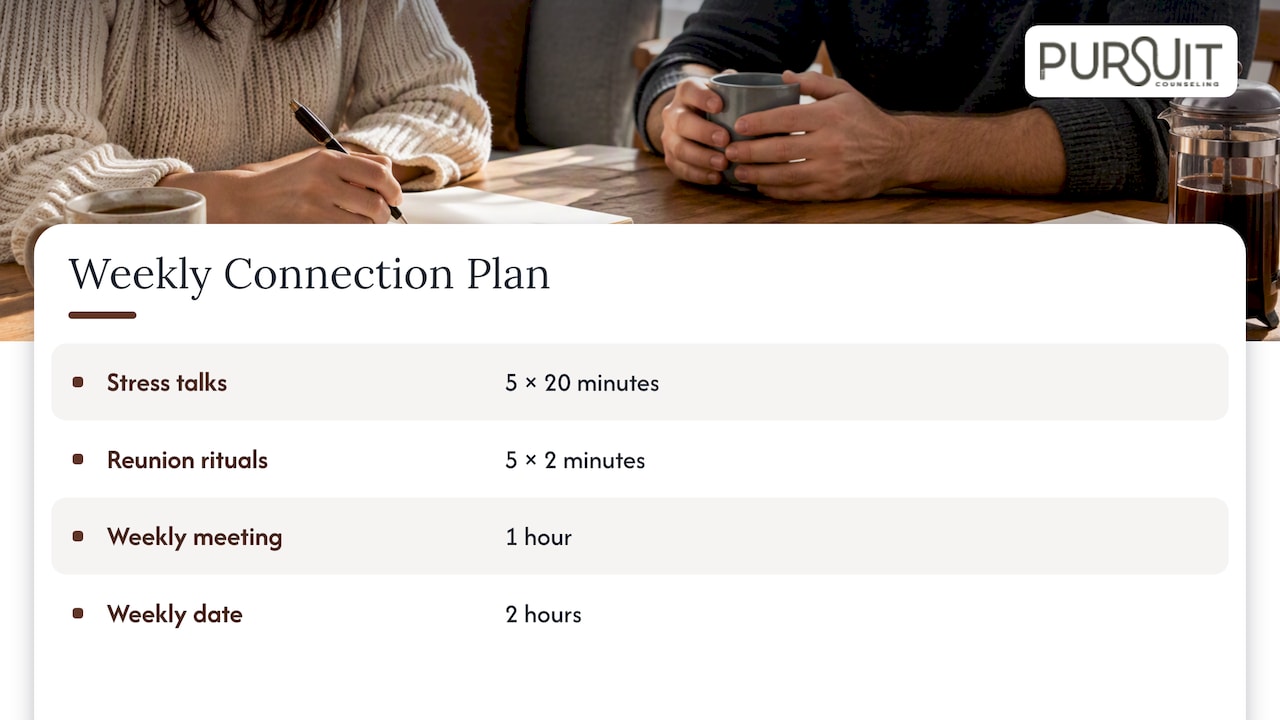
The best-known blueprint comes from Gottman-based work, and the six hours a week breakdown is specific. It includes five 20-minute stress-reducing conversations, five two-minute reunion rituals, one hour-long weekly state-of-the-union meeting, and two hours for a weekly date.
Gottman-based reporting found that adding six hours a week of focused connection, split into those four parts, correlates with improved relationship satisfaction. Notice how small most of the pieces are. The rhythm is built from minutes, with only the date and the weekly meeting taking real time.
Why does it work? Part of the answer is the difference between a ritual and a routine. Garcia-Rada and colleagues describe rituals as acts with shared symbolic meaning and mutual agreement. The meaning, not the action itself, is what predicts relationship satisfaction. A kiss on autopilot is a routine. The same kiss that you both treat as “our moment” is a ritual.
Frequency matters too. A longitudinal study of civilian couples found that more frequent shared activities were associated with higher relationship quality and fewer self-reported negative interactions over a five-week follow-up.
Underneath all of it sits a simple dynamic. Negative moments stick in memory harder than positive ones, which is why Gottman-informed guidance often points to a positive-to-negative ratio near 5:1. Daily rituals are a cheap way to keep adding to the positive side, and to give you both more chances to notice and answer each other’s small bids for attention.
3. How do you build a ritual that actually lasts?
Treat this as a short design project. A few steps can help.
- Choose one daily and one weekly ritual. Resist the urge to launch five at once. Set a concrete time and cue for each, such as “when the dishwasher starts” or “Sunday evening.”
- Name it and agree on what it means. Say out loud why it matters to each of you. “Our six seconds” carries more weight than “the kiss thing.” Shared meaning is what turns a habit into a ritual.
- Protect it with simple tools. Add calendar blocks, a phone reminder, and as little friction as possible. If a ritual needs a babysitter and a reservation every time, it will break on the first busy week.
- Give the weekly check-in a structure. One person speaks while the other listens, appreciations come first, and concerns come second. For harder topics, borrow the 20-minute stress-reducing format from the Gottman approach: each partner gets a turn to talk about stress from outside the relationship while the other simply listens. Listening well takes practice, and these tips for mindful listening are a handy place to start.
Pro Tip: Treat the early days as an experiment, not a test of your marriage. If either of you starts to withdraw, change the wording or timing before you drop the ritual.
4. What do you do when rituals keep falling apart?
Almost every couple hits friction. Most of it is fixable without a bigger commitment.
- Short on time: shrink the ritual to a brief moment and stack it onto something you already do. A tiny, repeated ritual can be easier to sustain than an elaborate one.
- One partner resists: frame it as a short experiment, lower the pressure, and let the reluctant partner choose the ritual or change its shape. Resistance often means the ritual felt like an assignment, not an invitation.
- Kids interrupt: build portable versions. A kiss goodnight through the bedroom door counts, and so does a late-night check-in on the couch once the house is quiet.
- Travel splits you up: send a video kiss, a voice memo, or a “best part, worst part” text. Then make it up with a longer version when you are back.
- It feels hollow or performative: go back to the shared meaning. Rename it, change the words, or ask each other what the ritual is supposed to say. Hollow usually means the meaning wore thin, not that the ritual failed.
If the same obstacles keep returning, our piece on barriers to connection in couples goes deeper.
5. How do rituals of connection support your own mental health?
You may think of rituals as something you do for the relationship. They also do quiet work for you as an individual. Predictable, warm contact with another person gives a day some shape. Many people who feel adrift, wired or low notice that a small repeated moment of being known steadies them more than they expected.
Rituals can also reduce the mental load of wondering where you stand. When you know a check-in is coming on Sunday, you don’t need to carry every worry until it boils over. That is not a promise of relief. It is a way of giving your concerns a place to land.
Rituals don’t have to involve a partner, either. A morning walk with a friend, a weekly call with a sibling, a Sunday coffee you protect for yourself can all work as anchors of connection. What matters is that the contact is repeated, chosen and meaningful to you.
We want to be clear about what this is. Rituals are a form of support, not an assessment or a treatment. If you are carrying persistent low mood, anxiety or exhaustion, a ritual may help you feel less alone, but it is not a substitute for a conversation with a clinician who can look at the full picture.

6. Can rituals help with trauma recovery and anxiety?
For people living with anxiety or the aftereffects of trauma, predictability is not a small thing. A nervous system that has learned to scan for danger often settles a little when it can count on certain moments: the same goodnight words, the same hand on a shoulder, the same weekly check-in at the same hour.
That is why we often encourage gentle, low-demand rituals in the early stages of this work. A shared walk after dinner, a slow cup of tea, a two-minute “how is your body feeling tonight?” Each one offers a small, repeatable experience of safety with another person.
A few cautions matter here. Don’t make a ritual a performance test, and never turn it into pressure to open up. Someone with a trauma history may need to control the pace, the closeness, or even the room. Let that partner set the terms. If a ritual sets off distress, pause it and talk about why.
Rituals can sit alongside trauma-focused therapy, including EMDR, but they are not a replacement for it. They give the rest of the week a steadier floor.
7. What do rituals look like for friends, family and couples?
The structure stays the same across relationships: repeated, shared, meaningful. What changes is the flavor.
Couples lean on touch, check-ins and dates: the six-second kiss, the Sunday planning chat, the monthly overnight away.
Friends usually need rituals that survive distance and busy calendars. A standing monthly dinner, a walking call every other Thursday, a shared playlist that grows over time. The ritual’s reliability matters more than its length.
Parents and children do well with small, sensory moments: a bedtime song, a Saturday pancake breakfast, a “high, low, and something silly” exchange at dinner. Kids often tell you what matters by noticing when you skip it.
Adult siblings and extended family can keep a thread alive with an annual trip, a group chat for photos and news, a holiday recipe cooked from the same card. These connections tend to thin out without a deliberate anchor.
Whatever the relationship, ask the same question: what do we both want this to say about us? Then build the ritual around the answer.
8. How can personalized rituals support therapy and neurofeedback?
Any form of therapy involves change that happens mostly between sessions. A personalized ritual can be the bridge. If your therapist suggests practicing a skill, such as a slower breath, a pause before replying, or naming a feeling aloud, a ritual gives that practice a regular time and a witness.
The same logic applies to neurofeedback. Many people find that consistent sleep, regular movement and calm transitions make a training schedule easier to sustain. A shared evening wind-down with a partner, for instance, can protect the very conditions the work depends on. We would describe that as support for the process, not as a claim about what the training will produce.
For couples in counseling, rituals are often the homework that actually sticks. A therapist might notice that a pair argues most in the hour after work, and together they design a two-minute reunion ritual to soften that moment. Then the next session starts with what happened, not with a recap of the week’s damage.
Personalization is the key word. A ritual that fits one couple’s temperament, schedule and history will outlast any generic list, ours included.
9. How should you adapt rituals during life transitions or crises?
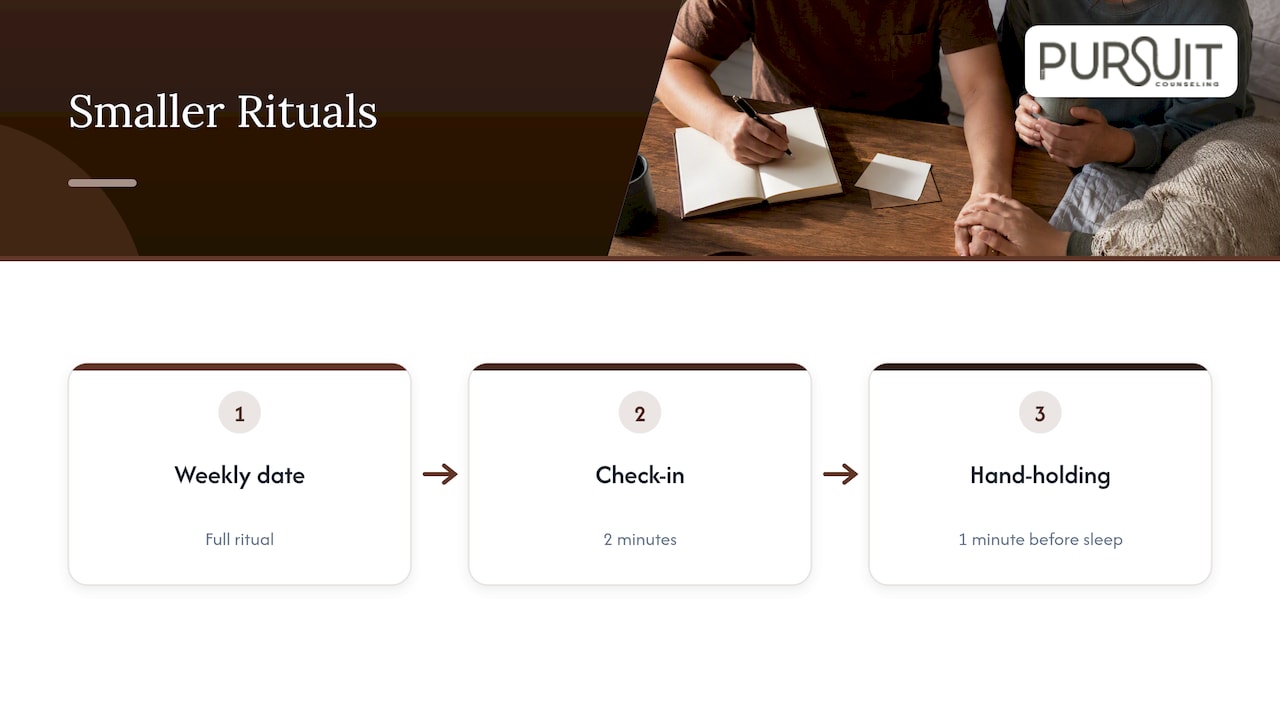
A new baby, a job loss, a move, a diagnosis, a death in the family: transitions tend to knock out the first things you built. Our advice is to shrink instead of quitting.
Keep the smallest version alive. If the weekly date is impossible, protect the two-minute check-in. If the check-in feels too heavy, hold hands for a minute before sleep. The point is to keep a thread intact so that returning to the fuller ritual later feels like picking something up, not starting over.
It also helps to name the season out loud. “We’re in the newborn months, so our ritual is five minutes on the couch after the baby’s down.” Saying so removes the guilt and the quiet scorekeeping.
In a crisis, let the ritual absorb some of the strain. A shared daily walk during a hard medical stretch, or a nightly “one thing that helped today” during a job search, can give both of you a small, reliable place to rest.
Finally, give yourselves a date to revisit the plan. Transitions end, and your rituals should be allowed to expand again when they do.
10. How do culture and background shape rituals of connection?
No ritual is culturally neutral. The way families greet each other, share meals, mark milestones, observe religious days or show affection varies widely, and it shapes what feels warm versus awkward. A six-second kiss may feel natural to one partner and out of place to another who grew up where affection was kept private.
If you come from different backgrounds, treat that as a source of material, not a problem to manage. Ask each other which rituals your families practiced, which ones you loved, and which ones you would rather leave behind. Many couples build their best rituals by blending two traditions into something new.
Faith and community practices can also be powerful anchors: a weekly service, a shared fast, a family meal on a particular evening. If those matter to one of you, make room for them in your rhythm rather than competing with them.
Be wary of any list, ours included, that tells you what connection must look like. Research on couples has often drawn from particular populations, so use these ideas as starting points and adjust them to your own culture, family and values.
11. Why we believe rituals matter more than most couples realize
Here is where we part ways with a common assumption. Many couples think connection is a feeling that either shows up or doesn’t, and that a good relationship shouldn’t need scheduling. We see the opposite. The couples who feel close for decades are usually the ones who stopped leaving it to mood.
Scheduling a check-in is not cold. It is a way of saying that this relationship deserves the same protection you give your work calendar. What readers underestimate is how much small, boring repetition carries. One dramatic weekend away rarely repairs what two minutes a day would have prevented.
We also see where rituals reach their limit. If bids go unanswered for months, if every conversation escalates, or if one or both of you have gone quiet to avoid conflict, a new habit may not be enough on its own. That doesn’t mean something is wrong with you. It means the pattern needs more support than a routine can give. A good next step is to run the two-week experiment, then set aside thirty minutes to talk about how it went, or reach out for a consult.
12. How we help couples make rituals stick
If you want guided help, our couples and relationship counseling gives you a place to design rituals with a clinician and practice them in the room. Our Couples Intensive offers concentrated time for couples who would rather work in a few focused hours than across many weeks.

A first step is simple: a brief consult to talk through what’s happening and what you want from the work. You can see everything we offer on our services page, and we’re glad to point you toward the right fit.
FAQ
What is the 7-7-7 rule for couples?
It is a popular relationship idea, not a research-defined standard. The usual version suggests regular date nights, getaways and longer trips. Treat it as a prompt for protecting regular time together, and adjust it to your budget and schedule.
What is the 72 hour intimacy rule?
This is informal advice, not an established clinical guideline, and definitions vary. It generally points to the idea of making meaningful physical or emotional closeness a regular part of the relationship. If it helps you stay in touch, use it, but there is no research-set threshold behind it.
What is the 3-3-3 rule for intimacy?
Like other social-media shorthand, versions differ from one source to the next. We would not treat it as a research-backed rule. A more reliable approach is the Gottman-aligned rhythm of daily micro-rituals plus a weekly check-in and date.
What is the Gottman 6 hour rule?
It refers to six hours a week of intentional connection: five 20-minute stress-reducing conversations, five two-minute reunion rituals, one hour-long weekly meeting, and a two-hour date. It is a framework for building a rhythm, not a guarantee of any outcome.
Sources
- News
- Rituals and Nuptials: The Emotional and Relational Consequences of Relationship Rituals
- Examining the association between engagement in shared relationship activities, couple quality, and negative interactions – Military REACH at Auburn University