

The Sound Relationship House is John and Julie Gottman’s evidence-based model that organizes a healthy romantic relationship into seven distinct “floors,” held together by two load-bearing walls: Trust and Commitment. Developed at The Gottman Institute from over 40 years of observing thousands of couples, it gives you a concrete map of where your relationship is strong and where the cracks are forming. The single most important takeaway? Start with the Friendship System. Floors 1 through 3, which are Love Maps, Fondness and Admiration, and Turning Toward, are where most couples see the fastest, most lasting gains. Everything above those floors depends on them.
Table of Contents
- What does the sound relationship house look like?
- How each floor shows up in everyday life
- Why trust and commitment hold the whole structure up
- How Gottman’s approach to conflict actually works
- How to self-assess and build a 30/60/90 day plan
- When professional help makes the difference
- Conversation starters, weekly exercises, and a 10-minute daily routine
- Key Takeaways
- What the Sound Relationship House gets right, and where couples go wrong
- Ready to work on your relationship with expert support?
- Authoritative sources and further reading
What does the sound relationship house look like?
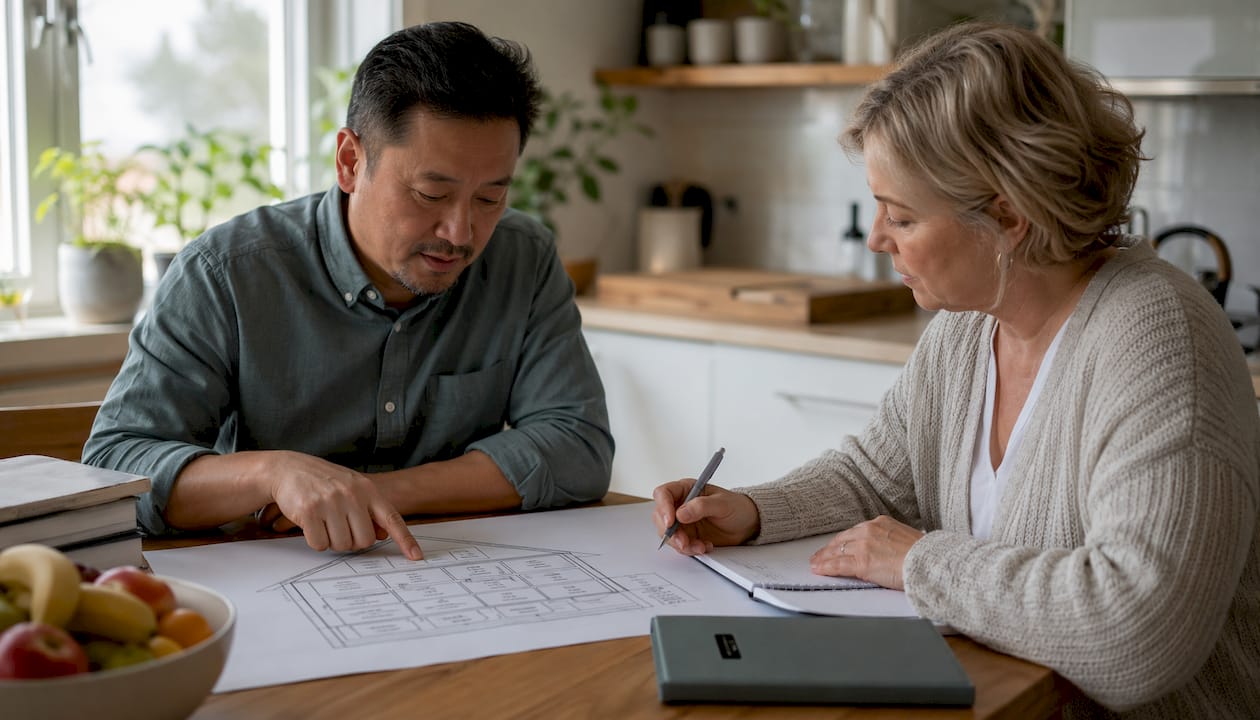
Picture an actual house. The foundation is the two walls. The floors stack upward, each one resting on the one below it. When the lower floors are solid, the upper floors hold. When they’re cracked, everything above them wobbles, no matter how much effort you pour into conflict resolution or shared meaning.
The two load-bearing walls are Trust (the belief that your partner has your best interests at heart) and Commitment (the active, daily decision to invest in this relationship above all others). They run the full height of the structure. Without them, no floor is truly stable.
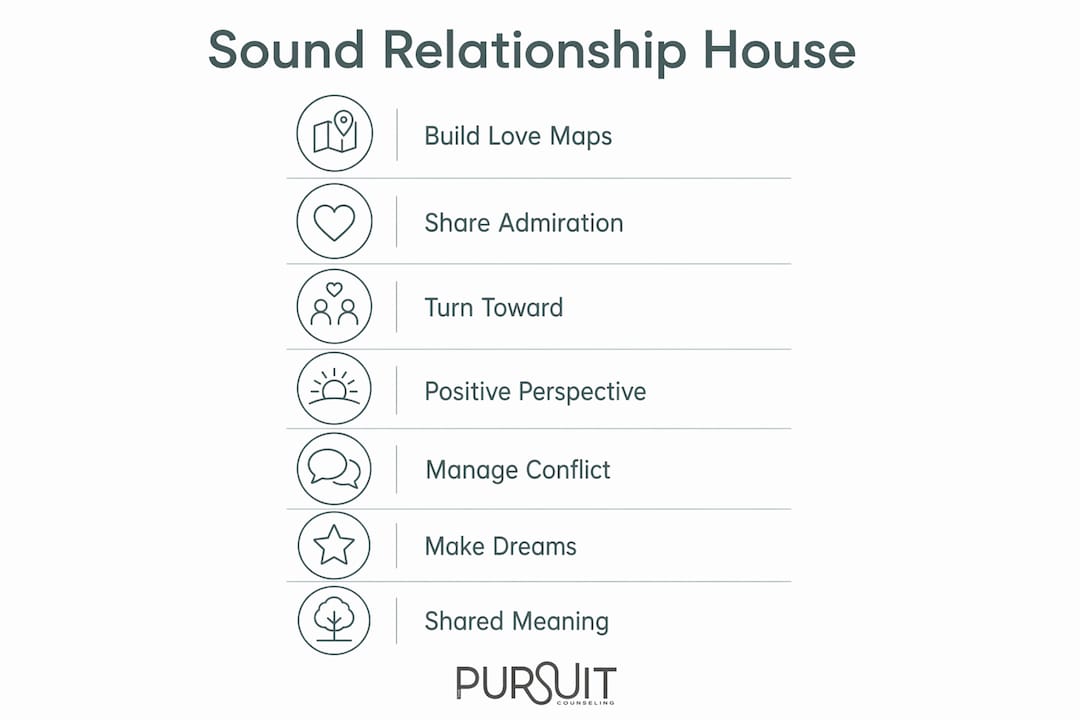
The seven floors of the Sound Relationship House are:
- Build Love Maps: Know your partner’s inner world, their fears, dreams, stressors, and joys.
- Share Fondness and Admiration: Actively express appreciation and respect for each other.
- Turn Toward Instead of Away: Respond to your partner’s bids for connection, even small ones.
- The Positive Perspective: Approach your partner with goodwill and benefit of the doubt.
- Manage Conflict: Navigate disagreements with skill and repair, not elimination.
- Make Life Dreams Come True: Support each other’s deepest hopes and aspirations.
- Create Shared Meaning: Build rituals, roles, and a shared narrative that gives the relationship purpose.
Clinicians often group these into three systems. Floors 1–3 form the Friendship System, the highest-leverage starting point. Floor 5 is the Conflict System. Floors 6–7 form the Meaning System. These systems interact in both directions: a strong Friendship System makes conflict easier to manage, and shared meaning reinforces fondness. The house is alive, not linear.
Ready to Take the Next Step in Your Pursuit?
You don’t have to have everything figured out before reaching out. Whether you’re feeling stuck, navigating a difficult season, working on your relationships, or simply know there’s another level of growth ahead, we’d love to help.
At The Pursuit Counseling, we’ll help you find the counselor who best fits your goals, personality, and needs.
Your next step is simple: book a consultation.
Let’s talk about where you are, where you want to go, and how we can help you move forward.
Book Your Consultation Today →
How each floor shows up in everyday life
Floor 1: Build Love Maps
A Love Map is the mental picture you hold of your partner’s world. Strong Love Maps mean you know their current work stress, their childhood wound that still surfaces, and what they’re quietly excited about. Shaky Love Maps look like partners who feel unknown, like they’re living with a stranger who stopped asking questions years ago.

Exercise: Tonight, ask one question you genuinely don’t know the answer to. “What’s been weighing on you most this week?” counts. The Love Map question set from The Gottman Institute offers dozens of prompts across life domains.
Floor 2: Share Fondness and Admiration
This floor is about the habit of noticing what’s right about your partner and saying it out loud. Couples who skip this floor don’t necessarily fight more; they just slowly stop feeling seen. The erosion is quiet and dangerous.

Exercise: Each morning, name one specific thing you appreciate about your partner before you part ways. Not “you’re great” but “I noticed how patient you were with the kids this morning.”
Floor 3: Turn Toward Instead of Away
Every day, your partner sends dozens of small bids for connection: a comment about the weather, a funny story, a sigh. Turning toward means responding, even briefly. Turning away means ignoring or dismissing. Turning against means snapping back. The cumulative score of these micro-moments is what builds or erodes emotional safety.
Exercise: For one week, track how often you turn toward versus away. No judgment, just data. Then pick one moment each day to turn toward deliberately, even a two-minute response to a bid you’d normally scroll past.
Floor 4: The Positive Perspective
This floor doesn’t require effort on its own. It emerges naturally when floors 1–3 are healthy. When you know your partner, appreciate them, and feel connected, you interpret their neutral actions charitably. When floors 1–3 are weak, the same neutral action reads as hostile. A late text becomes evidence of neglect. A distracted look becomes proof of disinterest.
Common misconception: Couples often try to “think more positively” about each other without rebuilding the friendship underneath. That’s like painting over a crack in the wall. The positive perspective follows from the work below it.
Floor 5: Manage Conflict
Notice the word is “manage,” not “resolve.” Research from The Gottman Institute shows roughly 69% of couples’ problems are perpetual, meaning they stem from personality differences that won’t disappear. The goal is not to fix your partner. The goal is to navigate recurring friction without letting it corrode the relationship.
Common misconception: Many couples believe that a good relationship means conflict-free. It doesn’t. Masters of relationships fight; they just fight differently.
Floor 6: Make Life Dreams Come True
This floor asks both partners to hold space for each other’s individual dreams, even when those dreams feel inconvenient or unfamiliar. Ignoring this floor breeds resentment that surfaces as conflict on floor 5, making it look like a communication problem when it’s actually a meaning problem.
Exercise: Ask your partner: “Is there a dream you’ve put on hold that you’d like me to know about?” Then listen without problem-solving.
Floor 7: Create Shared Meaning
Shared meaning is built through rituals of connection (how you greet each other, how you celebrate), shared roles (what it means to be a partner in this specific relationship), and a shared narrative about where you’ve been and where you’re going. Couples who invest here report a deeper sense of purpose in the relationship itself.
Exercise: Identify one ritual you already have and name it. “Sunday morning coffee before the kids wake up” becomes a ritual when both partners recognize it as meaningful and protect it.
External stressors can quietly erode the lower floors before couples notice. Caregiver stress, for instance, tends to reduce turning-toward counts and shrink the time available for Love Map conversations, which is worth watching if one or both partners carries a caregiving role.
Why trust and commitment hold the whole structure up
Trust is built in small moments, not grand gestures. Every time you choose your partner’s wellbeing over your own convenience, you deposit into the trust account. Every time you dismiss their concern, minimize their pain, or act in self-interest at their expense, you make a withdrawal. The account can go negative, and when it does, the floors above it become unstable regardless of how many date nights you schedule.
Commitment, in Gottman’s framing, is not just the absence of leaving. It’s the active choice to invest, to see the relationship as your primary project, and to resist the mental habit of comparing your partner to alternatives. Commitment erodes when partners mentally “exit” the relationship during conflict, fantasizing about a different life rather than working through the present one.
Signs trust or commitment are weakening:
- Secrets kept not for privacy but for self-protection
- Stonewalling that lasts days rather than hours
- Contempt that has become the default tone
- One partner consistently prioritizing outside relationships or work over the couple’s shared life
- Betrayal, whether emotional or physical, that has not been addressed
A 3-step repair plan for this week:
- Name the breach. Identify one specific behavior that has eroded trust and say it plainly, without blame: “When I found out about X, I felt unsafe.”
- Make a transparency commitment. Agree on one concrete behavior change: “I’ll tell you when I’m working late before 5 PM, not after.”
- Create a repair ritual. Choose a small, repeatable action that signals recommitment: a daily check-in text, a five-minute debrief at the end of the day, or a weekly “state of us” conversation.
Pro Tip: Repair the walls before or alongside upper-floor work. Couples who jump straight to shared meaning rituals while trust is broken often find those rituals feel hollow or performative. The sequence matters.
When betrayal has fractured trust deeply, infidelity recovery counseling offers a structured path back to safety before the upper floors can hold weight again.
How Gottman’s approach to conflict actually works
Most couples come into therapy wanting to resolve their conflicts. Gottman’s research reframes that goal entirely. Because roughly 69% of problems are perpetual, the aim shifts from solving to managing, from winning to navigating. That reframe alone reduces shame and opens the door to real progress.
Core conflict tools:
- Soft start-up: Begin a difficult conversation with “I feel” rather than “You always.” The opening move sets the trajectory of the entire exchange.
- Repair attempts: Any gesture, verbal or nonverbal, that de-escalates tension during conflict. A repair attempt can be as simple as “I need a five-minute break” or “I don’t want to fight about this.”
- Accept influence: Especially important for partners who default to defensiveness. Accepting influence means genuinely considering your partner’s perspective before countering it.
- De-escalation: When physiological flooding occurs (heart rate above 100 bpm), the rational brain goes offline. Taking a 20-minute break before continuing is not avoidance; it’s biology.
- Compromise scripts: “What do you need from me in this conversation?” and “What would help you feel heard right now?” are two of the most effective.
Short scripts to use tonight:
- Soft start-up: “I’ve been feeling disconnected lately, and I’d love to talk about it when you have a few minutes.”
- Repair attempt mid-conflict: “I’m starting to feel flooded. Can we take ten minutes and come back to this?”
- Accept influence: “That’s a fair point. I hadn’t thought about it from that angle.”
Pro Tip: The Four Horsemen (criticism, contempt, defensiveness, stonewalling) are the strongest predictors of relationship breakdown. If you notice contempt entering the room, that’s the moment to pause the conversation entirely, not push through. Contempt cannot be out-argued; it has to be addressed at the friendship level.
Healthy couples maintain roughly a 5:1 ratio of positive to negative interactions. That ratio doesn’t mean avoiding hard conversations. It means the daily texture of the relationship is warm enough to absorb friction without breaking.
Good relationship communication skills are learnable. The scripts above are a starting point, not a ceiling.
How to self-assess and build a 30/60/90 day plan
The Sound Relationship House works as a diagnostic tool precisely because it translates vague relational feelings into specific, trainable skills. “We need to communicate better” becomes “our turning-toward count is low and we haven’t updated our Love Maps in two years.” That specificity is what makes change possible.
Quick self-assessment (rate each floor 1–5):
- Love Maps: Do I know what’s currently stressing my partner most?
- Fondness and Admiration: Did I express genuine appreciation this week?
- Turning Toward: Am I responding to my partner’s bids more than I’m ignoring them?
- Positive Perspective: Is my default interpretation of my partner’s behavior charitable?
- Manage Conflict: Do our arguments end with repair, or do they end with distance?
- Life Dreams: Can I name one dream my partner holds that I’m actively supporting?
- Shared Meaning: Do we have at least one ritual of connection we both protect?
The Sound Relationship House questionnaire, available through The Gottman Institute, offers a more structured scoring system. For self-guided use, the prompts above give you enough signal to identify your weakest floors.
| Self-Assessment Score | Recommended Focus | Next Action |
|---|---|---|
| Floors 1–3 mostly 1–2 | Friendship System rebuild | Start Love Maps practice; daily appreciation; track bids for one week |
| Floor 5 mostly 1–2, floors 1–3 moderate | Conflict tools | Add soft start-up scripts; practice repair attempts; read The Seven Principles for Making Marriage Work |
| Floors 6–7 mostly 1–2, lower floors solid | Meaning System | Schedule a life-dreams conversation; identify one new shared ritual |
| Walls (trust/commitment) feel unstable | Foundation repair | Use the 3-step trust repair plan; consider professional support |
A 30/60/90 day plan:
- Days 1–30 (Friendship System): Ask one Love Map question daily. Name one appreciation each morning. Track turning-toward moments for two weeks, then aim to increase your count by one per day.
- Days 31–60 (Conflict tools): Introduce soft start-up language. Practice one repair attempt per conflict. Read or revisit The Seven Principles for Making Marriage Work by John Gottman and Nan Silver.
- Days 61–90 (Meaning and maintenance): Have one life-dreams conversation. Create or name one shared ritual. Schedule a monthly “state of us” check-in to review which floors need attention.
When professional help makes the difference
The Sound Relationship House is also the clinical backbone of Gottman Method couples therapy, which was built from over 40 years of empirical research observing thousands of couples. That evidence base is why targeted exercises reliably move relationship metrics in clinical practice, not just in theory.
Signs it’s time to seek professional support:
- The Four Horsemen (criticism, contempt, defensiveness, stonewalling) have become the default pattern
- Trust has been broken through betrayal, deception, or chronic dismissal
- Conflict regularly ends in shutdown, not repair
- One or both partners feel chronically unseen, unheard, or unsafe
- Individual trauma is surfacing inside the relationship dynamic
- You’ve tried self-guided tools and the same patterns keep returning
A Gottman-informed initial session typically includes a thorough assessment of all seven floors, a review of the couple’s conflict patterns, and the beginning of Love Map work. Couples intensives compress this process into a concentrated format, often two to three days, which suits high-performing adults who can’t sustain weekly sessions around demanding schedules.
The Pursuit Counseling’s couples intensive program is structured around the Sound Relationship House model, integrating Gottman Method tools with neuroscience-informed approaches. For couples where individual trauma is part of the picture, EMDR and neurofeedback can address what’s happening neurologically underneath the relational patterns. That integration matters because attachment styles, nervous system dysregulation, and trauma responses all interact with how each floor functions. A partner with an anxious attachment style, for example, may struggle with floor 3 (Turning Toward) not because they don’t want connection but because their nervous system reads bids as threats. Addressing that layer changes what’s possible on the floors above it.
Research on the Sound Relationship House also shows that shared meaning can be a particularly powerful pathway for couples navigating major life stressors together, including grief, illness, or significant life transitions.
Conversation starters, weekly exercises, and a 10-minute daily routine
The most actionable pieces of the Sound Relationship House are the micro-practices. Small, consistent actions compound faster than occasional grand gestures.
Conversation starters by floor:
- Love Maps: “What’s something you’re looking forward to in the next six months that I might not know about?”
- Life Dreams: “Is there something you’ve always wanted to try that we’ve never talked about?”
- Shared Meaning: “What does being a good partner mean to you right now, at this stage of our life?”
Three weekly exercises (5–15 minutes each):
- Appreciation inventory (10 minutes, once a week): Each partner writes down three specific things they admired about the other that week. Share them aloud. No commentary, just listening.
- Bid audit (5 minutes, mid-week): Sit together and each name one moment from the past few days when you felt your bid for connection was met. Then name one moment when it wasn’t, without blame.
- Dream check-in (15 minutes, Sunday or whenever you have quiet): Each partner shares one personal goal or dream they’re holding. The other partner’s only job is to ask one curious question.
A 10-minute daily routine:
- Morning (2 minutes): One specific appreciation before you part ways.
- Evening (6 minutes): A low-stakes check-in. “What was the best part of your day? What was the hardest?” No advice, no fixing, just presence.
- Before sleep (2 minutes): One small turning-toward gesture: a hand on the shoulder, a “I’m glad you’re here,” a moment of eye contact.
This routine won’t fix a broken floor overnight. But done consistently, it rebuilds the texture of daily connection that makes everything else in the house more stable. Family stress and sibling conflict over caregiving can spill into a couple’s dynamic in ways that reduce these small moments of connection, so protecting the routine during high-stress periods matters more, not less.
Key Takeaways
The Sound Relationship House works because it turns vague relational dissatisfaction into specific, addressable floors, and the Friendship System (floors 1–3) is where nearly every couple should begin.
| Point | Details |
|---|---|
| Start with the Friendship System | Floors 1–3 (Love Maps, Fondness, Turning Toward) produce the fastest early gains for most couples. |
| Manage conflict, don’t resolve it | Roughly 69% of couples’ problems are perpetual; repair attempts and soft start-ups matter more than winning arguments. |
| Walls come first | Trust and Commitment support every floor; repair them before or alongside upper-floor work. |
| Small moments compound | A 5:1 positive-to-negative interaction ratio and a 10-minute daily routine build more than occasional grand gestures. |
| The Pursuit Counseling | Offers Gottman-informed couples intensives and therapy integrating neuroscience tools for high-performing adults. |
What the Sound Relationship House gets right, and where couples go wrong
The most common mistake I see is couples arriving at therapy convinced their problem is conflict. They want scripts, they want techniques, they want a referee. And sometimes those tools help. But when I walk through the Sound Relationship House with them, the real gap is almost always on floors 1 through 3. They’ve stopped knowing each other. They’ve stopped saying what they appreciate. They’ve stopped responding to the small bids that used to feel automatic.
The Gottman model is honest about something most relationship advice isn’t: some problems won’t go away. That’s not a failure of the relationship. It’s a feature of two different people sharing a life. The goal is to build a house strong enough to hold the weight of those differences without collapsing.
What I find particularly useful with high-performing clients, whether executives, pilots, or professionals carrying enormous external pressure, is pairing the Sound Relationship House with a trauma-aware lens. The Friendship System floors often erode not because partners stopped caring but because their nervous systems are running on empty. When someone is chronically flooded at work, turning toward their partner at home takes a kind of neurological resource they may not have left. That’s not a character flaw. It’s a physiological reality, and it changes how we approach the work.
The house metaphor is apt in one more way: maintenance is ongoing. The couples who do best aren’t the ones who fixed everything in a six-week program. They’re the ones who kept asking the Love Map questions two years later, who kept naming what they appreciated, who kept turning toward even when it was inconvenient. The house doesn’t maintain itself.
Ready to work on your relationship with expert support?
High-performing couples in Florida often know exactly what the problem is. What they need is a structured, efficient path through it. The Pursuit Counseling’s couples and relationship counseling services are built around the Sound Relationship House model, giving you a clear assessment of which floors need work and a focused plan to address them.
For couples who want concentrated progress without waiting months for weekly sessions to accumulate, The Pursuit Counseling’s couples intensive compresses the assessment, skill-building, and repair work into a multi-day format designed for busy adults. The first step is a short intake conversation to map your current floors and identify where to begin. If you’re ready to stop circling the same arguments and start building something that holds, reach out to schedule your intake today.
Authoritative sources and further reading
The claims in this article draw on the following primary and clinical sources:
- The Gottman Institute (gottman.com): Primary source for the Sound Relationship House model, the seven floors, the 69% perpetual-problems finding, and the 5:1 positive-to-negative interaction ratio.
- Gottman, J. & Silver, N. — The Seven Principles for Making Marriage Work: The most accessible book-length treatment of the model; covers Love Maps, Fondness and Admiration, Turning Toward, and conflict management in practical detail.
- Gottman Institute blog — “What Is the Sound Relationship House?” (gottman.com/blog): Explains Trust and Commitment as load-bearing walls and the emergence of Positive Perspective from a strong Friendship System.
- Navarra & Gottman — Sound Relationship House Theory and Relationship and Marriage Education (johngottman.net): Clinical and training materials describing the empirical basis of the model and its application in Gottman Method interventions.
- TherapyExplained — “Gottman’s Sound Relationship House Explained” (therapyexplained.com): Practitioner-oriented summary of the model’s evidence base and diagnostic application.
- PubMed — “Gottman’s Sound Relationship House and Relational Resilience Through Infertility” (pubmed.ncbi.nlm.nih.gov/39219108): Peer-reviewed study demonstrating the shared meaning system’s role in couple satisfaction under major life stress.
- SD Relationship Place — “7 Ways to Practice the Sound Relationship House in Marriage” (sdrelationshipplace.com): Practitioner guide emphasizing micro-practices as the most actionable elements of the model.