


Start by blocking one hour of uninterrupted focus time on your calendar today, then send a short script that names your new availability. Boundary setting at work protects your energy inside a job, and it works best when it starts small and specific instead of sweeping and vague. The two moves you need in the next five minutes: block the time, then say it out loud.
- Block it: Open your calendar right now and add a recurring 60 to 90 minute focus block, labeled plainly (not “Busy,” but “Focus: no meetings”).
- Say it: Send a one or two line message to your team or manager: “I’m shifting to email hours of 9 to 5. If something’s urgent, call or Slack me directly.”
Pro Tip: Write your script once, save it in a notes app, and reuse it. Rehearsing the exact wording ahead of time, a method sometimes called a pre-mortem, cuts the anxiety spike that makes people abandon boundaries the first time someone pushes back.
Key Takeaways
Boundary setting at work holds only when a specific rule, a rehearsed script, and consistent enforcement all happen together, not in isolation.
| Point | Details |
|---|---|
| Start small | Block one focus period or set an autoresponder before attempting a sweeping rule change. |
| Script it before you need it | Write and rehearse the exact wording in advance to reduce reactivity in the moment. |
| Frame around impact | Tie the boundary to work quality or deliverables, not personal preference, to increase acceptance. |
| Document and escalate deliberately | Record dates and outcomes before involving a manager or HR. |
| Get professional support if it’s chronic | The Pursuit Counseling offers counseling and executive coaching for professionals whose boundary struggles are tied to burnout or repeated violations. |
Table of Contents
- What Does Boundary Setting at Work Actually Look Like?
- Why Does Setting Boundaries at Work Reduce Burnout?
- How Do You Set a Boundary at Work Step by Step?
- What Are Good Scripts for Saying No at Work?
- Why Do Boundaries Fail, and What Do You Do Next?
- How Do You Maintain Boundaries Over Time?
- Do Cultural Expectations Change How You Set Boundaries?
- How Do You Set Boundaries in a Remote or Hybrid Job?
- A Counseling-Informed Take on Boundaries That Actually Hold
- Ready to Build Boundaries That Stick?
- Sources
- FAQ
What Does Boundary Setting at Work Actually Look Like?
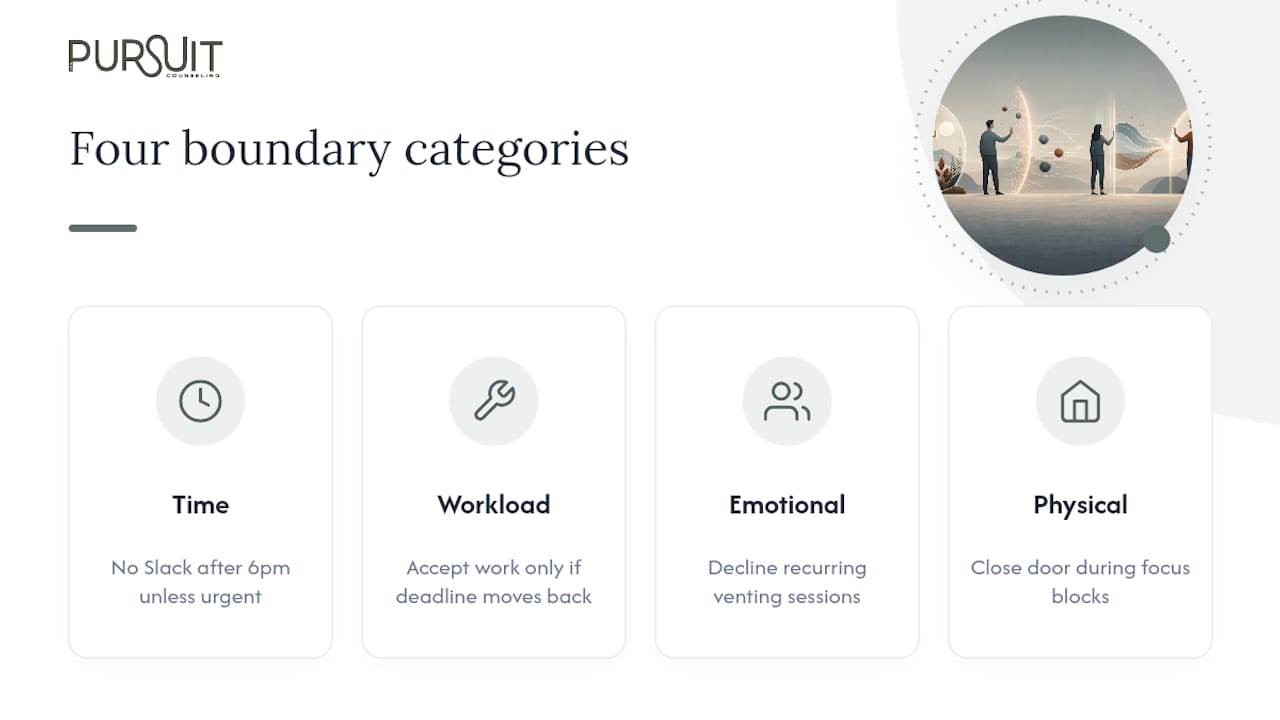
Boundary setting at work falls into four practical categories, and most professionals only ever notice the one that’s already broken.
Time boundaries govern when you’re reachable. Example: “I don’t check Slack after 6 p.m. unless it’s flagged urgent.” Workload boundaries govern how much lands on your plate. Example: “I can take this project if we move the deck deadline back a week.” Emotional boundaries govern how much of other people’s stress you absorb. Example: declining to be the default listener for a coworker’s daily venting session. Physical or space boundaries cover your desk, your office door, or your camera during video calls. Example: closing your door during a focus block instead of leaving it open as an implicit invitation.
Role matters here. An on-call ER nurse or IT responder can’t apply the same email-hours rule as a salaried marketing manager, and pretending otherwise sets you up to break your own rule within a week. Exceptions exist for genuine emergencies, and part of setting a good boundary is defining what actually counts as one, a point Lyra Health raises when it recommends pairing verbal limits with a clear emergency definition.
Before you script anything, ask yourself three questions: What is this costing me right now, sleep, focus, resentment? Which category does that cost fall into? And what’s the smallest rule that would fix it? Answer those honestly and the right boundary usually becomes obvious.
Why Does Setting Boundaries at Work Reduce Burnout?
Boundaries aren’t a soft skill. They’re a measurable buffer against burnout. Employees who report clearer separation between work and personal time also report less work-related rumination, the kind of looping, after-hours worry that keeps your brain “on” long after you’ve logged off, according to Atlassian’s research on workplace boundaries.
The core figure: Clearer work-life boundaries correlate with lower burnout risk and reduced after-hours rumination, per Atlassian’s workplace research.
The mechanism is straightforward. When your limits are clear, your brain doesn’t have to keep negotiating them in the background. That frees up attention for the actual work in front of you, and it lowers the slow-building resentment that erodes relationships with coworkers and managers alike.
The payoff isn’t only personal. When leaders model boundaries themselves, taking real lunch breaks, logging off visibly, declining a meeting that doesn’t need them, teams absorb the norm faster than any policy memo could teach it. That kind of modeling shows up later in retention and morale, because employees trust a workplace that doesn’t quietly punish people for having a life outside it.
How Do You Set a Boundary at Work Step by Step?
Setting a limit that actually holds isn’t about finding the perfect words. It’s about following a sequence, in order, without skipping the uncomfortable parts.
- Reflect first. Name what’s being cost, sleep, focus, patience, and the outcome you actually want. “I want my evenings back” is vaguer than “I want to stop answering emails after 7 p.m.” Specificity is what makes step two possible.
- Choose a measurable rule. “I’ll try to respond faster” isn’t a boundary. “I respond to non-urgent emails within one business day, and urgent means a phone call” is. Attach numbers, hours, response windows, meeting caps, wherever you can.
- Write the script before you need it. A workable template: name the boundary, give the reason in one clause tied to your work quality, and offer an alternative. “I’m blocking mornings for deep work, so I’ll respond to non-urgent requests by 2 p.m. instead.” TIME’s reporting on workplace boundaries notes that framing a limit around professional impact, rather than personal preference, makes it far easier for managers and colleagues to accept.
- Rehearse it once. Say the script out loud, or write out how the conversation might go sideways, a technique sometimes called a pre-mortem. Journaling the pushback you expect and planning your calm response in advance measurably reduces the reactivity that derails these conversations in the moment, according to AP News coverage on workplace boundaries.
- Communicate it directly, once, without over-explaining. State the boundary. Don’t apologize for it three times in the same sentence. If someone asks a clarifying question, answer it plainly and move on.
- Enforce it with small, consistent consequences. If you said you don’t take calls after 6 p.m., let the call go to voicemail. The first time you make an exception “just this once,” you’ve quietly renegotiated the boundary down to nothing.
- Reassert calmly when it’s tested. Expect at least one person to test the new limit, often not out of malice but habit. Repeat the boundary in fewer words than the first time: “Same as I mentioned, I’m offline after 6.”
Pro Tip: Document the boundary somewhere the other person can reference later, a follow-up email after a verbal conversation works well. “Just to confirm what we discussed, I’ll be handling requests during core hours of 9 to 5.” This isn’t about covering yourself legally. It gives both of you a shared record to point back to, which makes step 7 far less awkward.
If a boundary is violated repeatedly despite clear, documented communication, that’s the signal to escalate to a manager or HR, and Coursera’s guide to workplace boundaries recommends keeping factual records, dates, quotes, outcomes, before that conversation happens.
What Are Good Scripts for Saying No at Work?
Having the right words ready in the moment is half the battle. Here are five scenarios worth scripting in advance.
- Boss messaging after hours: “I saw your message. I’m off the clock right now, but I’ll have a full response by 9 a.m. tomorrow.”
- Being handed extra work with no capacity to absorb it: “I want to do this well, so I can’t take it on without moving something else off my plate. Which should I deprioritize?”
- A chatty coworker derailing your focus block: “I’m mid-task on something with a deadline. Can we catch up at lunch instead?”
- Someone pinging you during PTO: “I’m out until Monday and not checking messages. [Colleague] can help with anything urgent.”
- A meeting invite that doesn’t need you: “I don’t think I’ll add much to this one. Feel free to loop me in on the notes after.”
Pair every script with a nonverbal signal that backs it up. A calendar hold labeled “Focus, do not book,” a Slack status set to Do Not Disturb, or an autoresponder that states your actual hours, all of these do quiet work a verbal boundary can’t do alone. Lyra Health frames this combination, direct words plus a technical backstop, as the difference between a boundary that sounds good and one that actually holds.
Tone matters too. A boundary delivered in a blunt, transactional culture will land differently in a relationship-driven one. Soften the framing without softening the actual limit: add a warm opener, keep the rule identical.
Pro Tip: Start with the smallest possible version of a boundary, an autoresponder or a single blocked hour, before attempting a sweeping change like “no emails on weekends, ever.” Smaller asks meet less resistance and build the muscle for bigger ones later.
Why Do Boundaries Fail, and What Do You Do Next?
Most boundaries don’t fail because the idea was wrong. They fail because of how they were delivered or maintained. Two mistakes show up constantly: over-apologizing until the boundary sounds optional, and applying it inconsistently, holding firm on Monday and caving by Friday.
When a boundary gets crossed anyway, work through these steps in order:
- Restate it plainly, without re-explaining your reasoning from scratch. “Same as before, I’m not available after 6.”
- Document the pattern. Note dates, what was said, and what happened next. A factual record makes escalation credible instead of emotional.
- Reframe around impact, not preference, if you escalate to a manager. “Being pulled into after-hours requests three times this month has affected my output on the Morrison account” lands differently than “I just don’t like it.”
- Loop in HR when the pattern involves a policy violation or repeated disregard after a documented conversation with a manager.
- Reassess fit if violations are systemic rather than individual. Not every environment can accommodate the boundary you need, and that’s a legitimate finding, not a personal failure, per Harvard Business Review’s guide to setting better boundaries.
How Do You Maintain Boundaries Over Time?
Boundaries decay without upkeep, the same way any habit does. Build a short review into your routine instead of waiting for a breaking point to notice something’s slipped.
- Run a monthly check. Ask yourself: which boundary did I bend this month, and why? Patterns here tell you where to reinforce.
- Practice calendar hygiene. Cap recurring meetings, require agendas for anything over 30 minutes, and protect at least one full focus block daily.
- Model it if you lead others. A manager who takes lunch, logs off visibly, and declines unnecessary meetings teaches boundaries faster than any written policy, because teams copy behavior, not memos.
Do Cultural Expectations Change How You Set Boundaries?
What counts as a reasonable boundary shifts depending on the culture inside your organization and the broader culture you were raised in. Some workplaces, and some national cultures, treat immediate responsiveness as a sign of dedication; others treat it as a sign you haven’t learned to delegate. Neither read is universal, and assuming your coworkers share your default expectations is where a lot of boundary friction starts.
In hierarchical or high context cultures, a direct “I won’t be available” can land as abrupt or even disrespectful, even when the underlying limit is completely reasonable. The fix isn’t abandoning the boundary. It’s adjusting the wrapper. Add context, acknowledge the relationship, and frame the limit around shared outcomes: “I want to give the Hendricks proposal my full attention, so I’ll respond to smaller requests by tomorrow morning.” The rule stays identical. The delivery respects the norms around you.
Generational differences show up here too, often more than nationality does. Someone who came up in an always-on startup culture may read a defined stop time as a lack of commitment, while someone burned out by exactly that culture may see it as basic self-preservation. Neither party is wrong; they’re operating from different reference points. Naming that gap out loud, “I know this team has historically been reachable around the clock, and I want to talk about what’s sustainable,” often defuses more tension than any script alone.
How Do You Set Boundaries in a Remote or Hybrid Job?
Remote and hybrid work removed the physical cues that used to enforce boundaries automatically. Leaving the office used to signal “I’m done.” Closing a laptop doesn’t carry the same weight, especially when your phone sits on the nightstand with the same apps open.
That makes deliberate boundary setting at work even more necessary at home than it ever was in an office. A few adjustments matter specifically for distributed teams. Set your messaging status to reflect real hours, not just “online” by default, since a green dot at 9 p.m. reads as an invitation whether you meant it that way or not. Separate your physical workspace from your rest space wherever your living situation allows it, even if that’s just a specific chair you only use for work. And agree with your team on what response time actually means across time zones. “Same day” means something different for a coworker three time zones east.

Hybrid schedules add a second wrinkle: the days you’re in the office often get treated as the “real” work, while remote days quietly absorb extra meetings because you’re “available anyway.” Push back on that pattern directly, and protect a remote focus block with the same seriousness you’d protect an in-office one. A recurring calendar hold, visible to your whole team, does more here than any verbal agreement, since it removes the guesswork about whether you’re reachable.
A Counseling-Informed Take on Boundaries That Actually Hold
The gap between knowing you should set a boundary and actually holding it under pressure isn’t a willpower problem. It’s a rehearsal problem. Writing out a script, imagining the pushback, and planning your calm response ahead of time, the pre-mortem approach AP News describes, works because it takes the improvisation out of the hardest moment. Your nervous system reacts less when the words are already familiar.
Some situations go past what a script can fix. If you’ve documented repeated violations, tried direct communication, and escalated appropriately, and the pattern still repeats, that’s often a sign of chronic organizational dysfunction rather than a personal communication gap. Chronic boundary violations paired with exhaustion, cynicism, or a sense of dread about Monday mornings are also reasonable signals to bring in counseling for burnout and workplace stress, where a trained clinician can help you separate what’s fixable from what isn’t.
— Adam
Ready to Build Boundaries That Stick?
If you’ve tried the scripts, documented the pattern, and the same exhaustion keeps returning, that’s usually a sign the problem needs more than a better sentence. It needs practiced skills and steady accountability, which is exactly where structured coaching outperforms another article’s advice. The Pursuit Counseling works with high performing professionals, executives, pilots, lawyers, and business owners across Georgia, on the specific skill of holding a limit under real pressure, not just naming one.

Sessions focus on rehearsing the exact conversations that trip people up, reframing the guilt that makes boundaries collapse, and building consistency over weeks instead of one motivated Monday. If you’re early in your career and still figuring out how much access is reasonable to give a job, the young professionals program is built around exactly that. If burnout has already set in, start with getting started with counseling to book an initial session and see what ongoing support actually looks like.
Sources
- Atlassian: How to set boundaries at work
- TIME: 6 Ways to Set Boundaries at Work
- AP News: How setting boundaries can improve your health at work
- Coursera: How to set boundaries at work
- Lyra Health: Setting boundaries at work
FAQ
Can you give an example of setting boundaries at work?
A common example is telling your manager, “I’m blocking mornings for focused work, so I’ll respond to non-urgent messages by 2 p.m.” That names the limit, ties it to work quality, and offers an alternative.
How do you set boundaries politely?
Frame the limit around professional impact rather than personal preference, keep the wording brief, and avoid over-apologizing, which can make the boundary sound optional when it isn’t.
Why do I have trouble setting boundaries at work?
Difficulty usually comes from anticipating conflict or guilt rather than lacking the words themselves, which is why rehearsing a script ahead of time reduces the reactivity that derails these conversations.
What happens when workplace boundaries get broken repeatedly?
Repeated violations despite documented, direct communication often signal chronic organizational dysfunction rather than a personal failure, and that’s a legitimate reason to escalate to a manager, involve HR, or reassess whether the role fits, or to seek counseling support for the burnout that often follows.