


A leadership resilience workshop gives leaders science-backed tools, cognitive agility, emotional regulation, and structured action plans, to manage stress, adapt to change, and protect their team’s psychological safety. It fits new managers finding their footing, mid-level leaders absorbing organizational change, and senior executives who need to steady a team without burning out themselves. The right next move is checking a program against a real evaluation checklist before you book it, not just its brochure.
TL;DR:
- Effective leadership resilience workshops focus on building practical skills like cognitive agility, emotional regulation, and energy management, grounded in neuroscience.
- Formats vary from half-day intensives to multi-week programs, with experiential learning and follow-up coaching crucial for lasting behavior change.
- When evaluating a workshop, prioritize evidence-based curricula, facilitator credentials, active practice, and measurable transfer support.
- Clinical providers like The Pursuit Counseling distinguish themselves by offering neuroscience-based, therapist-led sessions with tailored, ongoing coaching.
- Resistance during training often stems from skepticism or distraction, so a structured approach with science-based explanations and immediate practice improves engagement and retention.
Table of Contents
- What Do the Best Leadership Resilience Workshops Cover?
- How Are Leadership Resilience Workshops Delivered?
- How Do You Evaluate a Leadership Resilience Workshop?
- Why The Pursuit Counseling Fits This Evaluation Checklist
- Common Challenges Leaders Face During Resilience Training
- Combining Counseling, Neuroscience, and Coaching in a Workshop Setting
- Book a Leadership Resilience Workshop With The Pursuit Counseling
- Sources
- FAQ
What Do the Best Leadership Resilience Workshops Cover?
Strip away the marketing language and a genuinely strong workshop teaches a short list of specific, learnable skills. It does not sell vague inspiration. It sells capability.
- Cognitive agility. The ability to shift perspective mid-crisis instead of freezing on the first interpretation of a problem.
- Emotional regulation. Recognizing physiological stress signals early enough to respond deliberately instead of reactively.
- Realistic optimism. A grounded read on a situation that neither denies the difficulty nor spirals into worst-case thinking.
- Energy management. Treating attention and recovery as finite resources that need scheduling, not something you push through on willpower.
- Psychological safety. Building the conditions where a team will actually surface bad news before it becomes a crisis.
The evidence base behind this curriculum comes largely from executive-education research on how the brain handles pressure. Harvard Medical School Executive Education frames resilience training around identifying physiological stress signals early and reframing burnout as something leaders can manage with rational, repeatable steps rather than sheer grit. Mindfulness and self-regulation practices, when built into that curriculum, reduce cognitive overload and sharpen decision making exactly when the stakes are highest.
Knowledge alone does not change behavior, though. The strongest programs pair that neuroscience with experiential learning: role-play simulations, peer coaching, and structured reflection that force leaders to practice the skill under mild pressure before they need it under real pressure. Wharton Executive Education treats resilience explicitly as a capability to build through active exercises rather than a personality trait, closing with a personalized resilience action plan participants take back to their teams.
Pro Tip: If a workshop’s agenda is 90% slides and 10% practice, that ratio is backwards. Ask for the breakout and simulation time before you ask about the curriculum topics.
How Are Leadership Resilience Workshops Delivered?
Format determines what a workshop can realistically accomplish, so match the format to the depth of change you actually need.
- Half-day intensives work as an introduction or a refresher for teams already familiar with the basics. Expect a condensed curriculum, one or two simulations, and less time for individual coaching.
- Full-day or two-day programs allow for a real assessment, multiple breakout simulations, and enough time to draft a personalized resilience action plan. Modular, immersive formats built for emerging leaders often run this length and sometimes carry CEU credit.
- Multi-week cohort programs spread the material across sessions with practice periods in between, which suits leaders building durable habit change rather than a one-time reset.
- Online cohorts trade in-person energy for scheduling flexibility and often work best for geographically spread leadership teams.
- Facilitator or train-the-trainer tracks prepare internal HR or L&D staff to run resilience sessions repeatedly inside the organization, which lowers long-term cost but demands a credentialed lead facilitator.
A typical agenda includes a stress or resilience assessment, facilitated instruction, breakout simulations, guided reflection, and a written action plan participants carry back to the job. Behavior change from a single session rarely sticks without reinforcement, so most credible providers build in a follow-up coaching call or refresher touchpoint within 30 to 90 days. Pricing varies by format, group size, and whether the session is customized to your organization’s specific pressures, so treat any number you see as a range to negotiate, not a fixed rate.
How Do You Evaluate a Leadership Resilience Workshop?
Most workshops look impressive on a one-page flyer. The differences show up when you ask harder questions before signing a contract.
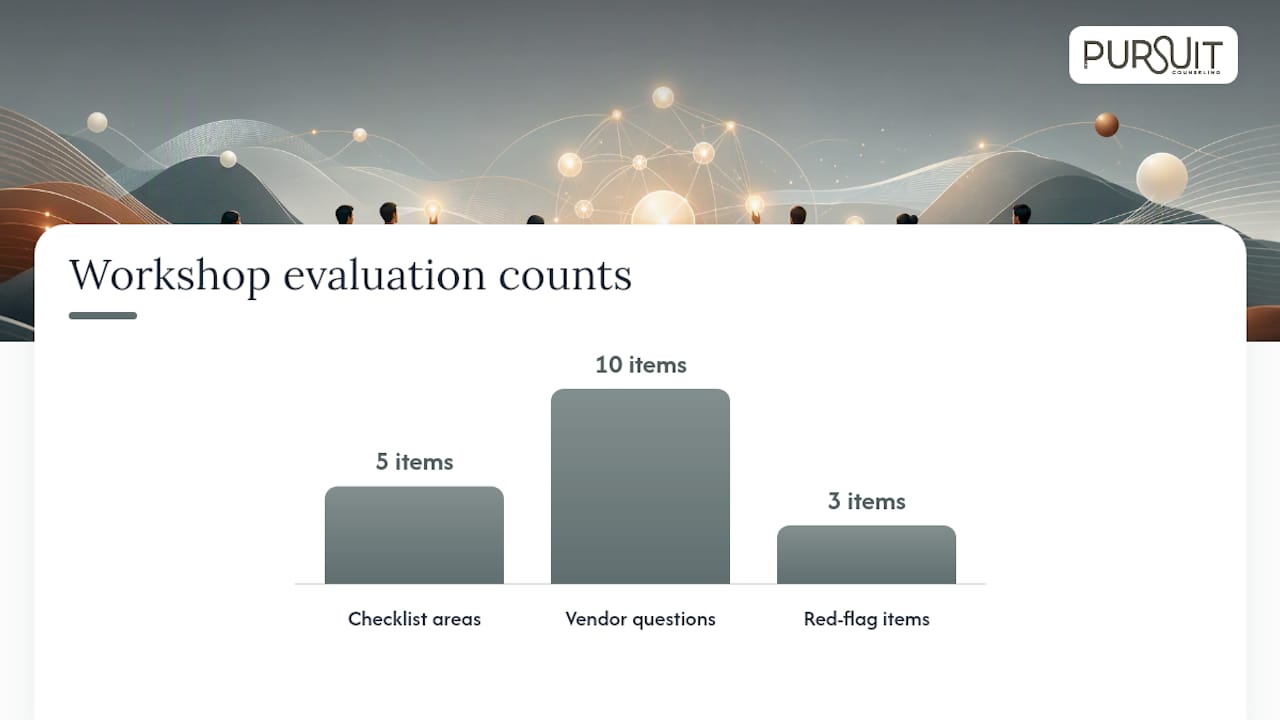
Start with a checklist covering five areas: the evidence base behind the curriculum, the facilitator’s actual credentials, whether the design is experiential or lecture-heavy, what transfer support exists after the session ends, and how the provider plans to measure whether anything changed. Skipping any one of these is how organizations end up paying for a motivational afternoon instead of a durable skill shift.
Ten questions worth asking a vendor or internal provider:
- What research or clinical evidence supports this specific curriculum?
- Who is facilitating, and what is their background in psychology, neuroscience, or coaching?
- How much of the session is active practice versus lecture?
- Will participants leave with a written, personalized action plan?
- How do you measure whether skills actually transferred to the job?
- What follow-up coaching or refresher touchpoints are included?
- Can the content be tailored to our industry’s specific stressors?
- What happens if a participant is in active crisis during the session?
- Is there a pilot option before we commit to a full rollout?
- How does the program scale if we need it for multiple teams?
Pro Tip: A vendor who cannot answer the measurement question specifically, and instead points to a satisfaction survey, is telling you they have not thought past the day of the event.
Red flags include a facilitator with no clinical or behavioral science background, a curriculum with zero built-in follow-up, and a pricing structure with no room to pilot before a large-group rollout. Understanding what actually drives burnout in leadership roles helps you judge whether a workshop’s content is addressing your team’s real pressure points or just repeating generic wellness talking points.
Why The Pursuit Counseling Fits This Evaluation Checklist
Run The Pursuit Counseling against that same checklist and the fit becomes clear fast. The Pursuit Counseling provides professional counseling and executive coaching for high performing people, grounded in neuroscience, neuropsychology, and evidence-based treatments including EMDR, neurofeedback, and the Gottman Method. That is a clinical foundation most generic corporate training vendors simply do not have.
- Facilitator qualifications: sessions are led by clinically trained professionals, not motivational speakers borrowing psychology vocabulary.
- Clinical integration: stress regulation techniques come from treatments already validated in therapeutic settings, not repackaged wellness content.
- Tailored team formats: organizational workshops are built around the specific pressures of the group in the room, from executive teams to first-line supervisors.
- Regional group experience: The Pursuit Counseling runs counseling group workshops in Fayetteville and Peachtree City, Georgia, giving it direct experience facilitating group therapeutic settings, not just one-on-one sessions.
- Follow-up supports: emotional intelligence coaching extends the workshop’s skills into ongoing individual work when a leader needs more than a single session provides.
That combination, clinical depth plus group facilitation experience, is exactly what the evaluation checklist above is designed to surface.
Common Challenges Leaders Face During Resilience Training
Most resistance to resilience training has nothing to do with the content and everything to do with the room. High-performing leaders often walk in skeptical of anything that sounds like “soft skills,” and some treat vulnerability in front of peers as a professional liability rather than the point of the exercise.
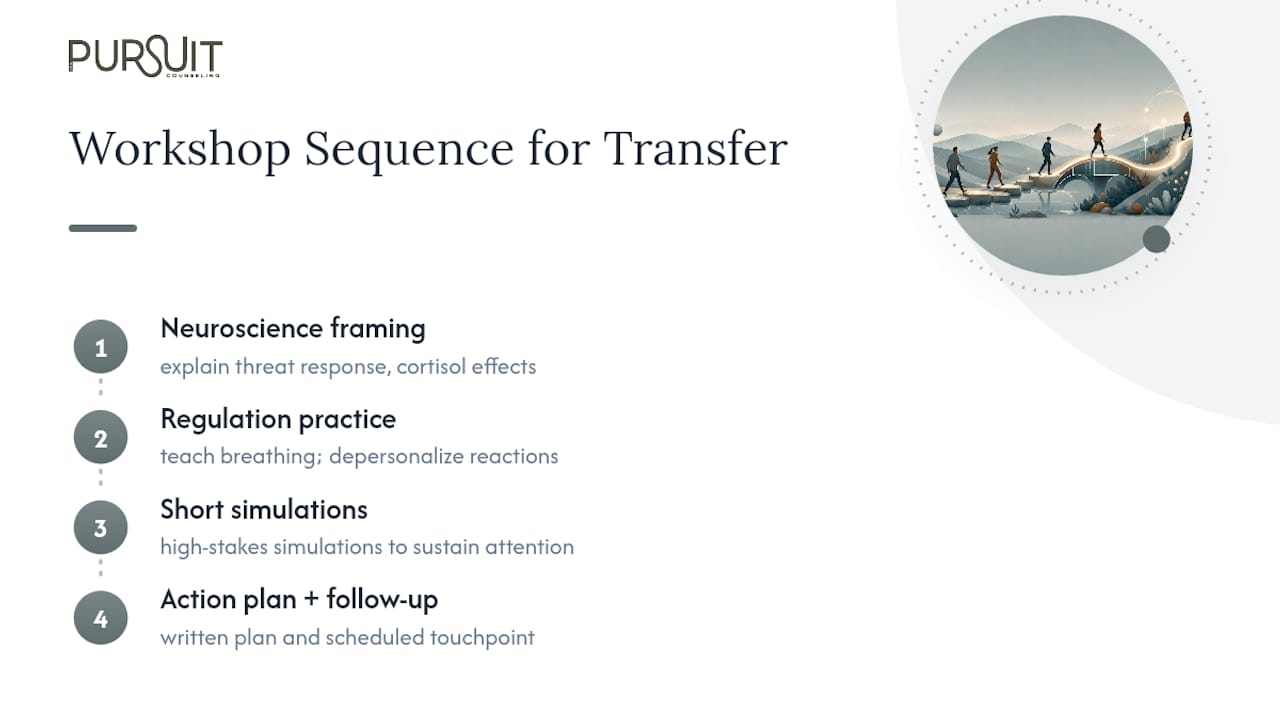
A well-run workshop addresses this directly instead of hoping it resolves on its own. Facilitators frame stress responses in neuroscience terms first, why the brain hijacks attention under threat, before asking anyone to share a personal example. That sequencing matters: leaders adopt regulation techniques more readily when they understand the mechanism, because it depersonalizes the reaction and removes the shame that often surrounds burnout. A leader who understands that cortisol narrows decision making is more willing to practice a breathing technique than one who is simply told to “manage stress better.”
Another common friction point is time. Executives arrive distracted, checking phones between breakouts, which undercuts the experiential design the whole program depends on. Strong facilitators build in short, high-stakes simulations rather than long lectures specifically because attention spans in senior leadership groups are short and protected. The last challenge is transfer: skills that feel obvious in a workshop room evaporate within a week without a concrete plan. That is why a written resilience action plan and a scheduled follow-up touchpoint carry more weight than anything covered in the session itself.
Combining Counseling, Neuroscience, and Coaching in a Workshop Setting
The gap I keep seeing in leadership training is a split between two camps that should never have been separated: strategy-focused programs that ignore how a stressed brain actually behaves, and wellness programs that skip the strategy entirely. Neither one produces a leader who can hold steady during a real crisis. A useful exercise pairs a brief physiological explanation, what cortisol does to decision making, with an immediate practice round: a leader identifies their own early stress signal, then rehearses a specific regulation response before the next simulation. That sequencing, science first, then practice, is what makes the skill stick past the workshop day. Case outcomes and longer-term data on specific cohorts will vary by organization and are worth requesting directly from any provider you’re evaluating.
— Adam
Book a Leadership Resilience Workshop With The Pursuit Counseling
The Pursuit Counseling gives leaders a clinically grounded alternative to generic corporate training: sessions led by professionals trained in neuroscience and evidence-based treatment, not facilitators reading from a wellness slide deck. Workshop formats include group sessions in Fayetteville and Peachtree City, leadership stress management programs, and custom organizational workshops built around your team’s specific pressures.
Pricing is not one-size-fits-all, and neither is your team, so options are scoped to your organization’s size and goals during an initial assessment call. If you’re weighing the cost of executive coaching against what a burned-out leadership team actually costs you, The Pursuit Counseling’s coaching and counseling programs for leaders is the place to start that conversation. Reach out to schedule an assessment call and find the workshop format that fits your team.
Sources
For readers who want to verify the research behind this curriculum directly: Harvard Medical School Executive Education covers the neuroscience of stress and mindfulness in leadership. Wharton Executive Education details experiential resilience program design. GWU’s CEPL program shows a modular format built for emerging leaders. Sustaining leadership performance also has a physical dimension worth exploring through research on executive longevity and long-term capacity.
- The Science of Leadership: The Brain, Resilience, and Mindfulness | Harvard Medical School Executive Education
- The Resilient Leader: Leading with Clarity in Uncertainty – Wharton Executive Education
- Developing Essential Leadership Skills for Career Growth & Transition | CEPL, George Washington University
FAQ
What Are the 5 C’s of Resilience?
The 5 C’s commonly cited in resilience frameworks are competence, confidence, connection, character, and coping, referring to the internal and relational resources that help someone recover from setbacks. Leadership resilience workshops typically build these through specific exercises rather than teaching the framework as an abstract list.
What Are the 5 P’s of Leadership?
Definitions vary across programs, but the term generally points to purpose, people, process, performance, and perseverance, the practical levers a leader manages day to day. Not every reputable workshop uses this exact framework, so ask a specific provider which model, if any, underpins their curriculum.
What Are the 7 C’s of Resilience?
The C’s model typically includes control and calm along with competence, confidence, connection, character, and coping. Workshops grounded in neuroscience, like those referenced by Harvard Medical School Executive Education, tend to focus heavily on the “calm” and “control” elements through emotional regulation training.
What Are Good Ideas for a Leadership Workshop?
Strong workshop agendas combine a stress or resilience assessment, a short neuroscience explanation of how stress affects decision making, breakout simulations or role-play, peer coaching, and a personalized action plan participants take back to the job. The Pursuit Counseling builds its organizational workshops around this same structure, tailored to each team’s specific pressures.
How Long Does It Take to See Behavior Change From a Resilience Workshop?
A single half-day or full-day session can shift awareness immediately, but durable behavior change generally requires follow-up coaching or a refresher touchpoint within 30 to 90 days. Programs with no built-in follow-up tend to see skills fade quickly once participants return to daily pressure.