


Fair fighting rules are agreements about how you disagree: one issue at a time, no degrading language, turns to speak and listen, and a way to pause when things get too hot. They don’t remove conflict. They keep a hard conversation from turning into damage you spend a week repairing.
If you’re reading this, you probably know the pattern. One of you gets louder, the other goes quiet, and the original issue gets buried under the way it was handled. Or you’ve both gotten so careful that nothing gets said at all. Both versions cost something. This guide covers the rules that matter, how to use them when your pulse is up, and what to do when your partner withdraws.
Key takeaways
- Fair fighting is about process. How you talk matters more than who wins the point.
- The core rules are simple: one topic, no insults or threats, take turns, and pause when you’re flooded.
- A break only works if it has an end. Say when you’ll come back, then come back.
- Avoiding conflict isn’t peace. Unspoken concerns pile up and tend to come out sideways.
- These rules are for ordinary disagreements. Fear, intimidation or physical harm are a different problem and need a different kind of help.
Table of Contents
- What fair fighting rules are (and aren’t)
- Before the argument: get clear on what you’re upset about
- 10 fair fighting rules that hold up under pressure
- How to pause an argument without it becoming withdrawal
- What Gottman’s research says about the fights that do damage
- When one of you avoids conflict
- What to do when your partner withdraws
- A worked example: the same fight, two ways
- After the argument: repair counts
- When rules aren’t enough
- Working on it with us
- Our perspective: the pain cave and the cracks
- FAQ
- Sources
What fair fighting rules are (and aren’t)
Think of them as rules of engagement. Relationship educators, therapists and researchers have built these guidelines from what we know about effective communication. The aim is to voice concerns respectfully and solve the problem together, not to keep score.
That last part is the shift most couples need. The National Domestic Violence Hotline describes healthy partners as people who treat an argument as the two of them against a problem they can solve. Not one against the other.
They aren’t a script. Nobody argues perfectly at 10 p.m. after a long day, and a rule you break once doesn’t mean you’ve failed. They’re a shared agreement you can point back to, ideally without it sounding like a citation.
One boundary matters here. The Hotline’s guidance is clear that physical altercations, abusive outbursts and screaming tirades are not a normal part of a healthy relationship. If you’re afraid of your partner, fair fighting rules are not the tool. Reach out to the Hotline or a licensed professional who can help you think through safety first.
Before the argument: get clear on what you’re upset about
Most fights go wrong in the first thirty seconds, and the cause usually sits upstream. You walk in with a feeling you haven’t named, so it comes out as an accusation.
The 2025 Healthy Relationships Initiative e-book suggests reflecting on your own feelings and needs before you start a conflict conversation. Ask yourself a few things:
- What am I actually feeling: hurt, scared, ignored, embarrassed?
- What do I need from this conversation? An apology, a change, just to be heard?
- Is this the right moment, or am I raising it because I’m already worked up?
Then pick a time. “Can we talk about the schedule this weekend? Saturday morning?” is a very different opening than ambushing your spouse in the driveway. A pinned-down time also helps the partner who tends to avoid conflict, because dread without a deadline is worse than dread with one.
10 fair fighting rules that hold up under pressure
The lists that rank for this topic overlap heavily, which tells you something: these ideas show up again and again for a reason. Here are the ones we’d keep.
1. One topic at a time
Partners should discuss one topic at a time rather than lumping several concerns together. If the dishes turn into your in-laws, then money, then something from 2019, nothing gets solved. Write the other topics down and set them for later.
2. No degrading language
No name-calling, sneering, mocking or swearing at each other. You can be furious and still be decent. Contempt in particular does lasting damage, because it tells your partner they are beneath you, not that you disagree with them.
3. Respect the belt line
You know your partner’s tender spots: the thing about their father, the job loss, the body insecurity. Fair fighters don’t hit below the belt line and attack those vulnerabilities, even when they’re angry and the ammunition is right there.
4. Drop “always” and “never”
“You never listen” invites a defense: “I listened Tuesday.” Now you’re arguing about Tuesday. Describe the specific thing that happened and what it did to you.
5. Use “I” statements, honestly
“I felt dismissed when the plans changed without a word to me” lands differently than “You’re so inconsiderate.” University of Florida IFAS Extension points to “I” statements as part of raising hard issues constructively. A caution: “I feel like you’re a selfish person” is an accusation wearing a costume. Name an actual feeling.
6. Take turns, and prove you heard
No interrupting. Then try what Utah State University’s Marriage Commission highlights: have your partner summarize what they heard. It catches misreadings before they become bigger fights. It can feel stiff at first. It’s also remarkably effective.
7. No stonewalling, no yelling
Both are ways of leaving the conversation. One leaves loudly, one silently. We’ll come back to the quiet version below, because it’s more common than people admit and harder to spot.
8. No empty threats
“Maybe we should just get divorced” said in anger is not a negotiating tactic. It teaches your partner that the relationship is always one bad night from ending. If you mean it, say it calmly and separately. If you don’t, don’t say it.
9. Take a time-out when it gets too heated
If an argument gets too intense, a partner can walk away and pick up the discussion later once things have calmed down. The rule that makes this work is in the next section.
10. Aim for closeness, not victory
Someone can win the argument and still lose the evening, the week, or a little of the other person’s trust. Christine Murray of the Healthy Relationships Initiative emphasizes that the process of communicating matters more than the content. Ask yourself during a fight: am I trying to understand, or to be right?
How to pause an argument without it becoming withdrawal
A time-out and stonewalling can look identical from across the room. Both involve someone going quiet and leaving. The difference is intent and follow-through.
A time-out sounds like this: “I’m too worked up to hear you well. I need 30 minutes. I’ll come find you at 8:00 and we’ll finish this.” Stonewalling sounds like silence, a closed door, and no return.
The physiology is real. During intense conflict, fear, anger or anxiety can set off the body’s fight-or-flight response, a state called flooding. A Psychology Today piece on emotional flooding notes that research supports Gottman’s 20-minute guideline: a break of at least 20 minutes during an intense conflict can help regulate emotional responses. You can’t think your way through a conversation while your heart is hammering.
Here’s how to make a break honest:
- Say it out loud. “I need a break” is a statement about your state, not a verdict on your partner.
- Name a return time. The partner who is left waiting needs to know it isn’t abandonment.
- Use the time to settle your body. Walk, breathe, drink water. Don’t spend it rehearsing your closing argument.
- Come back. This is the whole rule. A break you never end is stonewalling with a good excuse.
What Gottman’s research says about the fights that do damage
People ask for “the Gottman rules” a lot. Gottman’s work focuses less on a numbered list and more on what to refuse. According to the University of Florida IFAS Extension summary, fair fighting means refusing four destructive tactics: criticism, contempt, defensiveness and stonewalling. It also means learning to calm yourself, speak non-defensively, and validate your partner’s perspective.
Gottman calls one sequence the “negative cycle of reciprocity”: criticism may lead to defensiveness, then to mutual contempt and withdrawal. Each person’s move triggers the other’s. It’s rarely one villain. It’s a loop with two people inside it.
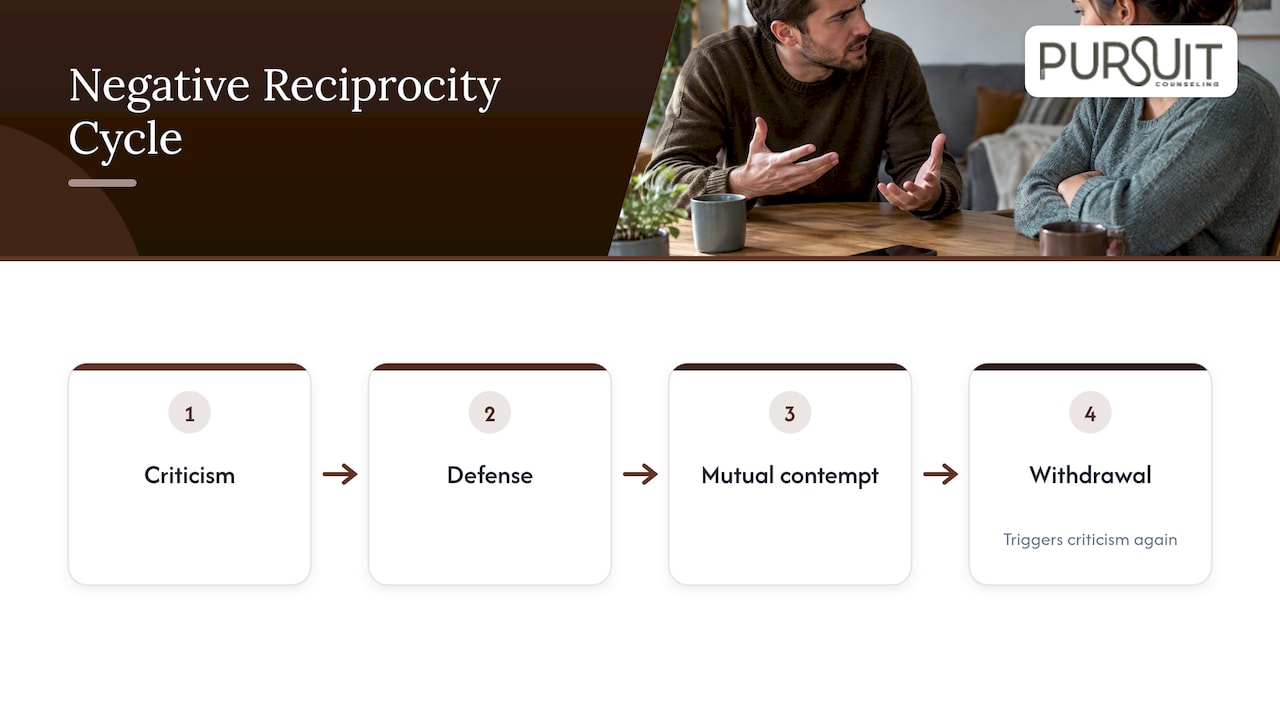
If you can spot the loop mid-fight, you can sometimes interrupt it with one sentence: “I think we’re doing the thing again.” It sounds small. It changes a lot.
We’ve written about this in more depth in the three toxic relationship patterns couples repeat without noticing, and about how to communicate effectively during disagreements.
When one of you avoids conflict
Some couples don’t scream. They go very polite and very far apart. If one or both of you would rather swallow it than say it, the fair fighting rules apply to you too, in a different direction: the rule is to speak.
Conflict avoidance has a cost. The University of Florida’s SMART Couples program describes “gunnysacking”, where unaddressed concerns build up in the bag until they eventually explode in a destructive way. The same source says disagreements are normal for people negotiating close relationships, and partners shouldn’t feel unable to raise an issue.
People avoid conflict for reasons that make sense. Maybe you grew up in a house where anger meant danger. Maybe you’ve learned that your partner’s reaction is bigger than the issue. Maybe you’re exhausted and the silence is cheaper. Those are explanations, not endorsements. The bill still comes due.
If this is you, try a smaller start:
- Raise the small things early, while they’re still small.
- Write down what you want to say before you say it.
- Use a time-out rule so you know you can leave if it gets to be too much.
- Ask for a specific time, so you aren’t expected to produce this on the spot.

What to do when your partner withdraws
This is the other side of the same pattern, and it’s lonely. You bring something up, your partner goes flat, short or silent, and you feel like you’re talking to a wall. So you push harder, which makes them retreat further.
A few things tend to help. None is guaranteed, because every couple’s version of this is different.
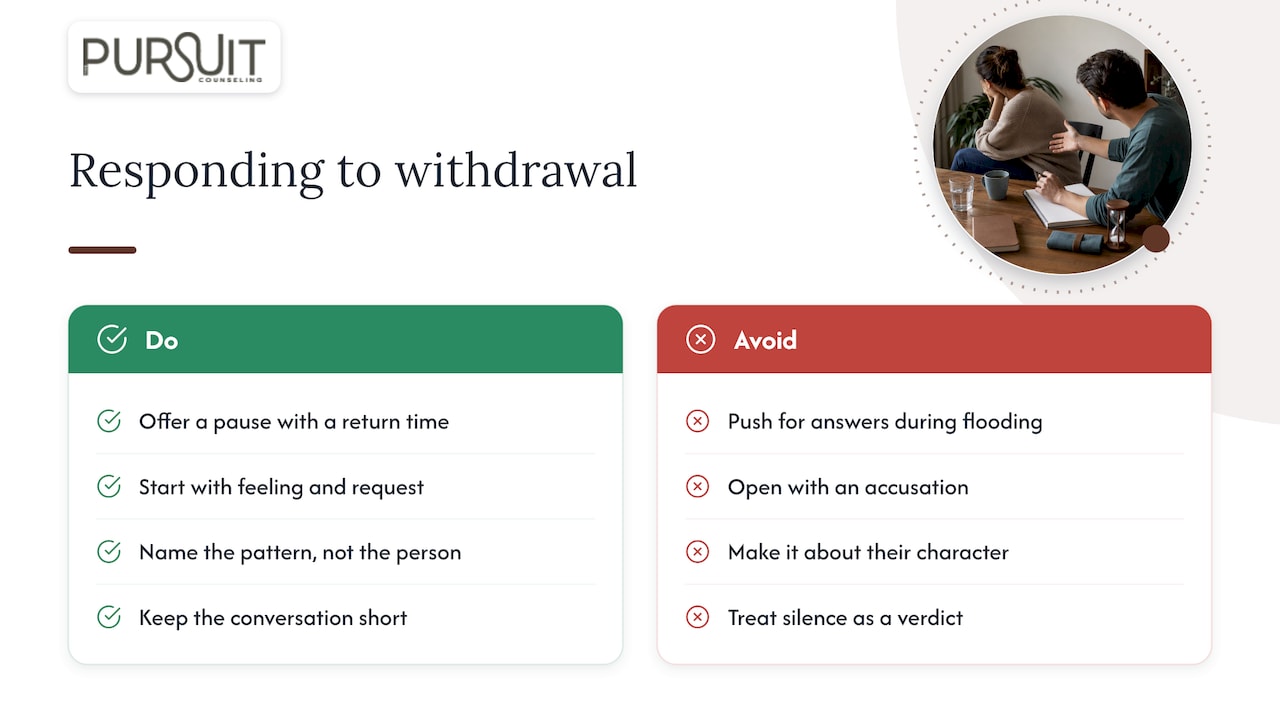
Ask yourself whether it’s a break or a shutdown. Someone who is flooded isn’t being cold on purpose. Pushing for an answer during flooding rarely gets you a better one. Offer a pause with a return time.
Soften the way you start. If the opening is an accusation, the withdrawal is often self-protection. Try beginning with the feeling and the request, not the charge.
Name the pattern, not the person. “When I push and you go quiet, we both end up alone. I don’t want that” is about the loop, not about your partner’s character.
Keep the conversation short. Ten calm minutes you both finish beat an hour you both dread.
Hold your own steady. If you’re the one chasing, your job is to keep your voice level and let the silence be a pause, not a verdict.
If withdrawal is the main way your marriage handles conflict, and attempts to shift it keep ending the same way, that’s usually a sign the pattern is bigger than a communication tip. It deserves a third person in the room. Our guide to identifying barriers to connection in couples walks through what tends to sit underneath.
A worked example: the same fight, two ways
Say one partner returns from a work trip to find the household plans rearranged without them.
Version one: “You always do this. You never think about anyone but yourself.” The reply: “Oh, here we go. You’re impossible.” Ten minutes later, one is yelling and the other is gone. Nothing about the plans has been settled.
Version two: “I felt blindsided when the plans changed while I was gone. Can we talk about how we decide things when I’m traveling?” The reply: “I hear that. I made the call because I couldn’t reach you, and I should have left a message. Let’s work out a better way.” If either gets flooded, they say so and set a return time.
The issue is identical. The second version just keeps both people in the room. That’s the entire point of the rules.
After the argument: repair counts
Fights end badly sometimes, even with good rules. What matters most is what you do next. Come back. Name your part without a “but.” Ask what was hardest for your partner to hear. Then decide on one concrete change.
Also check the unfinished business. If the issue was only paused, put it on the calendar so it doesn’t go into the gunnysack. And if you notice the same argument repeating monthly with different clothes on, that’s a signal worth taking seriously. The topic isn’t the problem. The cycle is.
When rules aren’t enough
Rules help couples who are mostly willing but a little untrained. They don’t do much when there’s deep hurt, such as infidelity, or when one person has stopped trying, or when old trauma gets triggered in every disagreement. Then you’re not failing at technique. You’re carrying something heavier than technique can lift.
Signs it may be time for professional support:
- The same fight returns no matter what you try.
- One or both of you routinely goes numb, leaves, or shuts down.
- Contempt has become your default tone.
- You’re avoiding each other to stay out of conflict.
- A betrayal or major loss hasn’t been worked through.
If you’re unsure about the type of help, our guide on marriage counseling versus couples therapy lays out the differences, and what happens in a first couples therapy session takes some of the mystery out of starting.
Working on it with us
At The Pursuit Counseling in Fayetteville, Georgia, we work with couples who are capable, busy and stuck in a loop they can see but can’t stop. For couples who can’t carve out an hour a week, or who want to go deeper than weekly sessions allow, we offer a Couples Intensive: a focused 3-hour session priced at ,500. We also offer ongoing couples work, in person or online, through our couples and relationship counseling services. We can’t promise an outcome. We can promise to take your particular marriage seriously.
Our perspective: the pain cave and the cracks
We see a lot of couples who are good at hard things. They run companies, fly aircraft, raise kids, and hold it together everywhere but at home. Then a disagreement about something small turns into the worst conversation of the week.
Here’s what we’ve noticed. The argument is rarely about the dishwasher. It’s about whether I matter to you, whether I’m safe with you, whether you’ll stay when this gets ugly. The rules matter, but they work best when both people understand what the fight is protecting.
We also think the quiet partner gets too little attention. Withdrawal is often read as not caring. More often it’s someone overwhelmed, trying not to say something they can’t take back. And the pursuing partner isn’t “too much.” They’re trying to reach someone who has gone behind glass.
The pain cave, the place where you want to quit, shows up in marriages too. Staying in the conversation when every instinct says leave is a skill. It can be practiced. We’d rather help you practice it with someone beside you than watch you white-knuckle it alone.
One more thing. Education and assessment are different. An article like this can give you language and a few tools. It can’t tell you what’s happening in your specific marriage. For that, you need a conversation with someone who can listen to both of you.
— Adam Glendye LPC, CPCS
FAQ
What are the basic rules of fair fighting?
Stick to one topic, avoid name-calling and threats, skip “always” and “never,” use “I” statements, and take turns speaking. If things get too heated, take a break with a set return time. Then come back and finish the conversation.
What are the rules of fair fighting according to Gottman?
Gottman’s work focuses on avoiding four destructive tactics: criticism, contempt, defensiveness and stonewalling. University of Florida IFAS Extension summarizes this alongside skills like calming yourself and validating your partner’s perspective. In practice, that means complaining about a specific behavior without attacking character.
How do you stop fighting with your spouse?
You probably won’t stop disagreeing, and you shouldn’t try to. What you can change is the pattern. Slow your opening, name your feeling, pause when flooded, and repair afterward. If the same fight keeps coming back, a counselor can help you see the cycle from the outside.
Is avoiding conflict bad for a marriage?
Over time it can be. Unspoken concerns tend to build until they come out in a harsh way, which is what “gunnysacking” describes. Raising small issues early, at a planned time and with a clear request, is usually easier on both of you than waiting.
Do fair fighting rules work if my partner won’t follow them?
Rules work best when both people agree to them, and one person can’t enforce them alone. You can still model them: speak calmly, stay on one topic, and take breaks honestly. If your partner’s behavior frightens you or involves intimidation or harm, contact the National Domestic Violence Hotline or a licensed professional.
Sources
- Fighting in a Way That’s Fair, Two of Us
- How to Fight Fair, The Hotline
- HRI E-Book: Managing Conflict in Close Relationships
- Speaking and Listening, Utah State University Extension
- 10 Rules for Constructive Conflict, UF/IFAS Extension
- Why letting it go doesn’t always work, SMART Couples
- Understanding and Coping With Emotional Flooding, Psychology Today