

Emotionally focused therapy (EFT) for couples starts from a simple premise: most relationship fights are not really about the dishes, the money or the in-laws. They are about whether you can count on each other. The therapist helps you see the cycle you both get pulled into, find the more vulnerable feelings underneath it, and learn to reach for each other differently. It usually runs eight to 20 weekly sessions. This guide covers how it works, what happens in the room, what the research says, and how to get ready if you are about to begin.
Key Takeaways
- EFT treats couple distress as emotional disconnection and insecure attachment, not as a communication-skills problem.
- Therapy moves through three broad stages: calming the negative cycle, restructuring how you respond to each other, and consolidating what changed.
- A typical course is eight to 20 weekly sessions, according to Psychology Today.
- Research reviews describe EFT as an evidence-based couple treatment, though no therapy can promise a particular outcome for your relationship.
- Preparing is simple: notice your pattern, name what you want more of, and decide together what you hope the first session does.
Table of Contents
- What EFT couples therapy is
- How EFT works, stage by stage
- What happens in a session
- How long EFT takes
- What the research says
- What to do while you wait to begin
- Our perspective
- Weekly sessions or an intensive
- Working with us
- FAQ
- Sources
What EFT couples therapy is
EFT is the common name for emotionally focused couples therapy. The APA Dictionary of Psychology says it was developed in the 1980s by Leslie Greenberg and Susan Johnson, and that it rests on the idea that relationship problems most often come from thwarted emotional needs, particularly attachment needs.
That is a different starting point from many people’s expectations. If you have tried “better communication” and ended up having the same argument with nicer words, you may have felt that mismatch. The Society of Clinical Psychology describes the rigid negative patterns and intense negative emotion in distressed couples as a sign of emotional disconnection and insecure attachment, rather than simply poor communication or missing relationship skills.
In plain terms: you are not two people who lack tools. You may be two people who stopped feeling sure the other would show up.
The cycle EFT looks for
Every couple has a version of the same loop. One partner pushes, criticizes or demands engagement. The other goes quiet, shuts down or defends. Each response confirms the other’s fear, so the loop tightens. Sue Johnson, in a 2020 Q&A, describes this kind of demand-and-withdraw dance as what keeps the disconnection going.
EFT treats the cycle, not either of you, as the problem. That is a relief for many couples who arrive keeping score of who is to blame.
The A.R.E. question
Johnson defines a secure relationship through three qualities: emotional accessibility, responsiveness and engagement. The shorthand is A.R.E., which maps onto the question underneath most conflict: are you there for me? Much of the work in the room is helping each partner ask that question out loud, and answer it, without armor.
How EFT works, stage by stage
The Society of Clinical Psychology outlines three broad stages. Researchers often break these into nine steps, but the arc is the same.
| Stage | What happens | What it can feel like |
|---|---|---|
| 1. De-escalation | You and the therapist map the negative cycle and name it as the shared enemy | Relief, and sometimes exposure, at seeing your pattern laid out |
| 2. Restructuring | Partners express attachment fears and needs and practice responding differently | The hardest and most tender part |
| 3. Consolidation | You use the stronger bond to handle everyday problems and decisions | More steadiness when old triggers show up |
Stage one: slowing the cycle
The first sessions are about de-escalating reactivity. You will each tell your story, and the therapist will track the moves you make in the moment. Psychology Today notes that the therapist is an active participant, not a silent observer, and that a key piece is reframing distancing behavior such as anger or withdrawal as misguided bids for connection rather than pathology.
That reframe changes the room. The critical partner is not “too much,” and the quiet partner is not “cold.” Each is protecting something.
Stage two: the vulnerable conversation
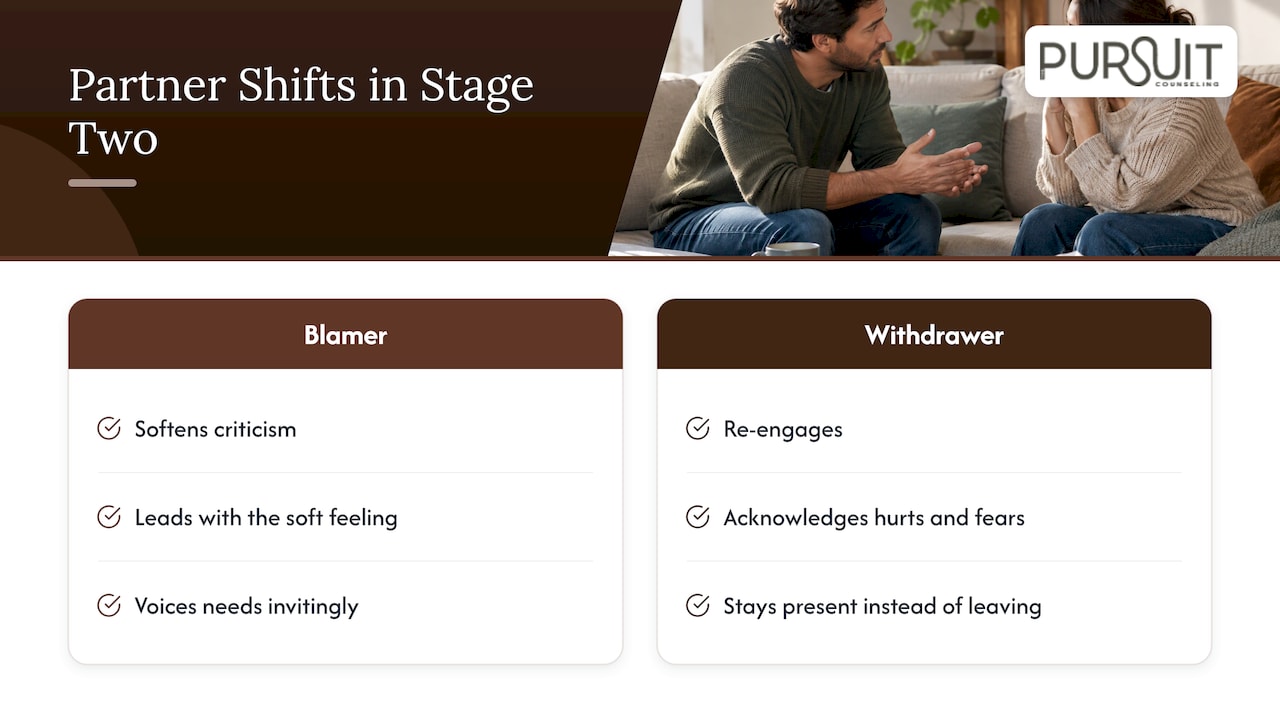
This is where EFT earns its reputation. A process research paper describes the major goals of this stage as withdrawer re-engagement and blamer softening: the partner who has been withdrawn becomes more able to acknowledge hurts and fears, and the previously critical partner does the same.
Sue Johnson describes the therapist helping partners move beneath reactive anger, criticism or withdrawal to fear, hurt, sadness and attachment needs, then voice those needs in ways that invite a response. In practice that sounds less like “you never listen” and more like “when you go quiet, I feel like I’m alone in this.” The second sentence is harder to say. It is also much harder to argue with.
The same paper notes that by the end of successful work here, the pattern of recognizing your own needs, asking for them in an inviting way, and receiving a soothing response is typical of secure attachment interactions.
For the partner steeped in the pushing role, this can mean learning to lead with the soft feeling. For the partner who withdraws, it can mean staying present when everything in you wants to leave. If you have ever watched a high-pressure career train you to stay composed and keep going, this stage can feel unfamiliar. That is normal.
Stage three: making it ordinary
The last sessions consolidate. The Society of Clinical Psychology describes this as using the more secure bond to address everyday problems. Money, parenting, sex, schedules: these stay on the table. They just stop carrying the weight of “do you even care?”
What happens in a session
A session is a conversation, with the therapist sitting alongside you rather than refereeing from a distance. Expect:
- Questions about what just happened between you, in real time, not only about last week
- The therapist slowing a moment down, asking what is underneath a sharp comment
- Turns where you speak to your partner, not about them
- Homework that is usually small: noticing the cycle, naming it, pausing
If you have never been in couples counseling, our guide to your first couples therapy session walks through the logistics.
A common worry is being nervous beforehand. That is ordinary. Many people carry shame about needing help, or fear that the session will become a trial. A good therapist’s job is to keep it from becoming one.
How long EFT takes
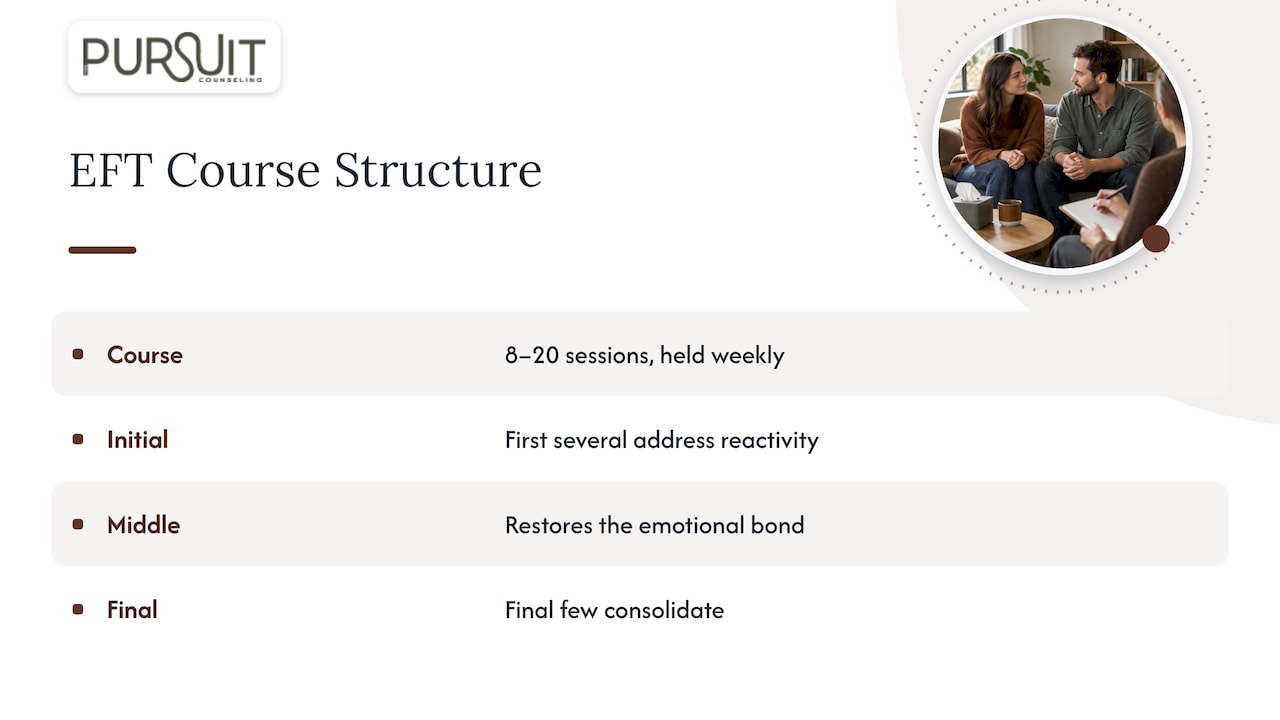
Psychology Today states that a course of EFT typically runs eight to 20 sessions, held weekly. The first several sessions address reactivity, the middle stage restores the emotional bond, and the final few consolidate.
Where you land in that range depends on factors your therapist can talk through with you: how entrenched the cycle is, whether there has been a betrayal or other attachment injury, how consistently you can attend, and whether individual stressors such as trauma, anxiety or ADHD are shaping the pattern. If you want help setting expectations about frequency and phases before you start, steps to prepare for therapy covers how to approach that planning.
What the research says
EFT has one of the larger research bases among couples approaches, and it is worth reading the numbers with care.
- A review of 20 outcome studies found that after treatment the average EFT couple fared better than 89% of untreated couples, and that between half and almost three quarters showed clinically significant improvement, maintained at follow-ups from four months to two years.
- Johnson and colleagues reported a weighted mean effect size of 1.31 across four randomized trials, which they describe as very large for psychotherapy research.
- A 2016 review by Wiebe and Johnson concluded that the research base meets or exceeds guidelines for classification as an evidence-based couple treatment.
These are group averages. They tell you that the approach has been studied and has helped many couples. They cannot tell you what will happen in your marriage, and nobody honest will promise that. What they do support is a reasonable expectation that a structured, attachment-focused process is worth your time and money.
Who it tends to suit
Psychology Today says EFT is especially useful for couples who arrive in real distress or feel so alienated that they wonder if the relationship is repairable, showing anger, fear, grief or loss of trust that can be read as protest and despair over lost connection.
This fits couples we often hear from: two capable adults who run a company, a household or a cockpit well, and who have quietly stopped turning toward each other. Competence at work does not translate into closeness at home. Often it hides the gap.
An education note: reading about EFT is not the same as an assessment. A therapist who meets you both can look at your history, your current stressors and whether something else, such as untreated trauma, addiction, or safety concerns, needs to come first or run alongside. This article is information, not a diagnosis or a treatment plan.
What to do while you wait to begin
The gap between deciding to go and the first appointment can be tense. Some things that tend to help without turning into a project:
- Notice your cycle without fixing it. When a fight starts, name your own move privately: pushing, shutting down, defending. Naming is enough.
- Write down what you want more of. Not what your partner does wrong. Something like “more warmth at the end of the day.”
- Agree on a pause signal. A word or gesture either of you can use when things heat up, with a promise to come back to the topic.
- Protect small moments. Ten minutes of coffee without a phone counts.
- Keep the waiting period free of ultimatums. Big decisions made mid-fight rarely survive the first session.
- Talk about the first session in advance. Share what worries you about it, so the therapist is not the first place it comes out.
If either of you feels unsafe at home, skip the pause-and-wait advice and contact a licensed therapist or a domestic violence hotline right away. Couples therapy is not the right first step in situations of abuse.
Our perspective
Couples rarely walk in saying, “our attachment bond is strained.” They say, “we keep having the same fight.” We have learned to treat that fight as a signal, not as the problem. Underneath it, there is usually a person who is tired of feeling alone and a person who is tired of feeling like a failure.
We value approaches that look at the emotional pattern between two people, and we pair that with the practical reality of busy lives. Many of the couples we see are leaders, pilots, business owners and parents with little margin. They do not need a lecture on communication. They need a place where both of them can be understood, and a plan that fits a real calendar.
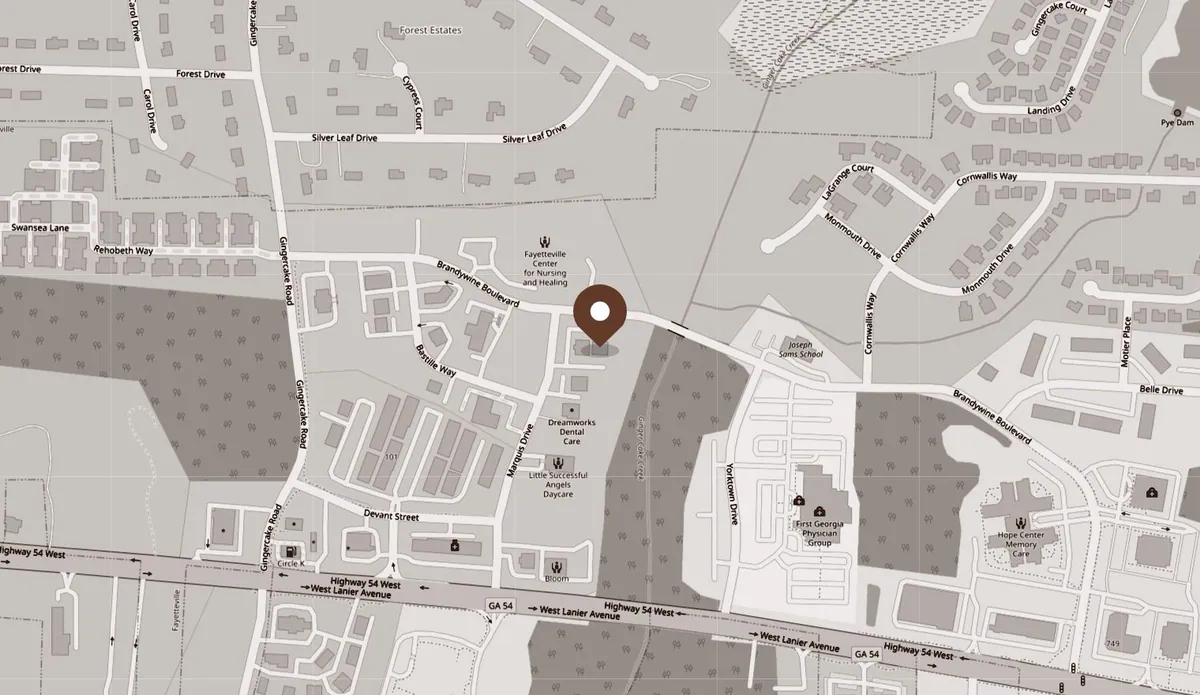
That is why we offer weekly couples counseling and concentrated intensives, in person in Fayetteville or online. We tailor the pace and the methods to the people in the room, and we pay attention to what each of you carries in, whether that is anxiety, trauma or the pressure of a demanding career. Pain is not a sign the relationship is broken. Often it is where the cracks let something true come through.
Adam Glendye LPC, CPCS
Weekly sessions or an intensive
Weekly sessions give you time between meetings to practice. An intensive concentrates the work into a longer block, which suits couples who travel, work irregular schedules, or want to build momentum quickly.
Neither format is better in every case. Which fits depends on your schedule, your budget and how much support you want between sessions.
Working with us
If you live in Fayetteville, Peachtree City, Senoia, Tyrone, Brooks or elsewhere in South Atlanta, we offer couples counseling and intensives in person, and sessions online for those who cannot travel. You do not need to be sure about the approach before you reach out. A first conversation can help you decide what kind of support fits the two of you.

See our couples and relationship counseling services or learn how attachment style therapy can help you understand your patterns. If one of you tends to pursue and the other to pull back, our piece on anxious avoidant couples therapy may feel familiar. When you are ready, you can start at our main site.
FAQ
Is EFT the same as emotionally focused couples therapy?
In couples work, yes. People use EFT and emotionally focused couples therapy interchangeably, and the APA Dictionary notes the approach is commonly called emotionally focused couples therapy. EFT also exists as an individual approach, so check which one a therapist means.
Is it normal to be nervous before couples therapy?
Yes. Many partners worry about being blamed, exposed or outnumbered. In EFT, the therapist’s job includes keeping the focus on the cycle rather than on a culprit. Telling your partner about the nerves beforehand often takes some of the pressure off.
Do we have to be about to split up for EFT to make sense?
No. Psychology Today describes EFT as especially useful for couples in serious distress, but nothing says you must be at the edge. Many couples come because they feel distant, not because they are in crisis.
How is EFT different from learning communication skills?
Skills training teaches techniques for talking. EFT, as described by the Society of Clinical Psychology, treats the problem as emotional disconnection and insecure attachment, so the work goes to the feelings and needs under the argument.
Sources
- APA Dictionary of Psychology: emotion-focused couples therapy
- Society of Clinical Psychology: Emotionally Focused Couples Therapy
- Psychology Today: Emotionally Focused Therapy
- Process Research on Emotionally Focused Therapy (EFT) for Couples
- Q&A with Sue Johnson on Emotionally Focused Therapy, Psychwire
- An Interview with Sue Johnson, EdD, Psychotherapy.net
- Efficacy of BCT and EFT, University College Dublin repository
- Johnson et al., Clinical Psychology 6:1
- Wiebe and Johnson, A Review of the Research in Emotionally Focused Therapy
- Preparing for family involvement in therapy