

In a first couples therapy session, you and your partner meet the therapist together, tell your side of the story, and start naming the pattern that keeps hurting you both. Nobody expects the fight to be resolved in fifty minutes. The therapist is learning how the two of you work, and you are deciding whether this is a person you can be honest with.
If you are reading this with a knot in your stomach, that is common. Many people walk in afraid of being blamed, afraid of saying the wrong thing, or afraid that the room will confirm what they already suspect. This guide walks through what usually happens, what you will be asked, how to prepare without rehearsing, and what stays private.
Key takeaways
- The first session is mostly about understanding. Expect questions about your history, your goals and the cycle you get stuck in, not a verdict on who is right.
- Many therapists treat the first few sessions as an assessment period, sometimes with individual meetings for each partner. Ask how yours works before you start.
- Confidentiality has written rules and legal limits. Ask about the therapist’s policy on private information from one partner before you share anything.
- Some situations, such as active intimate partner violence or intoxication, call for safety planning before joint sessions. Say so privately if that is your reality.
- You do not need to prepare a case. Come with one honest sentence about what you want to be different.
Table of Contents
- What the first session is actually for
- What happens, step by step
- The assessment phase: why it may take more than one session
- Questions your therapist may ask
- When joint sessions are not the right first step
- How to prepare without rehearsing
- Confidentiality when two people share one therapist
- Perspective: how we think about the first hour
- Choosing a therapist you can be honest with
- Working with us in Fayetteville and online
- FAQ
- Sources
What the first session is actually for
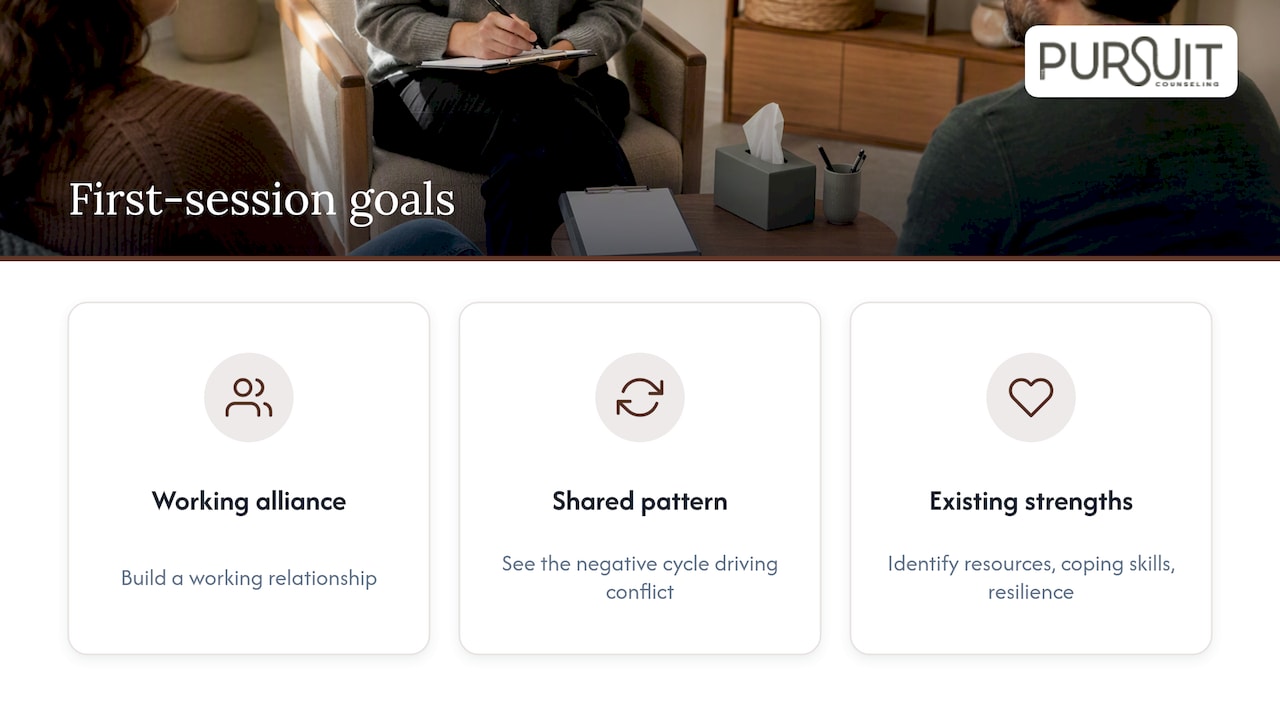
The goal of session one is not to fix your deepest problems. Clinicians who teach couple therapy describe it as building a working relationship and reaching a shared picture of the negative cycle driving the conflict. That cycle might look like one of you pursuing and the other shutting down, or both of you escalating until someone leaves the room.
This matters because it changes the question. Instead of “which of us is the problem,” the room starts asking “what keeps happening between us.” Therapists want you to see that your struggles are often patterns between two people, not proof of a character flaw in either one. If you want a closer look at those patterns, we wrote about three toxic relationship patterns couples repeat without realizing it.
A good first session also has a hopeful undertone, and that is not fluff. Guidance for clinicians describes therapy as strengths-focused from the start: the therapist looks for the resources, coping skills and resilience you already have, not only your complaints. You have probably survived hard things together. That counts.
What happens, step by step
Every therapist runs the hour a little differently, but most first sessions follow a recognizable shape.
- Paperwork and policies. You will usually sign consent forms and receive written information about privacy, fees, cancellations and how the therapist handles contact with one partner between sessions.
- Introductions and the “why now.” The therapist asks what brought you in and why today rather than six months ago. Often one partner pushed and the other agreed. That is fine, and it is worth saying out loud.
- Each partner’s view. You each get time to describe the problem. A skilled therapist keeps this from becoming a trial, interrupts gently, and checks that both of you feel heard.
- History and context. Expect questions about how you met, how long you have been together, what the early years felt like, and what stress is on you now: work, kids, health, money, loss.
- Goals. The therapist asks what you each hope will be different. “Less fighting” is a start. “I want to feel like we are on the same team” is better.
- A first look at the pattern. Some therapists will reflect back what they noticed in the room, or guide you through a short exercise to watch how you talk when things get tense.
- A plan for what comes next. You leave with a sense of the next one to three sessions and what the therapist recommends.
One published summary from a licensed therapist puts the content of the hour in similar terms: history, goals, ground rules and a guided exercise is not what that page says word for word, so treat our list as the common pattern, not a script. Your therapist will tell you how they work.
The assessment phase: why it may take more than one session
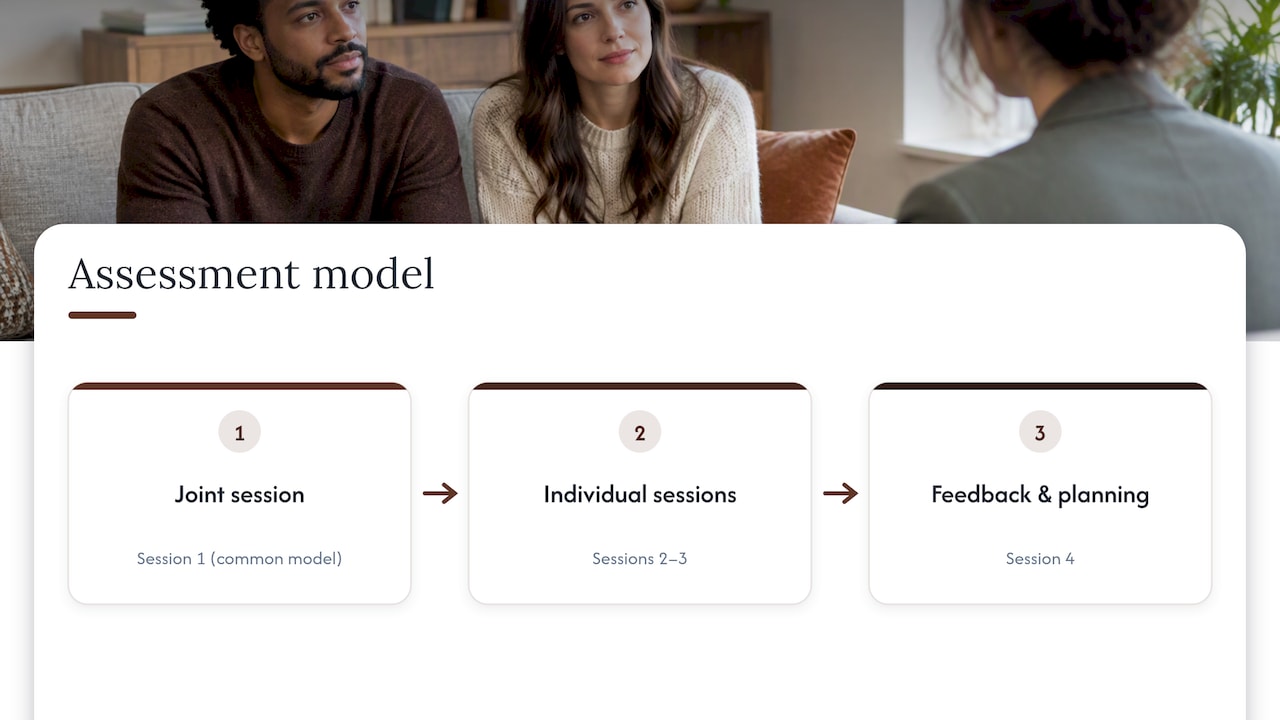
Some couples are surprised when the therapist asks to meet each of them alone. This is not a sign that someone is in trouble. In one common model described by a clinical psychologist on the APA’s podcast, the evaluation takes four sessions: one joint session, two individual sessions and one feedback and planning session. The same conversation notes that this structure helps ease ambivalence in a hesitant partner.
Another APA continuing education resource describes a clinician who always begins with a comprehensive assessment during the first two to three sessions, starting with the couple’s stated goals. So if your therapist says “let’s spend a few sessions understanding you before we start changing things,” that is standard, careful practice and not stalling.
If you are the partner who did not want to come, this structure can be a relief. You are not signing up for months of therapy on day one. You are agreeing to a defined stretch of looking, with a conversation at the end about what, if anything, to do next.
Questions your therapist may ask
Intake questions vary, but you can expect some version of these:
- How long have you been together, and are you married, engaged or living together?
- What brought you in now? What is the one thing that has to change?
- When did things feel good between you? What was different?
- How do you each handle conflict? What happens in the first minute of a fight?
- Is there anything in your history, such as past relationships, family patterns, loss or trauma, that shapes how you react to each other?
- How are sleep, work, drinking, health and stress affecting the relationship?
- Has either of you ever felt unsafe, threatened or controlled in the relationship?
That last question may be asked of each of you alone. Clinical sample assessment materials from the APA list questions such as whether you feel safe in your relationship as part of screening individuals. If the answer is yes, tell the therapist privately. You do not have to say it in front of your partner.
When joint sessions are not the right first step
Couples therapy assumes two people who can speak and listen without fear. Federal guidance for clinicians notes that some circumstances argue against joint sessions at the outset: active intoxication, severe psychiatric symptoms such as acute psychosis or active suicidality, and active intimate partner violence. In those cases, the priority is safety planning and the right referral, not relationship work.
This is not a failure on your part. If you are in danger, call 911. The National Domestic Violence Hotline is available at 1-800-799-7233. If you are in crisis or thinking about suicide, call or text 988. A therapist who redirects you toward individual support first is doing the careful thing.
Substance use is a related case. Research reviewed in a 2019 evidence summary supports systemic interventions for relationship distress, anxiety, mood disorders and substance abuse, including specific models for couples dealing with addiction, provided there is no active partner violence. Couples therapy can help, and the therapist will tell you if something else needs to come first.
How to prepare without rehearsing
You do not need a binder of evidence. You do need to arrive honest and a little curious. A few things help:
- Write one sentence each. Finish this: “I would know therapy was worth it if…” Do not share the sentences beforehand. Compare them in the room.
- Decide what you are afraid of. Being blamed? Being left? Finding out nothing can change? Naming it to yourself makes it easier to say aloud.
- List what still works. Where do you still laugh, cooperate or feel tenderness? Your therapist will want it.
- Agree on a ride home. Plan something low-stakes after the session, like a walk or dinner with no postmortem. The first session often stirs things up.
- Hold the ammunition. Skip the screenshots and the timeline of grievances. A pattern matters more than a case file.
If you are still trying to get your partner to say yes, how you ask matters. A guide on starting difficult conversations with parents is written for a different relationship, but its core advice carries over: decide what to say first, keep it short, and lead with care rather than accusation. Something like “I miss us, and I want help finding our way back” lands very differently than “you need therapy.”

Confidentiality when two people share one therapist
Privacy works differently in couples work, and it is worth asking about before you say anything you cannot take back.
The baseline is clear. The APA explains that therapists generally cannot share what you say with third parties without your written consent, with exceptions the therapist should explain at the first visit: mandatory reporting for ongoing abuse of a child, elder or person with a disability, threats of serious harm to yourself or others, and court orders.
The question unique to couples is what happens when one partner tells the therapist something privately. Policies differ. Some therapists use a “no secrets” rule, meaning they will not hold significant private information from the other partner. Others avoid that rule because it can undercut the alliance they are building with both of you early on. Neither approach is automatically right. What matters is that the policy is spoken and written before you meet individually.
So ask directly:
- If I tell you something alone, will you share it with my partner?
- What happens if one of us wants to stop and the other does not?
- Will you keep notes that either of us can request?
- If we do video sessions, how is the platform secured?
That last one matters. Regulators have taken action over how some online counseling companies handled sensitive data, as in the FTC’s complaint against BetterHelp. If you choose online sessions, read how the practice protects your information. We explain our approach in our page on secure online counseling and teletherapy options. Also be aware that coaching is not therapy; we explain why coaching confidentiality cannot replace HIPAA protection.
Perspective: how we think about the first hour
We work with complicated people. Pilots who are away half the month. Executives who solve problems all day and cannot solve this one. Parents running on fumes. Couples who love each other and keep landing in the same fight.
What we have seen is that most couples arrive believing the problem is the other person, and most leave the first session a little less sure. That is not us taking sides. It is the pattern coming into view. When two capable people keep colliding, there is usually a loop underneath, and the loop is the thing to work on.
We do not promise outcomes, and we do not diagnose a relationship in an hour. The first session is education about how therapy works and a first look at your dynamic, not an assessment of whether you will make it. Anyone who tells you that on day one is guessing.
What we do care about is that you feel understood, that both of you are heard, and that the plan fits your life. Some couples start weekly. Some need more concentrated time. If you are curious about the second option, see our page on what to expect from a couples therapy intensive. Wherever you start, the pain you walked in with is not the whole story. The cracks are often where the honest conversation finally begins.
— Adam Glendye LPC, CPCS
Choosing a therapist you can be honest with
The first session also works as an interview. You are allowed to leave without booking a second one. Pay attention to a few things:
- Fairness. Do both of you feel heard, even when you disagree? One partner leaving feeling outnumbered is a warning sign.
- Structure. Can the therapist explain how they work and what the next few sessions look like?
- Directness. Do they interrupt escalating fights, or let them run?
- Fit with your life. Can you realistically attend? If schedules or travel make weekly sessions hard, ask about online sessions or a concentrated format.
- Clarity on privacy and fees. Everything should be explained plainly and in writing.
We also keep a list of questions to ask your therapist in the first session, and a broader guide to what a first therapy session feels like. If you are unsure whether you want marriage counseling or couples therapy, we break down the difference between the two.
Working with us in Fayetteville and online
The Pursuit Counseling is in Fayetteville, Georgia, and serves Peachtree City, Senoia, Brooks, Tyrone and the rest of South Atlanta, in person and online. Our couples and relationship counseling services are built around collaboration: you are an active participant, and the work is shaped to your situation.
For couples who cannot find the time for weekly sessions, or who want to move through something stuck in one focused block, we offer a Couples Intensive: ,500 per 3-hour intensive. Individual therapy is listed at 5 to 0 per hour. We are private-pay, and you can see all current offerings and published prices on our services page.
If you are ready, the next step is small: reach out and say what is going on, in a sentence or two. You do not have to have the whole story straight. Start at thepursuitcounseling.com.
FAQ
Will the therapist take my side?
A trained couples therapist works for the relationship, not for one partner. They may name each person’s part in the pattern, which can feel uncomfortable. If you consistently feel outnumbered, raise it in session or consider a different therapist.
Should we have individual sessions as part of couples therapy?
Often, yes. Many therapists use one or two individual meetings during assessment to learn each person’s history and ask about safety. Ask your therapist how they handle what is said in those meetings before you attend.
What if my partner refuses to come?
You can start individual therapy, which can help you understand your own part in the pattern and decide how to invite your partner. Lead with care, not accusation, and offer a defined trial, such as an initial evaluation of a few sessions.
Is what we say in couples therapy confidential?
Generally yes, with legal limits. Therapists must usually obtain written consent to share details, but exceptions include ongoing abuse of a child, elder or person with a disability, serious threats of harm, and court orders. Ask for the written policy at your first visit.
Sources
- APA: Relationship advice from a couple psychologist
- APA: Protecting your privacy, understanding confidentiality in psychotherapy
- Carr (2019), Couple therapy, family therapy and systemic interventions: the current evidence base
- AAMFT: A Roadmap for Couple Therapy
- SAMHSA: The Importance of Family Therapy, Advisory 39
- APA: Treating Challenging Couples Cases
- APA: Relationship Problems Sample Assessment Questions
- FTC: BetterHelp complaint