


The pursuer distancer cycle is a reactive loop where one partner chases connection and the other retreats from it, and neither move is really about the other person, it’s about fear. This pattern is common, well documented in couples research, and treatable. If you recognize it, the fastest relief comes from the interruption protocol below, not from trying harder to close the gap or push your partner away.
TL;DR:
- Most couples in distress unknowingly cycle through pursuit and withdrawal driven by fear, not character flaws, with roles shifting over time and context.
- Unresolved pursuer-distancer patterns during early marriage increase the risk of divorce by over 80 percent within four to five years if not addressed.
- Effective intervention relies on structured scripts, pre-negotiated pause protocols, and therapy approaches like EFT or collaborative therapy to address underlying fears.
- Replacing blame with understanding and naming the pattern can significantly reduce escalation and help couples develop healthier connection strategies.
- Long-term success often requires outside therapy, especially for entrenched patterns, with intensive options providing faster, focused breakthroughs.
Table of Contents
- What Is the Pursuer-Distancer Cycle?
- What Do Pursuer and Distancer Behaviors Actually Look Like?
- Why Does the Pursuer-Distancer Pattern Develop?
- What Happens If the Cycle Never Gets Resolved?
- How Do You Interrupt the Pursuer-Distancer Cycle?
- What Therapy Options Actually Help With This Pattern?
- How The Pursuit Counseling Approaches the Pursuer-Distancer Cycle
- A Therapist’s Take on the Pursuer-Distancer Trap
- Ready to Stop the Chase-and-Retreat Pattern?
- Sources
- FAQ
What Is the Pursuer-Distancer Cycle?
The pursuer distancer cycle, also called the pursue withdraw cycle or “the protest polka” in some therapy circles, describes a repeating sequence: one partner reaches for closeness (calling, texting, asking “what’s wrong?” for the fifth time), and the other partner pulls back to protect their own sense of space (going quiet, changing the subject, leaving the room). The pursuer’s reach triggers more retreat. The retreat triggers a harder reach. Around and around it goes, usually without either person choosing it on purpose.
This pattern shows up in the majority of distressed couples who seek therapy, and clinical reviews link it directly to declining emotional and sexual satisfaction. That is not a small detail. Couples who feel stuck in this loop often describe their relationship as lonely even when they live in the same house and share the same bed.
Here’s the part that surprises most couples the first time they hear it in a session: the pursuer distancer pattern is not a description of who someone is. It’s a description of what a relationship does under stress. The same person who chases in one relationship might withdraw in another, depending on their partner’s style, the specific issue, or even the day of the week.
A few things worth knowing before you try to label yourself or your partner:
- Roles are context dependent, not fixed personality traits. Someone can pursue around emotional topics and distance around practical ones.
- The pattern often starts small, around scheduling or chores, then migrates into bigger territory like intimacy, trust, and long-term commitment.
- Both roles are attempts at self-protection, not character flaws. The pursuer is protecting the relationship from disconnection. The distancer is protecting themselves from feeling overwhelmed or criticized.
- Couples can shift roles entirely over the life of a relationship. The chaser in year two can become the withdrawer in year ten.
Understanding the mechanics matters more than assigning blame. Once you can name the dance, you can start changing your steps in it, which is the entire premise of the rest of this guide.
What Do Pursuer and Distancer Behaviors Actually Look Like?
You don’t need a clinical degree to spot this pattern in your own relationship. You need a short list of behaviors and the honesty to admit which ones feel familiar.
- The pursuer texts, calls, or follows up repeatedly when they sense distance. A single unanswered message becomes three, then a phone call, then a comment at dinner about “you never respond to me.”
- The pursuer asks pointed questions that sound like concern but function as urgency. “Are we okay?” asked four times in one evening is not really a question. It’s a bid for reassurance dressed up as curiosity.
- The pursuer criticizes the distance itself. “You always shut down” or “You never want to talk” are common lines, and they tend to accelerate withdrawal rather than reduce it.
- The distancer goes quiet mid-conversation. This is often mislabeled as stonewalling out of spite. More often it’s a nervous system trying to slow down an interaction that feels like too much, too fast.
- The distancer finds reasons to leave the room, the house, or the topic. Sudden interest in a garage project or a work email at 9 p.m. is frequently an exit strategy, not genuine distraction.
- The distancer minimizes the issue when pressed. “It’s not a big deal” or “I don’t know why you’re upset” can be a genuine attempt to de-escalate, even though it often lands as dismissive.
- Both roles can flip within the same relationship, sometimes within the same week. A distancer at home might become the pursuer with friends or family; a workplace pursuer might withdraw completely in romantic conflict.
Notice how many of these behaviors look reasonable in isolation. Asking “are we okay?” is not inherently unhealthy. Neither is needing quiet time after a hard day. The problem isn’t the individual behavior. It’s the repeating loop where each person’s coping strategy becomes the other person’s trigger.
Why Does the Pursuer-Distancer Pattern Develop?
This cycle isn’t a personality mismatch or a sign of incompatibility, and some people find that attachment anxiety hypnosis offers helpful tools to regulate their nervous system and reduce reactive patterns. It’s largely a byproduct of attachment history and nervous system wiring, and understanding that mechanism is the fastest way to stop blaming your partner, or yourself.
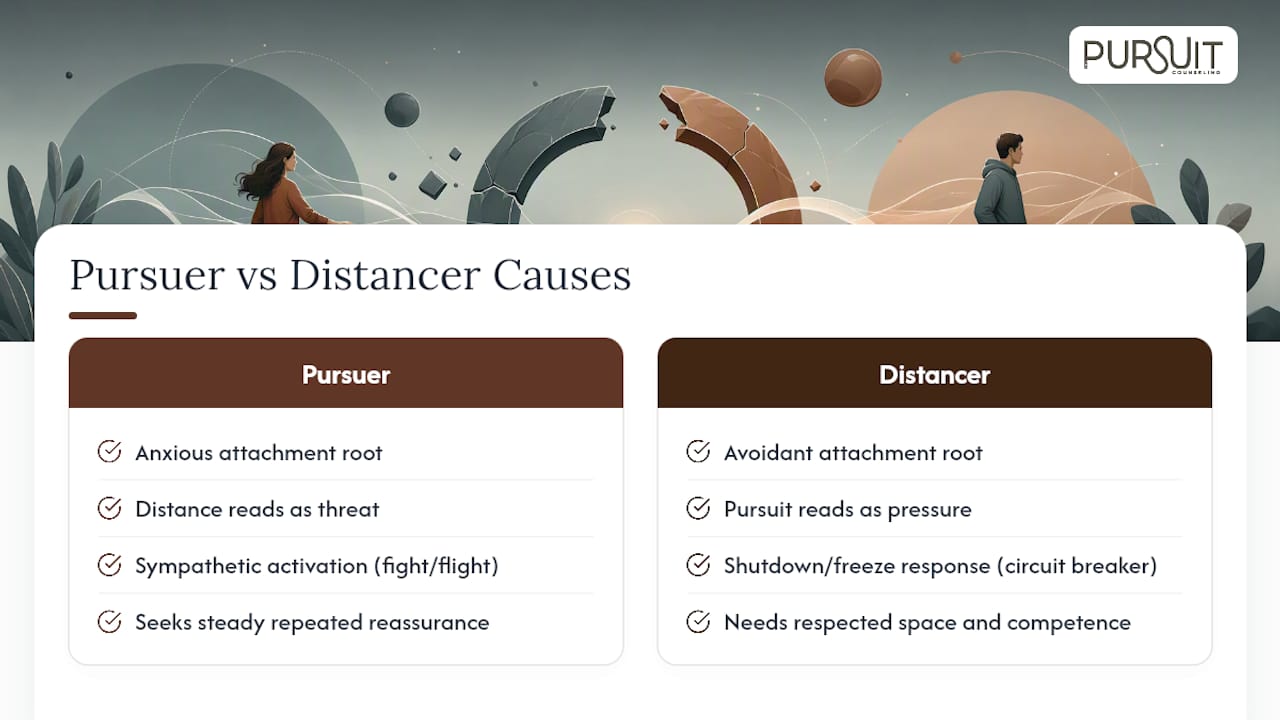
Attachment roots. People who lean toward the pursuer role often carry anxious attachment patterns, shaped early by relationships where closeness felt inconsistent. Distance registers to them as a threat signal: if I don’t close this gap right now, I might lose the relationship entirely. People who lean toward the distancer role often carry avoidant attachment patterns, shaped by relationships where too much closeness felt intrusive or overwhelming. To them, pursuit registers as pressure: if I don’t get space right now, I’ll lose myself.
Neither pattern is a diagnosis. Both are adaptive strategies that made sense in an earlier context and now misfire in a current one.
The nervous system angle. This is where the mechanism gets concrete. A pursuer’s body often shifts into sympathetic activation, the fight-or-flight gear, when connection feels threatened. Heart rate climbs, thoughts race, the urge to do something becomes almost physical. A distancer’s body more often shifts toward a shutdown or freeze response, the nervous system’s way of reducing input when it feels flooded. That shutdown can look like coldness from the outside, but physiologically it functions more like a circuit breaker tripping.
Attachment researchers have documented a related mechanism in early development through the still-face experiment, where an unresponsive caregiver reliably produces escalating protest behavior in an infant, crying, reaching, increasing intensity. That same escalation pattern shows up in adult pursue behavior when a partner goes unresponsive. Your nervous system doesn’t know the difference between a caregiver and a spouse in this respect. Unresponsiveness reads as danger either way.
The dependency paradox. Here’s the piece that resolves most of the confusion couples bring into a first session. Pursuers actually relax and pull back their pursuit when they receive reliable, repeated reassurance, not more of it in a single burst, but a steady pattern over time. Distancers, meanwhile, need to feel respected as competent adults who are allowed to need space without being punished for it. Both needs are legitimate, and both can be met in the same relationship, which is exactly what the Gottman Institute’s research on this dynamic points toward. The paradox is that giving your partner what they actually need, instead of what your fear tells you to do, is usually the move that finally breaks the loop.
What Happens If the Cycle Never Gets Resolved?
The stakes here are real, and the research on this specific dynamic is sobering enough that it deserves a direct look rather than a soft one.
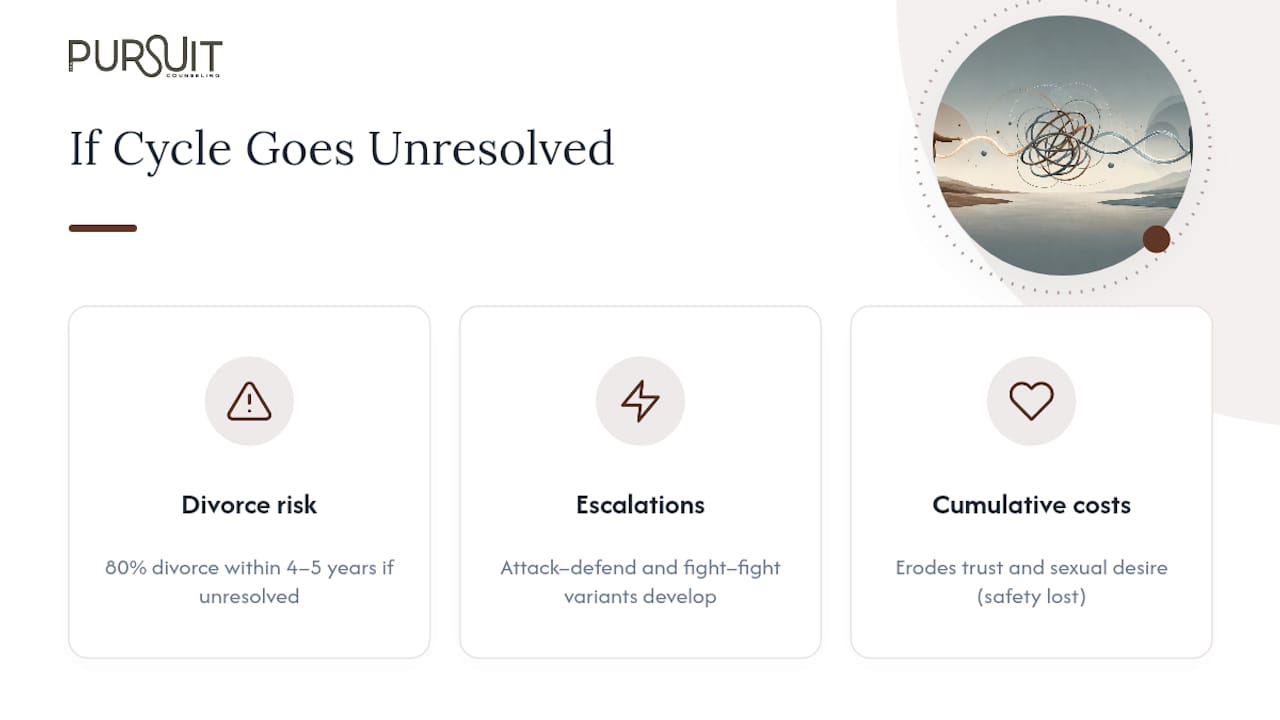
The Numbers Behind the Risk: John Gottman’s research on newly married couples found that those stuck in an unresolved pursuer-distancer pattern during the early years of marriage carry over an 80% chance of divorce within four to five years.
That figure carries an important caveat. It describes couples where the pattern remains unaddressed, not couples who identify it and actively work on it. The entire point of naming this dynamic early is to move yourself out of that statistic, not to be frightened by it.
Left alone, the basic pursue withdraw sequence rarely stays simple. Clinical literature on couple dynamics documents several escalation variants that this cycle can evolve into over time, including an “attack, defend” pattern where criticism meets counter-criticism instead of withdrawal, and a “fight, fight” variant where both partners pursue simultaneously, turning every disagreement into a standoff rather than a chase. These escalation patterns tend to be harder to treat than the original loop because both people have shifted into defensive postures instead of the original pursue and retreat roles.
The cumulative cost shows up in two places most often. Trust erodes because the pursuer starts to feel chronically unimportant, and the distancer starts to feel chronically criticized. Desire erodes because sexual intimacy requires a felt sense of safety that this cycle steadily depletes on both sides. Neither partner is doing this on purpose. That’s precisely why waiting for the feeling to change on its own rarely works, and why specific, structural intervention tends to outperform good intentions.
How Do You Interrupt the Pursuer-Distancer Cycle?
This is the part couples actually need: concrete moves, not concepts. The goal isn’t to eliminate either role overnight. It’s to give both partners a way to change the pattern’s mechanics before it reaches full escalation.
For the pursuer: reduce the intensity without abandoning the need
Pursuers tend to be outcome dependent, meaning their nervous system expects an immediate response to feel settled. That expectation is exactly what needs adjusting, not the underlying need for connection itself.
- Build a self-soothing anchor you can use in the moment: a specific breathing count, a short walk, a text to a friend, anything that doesn’t require your partner to act.
- Limit the intensity of a single ask. Instead of a paragraph or a string of texts, try one clear sentence: “I’d like fifteen minutes to talk tonight when you’re free.”
- Schedule a recurring check-in, even ten minutes twice a week, so reassurance becomes predictable instead of something you have to extract in the moment.
- Practice tolerating a delayed response without assuming it means rejection. Delay is not the same as abandonment, even though it can feel identical in the first sixty seconds.
For the distancer: offer a guaranteed return instead of a silent exit
Distancers often need graded re-engagement rather than direct pressure to open up immediately. The fix isn’t forcing yourself to stay in a flooded conversation. It’s making your exit predictable instead of alarming.
- Name the need for space out loud instead of just disappearing: “I’m getting overwhelmed. I need a break.”
- Attach a specific, honored time to every pause. “I need twenty minutes to calm down. I’ll be back at 8:15” works far better than “I need space” with no return point.
- Return at the time you named, even if you don’t have a full resolution yet. The return itself is the trust-building act, not the resolution.
- Avoid using space as a way to end the conversation permanently. A pause is a tool, not an exit strategy.
The pre-negotiation protocol
Pre-negotiating your pause-and-return language is one of the simplest, highest-impact interventions available to couples, and most never do it without a therapist prompting them to. Here’s a template you can adapt in five minutes, ideally during a calm moment rather than mid-argument:
- Agree on a shared phrase that signals a pause is needed, something neutral like “I need a timeout,” said without sarcasm.
- Set a maximum pause length in advance, generally between twenty and forty-five minutes. Longer pauses tend to increase pursuer anxiety without adding real benefit.
- Commit out loud to a return time and a return action: “I’ll come find you” or “I’ll text you when I’m ready.”
- Agree that the topic will actually be revisited, not dropped. A pause without a follow up promise just becomes another form of avoidance.
Two exercises worth practicing outside of conflict
Role reversal empathy. Set aside ten minutes when things are calm. Each partner spends two minutes describing what the other role feels like from the inside, as best they can guess. Pursuers often discover that distancers aren’t indifferent, they’re overwhelmed. Distancers often discover that pursuers aren’t controlling, they’re scared.
The ten-minute ritual. Pick a low-stakes daily check-in, morning coffee, a walk, a text exchange before bed, and protect it from becoming a venue for unresolved conflict. The point is building a reliable pattern of connection so the pursuer’s nervous system has evidence that closeness is stable, which naturally lowers the urge to chase.
Pro Tip: Practice these scripts during a calm week, not your next argument. If you introduce “I need twenty minutes” for the first time in the middle of a fight, it reads as an escape hatch instead of a tool. Rehearse it when nothing is wrong so it’s credible when something is.
If your household includes recurring communication breakdowns beyond this specific cycle, a structured communication skills approach can reinforce these scripts with more depth than a single article can offer.
What Therapy Options Actually Help With This Pattern?
Self-directed scripts and exercises solve a lot of the immediate friction, but plenty of couples reach a point where the pattern has enough history behind it that outside structure genuinely helps.
Emotionally Focused Therapy (EFT) and Collaborative Couple Therapy are the two modalities most consistently recommended for this exact dynamic. Both approaches work by identifying the underlying fears driving each partner’s behavior, abandonment fear beneath pursuit, inadequacy fear beneath withdrawal, and then restructuring how the couple interacts around those fears rather than just managing the surface behavior. Outcome research on these models shows meaningful movement from distress toward more secure connection for many couples, though results understandably vary by couple and by how long the pattern has been entrenched.
Collaborative Couple Therapy specifically uses a technique of mapping the interactional cycle step by step, behaviors, then the thoughts that coach those behaviors, then the primary emotion underneath, then the actual unmet need. This turns an abstract fight into a diagram both partners can see together, which tends to reduce blame because the pattern becomes the shared enemy instead of either partner.
What a couples intensive offers that weekly sessions don’t. A standard weekly session gives you fifty minutes to process a week’s worth of accumulated friction, which often isn’t enough runway to get past surface conflict into the underlying cycle. A couples intensive compresses multiple hours of focused work into a single day or a short series of days, which matters most for couples who feel too far into escalation to make headway in incremental sessions.
When individual work is the right first step. Sometimes one partner’s contribution to the cycle is rooted in trauma or a nervous system that stays chronically dysregulated, in which case individual modalities like EMDR or DBT skills training may need to run alongside couples work, not instead of it. This is especially true when withdrawal resembles shutdown more than simple avoidance, or when pursuit resembles panic more than simple worry.
What to actually expect early on:
- The first few sessions usually focus on naming the cycle itself, not solving the underlying issue that triggered it.
- Homework tends to be small and specific: practicing the pause script once, trying the ten-minute ritual, noticing when the old pattern starts.
- Progress often looks like a shorter, less intense version of the same fight before it looks like no fights at all.
- One partner starting the work alone can shift the entire dynamic, even before the other partner is fully on board.
How The Pursuit Counseling Approaches the Pursuer-Distancer Cycle
Adam Glendye, LPC, CPCS, brings both direct clinical training and clinical supervision credentials to this work, meaning the approach used with clients is grounded in tested methodology rather than improvisation. The counseling services offered include couples intensives for pairs who need concentrated time to break an entrenched pattern, teletherapy options for couples with demanding schedules, and trauma-informed individual care when one partner’s role in the cycle is rooted in something deeper than the current relationship.
In practice, that means sessions build the pre-negotiation protocol directly into homework, and nervous system regulation gets taught explicitly rather than assumed. Couples leave with language they can actually use at home, not just insight about why the fighting happens.
A Therapist’s Take on the Pursuer-Distancer Trap
The biggest mistake couples make isn’t the chasing or the withdrawing. It’s deciding one of you is the problem. Both roles are protective strategies, not character flaws, and treating your partner as the villain in this story guarantees the cycle keeps running.
Watch for two common self-blame traps: pursuers who conclude they’re “too needy,” and distancers who conclude they’re “incapable of intimacy.” Neither conclusion is accurate, and both make the cycle harder to interrupt because shame rarely produces change.
Try this in the next 48 hours: name the pattern out loud to your partner, without blame, just the mechanics. “I think we get into a chase and retreat thing.” That single sentence, said with curiosity instead of accusation, often does more than a week of arguing about who started it.
— Adam Glendye LPC, CPCS
Ready to Stop the Chase-and-Retreat Pattern?
Recognizing this cycle is the easy part. Actually rewiring it under real-life stress, with a real partner who has their own history and reflexes, is where most couples need more than a blog post. The Pursuit Counseling offers a faster path than trial-and-error at home: structured couples therapy built specifically around interrupting patterns like this one, with both weekly session and intensive formats depending on how entrenched the cycle has become.

A first session typically starts with mapping your specific version of the cycle, not generic advice, so you leave with language that fits your actual relationship. If your pattern feels newer or less intense, weekly couples sessions usually give enough room to practice the scripts above with guidance. If you’ve been stuck in this loop for years, or the escalation has moved into attack-defend territory, a couples intensive compresses that work into focused time instead of stretching it across months. Either way, the next step is simple: book a session and bring your specific version of the story, whatever role you play in it.
Sources
For readers who want to verify the research directly, the Gottman Institute’s primer on the pursuer-distancer dynamic covers the divorce-risk data in full context. Their follow-up piece on avoiding the pattern offers the dependency paradox framework in more depth. For the attachment and nervous-system mechanism, Psychology Today’s breakdown of the still-face research is worth a full read, and clinicians interested in Collaborative Couple Therapy’s mapping technique can review the peer-reviewed summary on PubMed.
This article is general information, not a substitute for advice from a qualified doctor. Consult a qualified healthcare professional about your own circumstances before acting on anything here.
- How to avoid the pursuer-distancer pattern — The Gottman Institute
- Breaking the Pursue/Withdraw Cycle: The Power of Response — Psychology Today
- Intrusive partners – elusive mates: the pursuer-distancer dynamic — PubMed citation
FAQ
How Do You Break the Pursuer-Distancer Cycle?
Break it by naming the pattern together, then using pre-negotiated pause language, the distancer gets a limited, honored break with a set return time, while the pursuer practices self-soothing instead of escalating pursuit during that pause.
What Is the Pursuer-Distancer Cycle According to Gottman?
Gottman’s research describes it as a repeating loop where one partner seeks closeness and the other withdraws for space, and it warns that couples stuck in this unresolved pattern during early marriage face an over 80% divorce risk within four to five years.
Why Do I Always Chase in My Relationships?
Chasing usually reflects an anxious attachment pattern where distance registers as a threat to the relationship itself, and your nervous system shifts into an activated, urgent state that pushes you to close the gap immediately rather than tolerate uncertainty.
What Is the 3-6-9 Rule in Dating?
The “3-6-9 rule” is informal dating advice about pacing early relationship milestones rather than an established clinical framework, and it isn’t directly related to the pursuer-distancer dynamic, which applies more to established relationships than early dating stages.
Is There a “72-Hour Rule” for Intimacy After Conflict?
There’s no clinically established “72-hour intimacy rule” tied to the pursuer-distancer cycle; what the research does support is that repair after conflict, through pre-negotiated check-ins and honored return times, matters more than any fixed waiting period.