


In Georgia, neurofeedback typically runs about to 0 per session, with full programs landing between ,500 and ,000 depending on how many sessions your plan calls for. Insurance coverage is uncommon and inconsistent, so most clients pay out of pocket. Before committing to a clinic, ask for a written estimate that spells out the brain map cost, the per-session rate, and the expected number of sessions.
TL;DR:
- Most neurofeedback programs in Georgia cost between ,500 and ,000, depending on session count and protocol complexity, with assessment fees often billed separately.
- Larger clinics with more sensors and credentialed clinicians charge higher rates, and front-loaded programs cost more initially due to the brain map assessment.
- Insurance coverage is rare, but clients can seek out-of-network reimbursement using superbills and should verify if the provider offers detailed documentation.
- Clinic choice should consider equipment, clinician credentials, scheduling, and whether the brain map is bundled into the overall price to ensure real value.
- Remote or at-home neurofeedback options are cheaper but less personalized, and their effectiveness depends on treatment complexity and oversight levels.
Table of Contents
- Typical Price Breakdown: Assessment, Sessions, and Program Totals
- What Determines the Price You’re Quoted
- Clinic, Guided At-Home, or Self-Guided: Which Fits Your Budget?
- Insurance, Medicare, Medicaid, and Out-of-Network Reimbursement
- How to Budget and Spot Value Versus a Bad Deal
- Local Expertise: What a Georgia Clinic Can Offer You
- How Much Neurofeedback Costs Across Georgia
- Neurofeedback Versus Other Treatments: Comparing the Cost
- Financial Help and Assistance Options in Georgia
- Is the Cost Worth It for You?
- What Working With The Pursuit Counseling Looks Like
- FAQ
- Sources
Typical Price Breakdown: Assessment, Sessions, and Program Totals
Most neurofeedback programs start with a qEEG brain map, a diagnostic step that measures brainwave activity and shapes the treatment protocol. This assessment is usually billed separately from ongoing sessions and tends to be front-loaded into the first visit, which is one reason the opening weeks of treatment feel more expensive than the maintenance phase that follows.
Per-session pricing in Georgia generally falls into three bands. On the low end, group or template-based protocols can run closer to to 0. Typical individualized sessions with a credentialed clinician land between 5 and 5. High-end programs that include ongoing qEEG-guided adjustments and more clinician time can reach 0 or more per session.
Here is how those rates translate into real program totals.
- A 10-session trial, often used to gauge early response, costs roughly ,250 to ,000.
- A 20-session program, common for anxiety or mild attention concerns, runs about ,500 to ,000.
- A full multi-session protocol commonly used for ADHD typically totals several thousand dollars once the assessment is included.
Session-count norms matter here. Professional summaries tied to ISNR’s evidence review report that 30 to 40 sessions are commonly required for meaningful, sustained improvement in ADHD protocols, which explains why total program cost, not the per-session sticker price, is the number that actually matters.
What Determines the Price You’re Quoted
Two clinics in the same Georgia county can quote wildly different prices for what sounds like the same service. The gap usually comes down to a few factors.
- Equipment and protocol complexity: More sensors and qEEG-informed, individualized protocols cost more to deliver than a single-channel template approach.
- Clinician credentials: Practices staffed by board-certified providers (BCN/BCIA) and licensed clinicians such as LPCs typically charge more, but that premium often buys supervised assessment and documentation that supports reimbursement later. BCIA certification is one of the clearer signals of practitioner training in this field.
- Scheduling intensity: Front-loaded programs with two or more sessions a week in the early weeks cost more upfront but compress the overall timeline compared to once-a-week maintenance visits.
- Assessment depth: An initial brain map adds cost before treatment even begins, but it also lets a clinician target the protocol instead of guessing.
Pro Tip: Ask any clinic for an itemized estimate that separates the brain map fee from the per-session rate. A single bundled number hides which part of the cost is assessment and which is ongoing treatment.
Clinic, Guided At-Home, or Self-Guided: Which Fits Your Budget?
Not every neurofeedback option requires a clinic chair. The right format depends on what you’re treating and how much oversight you want along the way.
- In-clinic, clinician-led sessions run the full 5 to 0 per-session range discussed above and include a licensed or board-certified provider adjusting the protocol in real time. This is the format most appropriate for complex presentations, co-occurring conditions, or children, where misreading a response could waste sessions and money.
- Clinician-guided at-home programs cost less per session, often because equipment rental replaces an office visit, but still involve remote oversight from a trained provider who reviews your data and adjusts the plan.
- Self-guided consumer devices are the cheapest entry point and the least personalized. Without a qEEG or clinician review, there is no way to confirm the protocol matches your brain activity rather than a generic template.
Before choosing any format, ask three questions: does the price include a brain map, is a credentialed clinician reviewing your sessions, and what is the expected session schedule? A vague answer to any of these is worth treating as a caution flag.
Insurance, Medicare, Medicaid, and Out-of-Network Reimbursement
Here is the part most Georgia readers want clarity on: insurance rarely covers neurofeedback outright, and when it does, the path usually runs through out-of-network reimbursement rather than an in-network benefit.
CMS’s National Coverage Determination for biofeedback therapy treats this category narrowly. Coverage is generally limited to specific muscle re-education indications, and neurofeedback is often considered investigational for the behavioral health conditions most Georgia clients are pursuing it for, including ADHD, anxiety, and trauma. Georgia Medicaid’s behavioral health services page outlines what the state program does cover, and it is worth checking directly rather than assuming neurofeedback falls under an existing behavioral health benefit.
That does not mean every dollar is unrecoverable.
- Ask your provider for a superbill, an itemized receipt with CPT codes that you submit to your insurer for possible out-of-network reimbursement.
- Call your insurer before treatment begins to ask whether any preauthorization is required for the billed codes.
- Confirm in writing what your clinic will and will not provide in terms of documentation, since not every practice issues superbills automatically.
Our guide to out-of-network reimbursement in Georgia walks through the submission process in more detail, and our couples therapy insurance coverage guide covers similar reimbursement mechanics that apply across behavioral health services.
How to Budget and Spot Value Versus a Bad Deal
Cost anxiety is reasonable here. A few practical moves can soften the financial load without lowering the quality of care.
- Ask about package pricing, since many clinics discount per-session rates when you commit to a 10 or 20-session block upfront.
- Request a sliding scale or payment plan, particularly if you’re self-paying for a full 30 to 40 session protocol.
- Ask whether the brain map is bundled into a package price or billed as a separate upfront charge.
- Consider whether pairing neurofeedback with ongoing therapy makes more sense than neurofeedback alone. Adjunctive models combining neurofeedback with other treatment can improve cost-effectiveness for conditions like PTSD compared with either approach used by itself.
Pro Tip: Treat a guaranteed-results promise or an unusually cheap, unsupervised device as a reason to ask more questions, not fewer. Credentialed oversight costs money because it is doing real work.
Local Expertise: What a Georgia Clinic Can Offer You
Working with a credentialed local practice changes what you’re actually paying for. Neurofeedback is often offered alongside a qEEG Brain Map assessment, with both in-person and online options available in various locations in Georgia.
Licensed clinical supervision contributes to how these programs are structured, which matters when you’re trying to document care for reimbursement purposes or simply want a clinician reviewing your response to treatment rather than a template running on autopilot.
- Bring a list of current symptoms, prior diagnoses, and any previous treatment history to your first consult.
- Ask directly what protocol will be used and how many sessions are typically recommended for your concern.
- Ask whether the practice provides superbills so you can pursue out-of-network reimbursement on your own.
How Much Neurofeedback Costs Across Georgia
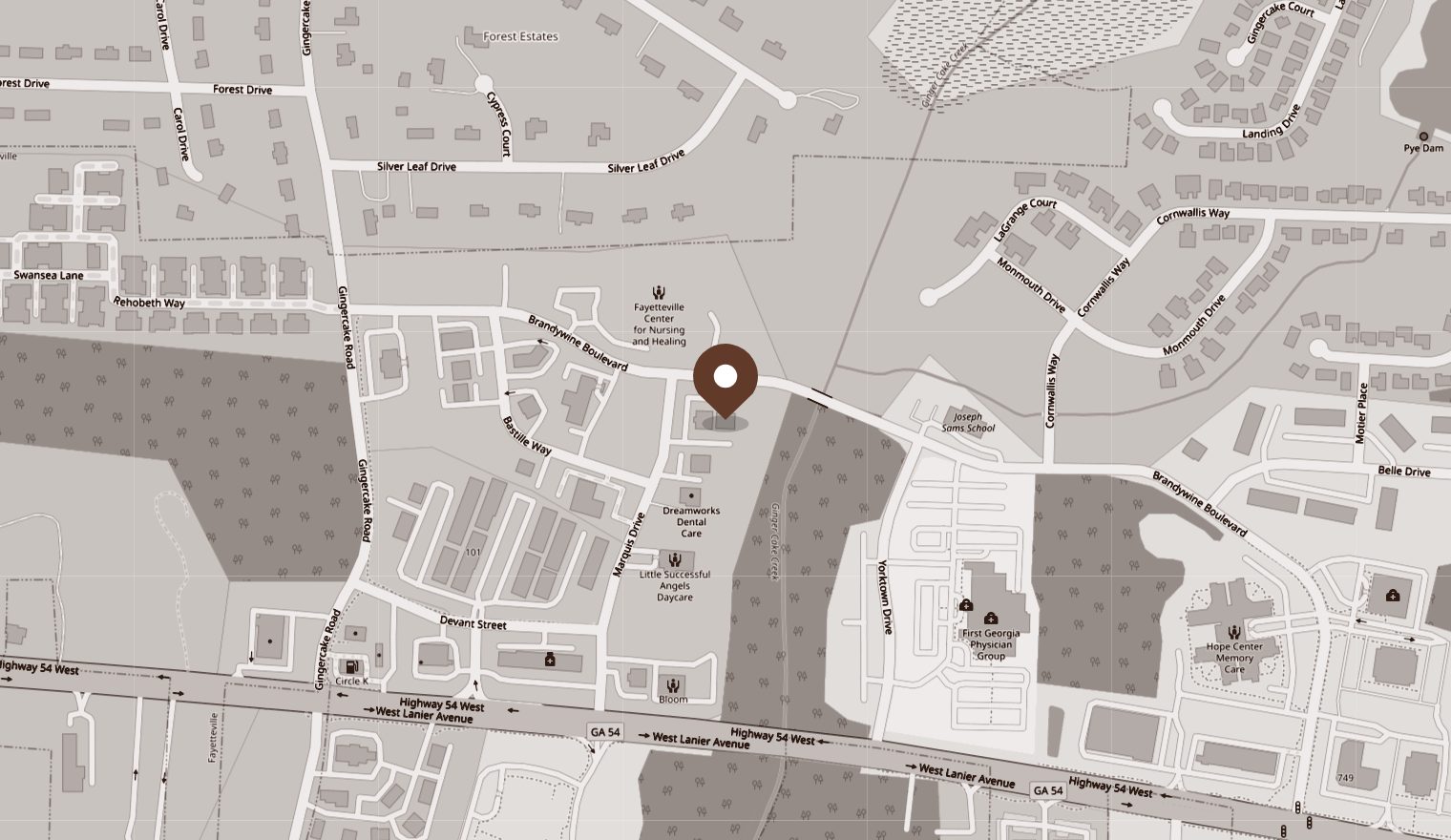
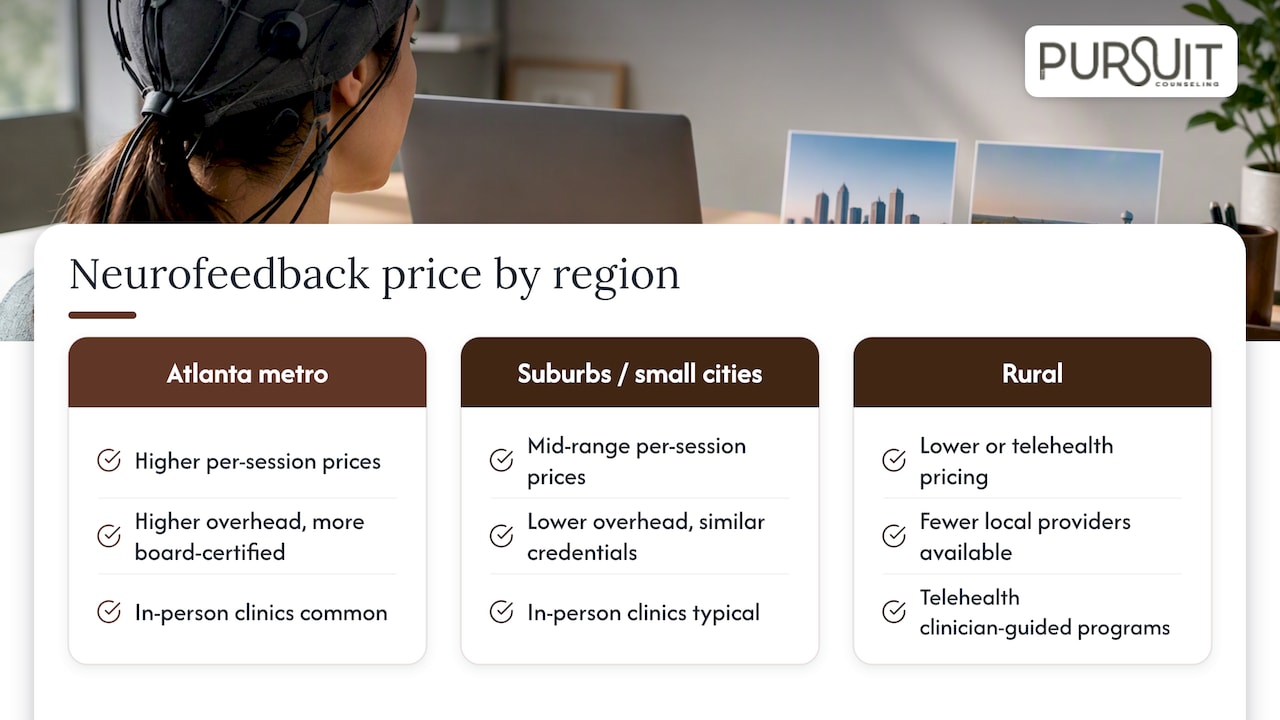
Pricing shifts somewhat depending on where in Georgia you’re looking. Clinics in the Atlanta metro area, including the northern suburbs, tend to sit at the higher end of the per-session range because of higher overhead and a denser concentration of board-certified providers. Smaller markets and suburban practices in areas like Fayetteville, Peachtree City, and the broader South Atlanta region often price closer to the middle of the typical range, reflecting lower overhead without necessarily sacrificing credential quality.
Rural parts of the state may have fewer neurofeedback providers altogether, which can push clients toward telehealth-based, clinician-guided at-home programs instead of in-person visits. If you’re considering a remote option, it’s worth confirming how your insurer treats telehealth billing before assuming the convenience comes without strings. A practical telehealth insurance coverage checklist outlines questions worth asking any provider or payer before starting remote treatment.
The underlying price drivers discussed earlier, credentials, equipment, and session intensity, matter more than zip code alone. A board-certified provider in a smaller Georgia town may charge comparably to a general-practice clinic in Atlanta, while a highly specialized qEEG-focused practice in either location can run above average regardless of city size. When comparing quotes, ask where the provider trained and whether their credentials are current rather than assuming a metro address guarantees better care.
Neurofeedback Versus Other Treatments: Comparing the Cost
Neurofeedback rarely exists in a vacuum. Most Georgia clients are weighing it against talk therapy, medication management, or EMDR, so it helps to see where the costs land relative to each other.
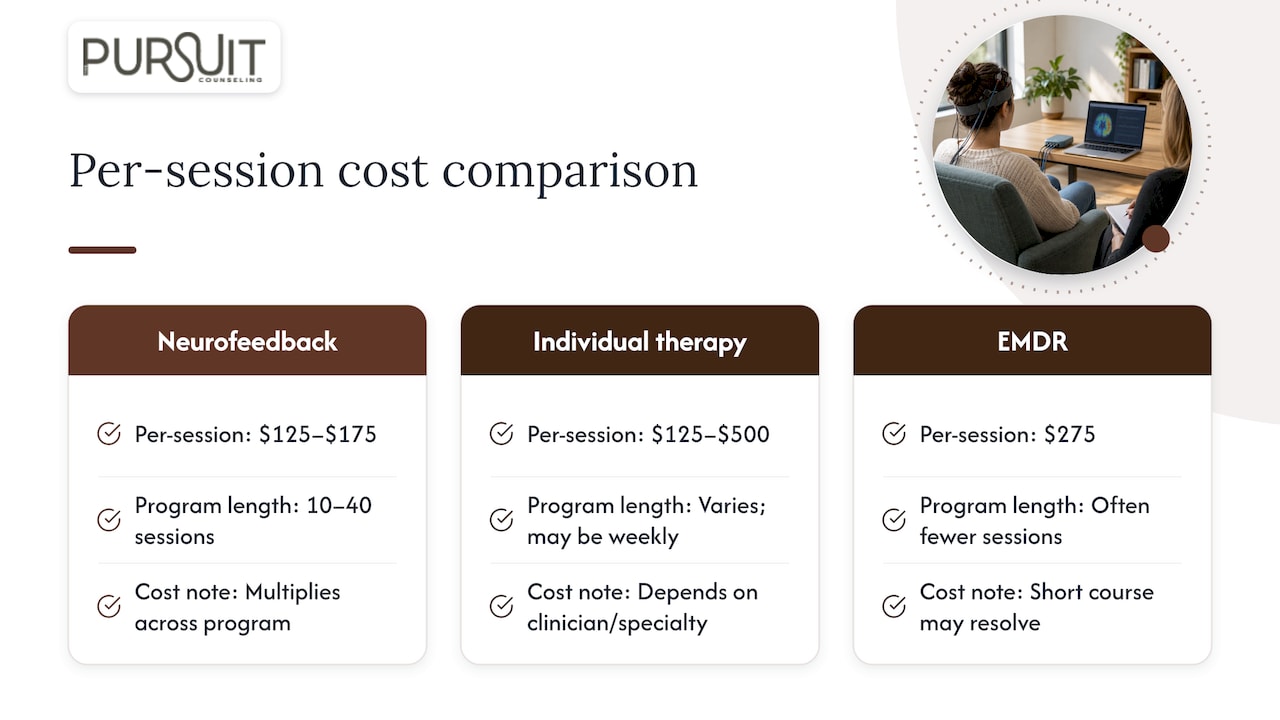
At The Pursuit Counseling, individual therapy runs 5 to 0 per hour depending on the clinician and specialty, while trauma therapy using EMDR is priced at 5 per hour. A single neurofeedback session at 5 to 5 sits in a similar range to a standard therapy hour, but a full neurofeedback program multiplies that cost across 10 to 40 sessions in a way that weekly talk therapy does not always require.
Medication management is typically the lowest upfront cost option, though it carries its own ongoing expense and does not address the same mechanisms neurofeedback targets. A cost-effectiveness analysis of neurofeedback for PTSD found that combining neurofeedback with other therapies can be more cost-effective in some models than psychotherapy or medication used alone, which suggests the real question for many clients is not which single treatment is cheapest, but which combination delivers the clearest value for the specific concern being treated.
The honest answer is that no single modality is categorically more affordable once you account for session count and duration. A short EMDR course might resolve in fewer total sessions than a full 30 to 40 session neurofeedback protocol, while neurofeedback may appeal to clients who have not responded well to talk-based approaches alone.
Financial Help and Assistance Options in Georgia
Dedicated grants or assistance programs specifically earmarked for neurofeedback are not something we’re aware of operating in Georgia at a state level. Most financial relief comes through the mechanisms already covered: superbills for out-of-network reimbursement, sliding-scale fees offered directly by individual practices, and payment plans negotiated with your provider.
Georgia Medicaid’s behavioral health services page is the place to check for any state-administered behavioral health benefit that might apply to your situation, though as covered earlier, neurofeedback is often treated as investigational rather than a standard covered service. If you have a flexible spending account or health savings account through an employer, those funds can often be applied toward neurofeedback costs since it is a legitimate medical expense, though you should confirm eligibility with your plan administrator before assuming it qualifies.
Some practices also offer reduced rates for extended commitments, effectively functioning as informal financial assistance by lowering the per-session cost when you commit to a full program upfront rather than paying session by session. If cost is the main barrier, it is worth asking any Georgia clinic directly whether they offer a sliding scale, since this is rarely advertised but often available for clients who ask.
Is the Cost Worth It for You?
Cost anxiety around neurofeedback is legitimate, not a sign you’re overthinking it. You’re being asked to commit real money to a treatment whose evidence base is still developing. Research on conditions like PTSD shows promising symptom reductions in limited trials, while other reviews caution that evidence for ADHD specifically has been inconsistent. Both things can be true at once.
My honest advice: get a written estimate and an informational consult before committing to a full program, and treat neurofeedback as one piece of a broader clinical picture rather than a standalone fix.
— Adam Glendye LPC, CPCS
What Working With The Pursuit Counseling Looks Like
If you’re in Fayetteville, Peachtree City, Senoia, Brooks, Tyrone, or anywhere across South Atlanta and want a clearer picture of your own numbers before committing to anything, The Pursuit Counseling offers a Neurofeedback Brain Map as the starting point for any protocol we build.

Here’s what that looks like in practice:
- A qEEG assessment that informs your protocol rather than applying a generic template.
- In-person sessions in Fayetteville or online options for clients across South Atlanta.
- Superbills and documentation available on request to support any out-of-network reimbursement claim you pursue.
We also offer individual therapy and related specialties for clients who want to pair neurofeedback with talk-based work, and an Executive Experience Program for adults whose attention and focus concerns extend into their professional lives. A first consult is informational: we’ll talk through your concerns, outline what a protocol would realistically involve, and give you a written estimate before you decide anything. No outcomes are promised at that stage, and none should be.
This article is general information, not a substitute for advice from a qualified doctor. Consult a qualified healthcare professional about your own circumstances before acting on anything here.
FAQ
Is neurofeedback worth the money?
Whether neurofeedback is worth the cost depends on the condition being treated and your own response to it, since evidence is stronger for some conditions than others. Research on PTSD shows favorable symptom reductions in limited trials, while evidence for conditions like ADHD remains mixed, so an informational consult and a clear estimate are worth getting before committing to a full program.
What is better, EMDR or neurofeedback?
Neither is universally better since they target different mechanisms and fit different clinical pictures. EMDR, priced at 5 per hour at The Pursuit Counseling, is a structured trauma processing approach, while neurofeedback trains brainwave patterns over a longer multi-session arc, and a licensed clinician can help determine which fits your specific concern.
How much does a neurofeedback session typically cost?
A typical neurofeedback session in Georgia costs between 5 and 0, with lower-cost group or template protocols sometimes available closer to . Full programs commonly range from ,500 to ,000 depending on how many sessions your protocol requires.
Will insurance pay for neurofeedback?
Insurance coverage for neurofeedback is uncommon, and CMS’s coverage policy treats it as investigational for most behavioral health indications. Many clients pay out of pocket and use a superbill to pursue out-of-network reimbursement, which is worth confirming with your insurer before treatment begins.
Sources
- The Evidence-Base for Neurofeedback as a Reimbursable Healthcare Service to Treat Attention Deficit/Hyperactivity Disorder
- Medicare National Coverage Determination: Biofeedback therapy (CMS)
- Neurofeedback may not be effective in reducing ADHD symptoms — King’s College London