


For most people, neurofeedback produces only mild, short-lived side effects like tiredness or a headache after a session. Serious adverse reactions are uncommon, and when they happen, they’re usually tied to a mismatched protocol or a practitioner working outside proper training. The sections below walk through which side effects to expect, which ones warrant a call to your provider, and how a qualified clinician manages both.
TL;DR:
- Most side effects are mild, temporary, and include fatigue, headaches, sleep disturbances, emotional sensitivity, and dizziness, typically resolving within 48 hours.
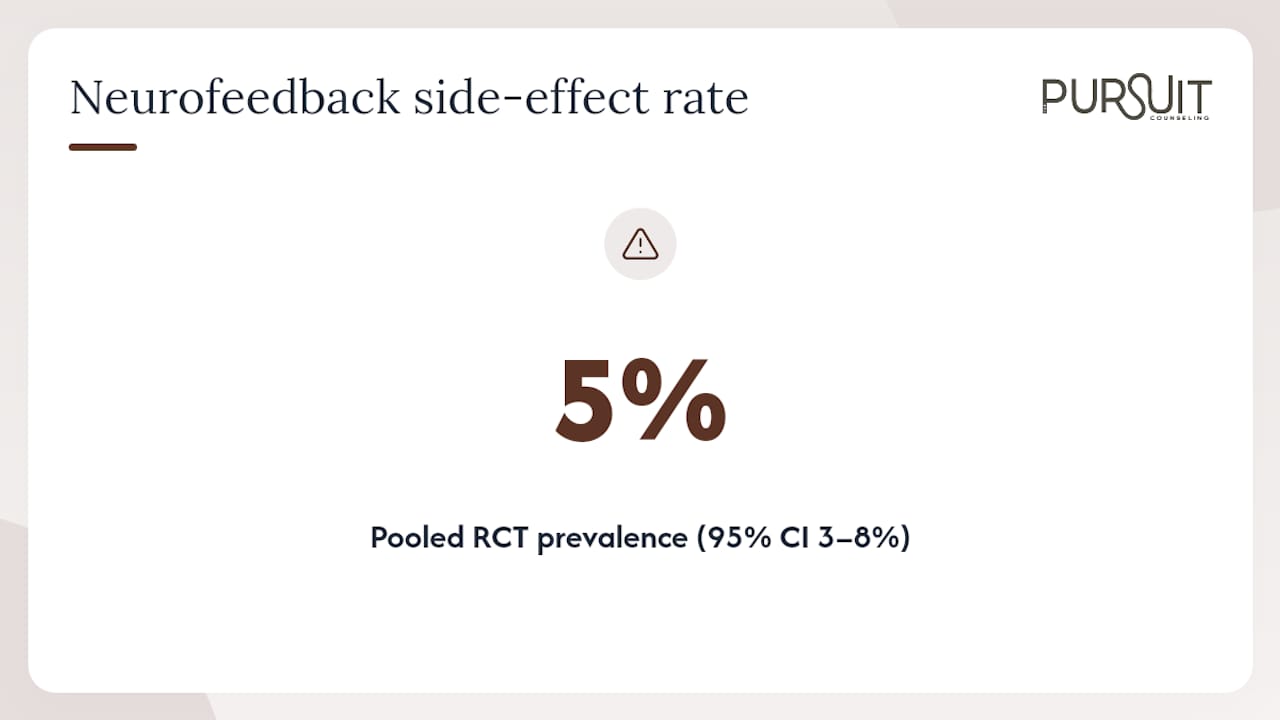
- About 5% of participants experience side effects, primarily protocol-specific transient reactions, with serious adverse effects being very rare and linked to protocol mismatches or untrained providers.
- The likelihood of adverse reactions depends on the protocol used, patient health factors, practitioner training, and session pacing, emphasizing the importance of a qualified, licensed clinician.
- Proper symptom tracking after each session and transparent communication with your provider help manage side effects and facilitate protocol adjustments if needed.
- Severe symptoms such as seizures, severe disorientation, or worsening mental health require immediate medical attention, and most side effects do not persist long after stopping treatment.
Table of Contents
- What Are the Most Common Neurofeedback Side Effects?
- Are There Serious Risks with Neurofeedback?
- Why Do Some People Get Side Effects and Others Don’t?
- How Long Do Neurofeedback Side Effects Last?
- How Can You Reduce and Manage Neurofeedback Side Effects?
- When Should You Stop Neurofeedback and Seek Medical Care?
- What Does the Research Say About Neurofeedback Safety?
- How Do You Choose a Safe Neurofeedback Provider?
- Does Neurofeedback Interact with Medications or Other Therapies?
- Are There Long-Term Side Effects from Neurofeedback?
- Balancing Benefits and Safety in Neurofeedback
- Ready to Explore Neurofeedback with a Licensed Provider?
- Sources
- FAQ
What Are the Most Common Neurofeedback Side Effects?
Most people who try neurofeedback describe the early sessions the way you’d describe a hard workout: a little sore, a little tired, but nothing alarming. That’s consistent with what researchers have documented using structured symptom checklists like the DESS (a validated questionnaire used in neurofeedback trials to track dozens of transient reactions).
Here’s what shows up most often in the research and in clinical practice:
- Fatigue or mental tiredness, especially right after a session, similar to how your brain feels after intense focused work
- Mild headaches, usually resolving within a few hours
- Sleep changes, which can go either direction: some people report wired, harder-to-fall-asleep nights, while others sleep more deeply or have unusually vivid dreams
- Emotional sensitivity, including irritability, tearfulness, or a temporary dip or spike in mood
- Mild dizziness, lightheadedness, or a foggy, spacey feeling that typically clears within a couple of hours
The specific protocol matters here. Frequency-based training like SMR (Sensory Motor Rhythm) or Upper Alpha protocols each carry a different sensitivity profile. A randomized, double-blind, sham-controlled trial found that side effects were often protocol-specific, and SMR training appeared to be the most sensitive of the protocols tested. That’s not a reason to avoid it. It’s a reason your clinician should be watching which frequency band you’re training and adjusting based on how you respond.
Pro Tip: Keep a simple note on your phone after each session: energy level, mood, sleep quality, and anything unusual, rated on a 1 to 5 scale. Patterns that would otherwise get lost in memory become obvious after three or four sessions, and that record is exactly what a good clinician wants to see at your next visit.
Are There Serious Risks with Neurofeedback?
Serious adverse effects are far less common than the mild ones above, but they do appear in the literature, and you deserve a clear picture of them rather than a reassurance that skips the hard parts.
Reported issues include:
- Worsening of the symptoms neurofeedback was meant to treat, such as increased anxiety, deepening depression, or in rare cases, emergent panic or manic episodes
- Seizures or increased epileptiform activity, generally documented in cases involving protocol mismatches or undiagnosed seizure vulnerability
- Cognitive deterioration, severe dissociation, or motor and speech disturbances, reported in isolated case reports rather than controlled trials
Context matters enormously here. A systematic literature review and meta-analysis pooled data across randomized trials and found an overall side-effect prevalence of about 5% (95% confidence interval: 3% to 8%), with low variability between studies. That figure includes the mild, transient effects covered above, not just the rare serious ones. The literature also has real limits: adverse events tend to be underreported in smaller trials, protocols vary widely between clinics, and practitioner skill isn’t standardized across the field, which makes true incidence of the rarest events hard to pin down precisely.
Why Do Some People Get Side Effects and Others Don’t?
Side effects aren’t random. They usually trace back to one of four factors, and understanding them helps you ask better questions before you start.
- Protocol specificity: Which frequency band is being trained, and whether the protocol is designed to increase or decrease power in that band, changes the reaction profile substantially
- Patient factors: Comorbid epilepsy, bipolar disorder, current medications, and your baseline EEG patterns all influence how your brain responds to training
- Practitioner factors: Providers without proper assessment skills or licensure are far more likely to select an inappropriate protocol or miss early warning signs
- Session dosing: Cumulative sessions, session length, and abrupt shifts in protocol without gradual titration can all provoke reactions that a slower approach would have avoided
Reviews of practice standards consistently point to one modifiable risk factor above the rest: inadequate practitioner training. An unlicensed provider running a generic protocol off a template, without assessing your history first, introduces risk that a trained clinician working from your actual EEG and clinical picture simply wouldn’t create.
How Long Do Neurofeedback Side Effects Last?
Most people find the discomfort is front loaded and fades fast, both within a single session and across the course of treatment.
- Hours to 48 hours: The majority of transient effects, fatigue, headache, mild mood shifts, resolve in this window without any intervention.
- First few sessions: Sensitivity tends to be highest early on, then stabilizes as your clinician fine tunes the protocol to your response.
- Beyond several days or worsening symptoms: This is the signal for a clinician to pause treatment or change the protocol rather than push through.
- After stopping neurofeedback: Side effects typically fade rather than persist, which is one of the more reassuring patterns in the safety data compared to some medication side effects that can linger.
That adjustment period is normal and expected. It’s also exactly why session-by-session communication with your provider matters more than any pre-treatment checklist.
How Can You Reduce and Manage Neurofeedback Side Effects?
You have more control over your experience than you might think, and so does your clinician. Practice-standard recommendations point to session-by-session symptom tracking and informed consent as core safety practices, not optional extras.
Before you start, give your provider the full picture:
- Complete medical and psychiatric history, including any seizure history or diagnosed mood disorders
- Every medication and supplement you currently take
- Honest information about sleep patterns and substance use, including caffeine and alcohol
During treatment, small habits go a long way:
- Rate your symptoms after every session and bring those notes to your next appointment
- Ask your provider directly about their training, licensure, BCIA certification if applicable, and what their emergency procedure looks like if something feels wrong
- Hydrate, protect your sleep, and avoid driving immediately after a session if you feel disoriented
- Plan something low-demand for the rest of the day rather than jumping into high-focus work
On the clinical side, a skilled provider has several levers to pull when side effects show up: lowering reward thresholds, shortening session length, adjusting target frequency bands, or spacing out how many sessions you do per week. None of these require starting over. They require a provider paying attention.
Pro Tip: If a side effect shows up after session three but wasn’t there after sessions one and two, mention it specifically by session number. That kind of detail helps your clinician isolate whether it’s the protocol, the dose, or something unrelated entirely.
When Should You Stop Neurofeedback and Seek Medical Care?
Most side effects don’t require emergency action, but a few signs mean you stop and get help right away, not at your next scheduled appointment.
Treat these as emergencies:
- Seizure activity or loss of consciousness
- Severe chest pain
- Suicidal thoughts or a sudden, severe mental health crisis
- Persistent, severe disorientation that doesn’t clear within a couple of hours
Treat these as urgent but non-emergency, meaning you contact your provider promptly rather than waiting:
- Mood or functioning that keeps getting worse across multiple sessions instead of stabilizing
If you need to escalate to a psychiatrist, neurologist, or emergency provider, bring your session notes, your symptom journal, and your neurofeedback provider’s contact information. That paper trail speeds up care and helps any new provider understand what’s already been tried.
What Does the Research Say About Neurofeedback Safety?
The strongest evidence on neurofeedback side effects comes from a small number of well-designed studies, and it’s worth knowing exactly what they do and don’t establish.
The most cited figure is the pooled prevalence estimate from a meta-analysis of randomized controlled trials: roughly 5% of participants across the included studies reported side effects, with a 95% confidence interval of 3% to 8% and low heterogeneity between studies. That’s a reassuring number for a treatment modality, though it reflects reported side effects across trial conditions, not a guarantee for any individual case.
The 2015 randomized, sham-controlled, double-blind trial remains one of the clearest windows into how protocol choice shapes side-effect risk: participants training the SMR protocol reported more transient adverse effects than those on other protocols, and effects were generally short-lived rather than lasting, highlighting the importance of understanding sports psychology’s role in athlete success.
That finding matters because it moves the conversation from “does neurofeedback cause side effects” to “which protocols carry which risk profile,” which is a far more useful question for both patients and clinicians.
Pooled side-effect prevalence across randomized trials: a low percentage of participants (with a narrow confidence interval).
Broader clinical trial data on neurofeedback’s benefits show real improvement in complex cases, though results aren’t always statistically superior to active control conditions. A separate retrospective real-world study of 593 patients using remote, app-based neurofeedback reported meaningful symptom reductions and EEG marker changes, but the authors flagged the same limitation that shows up across much of this literature: no randomized control group, and no way to rule out the effect of concurrent treatments. Underreporting of adverse events in smaller studies and inconsistent protocols between clinics remain the field’s biggest evidence gaps.
How Do You Choose a Safe Neurofeedback Provider?
Not all neurofeedback providers operate at the same level of training, and that gap is where most preventable risk lives. Before starting treatment, a provider should be able to speak clearly to each of these points:
- Active LPC (Licensed Professional Counselor) licensure or equivalent clinical credential
- BCIA (Biofeedback Certification International Alliance) certification or comparable documented neurofeedback training
- A track record of neurofeedback experience, not just general therapy experience
- A clear informed consent process that covers realistic benefits and potential side effects
- Outcome tracking across sessions, not just intuition about progress
- A defined emergency plan if a serious adverse reaction occurs
This article’s clinical perspective comes from Adam Glendye LPC, CPCS, whose credentials sit squarely in that checklist: Licensed Professional Counselor and Certified Professional Counselor Supervisor. Neurofeedback for ADHD and anxiety is available with approaches built around collaborative, individualized care rather than a one-size-fits-all protocol.
Does Neurofeedback Interact with Medications or Other Therapies?
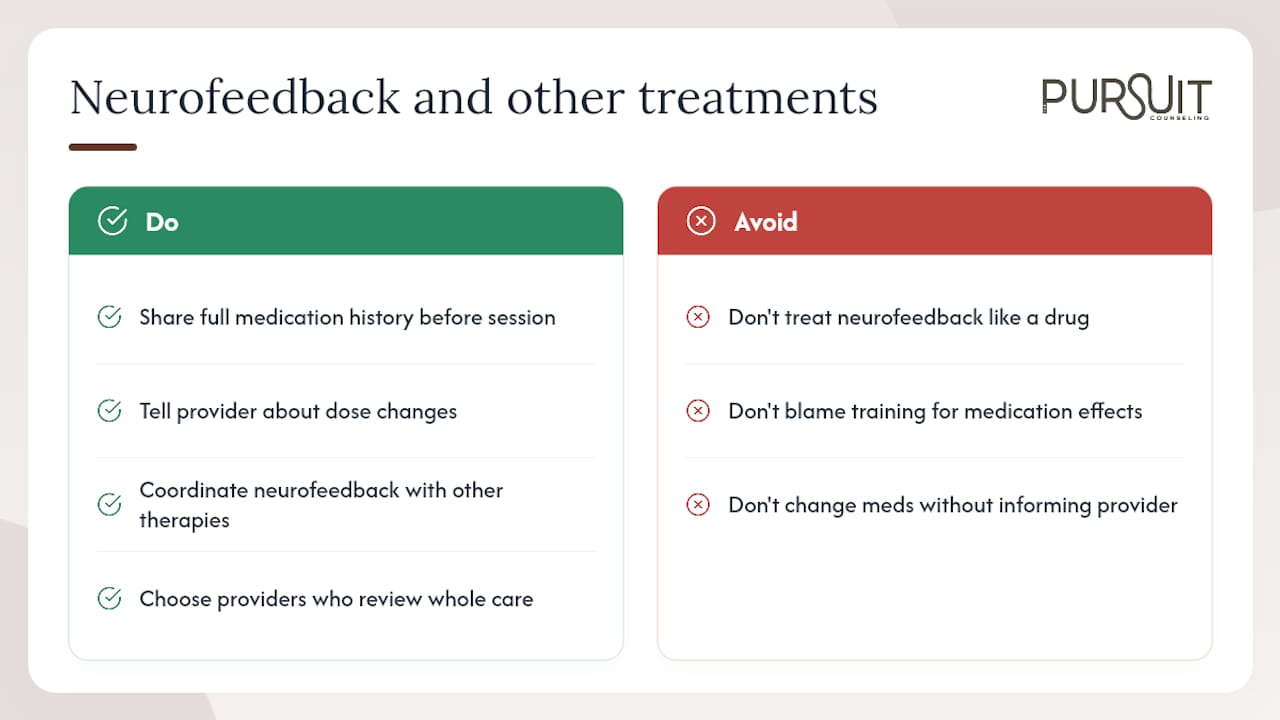
Neurofeedback doesn’t work like a drug, so it doesn’t carry the same kind of pharmacological interaction risk you’d see between two medications. But that doesn’t mean it operates in isolation from the rest of your care.
Medications that affect brain activity, including stimulants for ADHD, antidepressants, or anti-anxiety medications, can influence your baseline EEG patterns, which in turn affects how your brain responds to training. That’s part of why a thorough medication history matters before your first session, not as a formality but as clinical information your provider actually uses.
Neurofeedback also tends to work best as part of a broader plan rather than a stand-alone fix. Many clinics pair it with talk therapy, trauma-focused treatment, or medication management, and coordinating those pieces matters more than most people expect. If you’re changing a medication dose around the same time you start neurofeedback, tell your provider. Attributing a mood shift to the wrong cause, blaming the training when it was actually the medication change, or vice versa, can send you down the wrong troubleshooting path entirely. Providers who take a broader view of your care, including functional medicine approaches to mental health, are generally better positioned to sort out what’s actually driving a change in how you feel.
Are There Long-Term Side Effects from Neurofeedback?
The research on long-term neurofeedback safety is reassuring but incomplete, and it’s worth being honest about both halves of that statement.
Translational neuroscience research shows that targeted neurofeedback training can produce lasting changes in brain connectivity, which is actually the point of the therapy: you’re trying to create durable improvement, not a temporary state change. That same durability is exactly why protocol selection and monitoring matter so much early on. A training approach that reliably changes neural connectivity is also one where getting the target wrong has more staying power than a treatment with no lasting effect at all.
What the current evidence does not show is a pattern of delayed-onset or cumulative long-term harm once training stops. Side effects that occur tend to fade after treatment ends rather than persist for months or years afterward. The bigger gap in the research isn’t safety data pointing toward harm. It’s the absence of large, long-duration follow-up studies tracking people for years after their last session. That’s a limitation of how young the field’s research base is, not a red flag about the therapy itself.
Balancing Benefits and Safety in Neurofeedback
Neurofeedback has real potential, and pretending otherwise would do a disservice to the people it’s helped. But cautious optimism is the right posture here, not blind enthusiasm. The evidence supports meaningful benefit for many people while also asking practitioners to take side-effect reporting seriously, protocol by protocol, session by session. Use the checklist in this article. Ask your provider direct questions. A good clinician will welcome them, not deflect them, and that openness tells you more about the safety of your care than any statistic can.
— Adam Glendye LPC, CPCS
Ready to Explore Neurofeedback with a Licensed Provider?
If you’ve read this far, you’re the kind of person who wants a provider who treats safety as part of the treatment, not an afterthought. Such a model includes individualized assessment before any protocol starts, transparent conversations about what to expect, and both in-person and telehealth options available in the South Atlanta area.

An initial assessment covers your full history, including medications, prior mental health treatment, and specific goals, whether that’s ADHD focus and calm or anxiety relief. From there, your protocol gets built around your actual brain patterns and symptoms, not a generic template, and your clinician tracks your response session by session so adjustments happen early rather than after weeks of discomfort. If neurofeedback is one piece of a bigger picture for you, whether that includes trauma work, medication coordination, or movement-based approaches, The Pursuit Counseling’s collaborative care model is built to fit around that. Visit the neurofeedback services page to see current offerings, or go ahead and get started with an initial appointment to talk through whether neurofeedback fits your situation.
This article is general information, not a substitute for advice from a qualified doctor. Consult a qualified healthcare professional about your own circumstances before acting on anything here.
Sources
- Transient Adverse Side Effects During Neurofeedback Training: A Randomized, Sham-Controlled, Double Blind Study
- Are There any Possible Side Effects of Neurofeedback? A Systematic Literature Review and Meta-analysis
- Randomized controlled evidence and clinical trial summaries (PMC 2021 clinical trial)
- First, Do No Harm: Adverse Effects and the Need for Practice Standards in Neurofeedback
FAQ
Can neurofeedback go wrong?
Yes, though serious problems are uncommon. Most issues that arise are mild and transient, like fatigue or headache, while rarer, more serious reactions are typically linked to an unsuitable protocol or an undertrained practitioner.
What happens when you stop neurofeedback?
Any side effects you were experiencing typically fade rather than persist once training stops. The brain changes that produced therapeutic benefit tend to be more durable than the transient side effects, which is the outcome neurofeedback is designed to produce.
How long do neurofeedback side effects last?
Most transient effects resolve within hours to 48 hours. Sensitivity is usually highest during the first few sessions, then settles down as your provider adjusts the protocol to your response.
How safe is neurofeedback?
Choosing a licensed provider with documented neurofeedback training meaningfully lowers the risk of more serious complications.