


Neuroscience-based therapy uses findings about brain chemistry and its impact on behavioral issues, brain structure, function, and neuroplasticity to guide how clinicians treat mental health conditions, targeting specific neural circuits instead of just talking through symptoms. The main methods you’ll encounter are neurofeedback, EMDR, and brain stimulation (rTMS, ECT, and VNS). The evidence isn’t uniform across these tools. The NIMH confirms that rTMS and ECT are FDA-authorized for specific disorders, while methods like functional connectivity neurofeedback (FCNef) remain experimental, promising but still being refined in research settings.
- Neurofeedback: trains self-regulation of brain activity patterns
- EMDR: reprocesses traumatic memory through structured eye-movement protocols
- Brain stimulation: rTMS and ECT directly modulate neural circuits under clinical supervision
- FDA-authorized brain stimulation therapies like rTMS and ECT have strong support for treatment-resistant depression, whereas neurofeedback and FCNef are promising but still experimental.
- Stabilization techniques should precede high-cognitive-load interventions, especially for clients in acute dysregulation, to ensure treatment effectiveness.
- Personalized treatment relies on neuropsychological testing and imaging to identify specific neural circuit dysfunctions and match appropriate techniques accordingly.
- Effective neuroscience-based therapy depends on careful sequencing and measurement of progress rather than relying on equipment or marketing claims alone.
- Most outcomes are gradual and require multiple sessions; clinicians should provide clear, realistic expectations based on peer-reviewed protocols and individual neural profiles.
Understanding Neuroscience-Based Therapy: A Comprehensive Guide
- What Does Neuroscience-Based Therapy Actually Mean?
- How Does Brain Plasticity Shape Your Treatment Plan?
- What Neuroscience-Informed Therapies Are Clinicians Actually Using?
- What Does the Research Actually Support?
- How Clinicians Build a Neuroscience-Informed Treatment Plan
- Who Benefits Most, and How Should You Choose a Provider?
- Why Trust This Explainer, and What The Pursuit Counseling Offers
- What Are the Real Risks and Realistic Outcomes?
- How Do Clinicians Match Patients to the Right Approach?
- What Ethical Questions Come With Brain-Based Treatment?
- Where Is Neuroscience-Based Therapy Headed Next?
- Key Takeaways
- An Editorial Take on Where the Field Is Really Heading
- Find Neuroscience-Informed Care That Fits Your Life
- Sources
- FAQ
What Does Neuroscience-Based Therapy Actually Mean?
Neuroscience-based therapy means the clinician is working from a map, not a guess. Instead of treating “anxiety” as a vague cloud, the therapist looks at which neural circuits are misfiring, dysregulated, or under-connected, and builds an intervention around that specific target. This is the difference between symptom management and circuit-level change.
The approach traces back to the 1990s “Decade of the Brain,” when imaging technology first let researchers watch neural activity shift in real time. That research eventually made its way from labs into consulting rooms. A position paper on neuroscience-based psychotherapy argues that talk therapy itself drives measurable, experience-driven plasticity, and that pairing it with neuropsychological data sharpens how precisely a clinician can target treatment.
- Traditional therapy asks: “What are you feeling, and why?”
- Neuroscience-informed therapy adds: “Which network is struggling to regulate that feeling, and how do we retrain it?”
That second question is what separates a brain-based approach from general counseling, even when both use the same conversational tools.
How Does Brain Plasticity Shape Your Treatment Plan?
Neuroplasticity is the brain’s capacity to rewire itself based on repeated experience, and it’s the reason therapy can produce change that outlasts the session itself. Practical, patient-facing translation: the neural pathways strengthened by weeks of practicing new emotional responses tend to persist, but only if the practice is consistent and the nervous system isn’t too dysregulated to encode anything new.
Three network systems matter most in day-to-day treatment planning:
- The default mode network, active during rest and self-reflection, often overactive in rumination and depression.
- The executive control network, responsible for planning, focus, and impulse regulation, frequently taxed in ADHD and high-stress executive roles.
- The limbic system, the emotional alarm center, often hyperreactive after trauma.
Clinicians also work from a stability versus change model: a nervous system in crisis needs to stabilize before it can absorb new learning. Push change too early, and the brain simply can’t integrate it.
Pro Tip: If you’re in a highly dysregulated state, avoid heavy analytical or verbal-processing work first. Grounding and sensory-based techniques calm the nervous system enough that deeper cognitive work actually sticks.
What Neuroscience-Informed Therapies Are Clinicians Actually Using?
Several distinct methods fall under the neuroscience-informed umbrella, and they aren’t interchangeable. Each targets a different mechanism, and clinicians choose based on what the assessment shows.
- Neurofeedback: Real-time monitoring of brainwave activity feeds back to the client, usually through a screen or sound cue, training the brain toward more regulated patterns over repeated sessions. It’s commonly used for attention difficulties and anxiety regulation.
- EMDR (Eye Movement Desensitization and Reprocessing): Uses structured eye movements to help the brain reprocess traumatic memories that got stuck in unintegrated storage, largely for PTSD and single-incident trauma.
- rTMS, ECT, and VNS: Brain stimulation therapies that directly modulate circuit activity. The NIMH notes these are typically reserved for cases where other treatments haven’t worked, delivered under medical supervision, with ECT involving brief anesthesia.
- Brainspotting and mindfulness-based work: Techniques that engage experiential, right-hemisphere processing rather than verbal analysis, often guided by neuropsychological assessment to match the client’s functional profile.
- FCNef (functional connectivity neurofeedback): An experimental, fMRI-based approach still mostly confined to research settings due to cost and access.
What Does the Research Actually Support?
The evidence strength varies a lot depending on which method you’re evaluating, and that gap matters when you’re weighing clinic claims. rTMS and ECT carry the strongest backing for specific conditions like treatment-resistant depression, with FDA authorization behind them. Neurofeedback sits in a more complicated spot: comprehensive reviews show it produces measurable changes in trained neural circuits, but randomized controlled trials report mixed clinical results, largely because protocols vary so widely between studies.
FCNef is the one to watch. A 2026 replication study in Translational Psychiatry found that functional connectivity neurofeedback normalized targeted brain connectivity and reduced brooding rumination, with results improving when training happened on consecutive days with stronger reinforcement.
- Small sample sizes and inconsistent protocols remain the field’s biggest research caveats.
- Effects from stimulation and neurofeedback have shown persistence ranging from weeks to, in some studies, one to two months.
- When evaluating a clinic’s claims, ask whether they can point to peer-reviewed protocols and whether they measure your progress before and after treatment, not just anecdotally.
How Clinicians Build a Neuroscience-Informed Treatment Plan
A brain-based treatment plan usually starts with assessment beyond the standard intake interview. Neuropsychological testing, and occasionally imaging like DTI tractography, helps map which networks are intact and which are compromised.
- Assess functional capacity. Testing identifies which cognitive and emotional systems are working well and which need support.
- Match technique to capacity, a concept called functional compatibility. A 2026 single-case report used DTI-informed planning to guide psychotherapy after mild brain injury, and the client’s anxiety score dropped from 11 to 6 on the HADS-A scale, with processing speed improving from 190 to 128 seconds on the Trail Making Test, after multiple sessions.
- Sequence the work. Stabilization and regulation come first, experiential practice follows, and targeted brain training runs alongside ongoing therapy.
Pro Tip: Ask your clinician how they’ll measure progress. A number on a symptom scale or a neurofeedback readout tells you far more than “I feel like it’s helping.”
Who Benefits Most, and How Should You Choose a Provider?
Certain profiles tend to see the clearest gains from neuroscience-informed care: people with treatment-resistant depression, trauma survivors whose symptoms haven’t budged with talk therapy alone, adults with ADHD, and those recovering from mild traumatic brain injury.
Credentials matter here more than marketing language. Look for licensed clinicians with formal training in the specific modality, whether that’s EMDR certification, supervised neurofeedback hours, or collaboration with a neurologist for stimulation-based cases.
- Ask how they measure progress, not just how they describe it.
- Ask what a realistic timeline looks like for your specific concern.
- Ask how the approach integrates with any medication you’re already taking.
- Ask about cost structure directly, since many of these programs run private-pay.
- Overstated guarantees of a “cure” or a fixed number of sessions before any assessment.
- No measurement tools used to track your progress.
- Vague or absent informed consent about risks and alternatives.
Why Trust This Explainer, and What The Pursuit Counseling Offers
This piece is written from the perspective of Adam, a counselor and executive coach who applies neuroscience-informed methods in daily clinical work. The Pursuit Counseling integrates EMDR, neurofeedback, and executive coaching for high performers navigating trauma, ADHD, and chronic stress.
- EMDR for trauma processing
- Neurofeedback for attention and regulation
- Executive coaching grounded in neuroscience principles
What Are the Real Risks and Realistic Outcomes?
Every neuroscience-informed method carries its own risk profile, and no reputable clinician should promise a guaranteed outcome. Brain stimulation therapies carry the most clearly documented risks: ECT requires brief anesthesia and can cause temporary memory disruption; rTMS carries a small seizure risk and commonly causes scalp discomfort or headache during early sessions. Both require careful screening and, per the NIMH, are usually reserved for cases where standard treatments haven’t worked.
Neurofeedback and EMDR carry gentler risk profiles but aren’t without downsides. Neurofeedback can trigger temporary fatigue or emotional sensitivity as the brain recalibrates. EMDR can bring up intense emotion mid-session, which is why pacing and stabilization matter so much before diving into memory reprocessing work.
Contraindications matter too. Certain stimulation therapies aren’t appropriate for people with specific implanted devices or a history of seizure disorders, and neurofeedback protocols need adjusting for anyone with significant untreated psychiatric instability. This is exactly why a thorough intake assessment isn’t optional; it’s the safeguard that keeps a promising technique from becoming a risky one.
Realistic outcomes look different from what marketing language sometimes implies. Most people see gradual, cumulative improvement, not overnight transformation. Symptom reduction of the kind seen in single-case reports, like the drop from an anxiety score of 11 to 6 in the DTI-informed case study, tends to build over dozens of sessions, not a handful.
How Do Clinicians Match Patients to the Right Approach?
Patient selection isn’t one-size-fits-all, and the neuroscience data explains why. A person with treatment-resistant depression who hasn’t responded to two or more medication trials looks like a strong candidate for rTMS or ECT. Someone with a singular traumatic event and an otherwise stable nervous system often responds well to EMDR alone. A client with ADHD and chronic attentional dysregulation might benefit most from a sustained neurofeedback protocol paired with coaching.
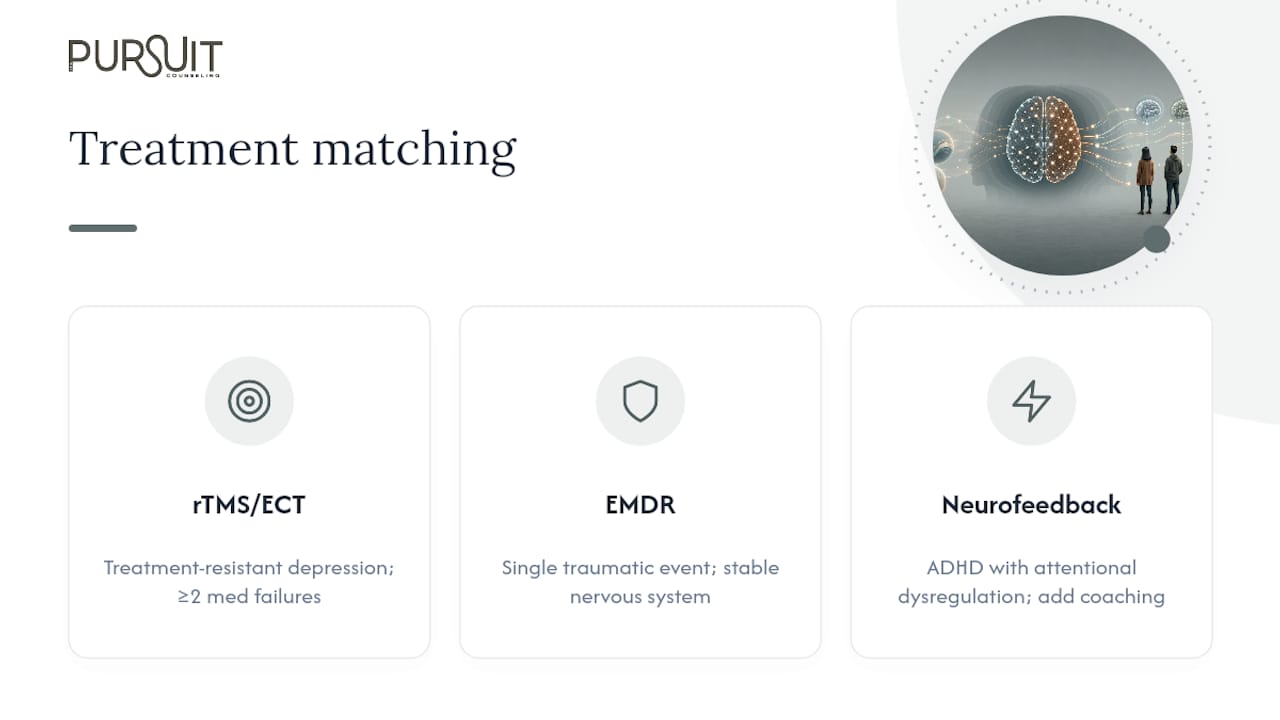
Personalization starts with functional assessment rather than diagnosis alone. Two people with the same depression diagnosis can have very different underlying network profiles, one might show blunted executive control, the other overactive default mode network rumination, and that difference should shape the plan. This is where neuropsychological testing earns its place in the process: it tells the clinician which systems are resilient enough to handle direct intervention and which need to be stabilized first.
Comorbidity complicates the picture further. A client managing both ADHD and unresolved trauma may need sequenced treatment: regulation and safety work before neurofeedback training, and neurofeedback stabilization before deep trauma reprocessing. Rushing that sequence risks overwhelming a nervous system that hasn’t built the capacity to integrate the work yet.
Personalized planning also has to account for real-world constraints, work schedules, travel demands for high-performing executives, and financial realities of private-pay care. The best plan on paper isn’t the right plan if a client can’t sustain the session frequency it requires. Good clinicians build flexibility into the protocol rather than forcing a rigid template onto every case.
What Ethical Questions Come With Brain-Based Treatment?
Working directly with someone’s neural circuitry raises ethical stakes that standard talk therapy doesn’t always face. Informed consent has to go deeper than a signature on a form. Clients deserve a clear, honest explanation of what a technique can and can’t do, especially for methods like FCNef that remain experimental and lack the large-scale trial data that rTMS or ECT have accumulated.
Overselling neuroplasticity is a real temptation in this space, and a real risk. It’s tempting for a provider to market “rewiring your brain” as a guaranteed fix, but that framing can set unrealistic expectations and erode trust when progress moves slower than promised. Ethical practice means naming uncertainty plainly: what’s established, what’s promising but preliminary, and what’s still confined to research settings.
Equity and access deserve attention too. Neuroscience-informed therapies, particularly neurofeedback and stimulation-based treatments, tend to be private-pay and cost-intensive, which limits who can access them. Clinicians working in this space have some responsibility to be transparent about cost early, rather than letting financial surprises derail care midway through a protocol.
Data privacy is another emerging concern as neurofeedback and imaging-based approaches generate increasingly detailed data about a person’s brain activity. That information deserves the same confidentiality protections as any other clinical record, and clients deserve clarity on how it’s stored and used.
Where Is Neuroscience-Based Therapy Headed Next?
Precision psychiatry is the clearest emerging trend, treatment matched to an individual’s specific neural profile rather than a diagnostic category. FCNef sits at the center of that shift. The 2026 replication study showing normalized connectivity and reduced rumination points toward a future where protocols get optimized around individual response patterns rather than one-size-fits-all session counts.
Portable and lower-cost neurofeedback technology is also closing the access gap that currently limits fMRI-based approaches to research institutions. As consumer-grade EEG devices improve, some of this precision work may migrate from the lab toward more accessible outpatient settings, though rigorous validation has to catch up first.
Combination protocols are gaining traction too, pairing stimulation therapies like rTMS with structured psychotherapy rather than treating them as separate tracks. Early research suggests the neural changes from stimulation may create a more receptive window for psychotherapeutic work to take hold, though larger trials are still needed to confirm how durable that window is.
Expect more single-case and small-cohort studies like the DTI-informed case report to keep bridging the gap between neuroscience labs and clinical offices before larger trials catch up, since translational work like this often shapes clinical practice well before randomized trials confirm it at scale.
Key Takeaways
Neuroscience-based therapy works best when clinicians match specific techniques, like neurofeedback, EMDR, or brain stimulation, to a client’s actual neural profile rather than applying one method universally.
| Point | Details |
|---|---|
| Definition matters | Neuroscience-based therapy targets specific neural circuits, not just symptoms, using tools like neurofeedback, EMDR, and brain stimulation. |
| Evidence varies by method | rTMS and ECT carry FDA authorization for specific conditions; FCNef and standard neurofeedback show promise but need more replication. |
| Pacing protects progress | Stabilization work should come before high-cognitive-load interventions, especially during acute dysregulation. |
| Assessment drives personalization | Neuropsychological testing, and sometimes imaging, helps match technique to a client’s functional capacity. |
| Choose providers carefully | The Pursuit Counseling combines EMDR, neurofeedback, and executive coaching within a neuroscience-informed framework for high-performing adults. |
An Editorial Take on Where the Field Is Really Heading
Most articles on this topic oversell either the science or the skepticism. The truth sits in the middle, and it’s less flashy than either extreme. Neurofeedback and EMDR aren’t magic, and they’re not snake oil either; they’re tools with mechanistic evidence behind them and real variability in clinical outcomes, which is exactly what you’d expect from any intervention still being refined through replication.
What’s underestimated is how much the sequencing matters more than the technique itself. A brilliant neurofeedback protocol delivered to a client who hasn’t stabilized first will likely underperform a mediocre protocol delivered with proper pacing. That’s not a popular talking point because it doesn’t sell as well as “brain training fixes anxiety,” but it’s what the functional compatibility research actually demonstrates.
If you’re evaluating providers, prioritize how they sequence and measure treatment over how impressive their equipment sounds. A clinician who can explain why they’re starting with regulation work before touching a targeted intervention understands the neuroscience better than one who leads with jargon.
— Adam
Find Neuroscience-Informed Care That Fits Your Life
If this article clarified what brain-based therapy actually involves, the next question is finding a provider who applies it responsibly rather than as a buzzword. The Pursuit Counseling builds treatment plans around your specific neural and behavioral profile, not a generic protocol, combining EMDR, neurofeedback, and executive coaching for high-performing adults, leaders, and professionals across Georgia.
Sessions run in-person or online, and care is private-pay, which means your treatment plan gets built around your actual needs rather than what an insurance code allows. Whether you’re managing chronic stress in a demanding leadership role or working through trauma that talk therapy alone hasn’t resolved, the assessment process starts with understanding your specific patterns before recommending a path forward. If you’re ready to see what a personalized, evidence-minded plan looks like, get started with counseling and take the first step toward a plan built around how your brain actually works.
This article is general information, not a substitute for advice from a qualified doctor. Consult a qualified healthcare professional about your own circumstances before acting on anything here.
Sources
- Brain stimulation therapies | NIMH
- Neuroanatomically informed psychotherapy after mild brain injury: a single-case report
- Neurofeedback review (Nature Reviews Neuroscience, 2016)
FAQ
What Is Neuroscience-Based Psychotherapy?
It’s a treatment approach that uses findings about brain structure, function, and neuroplasticity to target specific neural circuits tied to a client’s symptoms, rather than addressing symptoms in isolation. It often pairs standard psychotherapy with tools like neurofeedback or EMDR.
Does Neurofeedback Actually Work?
Research shows neurofeedback produces measurable changes in the trained neural circuits, but randomized controlled trials report mixed clinical results because protocols vary widely between studies. It shows the strongest mechanistic evidence when training schedules are consistent and consecutive.
What Are the Main Types of Neuroscience-Informed Therapy?
The most commonly used approaches include neurofeedback, EMDR, brain stimulation methods like rTMS and ECT, brainspotting, mindfulness-based neuroplasticity work, and experimental fMRI neurofeedback known as FCNef.
Is Brainspotting Therapy Legitimate?
Brainspotting is used clinically as an experiential, right-hemisphere-focused technique, often alongside neuropsychological assessment to guide case planning. It has less large-scale trial data than EMDR or rTMS, so it’s best considered a complementary tool rather than a first-line, heavily validated treatment.
How Does The Pursuit Counseling Apply These Methods?
The Pursuit Counseling integrates EMDR, neurofeedback, and executive coaching into individualized treatment plans for high-performing adults dealing with trauma, ADHD, and chronic stress, matching techniques to each client’s specific needs rather than applying one standard protocol.
Recommended
- neurofeedback – The Pursuit Counseling
- Neurofeedback for ADHD: Can Brain Training Help You Focus, Feel Calmer, and Thrive? – The Pursuit Counseling
- Neuro Insights to Improve Your Everyday Life – The Pursuit Counseling
- Neurofeedback for Anxiety: Can Brain Training Help You Feel Calmer and More in Control? – The Pursuit Counseling