


Yes, you can get reimbursed for out-of-network therapy — if your plan includes those benefits. Most PPO and POS plans offer partial reimbursement for out-of-network care. Most HMO and EPO plans do not, except in emergencies. Reimbursement is almost always partial, calculated on your insurer’s allowed amount rather than what your therapist actually charges, and it requires you to handle the paperwork yourself. Here is where to start right now:
- Check your Summary of Benefits and Coverage (SBC) — look for “out-of-network” under mental health or behavioral health.
- Confirm your plan type — PPO or POS plans are far more likely to have out-of-network benefits than HMO or EPO plans.
- Find the member services number on the back of your insurance card and call to verify OON mental health coverage.
- Ask your therapist for a superbill at your first session and confirm they have an NPI (National Provider Identifier).
- Set a calendar reminder for your insurer’s claim filing deadline — missing it forfeits reimbursement entirely.
Expect the process to take some effort. The check you receive will be less than what you paid, and you will likely need to meet a separate out-of-network deductible before reimbursement begins.
Table of Contents
- How to verify whether your insurance plan covers out-of-network therapy
- How out-of-network therapy reimbursement actually works
- Step-by-step: getting a superbill and submitting your claim
- What fields and codes should you expect on a superbill?
- What to expect: processing times and how much you might recover
- Common denial reasons and how to appeal in Georgia
- Is paying out-of-pocket worth it? A quick decision checklist for Georgia clients
- The Pursuit Counseling supports private-pay clients in Georgia
- Key Takeaways
- Why clients choose out-of-network care: a practitioner’s perspective
- Useful sources and a sample member-services script
How to verify whether your insurance plan covers out-of-network therapy
Your SBC is the fastest place to confirm coverage. Every insurer is required to provide one, and you can find it in your member portal, your employer’s benefits hub, or by calling member services. Once you have it, scan specifically for these terms: “out-of-network deductible,” “coinsurance,” “UCR” or “usual, customary, and reasonable,” and “out-of-pocket maximum.”
HMO and EPO plans generally provide no out-of-network benefits for voluntary, non-emergency care. PPO and POS plans often do, though the cost-sharing is steeper than in-network. Knowing your plan type before you book a single session saves you from a very unpleasant surprise on the back end.
From your SBC, write down four specific numbers:
- Your OON deductible amount and how much you have already met this year
- Your coinsurance percentage after the deductible (e.g., insurer pays 60%, you pay 40%)
- Whether OON spending counts toward your in-network out-of-pocket maximum
- Your plan’s claim filing deadline (often 90 days to one year from the date of service)
Pro Tip: When you call member services, use this script: “I’m considering seeing an out-of-network outpatient mental health provider. Can you confirm my OON deductible, my coinsurance rate, the allowed amount for CPT code 90837 in my zip code, and my claim filing deadline?” Write down the rep’s name and the date of the call.
Understanding how mental health benefits vary by plan tier can also help you interpret what your SBC language actually means in practice.
How out-of-network therapy reimbursement actually works
The money flow is more layered than most people expect. You pay your therapist the full session fee upfront. Your therapist then provides a superbill, which is a detailed itemized receipt you submit to your insurer. The insurer does not reimburse your therapist’s billed rate. Instead, it applies its own allowed amount or UCR rate — a benchmark it sets for “reasonable” fees in your area, which is almost always lower than what your therapist charges. Coinsurance applies to that lower allowed amount, not to what you actually paid. The gap between the therapist’s fee and the allowed amount is yours to absorb — this is called balance billing.

The No Surprises Act protects you from balance billing in emergency care, post-stabilization situations, and ancillary services at in-network facilities. It does not apply to voluntary, scheduled outpatient therapy with an out-of-network provider.
| Step | Who acts | What happens |
|---|---|---|
| You pay therapist | You | Full session fee paid upfront |
| Superbill submitted | You | Detailed receipt sent to insurer |
| Insurer applies allowed amount | Insurer | Sets reimbursable benchmark (UCR) |
| Deductible applied | Insurer | Allowed amount counts toward OON deductible |
| Coinsurance calculated | Insurer | Pays its percentage of allowed amount |
| Balance billing | You | You owe the gap between allowed amount and therapist’s fee |
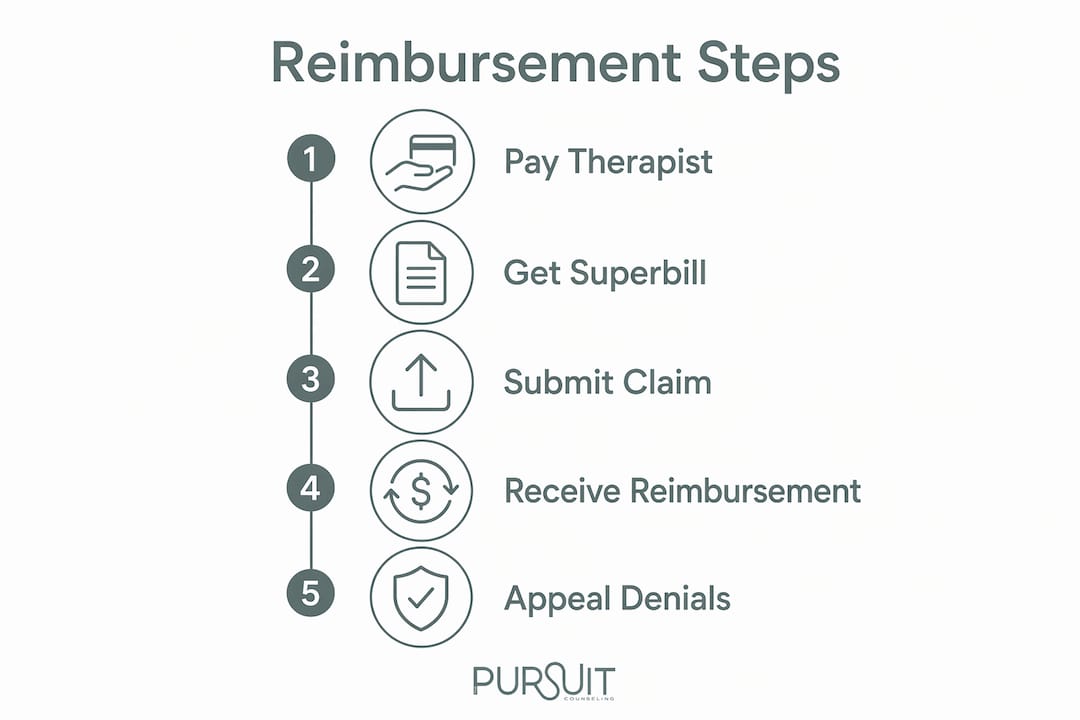
OON deductibles are typically separate from and higher than in-network deductibles, and many plans exclude OON spending from the in-network out-of-pocket maximum entirely.
Step-by-step: getting a superbill and submitting your claim
A superbill is the therapist’s detailed receipt that you, the client, submit to your insurer to request reimbursement. Here is the exact sequence:
- Pay your therapist for the session at the time of service.
- Request a superbill — ask at your first appointment whether they provide them routinely and how often (monthly is common).
- Confirm all required fields are present (see Section 5 below for the full list).
- Download your insurer’s claim form from the member portal, or ask member services to mail one.
- Submit via the member portal (fastest) or by certified mail to the claims address on the back of your insurance card.
- Keep copies of everything — scan the superbill and claim form before you send them.
- Track your submission date and note the claim reference number if the portal provides one.
Ask your therapist specifically for their NPI, the CPT codes they plan to use, the ICD-10 diagnosis code, their billing address, phone number, and taxonomy code. If your therapist works under supervision, your insurer may also require the supervisor’s NPI and credentials.
Pro Tip: Submit claims monthly rather than letting several sessions pile up. Missing your insurer’s filing deadline — even by one day — forfeits reimbursement for that session permanently, regardless of how complete your documentation is.
If no Explanation of Benefits (EOB) or payment arrives within 30 days of submission, call member services, ask for a claim status, and request a list of any missing documentation. Administrative backlogs and missing fields are the two most common causes of stalled claims.
What fields and codes should you expect on a superbill?
A complete superbill protects you from avoidable denials. Claims are frequently rejected for missing or incorrect superbill information, so confirm every field before you submit.
Provider information:
- Therapist’s full name and credentials (e.g., LPC, LCSW, PhD)
- National Provider Identifier (NPI)
- Billing address and phone number
- Taxonomy code
- Tax Identification Number (TIN), if applicable
- Signature and date
Session and billing details:
- Date and length of each session
- CPT code (e.g., 90837 for a 60-minute individual psychotherapy session; 90834 for 45 minutes)
- ICD-10 diagnosis code — your therapist assigns this; you do not select it
- Fee charged per session
- Payment method and amount paid
- Document labeled “Superbill” or “Detailed Receipt”
Keep originals and scanned copies for at least seven years. Your insurer may also have its own retention requirements tied to appeal deadlines, so check your plan documents.
What to expect: processing times and how much you might recover
Processing times range from 2–3 weeks in best-case scenarios to 4–6 weeks commonly, and up to 12 weeks for flagged or complex claims. Plan for the middle range and follow up at 30 days if nothing has arrived.
| Scenario | Processing time | Reimbursement rate |
|---|---|---|
| Clean claim, no issues | 2–3 weeks | 50–80% of the allowed amount after OON deductible |
| Minor documentation gap | 4–6 weeks | Same rate once corrected |
| Flagged or complex review | Up to 12 weeks | Varies; may require appeal |
Most plans reimburse 50–80% of the UCR/allowed amount after the OON deductible is met, with common OON deductibles running ,000–,000 per year. Because coinsurance applies to the allowed amount rather than your therapist’s actual fee, your net recovery is often smaller than the percentage suggests.
A few things that shift the math in your favor:
- HSA or FSA funds can pay the unreimbursed portion — therapy qualifies as an eligible HSA/FSA expense, and the superbill serves as your documentation.
- Timing intensive care early in your plan year helps you meet the OON deductible faster, so more sessions become eligible for cost-sharing.
- Prior-year deductible progress resets on January 1 for most plans — starting a new intensive program in January means you are starting from zero.
Common denial reasons and how to appeal in Georgia
Denials feel like a dead end. They rarely are. Start by reading the EOB your insurer sends after processing — it includes a denial reason code and a plain-language explanation.
Most common denial reasons:
- Missing or incorrect superbill fields (NPI, diagnosis code, CPT code)
- Member ID or date of birth mismatch between the superbill and insurer records
- CPT code does not match the service description
- Claim submitted after the filing deadline
- Plan excludes OON benefits for the service type
Appeal sequence:
- Pull the original superbill, claim form, and EOB.
- Identify the exact denial reason code on the EOB.
- Correct the error (fix the field, add missing documentation) and resubmit as a corrected claim.
- If resubmission is denied again, file a formal internal appeal in writing within your plan’s appeal deadline (typically 180 days from the denial date).
- Include a cover letter citing the denial reason, your corrected documentation, and any relevant mental health parity argument if the denial appears to apply a stricter standard to behavioral health than to medical claims.
- If the internal appeal fails, request an external review through your plan.
For Georgia clients, the Georgia Office of Commissioner of Insurance handles consumer complaints when an insurer’s internal process stalls or produces an unreasonable outcome. File at oci.ga.gov and include copies of your EOBs, superbills, appeal letters, and any written correspondence with the insurer. The Commissioner’s office can compel a response and investigate potential parity violations.
Is paying out-of-pocket worth it? A quick decision checklist for Georgia clients
This is the real question, and it deserves an honest answer. The administrative work is real. So is the clinical benefit of finding the right fit.
Evaluate these factors first:
- Does your plan have OON benefits at all? (If not, the math changes entirely.)
- How large is your OON deductible, and how close are you to meeting it?
- Is the therapist you want available in-network? If yes, the case for OON weakens considerably.
- How urgent is your need? Clinical fit matters more when the presenting issue is complex or specialized.
- Do you have HSA or FSA funds available to offset unreimbursed costs?
- Have you already met your in-network MOOP this year? (If so, in-network care may cost you nothing.)
Honest pros and cons:
- Pros: Access to the specific therapist or modality you need, greater privacy (no insurance record of diagnosis), no session limits or prior authorization requirements, flexibility in scheduling and treatment approach.
- Cons: Higher upfront cost, administrative burden of claim submission, reimbursement is partial and delayed, balance billing exposure.
Quick-score questions:
- Does your plan have OON mental health benefits? (No = strong case against OON unless you have HSA/FSA.)
- Is the clinical fit significantly better than any in-network option? (Yes = OON worth considering.)
- Can you absorb the OON deductible without financial hardship? (No = reconsider timing or explore in-network first.)
- Do you have HSA or FSA funds available? (Yes = meaningfully reduces net cost.)
If you answered yes to questions 2 and 4 and your plan has OON benefits, the clinical and financial case for out-of-network care is often strong enough to move forward.
The Pursuit Counseling supports private-pay clients in Georgia
Private-pay therapy does not have to mean navigating the paperwork alone. The Pursuit Counseling serves adults, executives, couples, and high performers across Georgia — in person in Fayetteville and Peachtree City, and online statewide — with individual psychotherapy, couples counseling, EMDR, neurofeedback, intensive programs, and executive coaching.
Every client receives an accurate superbill with all required fields: NPI, CPT codes, ICD-10 diagnosis, session dates, fees, and provider credentials. The team can walk you through the claim submission process before your first session so you arrive prepared, not guessing. For clients considering an intensive therapy program, scheduling early in your plan year can help you meet your OON deductible faster and maximize reimbursable sessions.
Whether you are a high-performing professional seeking executive support or a couple working through a difficult season, The Pursuit Counseling provides the clinical depth and administrative support to make private-pay care work for you. Book your first session or request superbill guidance at thepursuitcounseling.com.
Key Takeaways
Out-of-network therapy reimbursement is achievable for most PPO and POS plan holders who submit accurate superbills on time, meet their OON deductible, and follow up within 30 days of submission.
| Point | Details |
|---|---|
| Check your SBC first | Verify OON mental health benefits, deductible amount, and filing deadline before booking. |
| Superbill accuracy prevents denials | Confirm NPI, CPT codes, ICD-10 diagnosis, and member ID match before submitting. |
| Reimbursement is partial | Insurers pay 50–80% of the allowed amount after the OON deductible, not your therapist’s full fee. |
| Appeal denied claims | Use the EOB denial code, correct the error, and escalate to the Georgia Office of Commissioner of Insurance if needed. |
| The Pursuit Counseling | Provides accurate superbills and claim guidance for private-pay clients in Fayetteville, Peachtree City, and across Georgia. |
Why clients choose out-of-network care: a practitioner’s perspective
The clients who choose out-of-network care are not doing it because it is easier. They are doing it because something matters more to them than convenience. Clinical fit. Privacy. A specific modality their in-network options simply do not offer. EMDR for trauma that has not responded to anything else. Neurofeedback for an executive whose ADHD has been mismanaged for years. Couples work that requires a therapist trained in the Gottman Method, not just someone who is available and in-network.
What I see consistently is that the administrative friction of OON claims is real but manageable when clients are prepared. The gap that actually derails people is not the paperwork. It is not knowing what to ask for, or discovering three months in that their superbill was missing a field. Preparation at session one changes everything. Confirming the superbill fields, understanding the allowed amount math, and timing intensive work early in the plan year are small moves that compound into meaningful savings.
The deeper truth is this: the right therapeutic relationship, at the right time, with the right approach, is worth the effort of a claim form. The cracks in a person’s life do not wait for an in-network opening. When you find the fit that actually moves the needle, the paperwork becomes a small price for something that genuinely changes your trajectory.
Useful sources and a sample member-services script
Georgia regulator:
- Georgia Office of Commissioner of Insurance: oci.ga.gov. Include EOBs, superbill copies, appeal letters, and written insurer correspondence in your complaint file.
Federal resources:
- CMS No Surprises Act: cms.gov/nosurprises — covers emergency and ancillary protections.
- HealthCare.gov: healthcare.gov/glossary/out-of-pocket-maximum-limit — explains MOOP and how OON spending interacts with it.
Sample member-services call script:
Write down the rep’s name, the date, and every number they give you. That record protects you if a claim is later denied on grounds that contradict what you were told.
This article is general information, not legal or financial advice. Confirm your plan’s specific terms with your insurer or a licensed benefits professional before making coverage decisions.
Recommended
- Intensive Therapy Program Fayette County GA (2026) – The Pursuit Counseling
- Couples Counseling Peachtree City GA: Find Help (2026) – The Pursuit Counseling
- Therapy for High-Performing Men in Peachtree City, Fayetteville, and Across Georgia – The Pursuit Counseling
- EMDR Therapy Fayetteville GA: Trauma Treatment Guide (2026) – The Pursuit Counseling