

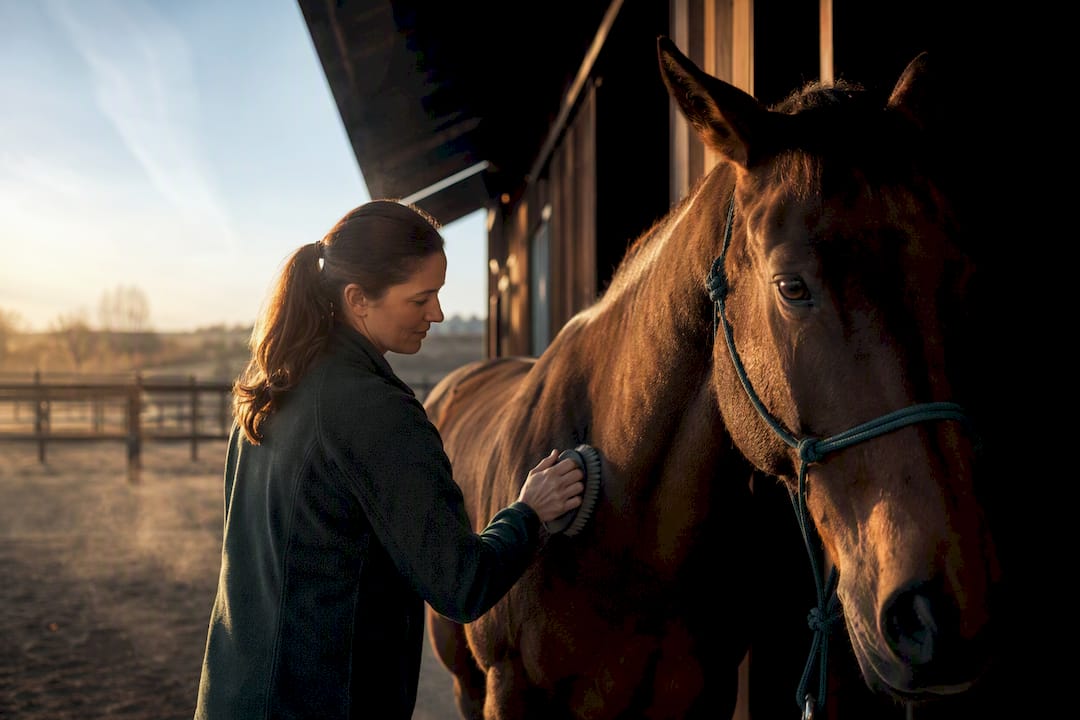
Equine therapy for adults pairs a licensed mental health professional and a certified equine specialist to help people process trauma, addiction, anxiety, and depression through structured work with horses. It works best as a complement to established treatments like EMDR, CBT, or medication, not a replacement for them. A 2026 randomized controlled trial and several clinical reviews support its promise, though the evidence base is still young. If you’re weighing whether it fits your situation, the program’s credentials matter more than the horses do.
TL;DR:
- Equine-assisted psychotherapy (EAP) is a ground-based, clinically guided approach focused on emotional processing, led by a licensed mental health professional and a certified equine specialist.
- The strongest evidence supports its use for depression in older adults and PTSD symptoms, but most studies have small samples and limited generalizability.
- Program credentials hinge on pairing a licensed clinician with a certified equine specialist, with Eagala and PATH Intl certification being key indicators of safety and professionalism.
- Costs vary widely, with hippotherapy more likely to be reimbursed by insurance if billed as medical treatment, while standalone EAP sessions are usually private pay.
- Equine therapy is most effective when integrated with other treatments like EMDR, CBT, or medication, and requires careful medical and psychiatric screening to ensure safety.
Table of Contents
- What Is Equine Therapy for Adults, and What Forms Does It Take?
- Which Adult Conditions Respond Well to Equine Therapy?
- What Happens During an Equine Therapy Session?
- Does the Research Actually Support Equine Therapy?
- How Do You Choose a Safe, Legitimate Program?
- How The Pursuit Counseling Approaches Equine Work
- What Are the Risks and Who Should Avoid Equine Therapy?
- What Results Can You Realistically Expect?
- How Does Equine Therapy Fit With Psychotherapy and Medication?
- How Often and How Long Should Sessions Run?
- What Training Do Equine Specialists Actually Have?
- How Do Personal Background and Culture Shape the Experience?
- A Clinician’s Honest Read on What Progress Looks Like
- Ready to Explore Equine Therapy With an Integrated Care Team?
- Sources
- FAQ
What Is Equine Therapy for Adults, and What Forms Does It Take?
Equine therapy for adults isn’t one single practice. It’s an umbrella term covering several distinct approaches, each with a different clinical purpose and a different set of credentials behind it.
Equine-assisted psychotherapy (EAP), sometimes called equine-assisted therapy (EAT), is ground-based work. There’s no riding involved. A licensed clinician and a certified equine specialist guide you through activities like grooming, leading, or navigating a horse through an obstacle course, then use what happens (and what you feel while it’s happening) as material for the session. Eagala defines this model as structured, ground-based activities run jointly by a licensed mental health professional and a certified equine specialist to support emotional healing, and this pairing is the core credential to look for regardless of which format you choose.
Therapeutic riding is different. It’s mounted, instructor-led, and often geared toward physical or adaptive goals rather than talk-therapy processing. Hippotherapy overlaps with therapeutic riding but is delivered by a licensed physical, occupational, or speech therapist using the horse’s movement as a treatment tool, usually under American Hippotherapy Association standards. Equine-assisted learning (EFL) skips the clinical framing entirely and focuses on leadership, communication, and personal-development skills, often for corporate or coaching clients rather than mental health treatment.
Here’s how the formats break down by what they’re built to do:
- EAP/EAT: ground-based, emotional processing, run by a licensed therapist and Eagala or PATH Intl-affiliated specialist
- Therapeutic riding: mounted, physical and adaptive skill-building, PATH Intl certified instructors
- Hippotherapy: mounted, medical rehabilitation, delivered by a licensed PT, OT, or speech therapist
- Equine-assisted learning: ground-based, skills and leadership development, not clinical treatment
If your goal is trauma processing or emotional regulation, EAP is the format that fits. If you’re recovering from a physical injury, hippotherapy is the more relevant path.
Which Adult Conditions Respond Well to Equine Therapy?
Adults turn to equine therapy for a specific reason: talk therapy alone hasn’t gotten them all the way there, or they need a modality that works through the body rather than only through language. That’s not a knock on traditional therapy. It’s just how some nervous systems respond better.
Conditions where equine work shows the clearest clinical rationale include:
- PTSD and trauma, particularly when hypervigilance makes it hard to sit still in an office and talk
- Substance-use recovery, where rebuilding trust, routine, and impulse control are as important as insight
- Anxiety disorders, where the horse’s response to a regulated nervous system offers immediate, honest feedback
- Depression, especially treatment-resistant presentations in older adults
- ADHD, where the sensory and physical engagement holds attention differently than a conversation does
Veterans and adults who’ve struggled to open up in conventional talk therapy often respond well here, largely because the horse doesn’t require verbal fluency to build a working relationship. That said, equine therapy works best as a complement to trauma-informed counseling, medication management, or evidence-based approaches like EMDR and CBT, not as a substitute for them when symptoms are severe or acute.
What Happens During an Equine Therapy Session?
A typical equine therapy session runs 60 to 90 minutes and follows a consistent arc, even though the activities change week to week.
- Intake and check-in. The clinician asks how you’re doing and sets an intention for the session, sometimes tied to a goal from your ongoing individual therapy.
- Barn orientation and safety briefing. The equine specialist reviews ground rules, herd behavior, and how to read the horse’s body language.
- The activity itself. This might be grooming a horse in silence, leading it through a pattern of cones, or observing how the herd reacts when you enter the space. The activity is chosen deliberately, based on your treatment goals.
- Debrief. The licensed therapist connects what happened with the horse back to patterns in your life. This is where the clinical work actually lands.
Two professionals are always present in a legitimate program: a licensed clinician (LPC, LCSW, LMFT, or psychologist) who handles the mental health component, and a certified equine specialist who manages horse behavior and safety. Neither one substitutes for the other.
Many programs recommend a series of sessions to see meaningful movement, though this varies with your goals and how you respond. Expect helmets during any mounted work, horses that have been temperament-tested and matched to the group, and a clear emergency protocol posted at the barn. Programs vary in structure and pacing, and horses are matched to participants rather than overworked across back-to-back sessions, according to guidance from providers like Therapeutic Horses of Saratoga.
Pro Tip: Ask what happens if a horse seems anxious or unwilling on a given day. A program that reschedules or swaps horses without hesitation is prioritizing the animal’s welfare, which is a good proxy for how seriously they take yours.
Does the Research Actually Support Equine Therapy?
The strongest recent evidence comes from a 2026 multicenter randomized controlled trial testing Equine-Assisted Biographical Work (EABW) in adults 50 and older with subclinical depression. The trial found statistically significant, clinically meaningful reductions in depressive symptoms compared to no treatment, with large effect sizes (Cohen’s d up to 1.80 pre-to-post) that held up at a three-month follow-up.
That’s a notably strong result for a talk-adjacent intervention in a population where depression often goes undertreated.
Beyond that single trial, systematic reviews of equine-assisted interventions describe the broader picture more cautiously. Clinical-effectiveness reviews find promising signals for PTSD, depression, and social functioning, but flag that most studies involve small samples and inconsistent methods, which limits how confidently the findings generalize.
What this means practically: equine therapy has real evidence behind it, particularly for depression in older adults and PTSD symptom relief, but it’s not yet backed by the kind of large-scale, replicated trials that support first-line treatments like CBT or EMDR. Treat it as a complementary tool with growing support, not a proven standalone cure. That framing should shape how you decide whether to try it, not whether it’s worth trying at all.
How Do You Choose a Safe, Legitimate Program?
The credential that matters most is the pairing itself: a licensed mental health clinician working alongside a certified equine specialist. Eagala and PATH Intl are the two certifying bodies most reputable programs list, and their absence should raise a question, not necessarily a disqualification.
Before you book, ask the intake coordinator these questions:
- Who is the licensed clinician on my case, and what’s their license type?
- Is the equine specialist Eagala or PATH Intl certified?
- What’s your protocol if a horse shows signs of stress or fatigue?
- Do you require a medical clearance before mounted activities?
- What does documentation and progress tracking look like?
Red flags include a program that can’t name a licensed clinician, vague answers about safety procedures, horses that look overworked or poorly kept, and treatment goals that never get more specific than “connect with animals.”
| What to check | Why it matters |
|---|---|
| Licensed clinician + certified equine specialist | Core credibility filter recommended by Utah State University Extension |
| Eagala or PATH Intl affiliation | Signals adherence to an established safety and ethics model |
| Written safety and emergency protocol | Protects you and the horse during sessions |
| Clear treatment goals tied to your intake | Distinguishes clinical therapy from recreational riding |
Costs vary widely by region, program type, and staff credentials, and a per-session price can differ significantly between a ground-based EAP program and hippotherapy delivered by a licensed physical therapist. Hippotherapy has the best odds of insurance reimbursement when it’s billed under a licensed therapist’s medical CPT codes; standalone EAP sessions are more often private-pay. Ask directly about your specific plan before assuming either way.
How The Pursuit Counseling Approaches Equine Work
At The Pursuit Counseling, equine sessions aren’t a stand-alone offering bolted onto a website. They sit inside a broader, neuroscience-informed treatment palette that includes EMDR, neurofeedback, and Gottman Method work for couples. A common pattern: EMDR handles the deep trauma processing in-office, while equine sessions give clients a place to practice regulation skills in real time, outside the therapy room. Fit gets evaluated during an initial consultation, coordinated with whatever care you’re already receiving elsewhere.
What Are the Risks and Who Should Avoid Equine Therapy?
Equine therapy carries real physical risk. Horses are large, unpredictable animals, and even ground-based work involves a chance of being stepped on, bitten, or knocked over during an unexpected spook. Reputable programs mitigate this through temperament-tested horses and close supervision, but the risk never drops to zero.
Certain adults should approach equine therapy with caution or avoid it outright. People with severe, uncontrolled psychosis or active suicidality generally need stabilization in a higher level of care before adding an experiential modality like this one. Those with significant physical limitations, including uncontrolled seizure disorders or severe osteoporosis, need a medical clearance before any mounted work, and some may be better suited to ground-based EAP than riding-based formats. Severe animal phobias can also make the modality counterproductive rather than therapeutic, at least without a slower, more gradual introduction.
There’s also a psychological risk worth naming: equine therapy can surface intense emotional material quickly, sometimes faster than office-based talk therapy does, because the physical and sensory engagement bypasses some of the usual verbal defenses. That’s often the point. But it means a program without a licensed clinician present to contain and process that material isn’t just under-qualified. It can leave you activated with nowhere to put it.
Anyone with a known allergy to horses or hay, or a compromised immune system that makes barn environments risky, should discuss alternatives with their provider first. None of this rules equine therapy out for most adults. It just means the intake conversation should include a real medical and psychiatric history, not a form filled out in the waiting room five minutes before your first session.
What Results Can You Realistically Expect?
Equine therapy rarely produces a single dramatic breakthrough. What it tends to produce is a series of smaller, cumulative shifts: better emotional regulation under stress, more comfort reading and responding to nonverbal cues, and a growing sense of agency that often transfers into other relationships.
For trauma-focused clients, a realistic goal over 8 to 12 sessions is a measurable reduction in hypervigilance and an increased tolerance for physical closeness and unpredictability, both of which are common trauma triggers. For depression, the 2026 EABW trial showed large symptom reductions in older adults, sustained at three months, which suggests durable rather than fleeting change when the protocol is followed closely.
For substance-use recovery, expect the work to target impulse control, patience, and the ability to sit with discomfort without immediately reacting to it. Horses respond instantly and honestly to erratic energy, which gives clients a live feedback loop they don’t get anywhere else in treatment.
What equine therapy is not likely to do: replace medication for a diagnosed mood disorder, resolve a severe personality disorder on its own, or produce results without consistent attendance. Like most experiential therapies, the gains come from repetition and integration, not the novelty of the first session. Setting goals with your clinician before you start, and revisiting them every few sessions, keeps expectations grounded and gives you a concrete way to measure whether the work is landing.
How Does Equine Therapy Fit With Psychotherapy and Medication?
Equine therapy is almost always positioned as complementary care, and the clinical literature backs that framing directly. Guidance from Therapist notes that EAP is typically paired with CBT, medication management, or trauma-focused approaches like EMDR rather than used as a standalone treatment, largely because the standalone evidence base isn’t yet strong enough to support that role.
In practice, this pairing tends to work in one of two directions. Some clients do their deep trauma processing in an office setting with EMDR, then use equine sessions to practice the regulation skills that processing requires. Others start with equine work to build enough safety and trust to tolerate more direct trauma-focused therapy later. Neither sequence is inherently better. It depends on where you’re starting from and how your nervous system responds to different formats.
Medication management stays in the picture regardless. If you’re on an antidepressant, anti-anxiety medication, or a mood stabilizer, equine therapy doesn’t replace that regimen. It runs alongside it. A well-run program will ask about your medication and coordinate, at least loosely, with your prescribing provider, particularly if the treatment goals overlap.
The practical takeaway: ask any program you’re considering how they coordinate with outside providers. A program that treats itself as a closed system, disconnected from your psychiatrist or your primary therapist, is missing a piece of what makes integrated care actually work.
How Often and How Long Should Sessions Run?
Frequency and duration depend heavily on what you’re treating and how acute your symptoms are. For trauma and PTSD, weekly sessions over several weeks are a common starting structure, mirroring the pacing of many EMDR protocols, though some clients extend well beyond that if progress is gradual.
Depression treatment, based on the structure of the EABW protocol tested in the 2026 trial, often follows a defined, structured program rather than open-ended weekly visits, with sessions building on each other toward a specific endpoint.
Substance-use recovery programs frequently integrate equine sessions into a broader intensive schedule, sometimes multiple times a week during early recovery, then tapering to biweekly or monthly as stability increases. Anxiety and ADHD-focused work tends to sit in the middle: weekly or biweekly sessions, often continuing for several months since the goal is ongoing skill-building rather than resolving a single acute episode.
There’s no universal formula here, and any program worth choosing should adjust the schedule based on how you’re actually responding, not a one-size template applied to every client. If you’re not seeing any shift after 10 to 12 sessions, that’s worth a direct conversation with your clinician about whether the format, frequency, or your goals need adjusting.
What Training Do Equine Specialists Actually Have?
A certified equine specialist isn’t a hobbyist who happens to own horses. Certification through Eagala requires a defined training curriculum covering horse behavior, herd dynamics, safety protocols, and how to work collaboratively with a mental health professional inside a clinical framework, according to Eagala’s own program description.
PATH Intl certification, more common in therapeutic riding and hippotherapy contexts, involves its own instructor training track focused on adaptive riding technique, disability-specific accommodations, and horse management standards. Hippotherapy adds another layer entirely: the person guiding the horse’s movement as treatment is a licensed physical, occupational, or speech therapist who has completed additional coursework through the American Hippotherapy Association, not a general equine specialist.

What none of these certifications include is a mental health license. That’s precisely why legitimate programs never let the equine specialist run sessions alone. Their expertise is the horse. The clinician’s expertise is you. When you’re vetting a program, ask specifically how long the equine specialist has held their certification and how many hours of supervised practice preceded it. A specialist a few months out of certification isn’t necessarily unqualified, but a program that can’t answer basic questions about their equine staff’s credentials is a program that hasn’t thought carefully about who’s handling a 1,200 pound animal around a vulnerable client.
How Do Personal Background and Culture Shape the Experience?
Not everyone arrives at a horse with the same relationship to it. Adults who grew up around agriculture or ranching often bring a baseline comfort that speeds up the early trust-building work. Adults with no animal experience at all, or a specific fear of large animals, may need several sessions just to feel safe standing near the horse before any deeper clinical work can happen. Good programs plan for that difference rather than rushing past it.

Cultural background matters too, sometimes in ways that aren’t obvious at intake. In some cultural and religious contexts, animals carry different symbolic meanings, and horses specifically can evoke associations tied to status, labor, or spiritual significance that shape how a client interprets the work. A clinician attuned to this will ask rather than assume.
Gender and body-related experiences also shape the work in practical ways. Adults recovering from sexual trauma may respond strongly, and sometimes unpredictably, to the physical closeness that grooming or leading a horse requires, since that proximity can feel either grounding or triggering depending on where someone is in their healing. Age plays a role as well: the EABW trial specifically targeted adults 50 and older, and the protocol’s biographical, life-review framing was built around that population’s developmental stage, not a generic template applied to any age group.
None of this means equine therapy works differently depending on who you are in some deterministic sense. It means a competent program treats your background as clinical information, not a footnote, and adjusts pacing accordingly.
A Clinician’s Honest Read on What Progress Looks Like
Meaningful change here rarely looks dramatic. It looks like a client noticing they can tolerate an unpredictable moment with a horse without shutting down, then realizing that same tolerance is showing up at work or at home. The real work happens in how you carry that regulation skill back into your week between sessions.
Equine work integrates best when it’s paired with, not separate from, whatever processing happens in your regular therapy sessions. If you’re doing EMDR for trauma, expect your therapist to reference the barn sessions directly, using what happened there as material for the next office visit.
— Adam
Ready to Explore Equine Therapy With an Integrated Care Team?
If you’ve read this far, you already know the credential that matters most: a licensed clinician working alongside a certified equine specialist, not a horse ranch offering therapy as a side activity. That’s the standard The Pursuit Counseling builds its equine program around, integrated with EMDR, neurofeedback, and other evidence-based treatments rather than as an isolated experience.
A first consultation typically covers your history, current symptoms, and whether equine work makes sense alongside other treatment you’re already receiving, whether that’s trauma processing, medication management, or executive coaching as part of an employee mental health program for a high-stress role. Pricing and any insurance questions get addressed directly during intake, since coverage depends heavily on the specific service and your plan. If you’re ready to find out whether this fits your situation, the next step is straightforward: visit the Getting Started with Counseling page and schedule an initial consultation.
This article is general information, not a substitute for advice from a qualified doctor. Consult a qualified healthcare professional about your own circumstances before acting on anything here.
Sources
- Effect of Equine-assisted Biographical Work (EABW) in older adults with subclinical depression: a randomized controlled trial | BMC Complementary Medicine and Therapies | Springer Nature
- What is Equine Assisted Psychotherapy – Eagala
- What are equine-assisted services? A practical guide for families and communities | Utah State University Extension
- Canine and Equine Therapy for Mental Health: A Review of Clinical Effectiveness
Looking for a therapist or counselor in Fayetteville or Peachtree City, GA? The Pursuit Counseling provides personalized therapy, couples counseling, anxiety treatment, trauma therapy, EMDR, ADHD support, and neurofeedback Brain Mapping for adults, teens, couples, professionals, and families throughout Fayette County and South Atlanta. With a convenient office in Fayetteville, GA, near Peachtree City, Trilith, Tyrone, Senoia, and Newnan, our experienced counselors help clients improve mental health, strengthen relationships, manage stress, and pursue meaningful growth. Schedule a counseling consultation with The Pursuit Counseling today and find the right therapist for you in Fayetteville or Peachtree City, Georgia.
FAQ
What Is Equine Therapy for Adults?
It’s a structured, experiential therapy that uses guided interaction with horses, led jointly by a licensed mental health professional and a certified equine specialist, to help adults process trauma, addiction, anxiety, and depression.
Will Insurance Pay for Horse Therapy?
Coverage depends heavily on the format. Hippotherapy delivered by a licensed physical, occupational, or speech therapist has the best chance of reimbursement when billed under medical treatment codes, while standalone equine-assisted psychotherapy is more often private-pay.
How Much Does Equine Therapy Usually Cost?
Prices vary widely by program type, region, and staff credentials, so it’s best to ask each program directly for their current session rates rather than assume a fixed price applies everywhere.
Will Medicare Pay for Equine Therapy?
Medicare coverage typically hinges on whether the service is billed as a recognized medical treatment, such as hippotherapy delivered by a licensed therapist for a documented physical condition, rather than as general equine-assisted psychotherapy.
How Does Equine Therapy Work Alongside Other Treatments?
It functions best as a complement to established approaches like EMDR, CBT, or medication management, giving clients a place to practice regulation and trust-building skills that reinforce the deeper processing work done in individual therapy.