

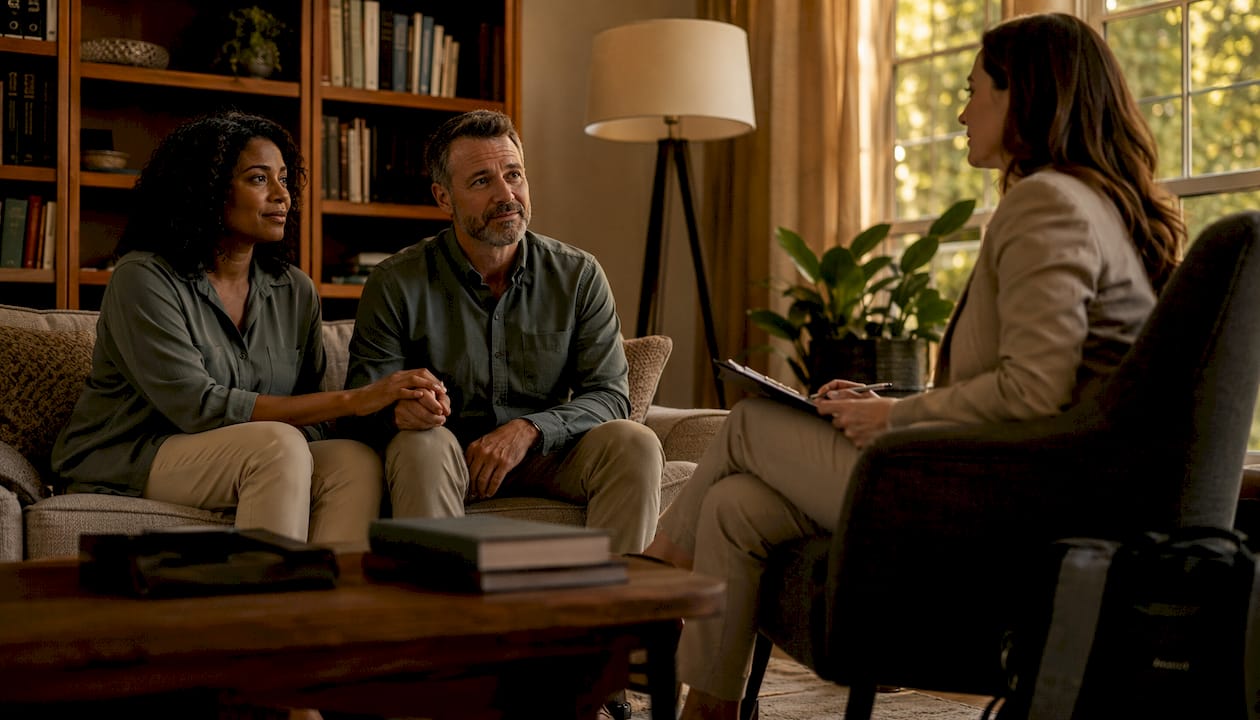
Marriage counseling and couples therapy are not the same thing, even though people use the terms interchangeably every day. The core difference comes down to scope and timing. Marriage counseling is typically short-term and solution-focused, targeting specific present-day issues like communication breakdowns or financial conflict, and averages around 12 sessions. Couples therapy goes deeper, exploring historical patterns, individual attachment styles, and the emotional roots of recurring conflict, often over a longer, more open-ended timeline.
Here is what that looks like in practice:
- Marriage counseling works best when a couple wants practical tools fast: premarital preparation, a specific trust rupture, or a communication habit that keeps derailing them.
- Couples therapy fits when the problem feels bigger than any single issue, when patterns repeat no matter what you try, or when one or both partners carry individual wounds that spill into the relationship.
- Both approaches rely on licensed professionals and evidence-based methods as their foundation. The label matters far less than the clinician’s training and the fit between their method and your situation.
What are the real differences between marriage counseling and couples therapy?
The distinction between these two forms of relationship support has blurred considerably over the past two decades. Experts note that contemporary couples therapists increasingly use cognitive and skill-based strategies once associated with marriage counseling, while marriage counselors now incorporate psychotherapeutic techniques. What once separated these fields by method now separates them more by intent: prevention-oriented versus treatment-oriented.
Service focus and goals
Marriage counseling zooms in on the marriage itself, addressing specific problems with targeted steps and a clear endpoint. Couples therapy examines the relationship system, including individual histories and the emotional dynamics that shape how two people connect or disconnect over time.
Therapeutic approaches
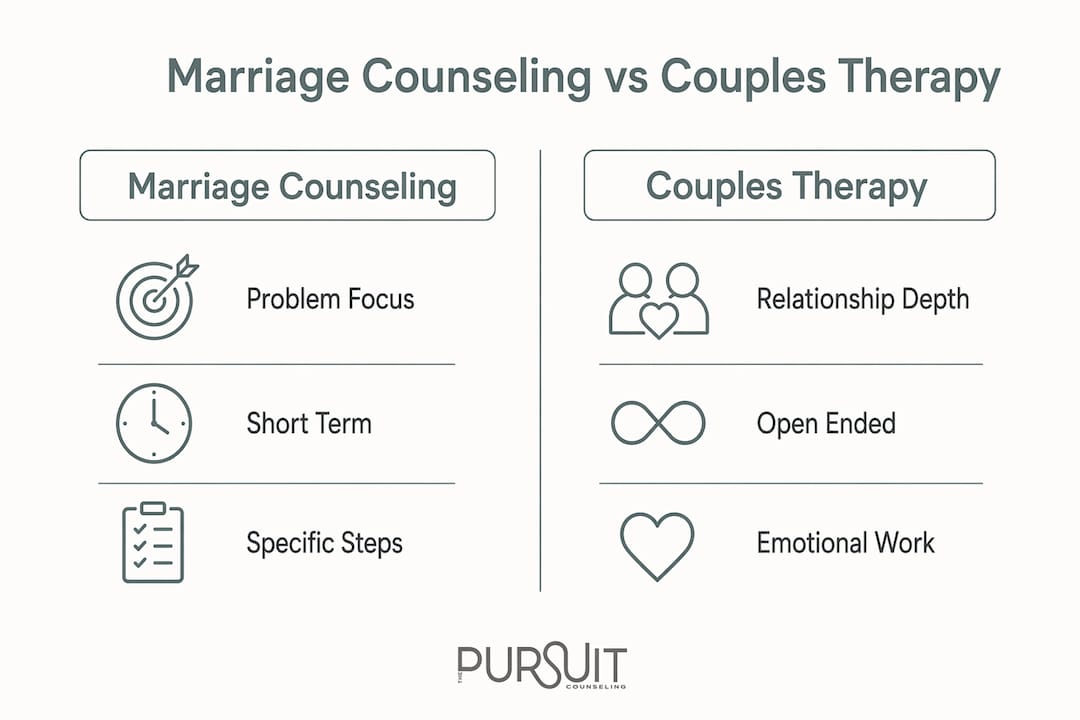
Marriage counseling leans on solution-focused strategies, communication skill-building, and practical conflict management for couples. Couples therapy draws on modalities like Emotionally Focused Therapy (EFT), the Gottman Method, and Cognitive-Behavioral Therapy (CBT), chosen based on the couple’s specific relational dynamics.
Typical use cases
- Marriage counseling: premarital preparation, parenting disagreements, financial conflict, rebuilding after a specific breach of trust
- Couples therapy: recurring destructive cycles, infidelity recovery, attachment injuries, individual mental health issues affecting the relationship
Duration and session count
Marriage counseling typically wraps in a limited number of sessions. Couples therapy is more open-ended; some couples work for six months or longer, especially when deeper trauma or entrenched patterns are involved.

Cost and insurance
Session rates for both typically range from to 0 per hour depending on the clinician’s experience and location. Because couples therapy usually requires more sessions, the total investment tends to be higher. Insurance coverage for either service varies widely. The Affordable Care Act requires mental health benefits, but insurers are not always required to cover couples-specific work unless a diagnosed mental health condition is part of the treatment. Many Georgia couples pay out of pocket, so confirming coverage before your first session is worth the call.
Credentials and licensing
Licensed Marriage and Family Therapists (LMFTs) are trained for both modalities. A key distinction: some marriage counselors, particularly those operating through faith communities, are not licensed mental health professionals and cannot diagnose or treat clinical conditions. Always verify licensure before starting treatment.
How can Georgia couples decide which approach fits them?
The honest answer is that therapy is rarely linear. A couple might start with marriage counseling for a communication problem and discover, three sessions in, that the real issue runs deeper. A good clinician adjusts. What matters most is starting somewhere with a licensed professional who uses evidence-based methods and creates a genuinely neutral space for both partners.
Use these criteria to guide your decision:
- Severity of distress: If the relationship feels fundamentally broken or one partner is questioning commitment, couples therapy is the stronger starting point.
- Desired outcome: Quick, practical tools? Marriage counseling. Lasting change in how you relate to each other at an emotional level? Couples therapy.
- Individual factors: If anxiety, trauma, or depression is part of the picture, look for a therapist trained in both individual and relational work.
- Relationship type: Couples therapy welcomes all committed relationships, including unmarried, LGBTQIA+, and blended families. Marriage counseling has historically focused on married couples, though many counselors now serve all relationship types.
When interviewing a prospective clinician, ask directly: What modalities do you use? How do you handle it when partners have very different repair styles? Research from the Gottman Institute shows that partners often have different repair rhythms, with some needing immediate discussion and others needing space before they can engage productively. A skilled therapist accounts for that difference rather than forcing one partner’s pace onto the other.
Successful repair also depends on more than conflict resolution. Consistent positive interactions between sessions, what the Gottman Method calls “emotional bank account” deposits, matter as much as what happens in the therapy room. Ask any prospective provider how they support couples between sessions, not just during them.
Pro Tip: If you are unsure which approach you need, book a single consultation session and tell the clinician exactly that. A good therapist will assess your situation honestly and recommend the right level of care, even if that means referring you elsewhere.
Which Georgia providers offer verified relationship support?
Seven Georgia-area providers offer distinct approaches to couples counseling and therapy. Here is how they compare across the dimensions that matter most.
| Provider | Therapeutic Approach | Specializations | Delivery | Best For | Rating |
|---|---|---|---|---|---|
| Fava Counseling Associates | Relationship counseling, anxiety therapy | Marriage counseling, family therapy, premarital counseling | In-person and online | Broad marriage and family therapy needs | 4.9★ (58) |
| Maverick Marriage Therapy | Personalized couples therapy | Affair recovery, Christian counseling, premarital | In-person and telehealth | Rebuilding trust after infidelity | 5★ (44) |
| Dream Builders Marriage Coaching & Counseling | Faith-based coaching and counseling | Marriage restoration, affair recovery | Not publicly listed | Faith-oriented couples seeking restoration | 5★ (41) |
| The Pursuit Counseling | Neuroscience-informed, Gottman Method, EMDR | Anxiety, stress, relationship strengthening | In-person and online | Couples wanting neuroscience-informed therapy | 5★ (21) |
| Couples Counseling ATL | Gottman Method | Marriage and couples therapy | Local Atlanta | Research-based Gottman Method therapy | 4.2★ (12) |
| The Relationship House | Emotionally Focused Therapy (EFT) | Trauma-informed, LGBTQIA+ affirming, family therapy | In-person and online | Attachment-based and trauma-informed care | 5★ (10) |
| Aspen Grove Counseling + Wellness | Individual and couples therapy | Anxiety, depression, grief, postpartum | In-person (Decatur, GA) | Couples wanting a free intro consultation | 5★ (4) |
Fava Counseling Associates offers one of the widest service ranges on this list, covering marriage counseling, family therapy, premarital counseling, anxiety treatment, and teen counseling, all with both in-person and online delivery in Georgia. That breadth makes them a practical first call for couples who are not yet sure what level of support they need.
Maverick Marriage Therapy is purpose-built for couples navigating infidelity. Their affair recovery focus, combined with Christian counseling and intensive weekend options, serves couples who need both clinical structure and a faith-aligned framework. They serve Georgia and Illinois via in-person and telehealth.
Dream Builders Marriage Coaching & Counseling brings a personal dimension to faith-based work: the practice was founded by a couple who navigated infidelity themselves. Their services include marriage coaching, counseling, premarital work, and maintenance coaching for couples who want ongoing support after an initial crisis.
The Pursuit Counseling stands out for couples where anxiety, stress, or unprocessed trauma is driving relational conflict. Their Pursuit Method integrates neuropsychology with traditional counseling, using tools like EMDR and neurofeedback alongside the Gottman Method. For high-performing couples in Georgia who want a clinically rigorous, science-grounded approach, this is the strongest fit. Their couples and relationship counseling services are available both in-person and online.
The Relationship House specializes in Emotionally Focused Therapy, an approach recognized by the American Psychological Association for its effectiveness with attachment injuries. Their trauma-informed and LGBTQIA+ affirming practice makes them a strong option for couples whose relational pain connects to identity, family-of-origin wounds, or complex trauma.
Couples Counseling ATL focuses specifically on the Gottman Method, making them a clear choice for couples who have researched that framework and want a local Atlanta provider dedicated to it.
Aspen Grove Counseling + Wellness, based in Decatur, GA, offers a free 15-minute phone consultation alongside individual and couples therapy, pregnancy and postpartum support, and addiction recovery services. A good entry point for couples who want to talk to someone before committing.
The Pursuit Counseling brings neuroscience to relationship healing
When anxiety or stress is quietly dismantling a relationship, standard talk therapy sometimes only scratches the surface. The Pursuit Counseling offers a different route: a method that pairs the Gottman Method and EMDR with neurofeedback to address the nervous system patterns that keep couples stuck in the same painful cycles.
This is not a one-size-fits-all model. The Pursuit Counseling serves high-performing adults, executives, and couples across Georgia through both in-person and online sessions, with couples intensive programs available for those who need concentrated work. If you and your partner are ready to go beyond surface-level conflict resolution and address what is actually driving the distance between you, The Pursuit Counseling is worth a conversation.
Key Takeaways
Marriage counseling targets specific present-day issues in roughly 12 sessions, while couples therapy addresses deeper emotional patterns over a longer, more open-ended timeline, and the right choice depends on the severity of distress and the outcomes you want.
| Point | Details |
|---|---|
| Scope is the core difference | Marriage counseling solves specific problems; couples therapy addresses deeper emotional and historical patterns. |
| Session count varies | Marriage counseling averages around 12 sessions; couples therapy is typically longer and more open-ended. |
| Credentials matter more than labels | A licensed clinician using evidence-based methods is more important than whether the service is called counseling or therapy. |
| Repair goes beyond conflict | Consistent positive interactions between sessions, not just conflict resolution, determine whether repair sticks. |
| The Pursuit Counseling | Best for Georgia couples where anxiety, trauma, or stress is driving relational conflict, using EMDR, neurofeedback, and the Gottman Method. |
Recommended
- Couples Counseling Peachtree City GA: Find Help (2026) – The Pursuit Counseling
- Premarital Counseling Peachtree City GA: Engaged Couples Guide (2026) – The Pursuit Counseling
- Couples and Relationship Counseling Services – The Pursuit Counseling
- Blended Family Counseling Peachtree City GA (2026) – The Pursuit Counseling