


Counseling confidentiality protects the identifiable details of what you share in therapy, but it is not an unlimited shield. Licensed clinicians who bill electronically are usually covered by HIPAA, and your psychotherapy notes get extra legal protection beyond the rest of your chart. That said, mandated reporting laws, court orders, imminent danger to yourself or others, and certain substance-use treatment rules can all override confidentiality under specific conditions.
TL;DR:
- Confidentiality is primarily protected by HIPAA and state laws, but legal exceptions include mandated reporting, court orders, and imminent danger situations.
- HIPAA-covered clinicians cannot share your full clinical record without your permission, but psychotherapy notes receive extra legal protection and are more restricted.
- Teletherapy privacy depends on your environment and device security, requiring both clinician safeguards and your control over physical surroundings.
- Asking specific questions about record storage, reporting triggers, and confidentiality practices during your first session helps prevent surprises later.
- Clinician transparency about confidentiality limits and clear informed consent are key to building trust and safeguarding your sensitive information.
Table of Contents
- What Does Counseling Confidentiality Actually Cover?
- HIPAA, Mandated Reporting, and 42 CFR Part 2: The Legal Limits
- Psychotherapy Notes vs. Your Clinical Record: What You Can Access
- Teletherapy Privacy: A Shared Responsibility
- What Should You Ask Before Your First Session?
- A Clinician’s View on Confidentiality and Client Trust
- How The Pursuit Counseling Handles Your Privacy
- Primary Sources Worth Bookmarking
- Sources
- FAQ
What Does Counseling Confidentiality Actually Cover?
Coaching and counseling get lumped together online constantly, and that confusion costs people real protection. A life or executive coach operates under a professional code of ethics, often through a certifying body, but that code is not a legal privilege. It is a private agreement, not a federal privacy law. Counseling confidentiality, by contrast, is backed by HIPAA, state licensing statutes, and in some cases court-recognized therapist-client privilege. When you are managing anxiety, trauma, or a relationship crisis, that legal weight matters. It is the difference between “my coach promised discretion” and “the law requires my therapist to protect this record.”
Here is what falls under a licensed clinician’s confidentiality umbrella:
- Your identifiable health information, including diagnosis, symptoms, and history shared during sessions
- Session notes, treatment plans, and billing records tied to your identity
- Communications between your therapist and any other provider, unless you authorize the exchange
- Your status as a client at all, in many practice settings
A licensed marriage and family therapist, licensed clinical social worker, or licensed professional counselor who transmits claims electronically is generally a HIPAA covered entity. That status triggers specific disclosure rules for treatment, payment, and operations, all governed by a “minimum necessary” standard. Your therapist can share what is needed to coordinate your care. They cannot share your entire file just because another provider asked.
HIPAA, Mandated Reporting, and 42 CFR Part 2: The Legal Limits
Confidentiality in counseling operates inside a framework, not a vacuum. HIPAA permits disclosure for treatment, payment, and health care operations, along with narrower categories like legal proceedings, oversight, and serious or imminent threats, always tethered to the minimum-necessary principle. Your therapist is not choosing what to disclose on a whim. They are working within defined categories that limit how much information leaves the room.
Mandated reporting is where things get genuinely complicated, and where a lot of clients feel blind sided if nobody explained it upfront.
- Every state requires licensed clinicians to report suspected child abuse or neglect
- Many states extend that duty to elder abuse or dependent-adult abuse
- Reporting thresholds differ: some states require reasonable suspicion, others require a higher confidence standard
- Imminent, serious danger to self or others can trigger disclosure even without a specific statute naming the situation
The Child Welfare Information Gateway’s 50-state overview confirms these laws vary meaningfully from state to state, including who qualifies as a mandated reporter and what standard of suspicion applies. A clinician licensed in Georgia operates under different specifics than one in California, which is exactly why this needs to come up before your first session, not after a crisis.
One more layer exists specifically for addiction treatment. 42 CFR Part 2 gives federally assisted substance-use-disorder programs stronger protection than standard HIPAA covered entities receive, generally requiring your written consent before any disclosure, with only limited exceptions like medical emergencies.
Psychotherapy Notes vs. Your Clinical Record: What You Can Access
Not everything in your file is treated equally, and understanding that distinction changes how you think about privacy.
- Psychotherapy notes are your clinician’s private process notes, kept separate from the rest of your chart. Under HIPAA, they receive extra protection and generally cannot be released without your specific authorization, even to insurance companies.
- The clinical record includes your diagnosis, treatment plan, session dates, medications, and progress summaries. This is the “designated record set,” and it does not carry the same heightened restriction as psychotherapy notes.
- Your access rights generally let you review and request copies of your clinical record, though a provider can deny access in narrow circumstances, such as when disclosure could cause harm.
- Requesting restrictions is your right too. You can ask a provider to use an alternate phone number or address for confidential communications, though the practice is not always obligated to agree if it is not administratively feasible.
Put your preferences in writing early. A verbal request is easy to forget; a written one becomes part of your file.
Teletherapy Privacy: A Shared Responsibility
Online sessions add a layer that in-person therapy never had to deal with: your environment and your Wi-Fi are now part of the privacy equation. Federal telehealth guidance frames this correctly as a two-sided job. Your clinician has to use a secure, encrypted platform with access and audit controls. You have to control what happens on your end of the screen.
Here is what falls on you:
- Choose a private room where nobody can overhear you, not a shared office or a car in a parking lot
- Use headphones so audio does not carry to anyone nearby
- Avoid public Wi-Fi networks for sessions involving sensitive material
- Lock your device with a passcode, especially if you are on a shared family computer
- Confirm out loud, at the start of the session, that no one else is present or listening
Pro Tip: Ask your therapist directly whether they record sessions, even temporarily, for supervision or note taking. Recording policy is a detail people rarely think to ask about, and it should be spelled out in writing during informed consent, not assumed.
The HHS informed-consent framework for telebehavioral health expects clinicians to document these privacy practices before sessions begin, not explain them reactively after something goes wrong. A practice offering secure online counseling should be able to walk you through its platform’s safeguards without hesitation.

What Should You Ask Before Your First Session?
A short conversation up front saves you from surprises later. Bring these questions to your consultation call or first appointment.
- How are my records stored, and who has access to them within the practice?
- Are psychotherapy notes kept separate from my clinical file, and can I request either one?
- Are you a mandated reporter in this state, and what specifically triggers a report?
- How do you handle confidential communications, like billing statements or appointment reminders by phone or email?
- What platform do you use for teletherapy, and what happens if there is a technical or security issue mid-session?
- How do you document disclosures if one becomes legally necessary?
| Question area | What good practice looks like |
|---|---|
| Recordkeeping | Psychotherapy notes stored separately from the clinical record |
| Mandated reporting | Clinician explains state-specific triggers during intake |
| Confidential communications | Written preferences honored where administratively feasible |
| Teletherapy security | Encrypted platform, documented consent process |
APA guidance on informed consent is explicit that clinicians should explain confidentiality limits and foreseeable uses of your information at the outset, then document that conversation. If a provider brushes past these questions or seems unprepared to answer them, that itself tells you something about how seriously the practice treats confidential communications.
A Clinician’s View on Confidentiality and Client Trust
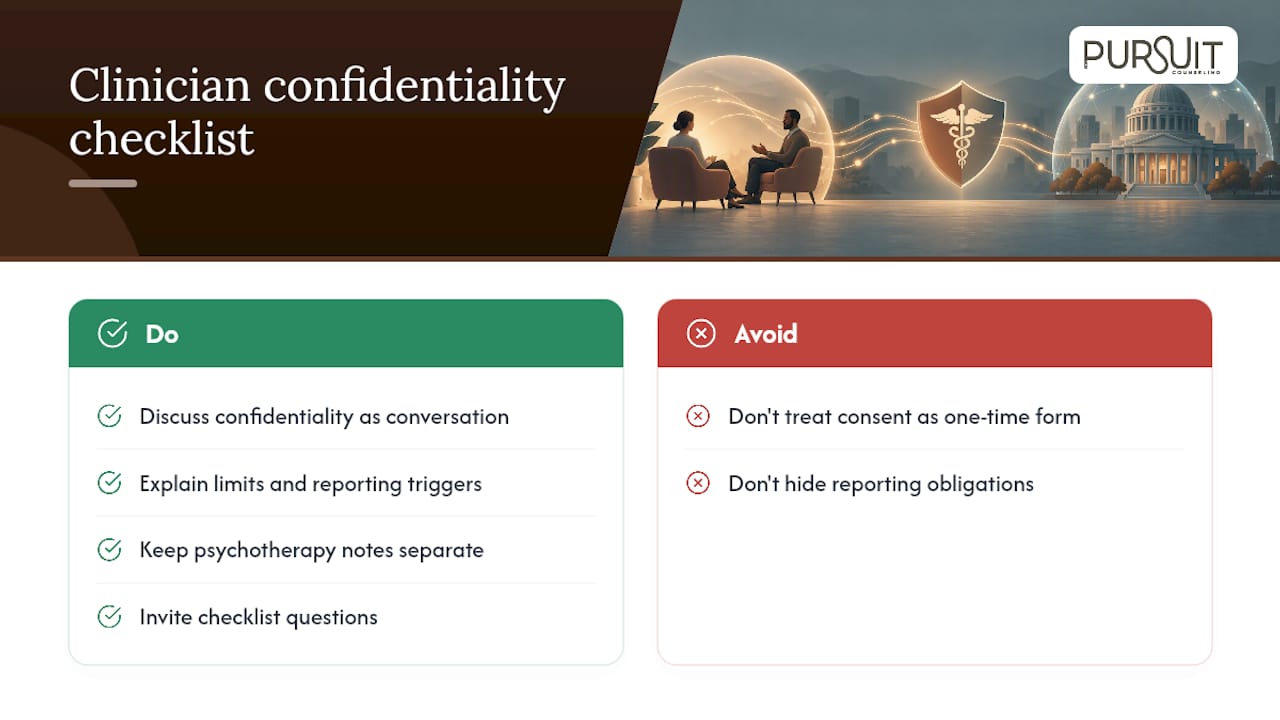
Good clinicians treat confidentiality as a conversation, not a form you sign and forget. I explain the limits, the mandated reporting triggers, and how psychotherapy notes stay separate from the clinical file, before we ever get to the hard stuff. That separation is not bureaucratic red tape. It protects the space where you process the material too raw for a formal chart.
Ask the checklist questions. A clinician who welcomes them is telling you something important about how they practice.
— Adam Glendye LPC, CPCS
How The Pursuit Counseling Handles Your Privacy
The Pursuit Counseling operates as clinician-led therapy, not a coaching model dressed up in clinical language, which means your sessions carry the legal weight of licensed confidentiality rather than a private ethics code alone. Intakes typically include a written privacy conversation covering HIPAA disclosures, psychotherapy note separation, and mandated reporting specifics before you commit to a single session.

If you are weighing therapy against a coaching program, that legal distinction is exactly why counseling tends to be the more protected choice for anxiety, trauma, and relationship work. The Pursuit Counseling offers both in-person sessions in Fayetteville, Georgia, and secure teletherapy options for clients across Peachtree City, Senoia, Brooks, Tyrone, and South Atlanta. Review the full range of therapy services, bring the checklist from this article to your consultation, and book a first session when you are ready to see how a clinician-led privacy conversation actually feels.
Primary Sources Worth Bookmarking
For the legal specifics behind everything above, go straight to the source rather than a secondhand summary.
- Hhs covers permitted disclosures and the minimum-necessary standard
- Hhs explains why they carry extra protection
- Telehealth details telebehavioral-health security expectations
- SAMHSA’s 42 CFR Part 2 overview applies specifically to substance-use treatment records
- The Child Welfare Information Gateway breaks down mandated reporting by state
This article is general information, not a substitute for advice from a qualified doctor. Consult a qualified healthcare professional about your own circumstances before acting on anything here.
Sources
FAQ
Is Counseling Confidentiality the Same as Coaching Confidentiality?
No. Counseling confidentiality is backed by HIPAA and state licensing law, while coaching confidentiality typically rests on a private ethical code with no legal privilege behind it. For anxiety, trauma, or relationship issues, licensed counseling generally offers stronger, legally enforceable protection.
Can a Therapist Ever Break Confidentiality?
Yes, under specific conditions: mandated reporting of suspected child or elder abuse, imminent danger to yourself or others, court orders, and certain HIPAA-permitted disclosures for treatment, payment, or operations. A good clinician explains these limits during your first session.
What Are Psychotherapy Notes, and Are They Different From My Chart?
Psychotherapy notes are a clinician’s private process notes, stored separately and given stronger legal protection than your treatment plan or diagnosis, which live in your main clinical record. You can ask your provider how they separate the two.
Does Teletherapy Put My Privacy at More Risk?
Teletherapy adds environmental risks, like unsecured Wi-Fi or a shared room, that in-person sessions do not have. Following HHS telehealth best practices on both the clinician’s and client’s side closes most of that gap.
How Much Does Therapy at The Pursuit Counseling Cost?
Pricing for individual therapy, couples therapy, and specialty programs varies; current rates and available services are listed on The Pursuit Counseling’s services page.