


The FAA has rules for pilots who are treated for anxiety, and how they apply depends on each pilot’s situation, so talk with your Aviation Medical Examiner (AME) about yours. The FAA says psychotherapy is compatible with an unrestricted medical certificate, as well as with special issuance or special consideration. For many pilots the real obstacle isn’t the rule. It’s the fear of what a rule might do, and that fear keeps people quiet for months.
This guide covers what treatment looks like, what you have to report, when to ground yourself, and how to find a therapist who understands the cockpit and the paperwork.
Key Takeaways
- Therapy for anxiety, stress and burnout is a recognized, FAA-acknowledged path. Most treated mental health conditions do not disqualify a pilot.
- Visits to a licensed therapist are reported on your medical application. Reporting is the rule, and it is manageable when you prepare.
- Self-ground when symptoms affect concentration, memory, judgment, decision-making or alertness.
- Medication is not always part of treatment. Education, coping skills and therapy are enough for some pilots.
- Early help is the FAA’s own advice. Waiting makes both the symptoms and the paperwork harder.
Table of Contents
- What anxiety and burnout do to a pilot
- When to get help, and when to ground yourself
- What treatment can look like
- What the FAA actually requires you to report
- What treatment can mean for your medical certificate
- Peer support: a first call that costs nothing
- How to choose a therapist as a pilot
- Our perspective
- Working with us
- A realistic next step
- FAQ
- Sources
What anxiety and burnout do to a pilot
Pilots are trained to compartmentalize. You run checklists, stay calm when the plane doesn’t, and treat a racing mind as something to push through. That skill is real. It also hides the early signs.
The CDC lists what acute stress looks like in aircrew: tension, disturbed sleep or digestion, fear, anxiety, irritability and difficulty unwinding. Chronic stress adds trouble making decisions, loss of interest, persistent sleep problems, feeling powerless and strain in relationships.
If that reads like a list of your last six months, you are not unusual. Irregular schedules, time away from home, medical certificate pressure and the expectation that you never show a crack all stack up. We have written about the challenges of a pilot’s life and how isolation shapes them.
Anxiety in a pilot doesn’t always look like panic. It can look like:
- Rehearsing every possible failure on the drive to the airport
- Dreading the next medical more than the flight itself
- Irritability at home that you only notice afterward
- Lying awake after a trip, unable to switch off
- Flat, exhausted detachment that people call burnout
None of these is a diagnosis. Reading about them is education. Only a licensed clinician sitting with you can assess what is going on.
When to get help, and when to ground yourself
The FAA encourages pilots to seek help early, before conditions become severe. It also says to self-ground if symptoms impair concentration, memory, emotional stability, judgment, decision-making or alertness.
Those are two separate decisions:
- Seeking help is appropriate whenever stress or worry is taking more than it should. You don’t need a crisis.
- Grounding yourself is about the day’s flight. If your attention, judgment or alertness isn’t reliable, you don’t fly, the same way you wouldn’t fly with a fever.
ALPA’s May 2026 guidance offers a color-based self-check. It describes yellow concerns as potentially manageable with self-care and social support, and orange or red concerns as needing professional assistance. It also notes that a distracted, angry or upset pilot may not be ready for safe duty. Use a framework like that honestly. If you keep wondering which color you are, that’s usually information.
What treatment can look like
The FAA says therapy may help with anxiety or mood symptoms, life transitions, resilience, relationship challenges and stress management. It also treats therapy, psychotherapy and counseling as equivalent terms for FAA purposes. In its podcast, the agency adds that treatment doesn’t always involve medication: education, coping skills, therapy and professional support can be enough for some pilots.
Here is how we approach it at The Pursuit Counseling. Our work is built on personal connection and evidence-based methods that adapt to the person in the room. We don’t hand pilots a script.
Talk therapy and skills
Most pilot anxiety work starts with sitting down and naming what’s happening: where the worry shows up, what it’s protecting, and what it costs you. From there we build practical skills for the body and the mind. Cognitive behavioral approaches are common across the field, and they show up even in CBT programs at work designed to catch stress before it escalates. Our anxiety and stress management therapy is tailored, so the pace and tools depend on you.
EMDR for the experiences that stay loud
Sometimes anxiety has a source: a close call, an incident, a loss, a hard stretch in the military. When a past event keeps replaying, EMDR trauma therapy is one of the methods we use to process it. It isn’t for everyone, and we decide together whether it fits.
Neurofeedback for stress, focus and sleep
Some pilots tell us their problem is less a thought and more a wired, tired nervous system. We offer neurofeedback, which starts with a brain map. We explain how that works in our piece on neurofeedback for pilots and aviation professionals. Neurofeedback is a training approach, not a promise. We won’t tell you it will fix anything.
Outside the office
For people who think better in motion, our adventure therapy takes the conversation out of the chair. Pilots who spend their working lives in a sealed cockpit often find that useful.
Medication, when it’s part of the picture
Medication is a decision between you, your prescriber and your AME, and it has aviation-specific rules. You should never start, stop or change a medication on your own without that conversation. We cover the specifics for pilots on antidepressants on our page about private care for pilots on antidepressants.
What the FAA actually requires you to report
This is where most of the fear lives, so be precise.
The FAA says all visits to licensed healthcare providers, including therapists and counselors, must be reported on MedXPress. Stated exceptions include educational or religious counseling, couples counseling and some EAP consultations. Its Pilot Mental Fitness page says you report health-professional visits from the previous three years, along with current medications and relevant history.
Two things are worth knowing about what happens next:
- Therapy records are usually not reviewed. If documentation is requested, it is usually a brief therapist summary.
- FAA guidance for clinicians recommends keeping psychotherapy process notes separate from clinical progress notes, so process notes are not part of what gets sent.
Paying privately for therapy doesn’t change what you report. Our private-pay model is about flexibility and focus, not about concealment, and we’d never suggest skipping a required disclosure. A pilot who reports accurately and shows documented treatment is in a far stronger position than one whose records and application don’t match.
Talking to a therapist also doesn’t automatically create a diagnosis. The FAA says the therapist should assess whether a diagnosis is warranted. Its guidance for clinicians asks for accurate documentation, avoiding both upcoding and minimization.
If formal ongoing monitoring is requested, the FAA says your therapist should clarify any reporting obligations and get your consent before releasing information. Ask about that in the first session.
What treatment can mean for your medical certificate
The outcome depends on your diagnosis, symptom severity and risk factors. According to the FAA, an AME may issue a certificate or defer the case to the FAA, which may issue or consider special issuance or special consideration.
Some context that may ease the dread:
- The FAA reports that about 0.1% of applicants who disclose health issues are denied, and says most treated mental health conditions do not disqualify a pilot.
- AOPA’s explanation of the AME Guide says up to two listed uncomplicated anxiety, depression or related conditions may be eligible for AME issuance when treated with psychotherapy. Recent medication use or added risk factors can require FAA review.
- The FAA has said pilots adequately treated and in remission may be considered for special issuance on certain SSRIs.
- AOPA reported in August 2026 that the antidepressant protocol’s stability period had been reduced to three months, with initial neuropsychological testing still required. It covers nine medications, so confirm the current list with your AME instead of relying on older summaries.
These rules change. Treat this article as orientation and your AME as the authority for your case. We break down the three-month change in more detail in our guide to FAA mental health rules, and for pilots with attention concerns we cover ADHD and FAA certification.
Peer support: a first call that costs nothing
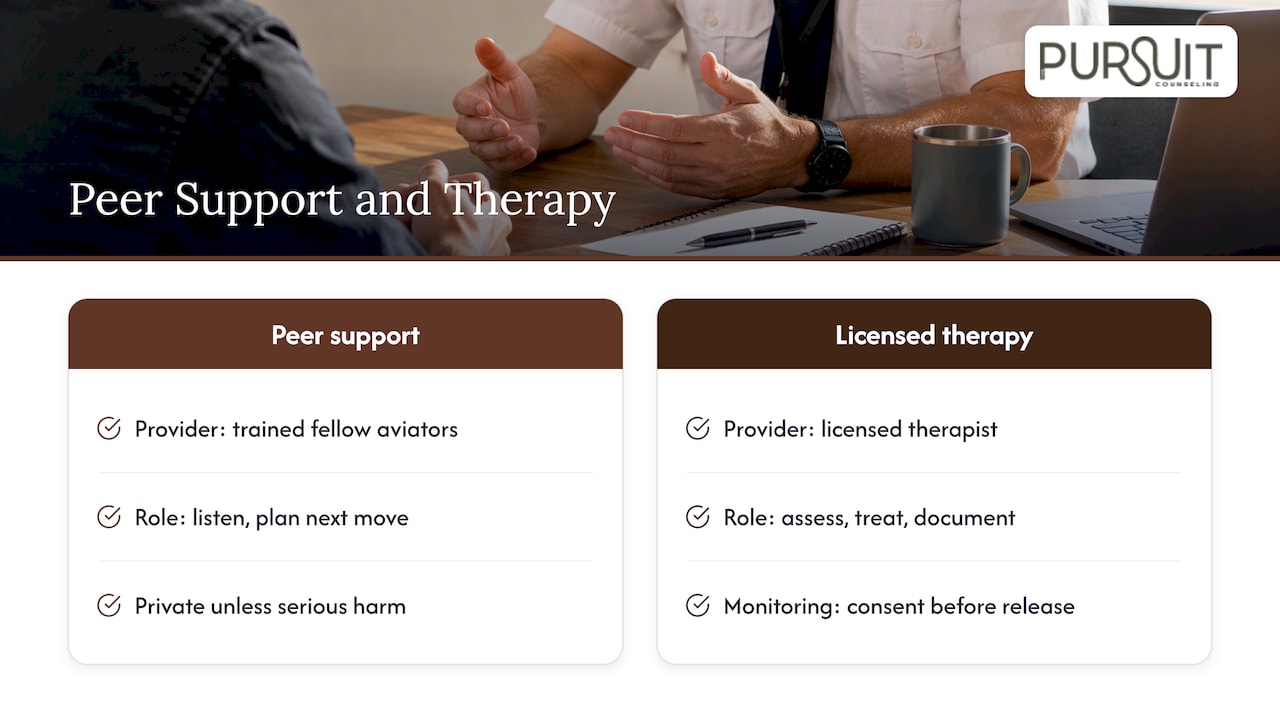
If walking into a therapist’s office feels like too much, a peer is a lower-pressure start. Peer programs connect you with trained fellow aviators who understand operational pressure, listen without judgment and help you work out your next move. ICAO’s 2025 working paper says access to peer support is associated with better mental wellbeing and a lower likelihood of poor mental health leading to cancellation of a medical certificate.
ALPA reported in May 2026 that its Pilot Peer Support program has more than 250 trained volunteers available around the clock. It says calls need not be reported on medical certification forms and stay private unless there’s an immediate risk of harm. IFALPA’s manual describes the same boundaries: confidentiality is central, with exceptions for consent, legal compulsion or serious risk of harm.
Peer support and therapy aren’t rivals. A peer can listen tonight. A licensed therapist can assess, treat and document. The FAA notes that a Pilot Peer Support Program, AME or primary-care provider can recommend a therapist.
How to choose a therapist as a pilot
The FAA recommends a licensed therapist or counselor with at least a master’s degree. Beyond that, a few questions matter:
- Do they understand the FAA process? You should be able to hand them the FAA’s psychotherapist guidance and have them read it.
- How do they handle documentation? Ask how they separate process notes from progress notes.
- Can they work with your schedule? Trip patterns break weekly appointments. Online and in-person options matter.
- Do they treat you as a person or a certificate? You want someone who stays curious about you, not just your risk profile.
- What’s the fee? Know before you start.
We offer both in-person sessions from Fayetteville, Georgia, and online sessions. Our work with pilots is described on our pages for counseling for pilots in Fayetteville and Peachtree City and confidential therapy for pilots.
Our perspective
Pilots rarely come to us because they can’t cope. They come because they’ve coped for years, and the cost has finally gotten louder than the pride.
We think the pain cave is a real place. Many of the pilots we sit with have spent a career pushing through it alone. What we’ve seen is that the cracks aren’t the end of competence. They’re where the work starts. When a pilot can say out loud what the worry is, what it’s been protecting and what it’s costing at home, something loosens that willpower alone couldn’t move.
That’s why we build therapy around the individual. Some people need EMDR to process one event. Some need skills for a body that won’t stand down. Some need neurofeedback, an hour outdoors, or simply one person who won’t flinch. We make no promises about outcomes, and we don’t assess a pilot in a blog post. We do promise that you’ll be treated as a complicated, capable adult.
If you’re wondering whether you’re “bad enough” to call, you’re probably the right person to call.
Adam Glendye LPC, CPCS
Working with us
If you’re a pilot in Georgia, or flying out of Atlanta, we’d like to hear what’s been happening. Sessions are private-pay, with in-person and online options.

For pilots who want concentrated time, our intensive programs offer a deeper block of work than a weekly hour. Neurofeedback begins with a brain map. Start with a conversation and we’ll tell you honestly what we think fits. You can reach us through The Pursuit Counseling.
A realistic next step
You don’t have to decide everything this week. An emotionally accurate next step is smaller than you think:
- Write down what you’ve noticed in the last month: sleep, irritability, dread, concentration.
- Decide honestly whether any of it affects your fitness to fly today. If yes, ground yourself.
- Talk to one person: a peer support volunteer, your AME, your primary-care provider or a therapist.
- Read the FAA’s therapist guidance before the first session so you both start from the same page.
- Book the first appointment before the next medical, not after.
The relief of saying it to someone qualified is often the first real change.
FAQ
Will seeing a therapist ground me?
Not by itself. The FAA says psychotherapy is compatible with an unrestricted certificate and with special issuance. You self-ground only if symptoms affect concentration, memory, judgment or alertness. Your AME can confirm what applies to your situation.
Do I have to report therapy to the FAA?
Yes, in most cases. The FAA says visits to licensed providers, including therapists, are reported on MedXPress, with exceptions such as couples counseling and educational or religious counseling. Report accurately, and ask your AME if you’re unsure whether a visit counts.
Can I be treated for anxiety without medication?
Often, yes. The FAA has said education, coping skills and therapy can be sufficient for some pilots. Whether medication is appropriate is a decision for you and a prescribing clinician, with your AME informed.
Is a call to peer support reported to the FAA?
ALPA says calls to its Pilot Peer Support program don’t need to be reported on medical certification forms. They stay private unless there’s an immediate risk of harm. Check the terms of any program you contact.
Can online therapy work for a pilot with an irregular schedule?
For many pilots it’s the only format that fits. We offer online and in-person sessions, so you can keep appointments from a layover or at home. Confirm that the therapist is licensed and familiar with FAA documentation.
Sources
- Job Stress in Aircrew, CDC
- Therapy, Psychotherapy, and Counseling FAQs for Pilots and ATCS, FAA
- Information for Psychotherapists Treating Pilots and ATCS, FAA
- Pilot Mental Fitness, FAA
- Mental Health podcast, FAA
- Pilot Self-Evaluation and Mental Well-Being, ALPA
- Enhancing safety and performance using peer support, ICAO
- Pilot Assistance Manual, IFALPA
- Mental health and your medical, AOPA
- AME Guide Updates: Anxiety, Depression, and Related Conditions, AOPA
Recommended
- FAA Mental Health Rules: What Pilots Should Know About Treatment
- Therapy for Pilots in Georgia
- Connection at 30,000 Feet: How Pilots Can Strengthen Mental Well-Being
- Confidential Private Pay Care for Pilots on Antidepressants
Take the next step
You don’t have to figure it out alone.
Explore the related services below, or book a free, 15-minute consultation to talk through what support could look like for you.
Book a free consultation →Choose a counselor or an available time. No commitment beyond the conversation.