


Yes, pilots can pursue psychotherapy while taking antidepressants, and doing both together often works better than either alone. The Pursuit Counseling provides confidential, private-pay treatment built specifically for pilots and other high performers, using evidence-based approaches that respect the realities of flight schedules and career stakes. The two priorities to sort out first are how you protect your privacy and how your therapist coordinates with whoever manages your medication.
- Combining psychotherapy with antidepressants offers significant relapse prevention benefits, reducing recurrence risk by approximately 22 percent when added after medication response.
- For pilots with severe or recurrent depression, initiating both treatments simultaneously tends to yield better outcomes than delaying therapy or medication changes.
- Telehealth, intensive multi-day formats, and flexible scheduling options ensure therapy can fit into unpredictable flight schedules and duty rosters.
- Evidence-based therapies like CBT and ACT are well-suited for pilots, while EMDR and neurofeedback address trauma and attention or anxiety issues, respectively.
- Private-pay treatment keeps records confidential and allows coordination of care without employer or insurance involvement, which is crucial for high performers.
Table of Contents
- What Pilots Should Know Before Starting Therapy While on Antidepressants
- How Well Does Combining Therapy and Medication Actually Work?
- Which Therapies Actually Fit a Pilot’s Life?
- How to Start or Continue Therapy While Managing Your Prescription
- What Timeline Should You Expect for Results?
- How We Work With Pilots and High Performers
- How The Pursuit Counseling Supports Pilots on Antidepressants
- Sources
- FAQ
What Pilots Should Know Before Starting Therapy While on Antidepressants
Before your first session, get a handful of decisions out of the way so the process feels less like paperwork and more like progress.
- Private-pay changes the privacy calculus. Skipping insurance means no claims trail through a third-party payer, and you can still request a superbill for potential reimbursement without your employer ever seeing a diagnosis code.
- A signed release of information is optional, not automatic. You control whether your therapist and prescriber talk to each other, and you can limit that release to specific topics like medication side effects.
- Combination treatment isn’t always day one. Some pilots start medication first and add psychotherapy later if symptoms persist; others start both at once when symptoms are more severe.
- Scheduling should bend to your duty roster, not the other way around. Telehealth sessions and multi-day intensives both exist precisely for people who can’t commit to a fixed weekly slot.
- Bring a simple packet to session one: your current medication list and dosages, a short history of prior treatment, and a plain description of what’s actually affecting your performance or sleep.
Pro Tip: Write down your operational concerns in one sentence before your first session, like “I need to know how fatigue and this medication interact during long-haul rotations.” A clear question gets a clearer answer than a vague worry.
How Well Does Combining Therapy and Medication Actually Work?
The clinical evidence favors combining the two, particularly when symptoms are moderate to severe. Guideline-based reviews recommend combination psychotherapy and pharmacotherapy for moderate to severe major depressive disorder, and sequential treatment, meaning psychotherapy added after someone has started medication but hasn’t fully improved, has strong support as well.
The most cited number in this research is a relapse-prevention figure worth understanding correctly. Pooled trials found that adding cognitive behavioral therapy or similar psychotherapy after a patient responded to antidepressant medication reduced relapse and recurrence risk by an absolute 22%, with the largest benefit showing up when medication was later discontinued during follow-up.
That number deserves context rather than blind repetition. The trials behind it often used tightly controlled or limited medication protocols, so the additive benefit measured in a study may look different from what happens in flexible, real-world prescribing. Therapist adherence to manual-based CBT or interpersonal therapy protocols, and the number of sessions actually delivered, were major factors driving whether a trial showed strong results at all.
What does this mean practically?
- If your symptoms are severe or you’ve had recurrent depressive episodes, combined care from the start tends to be more appropriate than waiting to see if medication alone gets you there.
- If you’re a partial responder to medication, meaning you feel somewhat better but not fully like yourself, adding psychotherapy often makes more sense as the next step than switching medications again.
- Manual-based therapies with defined session structures give you a clearer sense of what progress should look like and by when.
Which Therapies Actually Fit a Pilot’s Life?
Not every therapy modality translates well to the pressures of a flight deck, a sim check, or a recurrent training cycle. A few do it especially well.
Cognitive behavioral therapy (CBT) remains the backbone for treating depression and anxiety, and its skills-based structure suits people who think in checklists and procedures. Acceptance and commitment therapy (ACT) has shown real promise for high performers specifically: ACT improves psychological flexibility and reduces anxiety sensitivity in people facing high-pressure performance testing, which maps directly onto check rides, evaluations, and the general grind of being watched and graded.
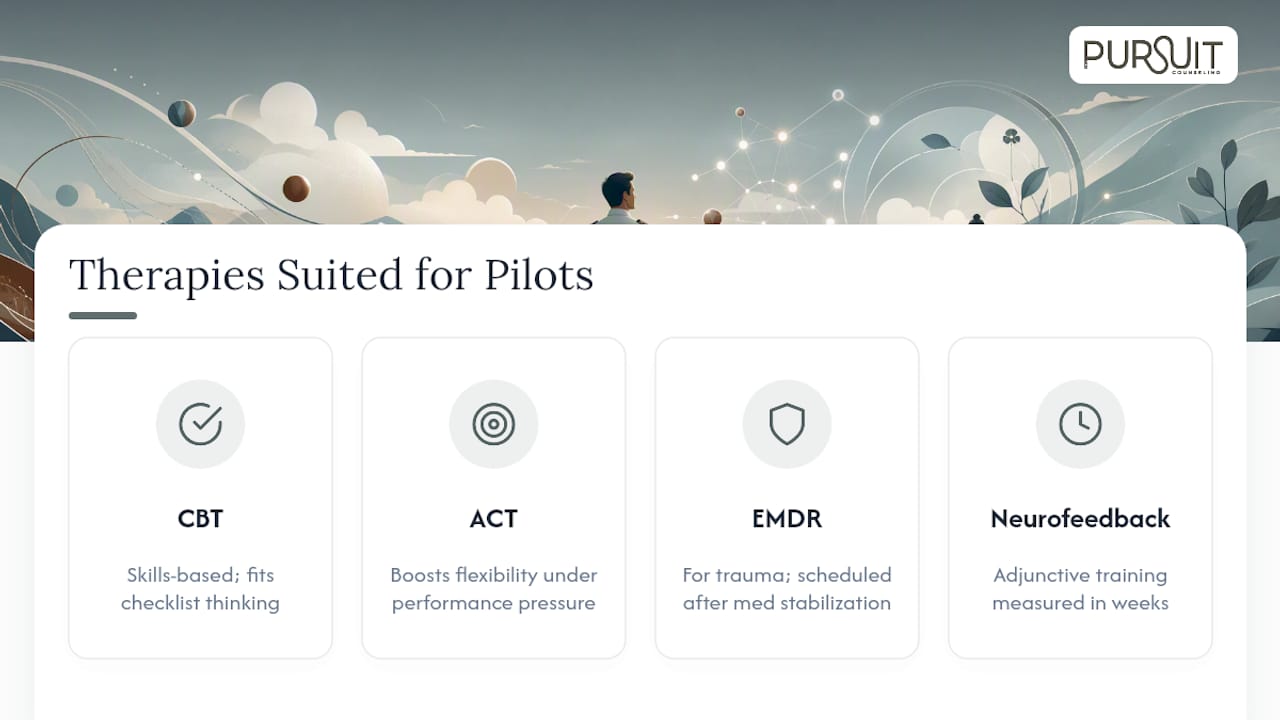
EMDR matters when trauma or an acute stressful event sits underneath the depression or anxiety, whether that’s a hard incident in the cockpit, a personal loss, or something entirely unrelated to flying. It typically gets scheduled around medication stabilization rather than in place of it. Neurofeedback works as an adjunctive option for ADHD and anxiety symptoms, though it requires patience. It’s a training process measured in weeks, not a quick fix.
Executive coaching rounds things out when the goal is functional performance rather than symptom reduction alone, sharpening decision-making and stress recovery once the clinical piece is stabilized.
How to Start or Continue Therapy While Managing Your Prescription
- Prepare your intake information. List every current medication, prior treatment history, and any operational limits (duty rest periods, deployment schedules) you’ll need to work around, then decide upfront whether you’re going private-pay or through insurance.
- Vet the therapist’s experience. Ask directly whether they’ve worked with pilots or similarly high-stakes professionals, and which evidence-based modalities (CBT, ACT, EMDR) they actually practice rather than just list on a website.
- Decide on coordination. If you want your therapist talking to your prescriber, sign a limited release of information specifying exactly what can be shared, and nothing more.
- Pick a format that survives your schedule. Weekly sessions work for some; intensive multi-day formats work better for pilots who can’t guarantee the same day every week, and telehealth closes the gap when you’re based out of the area.
- Plan for cost. Private-pay rates are straightforward and predictable, and many practices issue superbills so you can seek out-of-network reimbursement on your own terms.
Pro Tip: If your schedule rotates unpredictably, ask about intensives before you assume weekly therapy is your only option. A concentrated two or three-day format can cover what six weeks of once-a-week sessions would, which matters when your next bid line is anyone’s guess.
What Timeline Should You Expect for Results?
Acute-phase improvement with combined treatment typically shows measurable movement within several weeks, though full symptom relief usually takes longer than people expect. Sequential treatment, adding therapy after medication has already partially worked, tends to show benefit over a timeline once therapy actually starts.
The relapse-prevention data matters most here. That 22% absolute reduction in relapse risk from adding psychotherapy after medication response isn’t a one-time boost. It reflects a durable pattern that shows up especially clearly if medication is later tapered.
For pilots specifically, the outcomes that matter most are functional, not just symptomatic:
- Sleep quality and consistency across rotating schedules
- Sustained attention during long or monotonous flight segments
- Decision-making speed and clarity under fatigue
- Recovery time after a stressful event, whether operational or personal
Maintenance medication decisions, including whether and when to taper, should be made jointly with your prescriber, and psychotherapy often plays a direct role in supporting that decision by giving you skills to fall back on if symptoms start creeping back.
How We Work With Pilots and High Performers
Pilots come to this work carrying a specific kind of pressure: the job doesn’t tolerate half-measures, and neither should the care. At The Pursuit Counseling, we lean on neuroscience-informed methods because pilots respond well to understanding the mechanism behind the intervention, not just being told to trust the process.
EMDR gets used when trauma sits underneath the presenting symptoms. Neurofeedback comes into play for ADHD or anxiety when clinically indicated. CBT and ACT form the daily skill-building core, and coaching gets layered in once the clinical work is stable enough to shift focus toward performance. A confidential consult is the lowest-risk way to find out where you actually stand, no long-term commitment required to take that first step.
— Adam
How The Pursuit Counseling Supports Pilots on Antidepressants
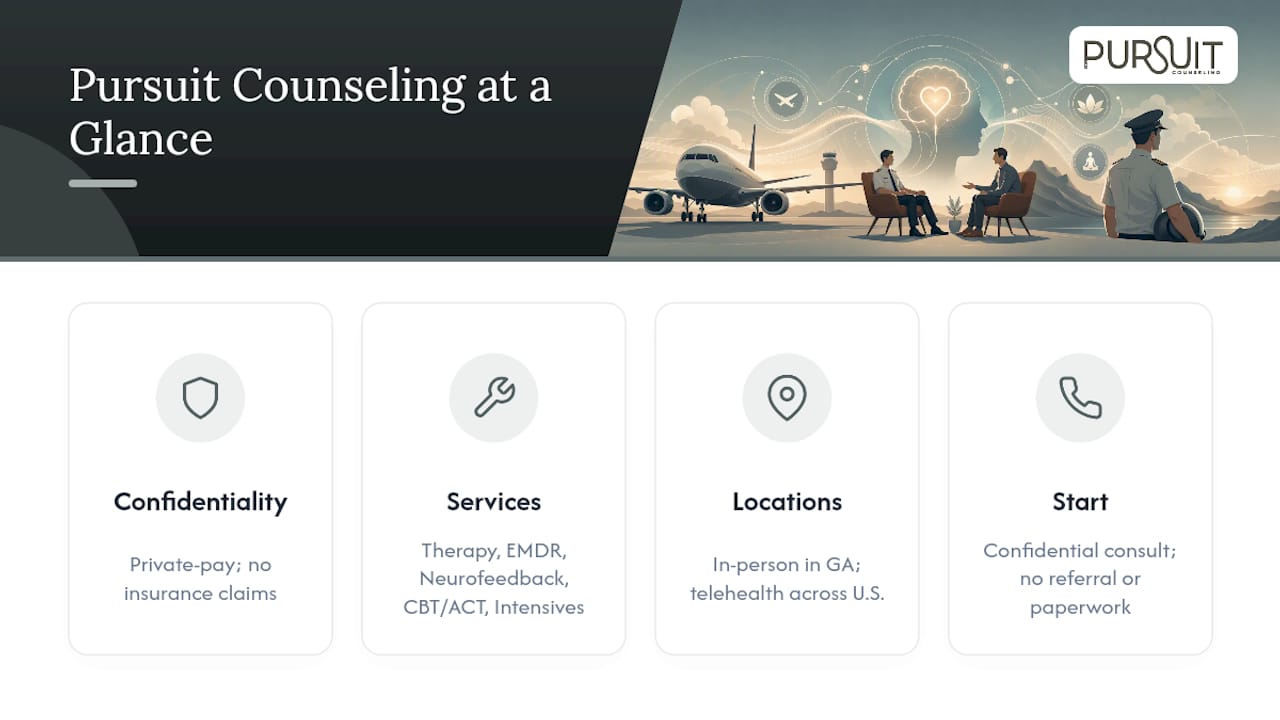
The Pursuit Counseling is built for pilots who need care that doesn’t show up on an insurance claim and doesn’t require explaining a diagnosis to anyone but the person treating them. That’s the real difference from insurance-based clinics: private-pay structure means your treatment record stays between you and your therapist, full stop.

Services include confidential individual therapy, EMDR for trauma, neurofeedback for ADHD and anxiety, CBT and ACT for depression and performance pressure, multi-day intensives for pilots who can’t do weekly sessions, and executive coaching for performance goals beyond symptom relief. In-person care is available in Georgia, with telehealth reaching pilots and high performers across the U.S., including Florida.
If you’re weighing whether to start therapy alongside your current medication, or you’re already on antidepressants and want a provider who actually understands pilot schedules, getting started begins with a confidential consult, no referral or insurance paperwork required.
Sources
For deeper reading on the evidence behind combination treatment, see the PMC review on combination psychotherapy and pharmacotherapy and the Flight Safety Foundation’s resilience program for aviation-specific context.
This article is general information, not a substitute for advice from a qualified doctor. Consult a qualified healthcare professional about your own circumstances before acting on anything here.
- Evidence-Based Applications of Combination Psychotherapy and Pharmacotherapy for Depression – PMC
FAQ
Can pilots take antidepressants and still fly?
That determination falls under aviation medical certification standards, which sit outside the scope of this article; this piece addresses the psychotherapy and coaching side of care for pilots who are taking or considering antidepressants.
Do pilots take antidepressants alongside therapy, or instead of it?
Many pilots use both together, and guideline evidence supports combining medication with psychotherapy for moderate to severe depression rather than choosing one over the other.
How does psychotherapy affect relapse risk for someone on antidepressants?
Pooled trial data shows adding psychotherapy after a positive medication response reduces relapse and recurrence risk by about 22% in absolute terms, an effect that grows if medication is later tapered.
Will my employer find out I’m in therapy if I pay privately?
Private-pay therapy, like the model used at The Pursuit Counseling, generates no insurance claim trail, and you decide whether any release of information is ever shared with anyone, including a prescriber.
What’s the difference between resilience training and therapy for pilots?
Industry programs like the Flight Safety Foundation’s resilience training teach general CBT-based coping skills in a short group format, but they’re not built as a substitute for individualized therapy when clinical mental health needs are present.