


Pilots can pursue therapy without automatically jeopardizing their FAA medical certification. The key is knowing which approaches protect your career and which ones require disclosure. Diagnosis-free and wellness-focused therapy, Accelerated Resolution Therapy, and Cognitive Behavioral Therapy all offer real clinical benefit without triggering automatic reporting obligations. In may 2026, the FAA updated its guidance to actively encourage counseling and therapy for pilots and air traffic controllers when medically appropriate. That shift matters. Getting support is no longer a career gamble when you work with the right provider.
- Therapy does not automatically disqualify you from flying
- Diagnosis-free and wellness-focused approaches avoid FAA reporting in most cases
- Relationship or marital counseling generally requires no FAA disclosure
- Formal diagnoses and psychotropic medications carry aeromedical implications
- Evidence-based modalities like Accelerated Resolution Therapy and CBT are well-suited for pilots
- Florida has licensed, aviation-aware providers offering confidential, HIPAA-compliant care
What mental health challenges do pilots actually face?
Flying is an identity, not just a job. That weight shows up in ways that generic stress management never quite addresses.
Pilots carry a unique combination of pressures: the expectation to be the calm one in every situation, irregular schedules that disrupt sleep and relationships, and the constant awareness that a mental health disclosure could affect their medical certificate. Performance pressure around checkrides, sim evaluations, and upgrades creates a specific kind of anxiety that most therapists have never encountered firsthand.
- High-stakes performance pressure tied to evaluations, upgrades, and line checks
- Chronic fatigue and schedule disruption affecting mood, cognition, and relationships
- Career anxiety linked to FAA medical certification and disclosure fears
- Burnout from years of emotional suppression and the “always capable” persona
- Trauma or lingering stress from close calls, critical incidents, or difficult flying environments
- Relationship strain from time away, communication breakdowns, and identity imbalance
- Identity shifts during career transitions, medical uncertainty, or retirement
Aviation therapy addresses these issues directly, treating FAA regulatory realities as part of the clinical work rather than an obstacle around it.
How do FAA mental health regulations affect therapy for pilots?
The FAA’s may 2026 update added new resources under Item 47 of the AME Guide, openly encouraging therapy for pilots and controllers. The agency’s own language now states that mental health is crucial for safety and operational performance. That is a meaningful cultural shift from the agency that once made pilots afraid to ask for help.
What the update did not change is the underlying certification framework. Reporting obligations still depend on what is being treated and how.
- Routine relationship or marital counseling generally does not require FAA disclosure
- Talk therapy for a diagnosable mental health condition often does require disclosure
- Formal diagnoses carry aeromedical implications, as do psychotropic medications
- Pilots who disclose a health issue are not automatically denied certification
- Working with an aviation-aware therapist who understands FAA documentation is critical
Understanding where the line sits, before you start therapy, is what separates a career-protective decision from an uninformed one.
Which therapy approaches work best for pilots?

The most effective approaches for pilots combine clinical rigor with aviation cultural fluency. Generic therapy that ignores FAA realities or cockpit culture tends to miss the mark.
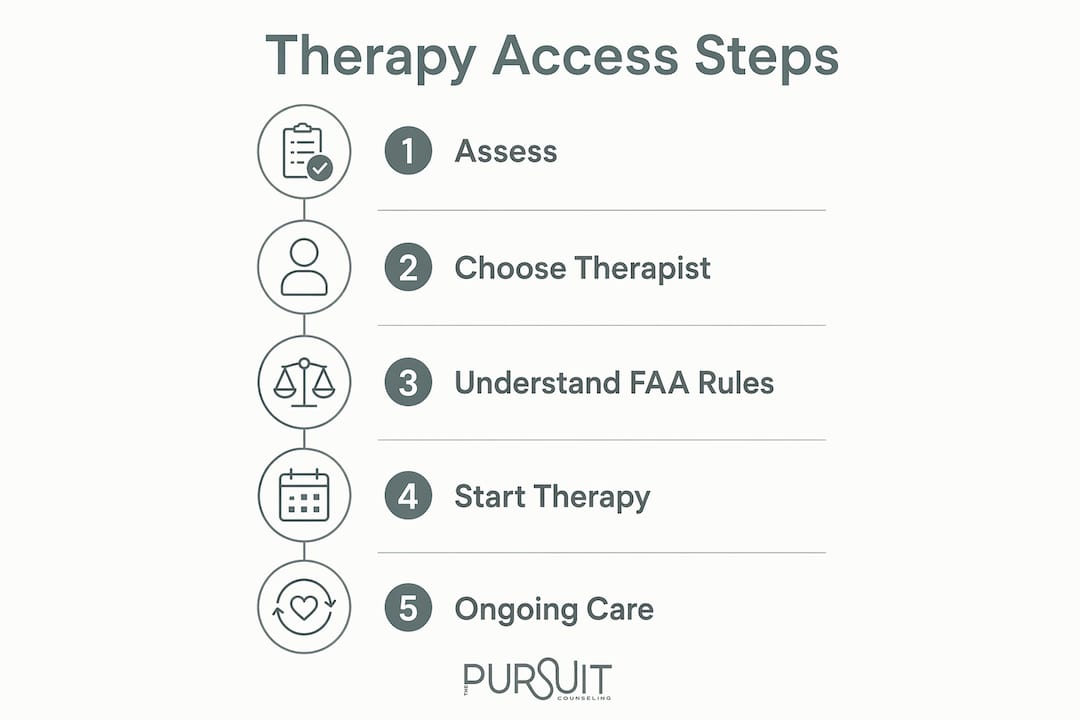
Diagnosis-free and wellness-focused models are often the smartest starting point. When no formal diagnosis is given, pilots can address stress, anxiety, and performance concerns without triggering FAA reporting. Differentiating between wellness coaching, performance work, and clinical treatment gives pilots real options.
Accelerated Resolution Therapy (ART) is particularly well-suited for pilots dealing with trauma, PTSD, anxiety, or depression. ART works by rapidly reprogramming distressing memories, often producing meaningful results in fewer sessions than traditional talk therapy. Veteran-specific ART programs exist, and therapist training with CE credits is available for clinicians who want to specialize.
- CBT targets the thought patterns driving anxiety and performance pressure
- EMDR therapy processes trauma at the neurological level, reducing emotional charge without requiring extensive verbal disclosure
- Neurofeedback trains the brain’s own regulation systems, useful for pilots managing chronic stress or attention challenges
- Aviation-aware psychotherapy integrates FAA rules, cockpit culture, and performance science into every session
As clinical experts affirm, effective pilot therapy treats FAA rules as a core component of care, not an afterthought.
Florida providers specializing in therapy for pilots
Four providers in Florida offer specialized mental health support for aviation professionals, each with a distinct approach.
| Provider | Service specialization | Therapy approaches | Location and accessibility | Privacy and career-safety | Rating |
|---|---|---|---|---|---|
| Accelerated Resolution Therapy | Trauma, PTSD, anxiety, depression | ART, veteran-specific programs | Online and in-person | Diagnosis-free options; no automatic FAA reporting | 4.9★ (51 reviews) |
| The Pursuit Counseling | FAA-compliant therapy for high-performing pilots and professionals | EMDR, neurofeedback, relational therapy | Florida; in-person and online | Aviation-aware, HIPAA-compliant, confidential | 5★ (21 reviews) |
| Flightpath Aviation Services | Mental health guidance with aviation operational insight | Hybrid consultation and support | Florida; serves aviation professionals | Pilot-specific operational context | 4.6★ (11 reviews) |
| Sea Hope Counseling | Aviation professionals, neurodivergence, family dynamics | Individual, couples, family therapy | Florida; in-person and online | Privacy-focused, tailored treatment | 5★ (7 reviews) |
Accelerated Resolution Therapy is the strongest choice for pilots whose primary need is rapid trauma or anxiety relief. The ART model’s structured, evidence-based protocol produces results quickly, and the veteran-specific programs signal real familiarity with high-stakes professional populations.
The Pursuit Counseling stands out for pilots who need FAA-informed clinical care combined with performance and leadership work. The integration of EMDR, neurofeedback, and aviation cultural expertise means the therapy addresses the whole pilot, not just a presenting symptom. For pilots who want a provider that understands both the cockpit and the certification process, this is the strongest fit.
Sea Hope Counseling offers personalized therapy for aviation professionals with particular depth in neurodivergence and family dynamics. Pilots whose challenges extend to ADHD, family communication, or relationship repair will find a thoughtful, tailored approach here.
Flightpath Aviation Services takes a hybrid consultation model, blending mental health guidance with direct knowledge of pilot operational realities. It suits pilots who want support that speaks their professional language.
How do you choose a safe, confidential therapist as a pilot?
Choosing the wrong therapist can create more risk than seeking no help at all. The right provider knows aviation from the inside.
- Confirm the therapist understands FAA mental health regulations and documentation requirements
- Ask directly whether they offer diagnosis-free or wellness-focused options
- Verify HIPAA compliance and ask how session notes are stored and shared
- Check credentials: licensed mental health counselors, psychologists, and clinical social workers all qualify
- Ask how they handle FAA reporting conversations and whether they have experience with aviation clients
- Consider telehealth if local confidentiality is a concern, many aviation-aware providers offer online therapy for pilots
Pro Tip: Ask any prospective therapist, “Have you worked with pilots before, and how do you handle FAA reporting conversations?” Their answer tells you everything about whether they are the right fit.
How to access therapy without putting your certification at risk
The safest path starts before the first session. Know your situation before you disclose anything.
Wellness coaching and performance-focused work carry no FAA reporting obligation because no clinical diagnosis is involved. If your concerns are stress, fatigue, relationship strain, or performance anxiety without a formal diagnosis, you can engage in therapy without any mandatory disclosure. When clinical treatment is needed, working with a provider who documents care appropriately and understands the FAA’s own guidance for treating clinicians protects you at every step.
How to talk to your AME about mental health
Aviation Medical Examiners (AMEs) are not adversaries. Most want to help you stay flying safely. Honesty, paired with preparation, is the most protective approach.
Before your exam, consult with an aviation attorney or an aviation-aware therapist about what your specific situation requires. Disclose what you are legally required to disclose, and bring documentation from your treating provider if relevant. AMEs respond well to pilots who arrive prepared, informed, and transparent rather than evasive. The FAA’s own 2026 guidance acknowledges that the vast majority of pilots who disclose a health issue are not denied certification.
What to do in a mental health crisis as a pilot
A mental health crisis does not wait for a convenient moment. If you are in acute distress, contact the Pilot Mental Health Clinic or a crisis line immediately. Do not fly until you have stabilized. Grounding yourself voluntarily, before a situation escalates, is both the ethical and the career-protective choice.
Crisis support for pilots also includes peer support networks, which offer confidential, non-clinical connection with colleagues who understand aviation culture firsthand.
Peer support programs for pilots
Peer support programs fill the gap between formal therapy and going it alone. Programs like HIMS AME networks and airline-specific Employee Assistance Programs (EAPs) offer confidential access to colleagues who have navigated mental health challenges in aviation. These are not therapy replacements, but they reduce isolation and often serve as the first step toward professional care.
What are the confidentiality limits in pilot therapy?
HIPAA protects your therapy records from most third-party access, including employers and the FAA. The exception is when a provider believes you pose an imminent danger to yourself or others. That threshold is high. Routine therapy, even for anxiety or depression, does not trigger mandatory FAA reporting by your therapist. The reporting obligation rests with you as the certificate holder, based on the nature of your diagnosis and treatment.
Long-term care and follow-up after therapy
Therapy is not a one-time fix. Pilots benefit from periodic check-ins, especially around high-stress periods like checkrides, fleet transitions, or major life changes. Many aviation-aware providers offer flexible session frequency, scaling back during stable periods and increasing support when operational demands spike. Neurofeedback for anxiety is one tool that translates well into long-term self-regulation, giving pilots skills they carry into the cockpit.
Support for the families of pilots in therapy
The people at home carry their own weight. Partners of pilots often manage solo parenting, communication gaps, and the emotional labor of supporting someone who rarely talks about what they carry. Couples counseling and family therapy give those relationships a structured space to rebuild. Sea Hope Counseling specifically addresses family dynamics alongside aviation professional care, recognizing that a pilot’s mental health does not exist in isolation from the people they come home to.
The Pursuit Counseling offers a different kind of pilot care

The Pursuit Counseling serves high-performing pilots and aviation professionals in Florida who need more than a standard therapy referral. Where the compared providers each bring real strengths, The Pursuit Counseling combines FAA-informed clinical care, EMDR, neurofeedback, and leadership counseling in one practice built for people who perform under pressure. Sessions are confidential, HIPAA-compliant, and structured around your schedule and certification realities. If you are ready to address what you have been carrying without risking what you have built, The Pursuit Counseling is worth the conversation.
Understanding Your FAA-Compliant Therapy Options
Pilots can access confidential, career-safe therapy in Florida without automatically triggering FAA reporting obligations when they choose the right provider and approach.
| Point | Details |
|---|---|
| FAA supports therapy | The FAA’s 2026 update actively encourages counseling for pilots when medically appropriate. |
| Diagnosis-free options exist | Wellness-focused and performance-oriented therapy avoids FAA reporting when no clinical diagnosis is given. |
| Disclosure depends on treatment | Relationship counseling rarely requires disclosure; treatment for a diagnosable condition often does. |
| ART and EMDR are effective | Accelerated Resolution Therapy and EMDR process trauma quickly and suit pilots’ time and privacy constraints. |
| The Pursuit Counseling | Offers FAA-informed, HIPAA-compliant therapy combining EMDR, neurofeedback, and aviation cultural expertise for Florida pilots. |
Recommended
- Counseling for Pilots in Fayetteville GA & Peachtree City, GA | Delta & Military Pilots – The Pursuit Counseling
- Connection at 30,000 Feet: How Pilots Can Strengthen Mental Well-Being – The Pursuit Counseling
- Married to a Pilot? Why Your Marriage Feels Different (And How to Stay Connected) – The Pursuit Counseling
- married to a pilot? 5 ways to strengthen your relationship