


DBT interpersonal effectiveness is the part of dialectical behavior therapy that teaches you how to ask for what you need, say no, and keep a relationship intact while you do it. It comes down to three skill sets with memorable names: DEAR MAN for getting a result, GIVE for protecting the relationship, and FAST for protecting your self-respect. This guide walks through each one, shows how they fit together in a real conversation, and tells you where practice stops being enough on your own.
If you are reading this at 11 p.m. after a conversation that went badly, you are in the right place. Most people we work with are not short on intelligence or insight. They are short on a repeatable way to say a hard thing under pressure.
Key takeaways
- DEAR MAN is for getting a specific request heard or a refusal respected. GIVE is for keeping the relationship steady. FAST is for keeping your integrity.
- You do not use all three the same way every time. Start by asking what you want from the interaction, how you want the other person to feel afterward, and how you want to feel about yourself.
- The skills are learned by rehearsal: writing scripts, role-playing, and getting feedback. Reading about them is a start, not the practice.
- Education is not assessment. This article teaches the skills. It cannot tell you what is driving your patterns or whether therapy is the right fit.
Table of Contents
- What interpersonal effectiveness actually is
- Start with three questions
- DEAR MAN: getting what you ask for
- GIVE: keeping the relationship intact
- FAST: keeping your self-respect
- Using all three in one conversation
- How people actually learn these skills
- Our perspective: the skills are simple, the people are not
- When to bring in a therapist
- FAQ
- Sources
What interpersonal effectiveness actually is
Interpersonal effectiveness is one of the four skill modules in DBT, alongside mindfulness, emotion regulation and distress tolerance. The VA describes DBT skills classes as weekly training in those four areas, with phone coaching to apply skills in real-life situations. The coaching detail matters. These skills are meant for the moment you are in the hallway with your boss, not only for a worksheet.
The U.S. Administration for Children and Families describes the training as teaching people to ask for what they want, say no when necessary, and keep respectful relationships with themselves and others. Marsha Linehan’s handouts organize this into three goals: objective effectiveness, relationship effectiveness and self-respect effectiveness.
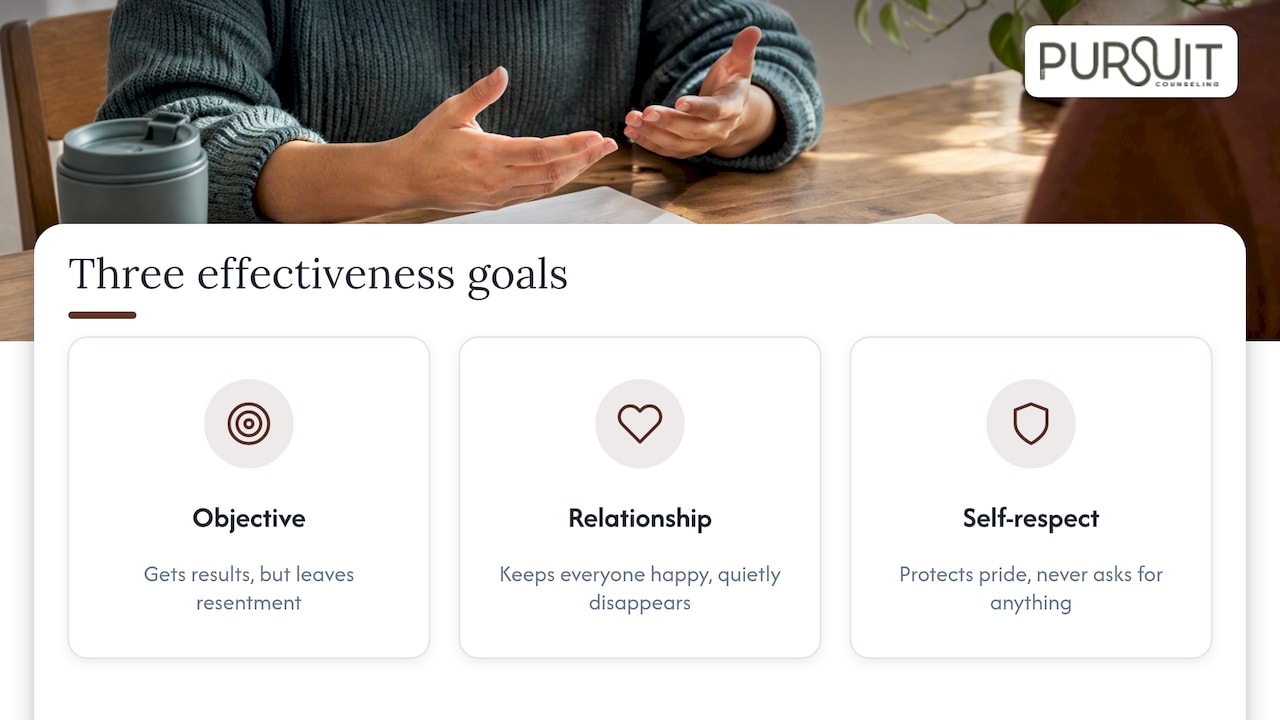
That three-part split is the useful idea. Most of us are good at one and sacrifice the others. The executive who gets every result and leaves a trail of resentment. The caretaker who keeps everyone happy and quietly disappears. The person who protects their pride so fiercely that nothing ever gets asked for. Interpersonal effectiveness asks you to hold all three at once, which is harder than it sounds.
Start with three questions
Before picking a skill, clarify what the moment is about. The Providence DBT handout frames the priorities as questions: what result do you want, how should the other person feel afterward, and how do you want to feel about yourself afterward?
The answers tell you where to lean.
| If the main aim is… | Lean on | The skill asks you to |
|---|---|---|
| A specific outcome (a request, a no) | DEAR MAN | Be clear, concrete and persistent |
| Keeping the relationship strong | GIVE | Be gentle, interested and validating |
| Staying true to yourself | FAST | Be fair, unapologetic, values-based and honest |
Sometimes the answers conflict. You want the raise, you want your manager to still like you, and you do not want to feel like you begged. That tension is exactly why the skills come as a set.
DEAR MAN: getting what you ask for
DEAR MAN is the objective-effectiveness skill. Each letter is a step, as laid out in a university counseling handout:
- Describe the facts of the situation, without commentary.
- Express your feelings or opinion about it.
- Assert a clear request or a clear no.
- Reinforce by explaining the benefit of getting what you ask for, or the consequence if you do not.
- Mindful: stay on your goal and ignore attacks and distractions.
- Appear confident and competent.
- Negotiate: offer alternatives or scale the request down.
If you want a second explanation of the same seven steps, this overview of assertive communication skills for conflict resolution covers the Describe-to-Negotiate sequence in plain terms.
A worked example
Here is an illustration we made up, not a case from a client. Say you have covered every school pickup for three weeks because your partner has been traveling, and the travel is over but the pattern has not changed.
- Describe: “I’ve done pickup every day for the last three weeks, and you’ve been home since Monday.”
- Express: “I’m running on empty, and I’m starting to feel resentful, which I don’t want.”
- Assert: “I’d like us to alternate days starting tomorrow.”
- Reinforce: “I think I’ll be a lot more present with you in the evenings if I’m not scrambling.”
- Mindful: If the answer becomes “you’re making a big deal of this,” you return to the request instead of defending your tone.
- Appear confident: Steady voice, eye contact, no apologizing before you begin.
- Negotiate: “If Wednesdays are impossible, would you take Fridays and handle the morning drop-off?”
Notice what is missing. There is no accusation, no history of every past offense, and no hint-dropping. The “mindful” step does a lot of the work. Most conversations do not fail on the first sentence. They fail when the other person changes the subject and you follow.
Where DEAR MAN breaks down
The University of Houston–Clear Lake guide lists the common barriers: lack of skills, myths about relationships and worry thoughts, strong emotions, indecision, and an environment that punishes requests or refusals. The last one deserves honesty. If asking for something in your household or workplace reliably gets you punished, a better script is not the whole answer. Sometimes the work is deciding how to respond to the environment itself.
For the strong-emotion barrier, our guide to DBT distress tolerance covers what to do before you speak when your body is already flooded. For the worry-thought barrier, opposite action is a useful companion.
GIVE: keeping the relationship intact
GIVE is the relationship-effectiveness skill. Per the Linehan handouts, it stands for:
- Gentle: no attacks, threats, judging or mocking.
- Interested: listen without interrupting and show you care what the other person says.
- Validate: show you understand their feelings and perspective.
- Easy manner: a light, soft, approachable style when it fits.
The Providence handout puts the aim simply: act so the other person feels good about themselves and about you.
Validation is the piece people most often misread. It is not agreement. You can say “I can see why that felt dismissive, and I still need us to change the schedule.” That is the dialectic at the center of DBT: acceptance and change held together. The UHCL materials make the same point, that you can validate another person’s view while still asking for change or saying no.
This gets tested hardest in painful family situations. If you are working out how to acknowledge someone’s struggle while holding a line, this piece on setting boundaries with someone who drinks shows the same balance in a very specific setting.
GIVE also has a limit. Being gentle with someone who is being abusive is not the goal of the skill. If you are afraid of a person you live with, talk with a licensed therapist or a domestic violence hotline before attempting any confrontation script.
FAST: keeping your self-respect
FAST is the self-respect-effectiveness skill. Again from the Linehan handouts:
- Fair to yourself and to the other person.
- No unnecessary Apologies for having a reasonable need, opinion or limit.
- Stick to values rather than abandoning them to avoid conflict or win approval.
- Truthful: no exaggerating, no excuses, no made-up reasons.
The UK’s Cambridgeshire and Peterborough NHS Foundation Trust defines FAST the same way, which tells you it is a standard part of the DBT curriculum, not one clinic’s variation.
FAST is where many high performers quietly struggle. You may be excellent at asking for things on behalf of a team and unable to ask for anything for yourself. Or you over-explain every no, building a legal case for a decision that needed one sentence. “I can’t take that on this quarter” is a complete answer. The extra three paragraphs usually invite negotiation.
Using all three in one conversation
The Linehan materials describe the skills as complementary: make the request with DEAR MAN, deliver it with GIVE, and check it against FAST. In practice, a conversation might sound like this.
Situation: a colleague keeps volunteering you for projects in meetings.
- Get clear first (FAST). Decide your values and your real limit before the conversation. Do you want to be seen as a team player, and also not be the default? Both can be true.
- Open with GIVE. “I appreciate that you think of me for these, and I know the team is stretched.”
- Make the ask with DEAR MAN. “In the last three meetings you’ve put me down for the vendor audit, the onboarding deck and the Q4 report. I’m over capacity. I’d like to be asked before I’m assigned. If something needs to move fast, I can take the Q4 report.”
- Stay mindful. If the reply is “everyone’s busy,” you say, “I know. I still need to be asked first.”
- Close with truth. No invented excuse about a deadline you do not have.
That takes about a minute to say. It takes much longer to rehearse well, which is the point of the next section.
How people actually learn these skills
DBT-trained clinicians treat this as a skill to practice, not a concept to read. A peer-reviewed study in BMC Nursing describes an interpersonal effectiveness program built on written scripts, role-play in pairs, discussion, worksheets and immediate instructor feedback. A 2024 NSF-supported study tested simulated DEAR MAN practice with feedback. Its abstract reports that simulation improved self-efficacy and reduced negative emotions, and that added feedback improved skill mastery. These are single studies in specific groups, so treat them as support for rehearsal, not a promise about your results.
A practice plan you can start this week:
- Pick a low-stakes conversation. A restaurant order, a returned item, a small schedule change.
- Write the script. Seven lines for DEAR MAN, one line each.
- Say it out loud alone, then to a trusted person who will push back a little.
- Debrief after real use. What did you get? How did the other person seem to feel? How did you feel about yourself?
- Move up gradually toward the conversation you have been avoiding.
If these skills feel flat on paper, that is normal. They work when they are rehearsed enough to be available when your heart rate is up.
Our perspective: the skills are simple, the people are not
We teach these skills to pilots, executives, business owners, parents and couples across Fayette County and South Atlanta. The acronyms are never the hard part. The hard part is that a person who cannot say no at work often learned, years earlier, that no was dangerous. A person who goes cold in conflict often learned that staying engaged cost too much.
So we do not hand people a worksheet and wish them luck. We look at what gets in the way: the old rules, the fear of being too much, the body’s response when a conversation turns tense. Sometimes that means trauma work such as EMDR alongside skills practice. Sometimes it means attention and focus, and sometimes it is as plain as rehearsing a sentence until it stops shaking.
In the pain cave, nobody wants a lecture on pacing. They want to know how to get to the next mile. A hard conversation is a small version of that. You do not need to be fearless. You need a plan and a few reps, and someone who will tell you the truth about how you sound.
— Adam Glendye LPC, CPCS
When to bring in a therapist
Self-study is enough for many everyday friction points. It is worth getting support when:
- You understand the skills but freeze, rage or shut down when it counts.
- The same conflict keeps repeating in your marriage or partnership.
- You are managing anxiety, trauma history or ADHD alongside the communication problem.
- You are leading people and your conflict pattern is costing your team.
A note on what this article is and is not. It is education about a set of skills. It is not an assessment, and it cannot say what is behind your patterns. A licensed clinician can do that with you.
At The Pursuit Counseling, individual therapy runs 5 to 0 per hour, depending on the service. Couples who want concentrated skills work can book a Couples Intensive, priced at ,500 for a 3-hour intensive. For leaders who want a team to practice together, we offer a 3-hour clinician-led DBT workshop for teams, and organizational workshops are listed at ,500 per 3-hour session on our workshops page. We see clients in Fayetteville in person and online across Georgia. If your struggle is mostly at home, our guide to relationship communication skills and the page on how to argue effectively are good next reads.
FAQ
What does GIVE stand for in DBT?
GIVE stands for Gentle, Interested, Validate and Easy manner. It is the skill for keeping a relationship steady during a difficult conversation. You avoid attacks and judgment, listen without interrupting, acknowledge the other person’s perspective, and keep your tone approachable.
What is the difference between DEAR MAN, GIVE and FAST?
DEAR MAN is for getting an objective, such as a request or a refusal. GIVE is for maintaining the relationship. FAST is for maintaining your self-respect. They are designed to be combined, and you decide how much weight each gets by asking what matters most in that conversation.
Can DBT help with relationship issues?
Interpersonal effectiveness is one of the four core DBT skill areas and is built around asking for needs, setting limits and keeping relationships respectful. It can give couples and families a common language for conflict. Whether it fits your situation depends on what is driving the conflict, which is a question for a licensed therapist.
Is DEAR MAN manipulative?
No. It asks you to state facts, feelings and a clear request, and it includes negotiation, so the other person can say no or counter. It does not guarantee agreement. The GIVE and FAST skills exist to keep it honest and respectful.
Sources
- Reproducible Materials: DBT Skills Training Handouts and Worksheets (Guilford)
- Dialectical Behavior Therapy, U.S. Administration for Children and Families
- Interpersonal Effectiveness, Providence behavioral health handout
- Getting What You Want (DEAR MAN), University of Richmond CAPS
- Interpersonal Effectiveness, University of Houston–Clear Lake
- Interpersonal Effectiveness, Cambridgeshire and Peterborough NHS Foundation Trust
- Dialectical Behavior Therapy Program, VA Houston Health Care
- The efficacy of applying the Interpersonal Effectiveness program, BMC Nursing
- IMBUE: Improving Interpersonal Effectiveness through simulation, NSF