


Yes: dialectical behavior therapy gives you both fast biological reset tools and repeatable skills that reduce destructive anger over time. If you feel anger rising right now, try paced breathing: inhale for four counts, exhale for six, and repeat for two minutes. A 2022 meta-analysis found DBT significantly reduces dysregulated anger, and the rest of this guide walks you through exactly how. If you or someone near you is in danger, contact emergency services before trying any skill below.
Key Takeaways
Dialectical behavior therapy effectively reduces dysregulated anger by combining fast biological reset tools with long-term skills for assertive, controlled responses.
| Point | Details |
|---|---|
| DBT reduces anger | A 2022 meta-analysis showed DBT significantly decreases dysregulated anger across multiple studies and thousands of participants. |
| Core DBT modules | DBT organizes skills into mindfulness, emotion regulation, distress tolerance, and interpersonal effectiveness for comprehensive anger management. |
| Practice and tracking | Consistent practice, tracking triggers, and review build the habits necessary to turn skills into reliable responses. |
| TIPP for quick reset | TIPP techniques such as cold exposure and paced breathing provide a rapid biological reset during anger peaks. |
| The Pursuit Counseling approach | We offer targeted DBT-based emotion regulation therapy tailored to address the specific ways anger manifests in individuals. |
Table of Contents
- What DBT for anger actually means
- How DBT reduces destructive anger
- Core DBT skills for anger: what to actually do
- TIPP deep dive: the fastest way to cool down
- Practicing DBT skills so they actually stick
- How to start DBT: what to expect and who to ask
- Research snapshot: what the evidence actually shows
- A clinician’s view on making DBT skills work in real life
- Our honest take on what actually moves the needle
- Support for working through anger with DBT skills
- FAQ
- Sources
What DBT for anger actually means
Dialectical behavior therapy rests on a tension that sounds contradictory until you live inside it: you accept your anger exactly as it is while also committing to change how you act on it. That dual stance matters because most people try to white-knuckle their way past anger, either stuffing it down or venting it, and both strategies tend to backfire. DBT asks you to notice the feeling honestly, then choose a response instead of reacting on autopilot.
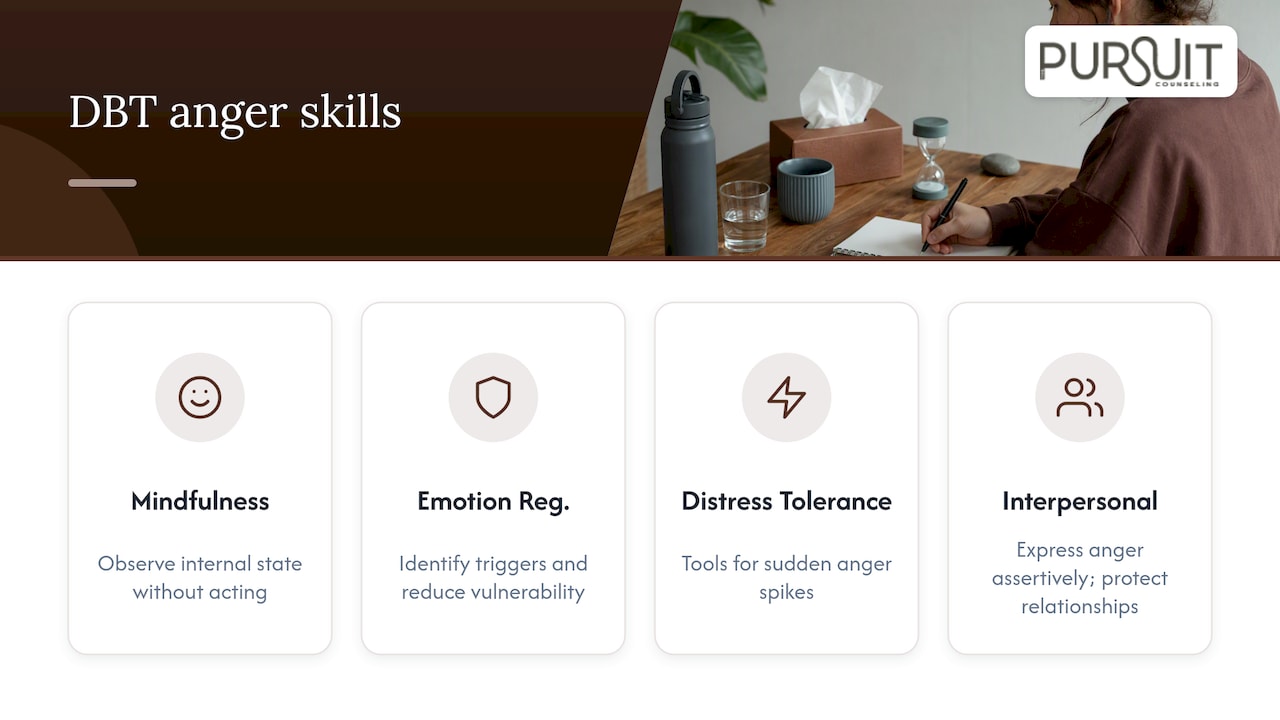
The approach organizes skills into four modules. Mindfulness teaches you to observe your internal state without immediately acting on it. Emotion regulation helps you understand what triggers your anger and how to reduce your vulnerability to it. Distress tolerance gives you tools for the moments when anger spikes faster than thought, including the TIPP skill covered later. Interpersonal effectiveness teaches you to express anger assertively, so your needs get heard without the relationship paying the price.
DBT was originally built for people with intense emotional swings and self-destructive patterns, but clinicians now use it widely for anger that feels disproportionate to the situation, anger that damages relationships, or anger that leaves you feeling out of control afterward. If your temper has cost you a job, a friendship, or your own peace of mind more than once, this is the kind of structured work that tends to help.
How DBT reduces destructive anger
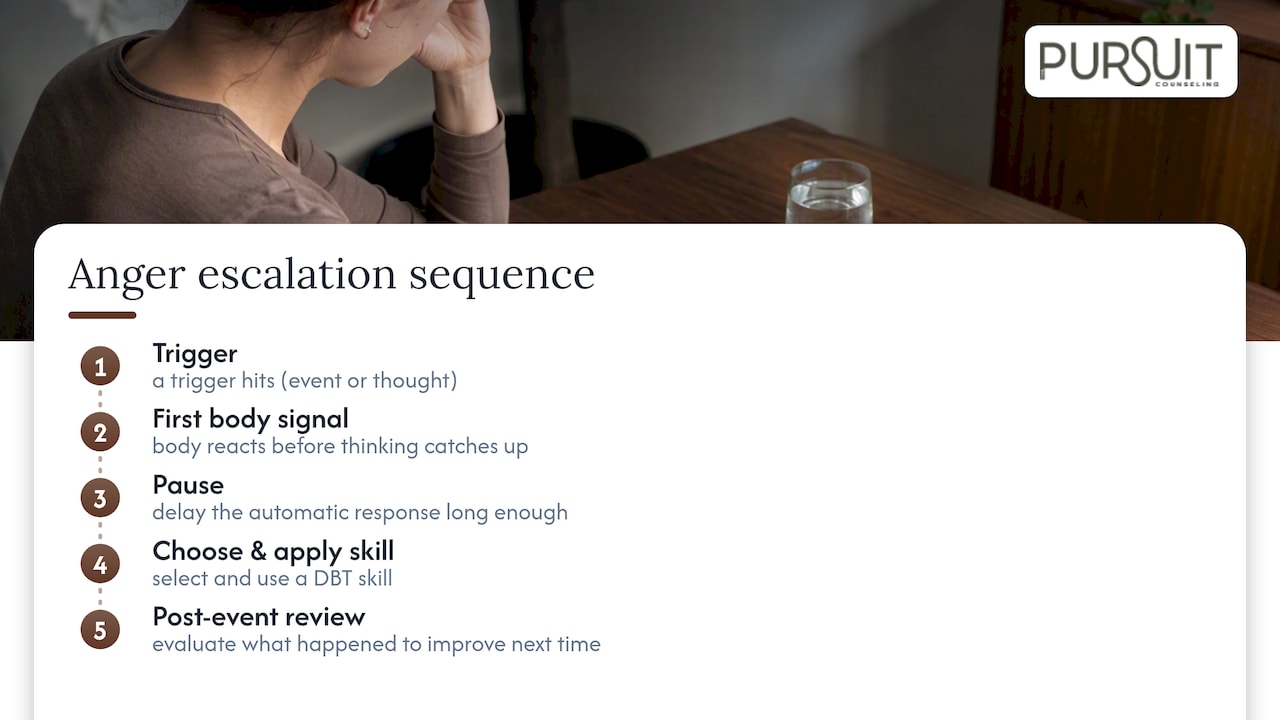
Anger escalates in a predictable sequence: a trigger hits, your body reacts before your thinking brain catches up, and you act in a way you may regret within minutes. DBT skills insert a pause at each step of that sequence. You learn to notice the first physical sign of anger, delay the automatic response long enough to choose a skill, apply that skill, and then evaluate what happened so the next attempt improves.
What makes this different from simply “calming down” is the goal. DBT does not aim to erase anger or teach you to swallow it. Clinical perspectives on DBT and anger describe a shift from destructive, rejecting anger toward assertive, problem-solving anger, the kind that gets a need met instead of burning a bridge. The feeling stays. The behavior changes.
The 2022 systematic review and meta-analysis backs this up with numbers: across 34 studies and more than 2,500 participants, DBT produced a significant reduction in dysregulated anger, and treatments that ran longer produced larger reductions. That second finding matters for anyone hoping for a quick fix. The skills work, but they work more the longer you practice them.
Core DBT skills for anger: what to actually do
Each module gives you something concrete to practice, not just a philosophy to agree with.
Mindfulness starts small. Try “urge surfing”: when anger spikes, notice the urge to yell, slam a door, or fire off a text, and imagine it as a wave you can ride without acting on it. Naming the feeling out loud, even just “I notice I’m angry,” creates enough distance to choose your next move instead of reacting instantly.
Emotion regulation works on the conditions that make anger more likely in the first place. Track what tends to set you off: poor sleep, skipped meals, a specific person, a recurring situation at work. Then reduce that vulnerability directly, since a body running on four hours of sleep has far less capacity to regulate anything. Building an “opposite emotion” on purpose, like watching something that makes you laugh before a hard conversation, can shift your baseline before the trigger even hits.
Distress tolerance is for the moments when anger has already crested. Distraction (counting backward from 100, leaving the room) and self-soothing (cold water on your wrists, a strong scent) both buy time. The TIPP skill, covered in depth in the next section, is the fastest biological reset available. Our guide to DBT distress tolerance walks through the IMPROVE skills as additional options when TIPP alone isn’t enough.
Interpersonal effectiveness uses the DEAR MAN framework to turn anger into a clear request instead of an attack:
- Describe the situation factually, without blame.
- Express how you feel using “I” statements.
- Assert what you need directly.
- Reinforce the benefit of getting it.
- Stay Mindful of the goal, Appear confident, and be willing to Negotiate.
A short script might sound like: “When the report came in late again, I felt frustrated. I need it by Thursday going forward. That would let both of us avoid the Friday scramble.” Our page on opposite action pairs well with this skill when the urge is to attack rather than request.
Pro Tip: Practice DEAR MAN scripts out loud during a calm moment, not just in your head during a conflict. Rehearsed words come out steadier than invented ones.
TIPP deep dive: the fastest way to cool down
TIPP exists for one purpose: to change your body’s chemistry fast enough to stop anger from turning into action you’ll regret. It works by engaging your nervous system directly rather than asking your already-flooded thinking brain to reason its way out.
- Temperature: Splash cold water on your face or hold an ice pack against your cheeks for 15 to 30 seconds. This can slow your heart rate within moments, though cold-water face immersion is not advised if you have heart disease or a seizure disorder; a cold compress on the back of the neck works as a safer substitute.
- Intense exercise: A short burst of jumping jacks, running up stairs, or fast walking for a few minutes burns off the adrenaline flooding your system.
- Paced breathing: Slow your exhale longer than your inhale, roughly four counts in and six to eight counts out, for two to three minutes.
- Progressive muscle relaxation: Tense each major muscle group for five seconds, then release, moving from your feet to your face.
TIPP is a biological reset for the peak of the wave, not a long-term fix. It buys you the ten minutes you need to think clearly, and it works best paired with the longer-term skills above. For a structured introduction to paced breathing, the beginner breathwork guide from Yune Yoga offers additional practice patterns, and a brief, well-structured boxing session for stress relief is a solid option for the intense exercise element when you need more than a few jumping jacks.
Practicing DBT skills so they actually stick
A skill you use once during a crisis rarely becomes a habit on its own. DBT relies on tracking and repetition to turn occasional use into a reliable response.
- Keep a minimal diary card. Each day, note the trigger, your anger intensity on a scale of 1 to 10, which skill you tried, and what happened afterward.
- Run a short daily drill. Spend 10 to 15 minutes practicing one skill when you’re calm, whether that’s a DEAR MAN script or a paced-breathing round, so it’s familiar before you need it under pressure.
- Review the week. Look back at your diary card for patterns: Does your anger spike at the same time of day, around the same person, or after the same trigger?
Pro Tip: Set a recurring phone reminder for your weekly review. Patterns you can’t see day to day often jump out once a week’s worth of entries sit side by side.
Phone coaching, a trusted peer, or a therapist can help you generalize a skill from the page into your actual life, since the gap between practicing DEAR MAN in a quiet room and using it mid-argument is real. That’s where outside support tends to make the biggest difference.
How to start DBT: what to expect and who to ask
Standard DBT programs typically combine weekly individual therapy sessions of about an hour with weekly skills-training groups of about 90 minutes, often running for a minimum of six months and sometimes up to a year, as VA Houston’s DBT program describes. Some programs also include phone coaching for in-the-moment support between sessions.
Before committing to a program, ask a few direct questions:
- Has the clinician completed formal DBT training, or are they DBT-informed rather than full-model trained?
- Is phone coaching available, and what does that look like in practice?
- Is a skills-only group an option if full individual-plus-group DBT isn’t feasible for your schedule or budget?
- How does billing work, since many DBT programs run private-pay rather than through insurance?
If full DBT isn’t accessible where you live, a DBT-informed therapist, a standalone skills workshop, or structured self-study with a clinician checking in periodically can still move the needle, particularly for anger that hasn’t reached crisis levels.
Research snapshot: what the evidence actually shows
The clearest evidence comes from a 2022 systematic review and meta-analysis covering 34 studies and 2,536 participants. DBT produced a significant reduction in dysregulated anger, with an effect size of Hedge’s G of approximately -0.21, while longer treatment duration was linked to larger reductions. That’s a modest but real effect, and it tells you something important: DBT is not a one-session fix. The people who benefit most are the ones who stick with the practice.
Clinically, the change shows up less as “anger disappears” and more as anger changing shape, becoming assertive and purposeful rather than explosive or withdrawn. VA and SAMHSA program materials both reflect this structure in practice, recommending tools like anger meters, scheduled timeouts, and written anger-control plans alongside the core DBT modules, which mirrors the diary-card-plus-drill approach outlined above.
A clinician’s view on making DBT skills work in real life
In session, we rarely hand someone TIPP on day one and call it done. We walk through a recent anger spike together, map exactly where the body signals showed up, and then practice the skill in that specific context so it has somewhere to attach.
Between sessions, the plan that tends to work is simple: a daily 10 to 20 minute drill, a diary card with three or four honest entries a week, and one weekly check-in on what’s shifting. When someone keeps hitting the same wall despite consistent practice, that’s often the signal to consider a more structured or intensive format rather than more of the same weekly rhythm.
Our honest take on what actually moves the needle
The skills themselves aren’t the hard part. Anyone can read a DEAR MAN script or learn to splash cold water on their face. What’s underrated is the tracking: the unglamorous habit of writing down what happened, what you tried, and whether it worked. People skip this step because it feels like homework, and then wonder why the same anger pattern keeps repeating six months later.
Conventional anger advice tends to stop at “count to ten” or “walk away,” which treats anger as something to suppress rather than understand. DBT’s real contribution is teaching you that anger often carries a legitimate signal underneath it, and the goal is to get that signal across without the collateral damage. If you take one thing from this article, let it be this: pick one skill, practice it daily when you’re calm, and track it for two weeks before judging whether it’s working. Skills practiced only during a crisis rarely take root.
— Adam Glendye LPC, CPCS
Support for working through anger with DBT skills
If reading through these skills left you wanting someone to practice them with, that’s exactly the gap individual therapy is built to close. We offer DBT-based emotion regulation work alongside our broader services, tailored to how your anger actually shows up rather than a generic script.

- Individual sessions for building and practicing DBT skills one-on-one.
- Structured intensives for people who want concentrated progress rather than a long weekly commitment.
- We offer in-person and online sessions for a range of locations in Georgia and beyond.
This kind of work tends to fit best for people whose anger has started costing them something real: a relationship, a job, or their own sense of steadiness. If that’s where you are, our first therapy session guide walks through what to expect, and you can reach out to book a session when you’re ready.
This article is general information, not a substitute for advice from a qualified doctor. Consult a qualified healthcare professional about your own circumstances before acting on anything here.
FAQ
Is DBT good for anger issues?
Yes. A 2022 meta-analysis of 34 studies found DBT significantly reduces dysregulated anger, with longer treatment producing larger effects. It works by combining crisis tools like TIPP with longer-term skills in emotion regulation and assertive communication.
What are some calming techniques for managing anger?
Paced breathing, cold water on the face or neck, and a brief burst of intense exercise are core DBT distress tolerance techniques that work within minutes. Progressive muscle relaxation, tensing and releasing muscle groups from feet to face, is another option when anger has already spiked.
Who is DBT not recommended for?
DBT is generally safe, but people with certain heart conditions or seizure disorders should avoid specific elements like cold-water face immersion and use alternatives such as a cold compress instead. Anyone in active crisis or at risk of harming themselves or others needs immediate support from emergency services rather than self-directed skills practice.
What is the 24 hour rule in DBT?
This isn’t a term covered by the research and clinical sources behind this article, and definitions vary depending on where you encounter it. If you’ve heard it referenced elsewhere, a DBT-trained clinician can clarify how it applies to your specific situation.
Sources
- The effect of dialectical behavior therapy on anger and aggressive behavior: A systematic review with meta-analysis.
- Dialectical Behavior Therapy Program | VA Houston Health Care | Veterans Affairs
- Anger Management for Substance Use Disorder and Mental Health Clients: Participant Workbook (SAMHSA)