


DBT distress tolerance is the set of crisis survival skills that helps you get through intense emotional pain without making a hard moment worse. Its one job is survival, not fixing your feelings. The highest-leverage tools are STOP, TIPP, and IMPROVE, each built to pull you back from the edge of an impulsive decision until the emotional storm loses some of its force.
TL;DR:
- Crisis survival skills like STOP, TIPP, and IMPROVE are designed for immediate high-arousal moments, not daily avoidance strategies or ongoing coping.
- Using these skills during physical signs of crisis, such as racing heart or impulsive urges, can prevent impulsive or self-harm actions and buy time for clearer thinking.
- Practicing these skills regularly in calm moments and keeping quick-reference notes improves automaticity, making them more effective during real crises.
- Crisis skills are only a foundation; addressing underlying issues through emotion regulation and problem-solving is essential for lasting progress.
- Professional guidance and repeated rehearsal significantly increase the likelihood that distress tolerance skills will be accessible when intensely needed.
Table of Contents
- What Is Distress Tolerance in DBT, Exactly?
- When Should You Actually Use Crisis Survival Skills?
- STOP, TIPP, and the Skills That Work Fastest
- Reality Acceptance: IMPROVE, Radical Acceptance, and Willingness
- How to Practice Distress Tolerance Skills Before You Need Them
- Mistakes That Undermine These Skills
- What Comes After the Crisis Passes?
- A Clinician’s View on Why These Skills Actually Stick
- Ready to Build These Skills With Support?
- Sources
- FAQ
What Is Distress Tolerance in DBT, Exactly?
Distress tolerance sits inside Dialectical Behavior Therapy as the module built for one purpose: enduring intense emotional pain without turning it into a bigger crisis. The goal isn’t to feel better right away. It’s to survive the moment, accept reality as it is, and reduce needless suffering so you can think clearly again.
The module breaks into three connected pieces, according to DBT’s core framework:
- Crisis survival strategies — STOP, TIPP, IMPROVE, distraction, self-soothing
- Reality acceptance skills — radical acceptance, turning the mind, willingness
- Tolerance-building practices — exercises that widen your capacity to sit with discomfort over time
Here’s what trips people up: these are short-term tools, not a long-term coping strategy. Leaning on distraction or self-soothing every single day instead of solving the actual problem underneath your pain isn’t distress tolerance. That’s avoidance wearing a DBT costume.
When Should You Actually Use Crisis Survival Skills?
A crisis, in DBT terms, is short-term and intense enough that acting on your emotions right now would probably make things worse, according to Linehan’s distress tolerance handouts. It’s not everyday stress. It’s the moment your nervous system is running the show.
Watch for these signals:
- An urge to act impulsively that feels almost impossible to resist
- A racing heart, tight chest, or other physical signs of high arousal
- Thinking that feels scrambled, looping, or shut down entirely
- Any immediate pull toward self-harm, substance use, or another high-risk behavior
If any of that is happening, reach for a crisis skill first and worry about the underlying problem later. What these skills are not for: a bad commute, a rude email, or a recurring relationship pattern you’d rather not deal with. Using distraction or self-soothing to permanently dodge those issues just delays the real work. Distress tolerance buys you time. It doesn’t buy you an exemption from your life.
STOP, TIPP, and the Skills That Work Fastest
When arousal is high, complicated thinking is the first thing to go. These skills are deliberately simple because simple is what survives a crisis.
STOP interrupts the impulsive spiral before it takes over:
- Stop. Freeze. Don’t move a muscle.
- Take a step back. Physically or mentally create distance.
- Observe. Notice what’s happening inside you and around you.
- Proceed mindfully. Choose your next move on purpose, not on autopilot.
TIPP changes your body chemistry fast, which matters because you can’t think your way out of a nervous system in overdrive. According to research on TIPP’s physiological effects, cold water triggers a dive response that slows your heart rate within seconds:
- Temperature: Hold cold water or an ice pack against your face for a short duration recommended in therapy guidelines. Skip extreme cold if you have a cardiac condition.
- Intense exercise: A short burst of jumping jacks or sprinting in place burns off adrenaline.
- Paced breathing: Exhale longer than you inhale. Try four counts in, six or eight counts out.
- Paired muscle relaxation: Tense one muscle group for five seconds, then release while exhaling slowly.
Psychology that TIPP works precisely because it bypasses the thinking brain entirely and targets the body first.
The pros-and-cons worksheet gives you a pause button for urges. Write down the short-term and long-term benefits of acting on the urge, then the short-term and long-term costs. Seeing the real trade-off on paper often kills the urge’s momentum.
Distraction and self-soothing work through your five senses: ice cubes in your palm, a strong peppermint, a favorite song at full volume, a weighted blanket, a photo of somewhere calm.
Pro Tip: Keep one TIPP action and one distraction technique memorized cold, the same way you’d memorize an emergency exit route. You won’t have time to browse a worksheet mid crisis.
Reality Acceptance: IMPROVE, Radical Acceptance, and Willingness
Once the acute wave passes, reality acceptance skills help you stay steady instead of relapsing into the same crisis an hour later.
IMPROVE the moment gives you six quick moves:
- Imagery: Picture a safe, calm place in detail.
- Meaning: Find a purpose or lesson in the pain, even a small one.
- Prayer: Turn to a higher power or personal source of guidance, if that fits you.
- Relaxation: Drop your shoulders, unclench your jaw, slow your breath.
- One thing at a time: Narrow your focus to the very next small task.
- Vacation: Take a brief, deliberate mental or physical break.
- Encouragement: Talk to yourself the way you’d talk to someone you love.
Radical acceptance means fully acknowledging reality as it is, not as you wish it were. It is not the same as approval or giving up. According to clinical explanations of the concept, acceptance is what allows action to happen next, while resignation just freezes you in place. A one-step practice: say silently, “This is what’s happening right now,” without adding judgment.
Turning the mind is choosing acceptance again each time your thoughts resist it. Willingness is showing up to do what the moment requires instead of fighting it. Both take repetition, not a single decision.
How to Practice Distress Tolerance Skills Before You Need Them
Skills you’ve never rehearsed rarely show up when your emotions are at their peak. Build them into a routine before a crisis hits.
- Daily micro-practice (5 minutes): Run through one TIPP step or one round of paced breathing, even on a calm day.
- Twice-weekly skill rehearsal: Pick a past distressing moment and mentally walk through which skill you’d use now.
- Weekly worksheet review: Fill out a crisis log. Rate your distress from 0 to 100, note the trigger, record which skill you used, and track the outcome.
- Quick-access storage: Save a shortlist of your go-to skills as a phone note, a card in your wallet, or a short spoken script you can recite from memory.
This kind of short, repeated rehearsal paired with before-and-after ratings is what actually builds skill fluency over time, rather than leaving you fumbling for a printout while your heart is pounding.
Mistakes That Undermine These Skills
The two most common errors: using crisis skills as a permanent substitute for dealing with the real problem, and trying to reason through a complex cognitive strategy while your arousal is already maxed out. Neither works.
Practitioners consistently recommend rehearsing TIPP and STOP while calm so the steps become automatic, the same way a fire drill works because nobody has to think during the actual fire. If you’re experiencing thoughts of self-harm or suicide, distress tolerance skills are not a substitute for immediate help. Call or text 988 in the United States, or go to your nearest emergency room.
What Comes After the Crisis Passes?
Distress tolerance gets you through the moment. It’s not where the work ends.
- Once your arousal drops, shift toward emotion regulation or problem-solving skills to address what triggered the crisis in the first place.
- If crises are recurring or intense, a DBT-informed therapist or a structured DBT skills group can help you build the full skill set, not just the emergency ones.
- Pairing distress tolerance with a skill like opposite action rounds out how you respond to overwhelming emotion, not just how you survive it.
- Reproducible handouts and printable worksheets give you a reference point when memory alone isn’t reliable yet.
Surviving the moment is the floor, not the ceiling. The real progress happens in the calmer stretches between crises, when you have the bandwidth to build something more durable.
A Clinician’s View on Why These Skills Actually Stick
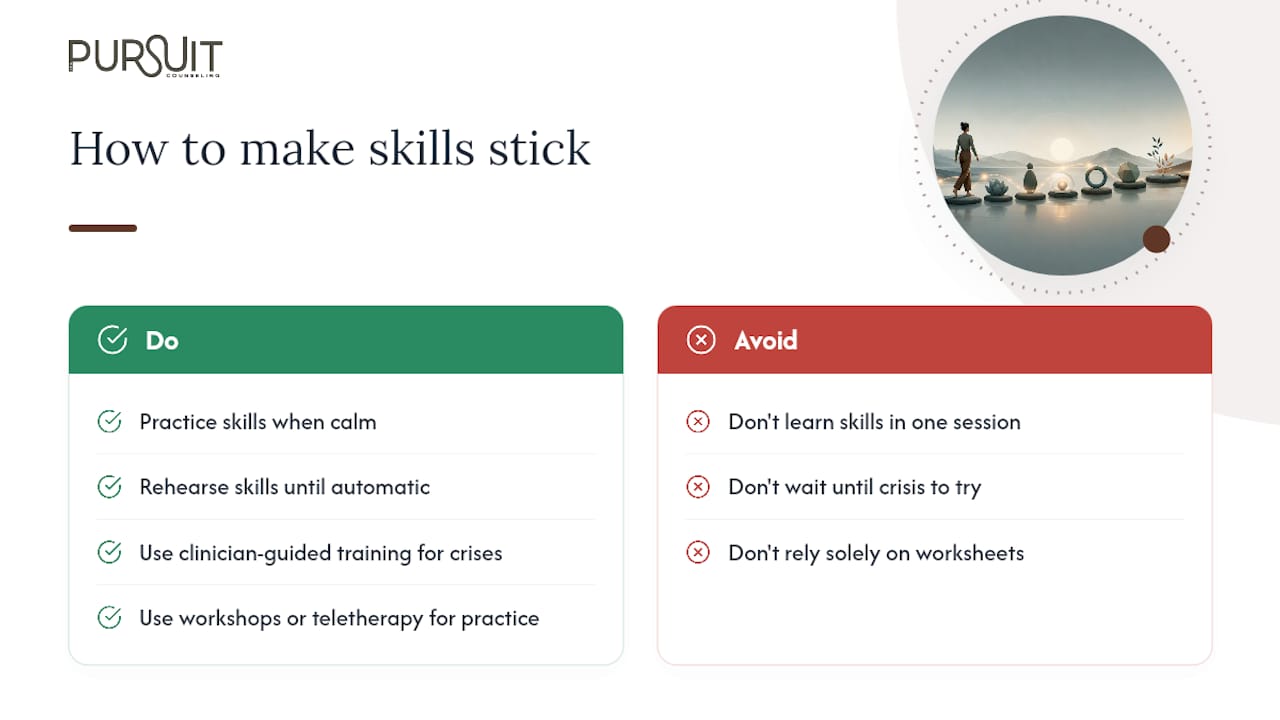
Distress tolerance skills fail for most people not because the skills are bad, but because nobody rehearsed them until they were automatic. That’s the gap I see most often: someone learns STOP or TIPP in a single session, nods along, and then can’t access any of it three weeks later during an actual crisis, because the first time they truly tried the skill was under maximum pressure.
DBT-informed skills training can happen through individual sessions, teletherapy, and workshops, structured so clients practice these tools when they’re calm, not just when they’re desperate. An intensive or clinician-guided format tends to make the most sense when crises are frequent, when self-harm risk is present, or when someone has tried self-guided worksheets and still can’t get the skills to hold under real pressure. That’s not a failure of willpower. It’s a sign the skill needs more repetition with support attached to it.
— Adam Glendye LPC, CPCS
Ready to Build These Skills With Support?
Reading about STOP and TIPP is one thing. Having a clinician walk you through them, adjust them to your triggers, and help you rehearse until they’re automatic is another. The Pursuit Counseling offers DBT-informed individual counseling for people who want more than a worksheet, someone to help troubleshoot why a skill isn’t landing yet, and a plan built around your specific triggers instead of a generic list.

Sessions are available in person from an office in Fayetteville, Georgia, or through secure online teletherapy, serving the wider South Atlanta area. For those already in frequent crisis or dealing with recurring self-harm urges, a therapy intensive can compress months of skill building into a concentrated stretch of focused work. Discussions in sessions are confidential. If you’re in immediate danger, call or text 988 or head to your nearest emergency room before anything else. Otherwise, booking a first session is the next concrete step toward having these skills feel automatic instead of theoretical.
Sources
Linehan’s DBT skills handouts cover full worksheets. In a crisis, contact 988 (U.S.).
- DBT® Skills Training Handouts and Worksheets — Distress Tolerance (Linehan handouts)
- DBT Distress Tolerance: Exercises, Videos and Worksheets
- Dbt
- Psychology
FAQ
Does DBT help with distress tolerance?
Yes. Distress tolerance is one of the four core modules in DBT, specifically designed to help people survive emotional crises without resorting to impulsive or harmful actions.
What is the 24-hour rule in DBT?
There is no official 24-hour rule in standard DBT distress tolerance training. DBT instead teaches you to delay impulsive action using crisis skills until you reach a calmer, clearer state of mind, without attaching a fixed time limit to it.
What are the signs of low distress tolerance?
Signs include intense urges to act impulsively, a racing heart or other physical arousal, scrambled or overwhelmed thinking, and an immediate pull toward self-harm or substance use when faced with emotional pain.
What are some examples of distress tolerance activities in DBT?
Common examples include the STOP skill, TIPP (temperature, intense exercise, paced breathing, paired muscle relaxation), IMPROVE the moment, radical acceptance, distraction, and self-soothing through the five senses. A clinician at a practice like The Pursuit Counseling can help you personalize which of these fits your specific triggers best.