


Anger therapy for men is structured work with a licensed therapist on what sits underneath your anger: the arousal in your body, the thoughts that light the fuse, and the habits that follow. If your anger is costing you in your marriage, at work or with your kids, individual therapy is the most direct place to start.
You may not call it anger. You may call it being short-tempered, wound tight, or “just done.” The word matters less than the pattern: it keeps happening, and you are tired of cleaning up after it.
Key Takeaways
- Anger is a normal emotion. It becomes a problem when it is exaggerated, uncontrolled, or tied to behavior that damages your relationships, work or health.
- Therapy for anger works on three things: your body’s arousal, your thinking, and your behavior. Most of the evidence is built on cognitive-behavioral methods.
- Chronic anger and irritability can sit on top of depression, trauma or anxiety, so a good first session looks at the whole picture rather than only the outbursts.
- The APA reports that a highly angry person can move toward a middle range of anger in about 8 to 10 weeks, depending on circumstances and techniques. No therapist can promise your result.
- If anger puts you or someone else at immediate risk, call or text 988 or 911 first. Therapy is for the work that comes after.
Table of Contents
- What Problematic Anger Actually Looks Like
- Where Anger Comes From
- When Anger Is Carrying Something Else
- What Anger Therapy Involves
- What a First Session Looks Like
- How Long Does It Take?
- Signs It Is Time to Talk to Someone
- If There Is Immediate Risk
- How We Work With Men and Anger
- Start With a Conversation
- Our Perspective
- FAQ
- Sources
What Problematic Anger Actually Looks Like
Anger itself is not the issue. The American Psychological Association describes it as an emotional state ranging from mild irritation to intense fury and rage, with real physical changes: a faster heart rate, higher blood pressure, a surge of adrenaline. Anger can even help you keep going when something is genuinely wrong.
It turns into a problem when it is, in the words of the Association for Behavioral and Cognitive Therapies, exaggerated, uncontrolled, or linked with dysfunctional behavior, and starts to affect many areas of life.
For men, that often shows up in ways that never look like “anger problems” from the inside:
- A fuse that has gotten shorter over months or years
- Snapping at your partner or kids, then replaying it for hours
- Road rage, or rage at objects, software, coworkers
- Going cold and silent instead of loud
- Drinking to come down afterward
- A sense that everyone else is the problem, and a quiet fear that you might be
That last one is worth sitting with. Many capable men run their lives well and still feel a pressure building that nothing they have tried releases. We have written before about the link between anger and dissatisfaction in men, and it is a common thread: anger is often the loudest signal in a room full of quieter ones.
Where Anger Comes From
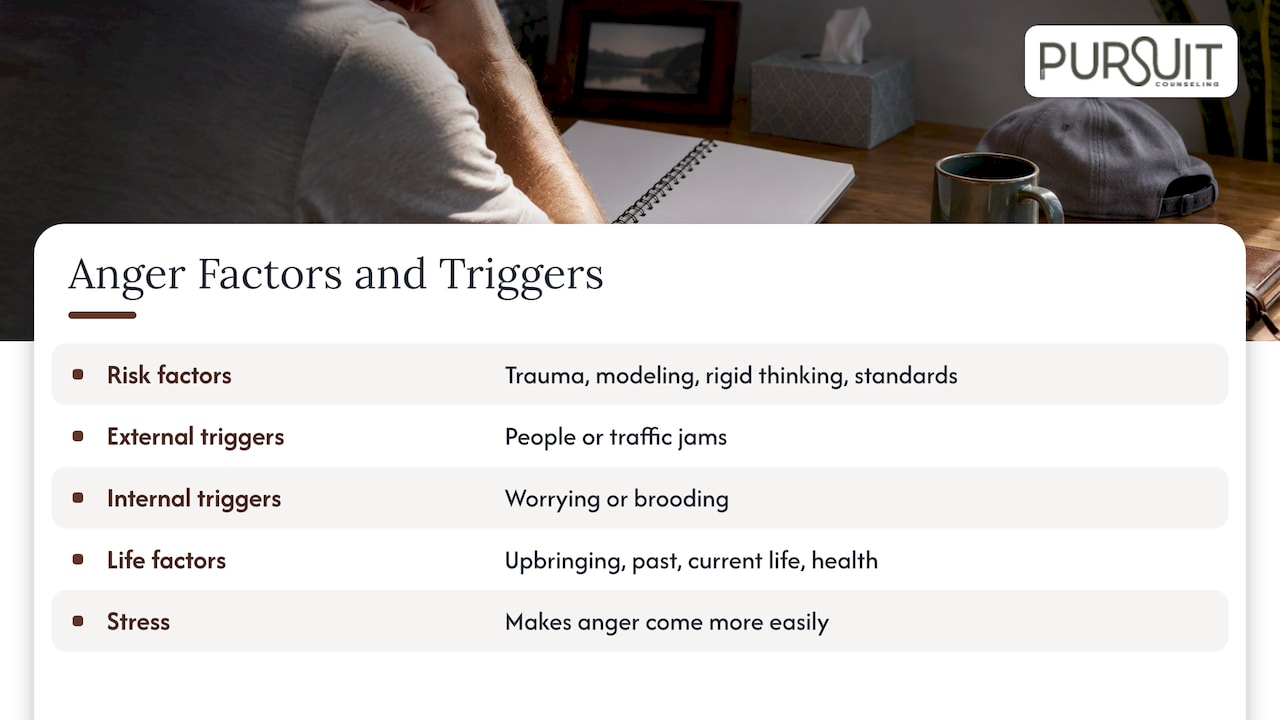
There is no single cause. The Australian Psychological Society notes that research has not yet found one cause of anger, but that the way you experience and express it can harden into habit. Risk factors it names include trauma-related memories, family and cultural modeling, fixed ways of thinking, and rigid standards or expectations.
The APA adds that triggers can be external (a person, a traffic jam) or internal, such as worrying or brooding about personal problems. Memories of traumatic or enraging events can set off angry feelings too.
Mind, a UK mental health charity, lists childhood and upbringing, past experiences, current circumstances, and health and wellbeing as factors, and notes that stress makes anger come more easily.
Many men were taught one acceptable emotion. Fear, grief, shame and disappointment get routed through anger because anger feels like action. If that sounds familiar, you are not broken. You learned a shortcut, and shortcuts can be unlearned.
When Anger Is Carrying Something Else
This is the part most quick-tip articles skip. Anger is sometimes the main problem. Sometimes it is the visible symptom of something else.
NAMI states that chronic anger and irritability can be symptoms of mental health conditions including depression, bipolar disorder and borderline personality disorder, and advises reaching out for help when anger feels out of control or comes with sadness or impulsivity.
Trauma is another common layer. The VA’s National Center for PTSD says many people feel angry after trauma, and that anger can help people keep going in the face of danger but can also create problems. It may be especially common when someone has been betrayed. For veterans, first responders, pilots and anyone who has carried something heavy alone, that can be the real story. Our piece on how unresolved trauma from the past can fuel anger goes deeper on this.
A note on education versus assessment: this article explains. It does not diagnose you. Only a licensed clinician who sits with you, asks questions and hears your history can assess what is going on.

What Anger Therapy Involves
Most of the research on anger treatment has centered on cognitive-behavioral therapy. The VA frames the work around three areas: arousal, behavior and beliefs. Here is what each looks like in practice.
Calming the body
When arousal runs high, thinking clearly is close to impossible. The VA describes goals of lowering overall arousal, with skills such as relaxation and physical exercises that release tension. ABCT describes practical versions: slow deep breathing, repeating a calming word or phrase, picturing a relaxation image, or noticing muscle tension and letting it go. These are practiced at home until you can settle quickly, which is the point. A skill you only try mid-explosion is a skill you have not trained.
If you want a concrete set of body-first tools, we lay out DBT skills, TIPP and short daily drills for calming anger fast.
Understanding the pattern
Many angry people cannot say where their anger comes from. ABCT notes that therapy builds awareness through detailed discussion, role-playing anger-evoking situations, and self-monitoring or recording anger episodes. You look at where and when anger happens, the triggers, what you feel in your body, what you were thinking, how you handled it, and whether you act differently in different settings.
One simple tool: after an episode, write down the time, the trigger, the first physical sign, the thought that came with it, and what you did. Two weeks of that tells you more than years of vague self-criticism.
Changing the thoughts that light the fuse
The VA describes helping clients notice the thoughts that lead up to anger and generate more useful replacement thoughts, with role-play to practice both. “He did that on purpose” and “I am being disrespected” feel like facts in the moment. In sessions you slow them down and test them.
Widening your options
On the behavior side, the VA’s first goal is to look at how you act under threat or stress, then expand your choices. Examples include taking a time out, writing down your thoughts, talking to someone instead of acting, and moving from “act first, think later” to “think first, act later.”
What a First Session Looks Like
Expect conversation, not a lecture. A first appointment with a licensed counselor usually covers what brought you in, what your anger looks like day to day, who it affects, your health, sleep and substance use, and what you want to be different. You are not graded. You do not have to arrive calm or articulate.
A few things worth knowing:
- You can be blunt. Therapists have heard worse than whatever you are about to say.
- The goal is specific. “Stop yelling at my kids” is a better goal than “be less angry.”
- Homework is normal. Tracking episodes and practicing relaxation between sessions is where much of the change happens.
- Other layers may come up. If depression, trauma or substance use are part of the picture, a good plan addresses them rather than treating anger in isolation.
How Long Does It Take?
The APA reports that a highly angry person can move closer to a middle range of anger in about 8 to 10 weeks, depending on circumstances and the techniques used. Treat that as a rough frame, not a guarantee. A man dealing with one stressful season looks different from a man carrying decades of unprocessed history, and the pace follows.
The APA also advises that when anger is out of control and affecting relationships and important parts of life, counseling is worth considering, with a psychologist or other licensed mental health professional developing techniques for changing thinking and behavior.
Signs It Is Time to Talk to Someone
You do not need a crisis to start. Consider reaching out if:
- People close to you have said they are afraid of, or walking on eggshells around, your temper
- You regret what you say or do after you get angry, repeatedly
- Anger shows up alongside low mood, numbness, poor sleep or heavy drinking
- You have damaged property, a relationship or a job
- You have tried to white-knuckle it and the pattern keeps returning
If There Is Immediate Risk
If your anger puts you or another person in danger right now, step away from the situation and get help first. In the United States, you can call or text 988 to reach the 988 Suicide & Crisis Lifeline, which offers 24/7 support for mental health and more. If anyone is in immediate physical danger, call 911. Therapy is the work you do once the moment has passed.
How We Work With Men and Anger
We treat anger as information. Sometimes it points to exhaustion, sometimes to old injuries, sometimes to a life that no longer fits.
Several of our services connect to the layers described above:
- Individual therapy for anger, anxiety and stress, in person in Fayetteville or online.
- DBT skills for regulating intense emotion in the moment.
If you want to see how we speak to this topic first, our articles on anger management tips for men and breaking free from anger are written by male therapists on our team. For local context, see our page on therapy for high-performing men in Peachtree City, Fayetteville and across Georgia.
Start With a Conversation
If anger has become the thing you manage instead of the thing you understand, a first session is a reasonable next step. You bring the story as it is. We help you sort out what is anger, what is underneath it, and what to do on Tuesday when the pressure builds.

You can see session options and book through our services and specialties page. We serve Fayetteville, Peachtree City, Senoia, Brooks, Tyrone and the rest of South Atlanta, and we offer online sessions for men elsewhere in Georgia.
Our Perspective
Most men who find us are not out of control. They are in control of nearly everything except this one thing, and that is exactly what makes it so frustrating.
We do not see anger as the enemy. We see it as the pain cave showing up in daily life: the place where exhaustion, old hurt and unspoken fear get loud. Cut the anger out and you lose information. Learn to read it and you can act on it.
That is why we do not hand out a generic script. A pilot with years of suppressed stress, an executive carrying a team, and a dad who grew up in a house where yelling was normal need different work, even if the outburst looks the same. We start with the person, then choose the tools: skills for the body, honest examination of the thoughts, and, where the history calls for it, trauma work such as EMDR.
We will not promise an outcome. We will promise a real conversation with someone who understands complicated people, and a plan that fits you. The cracks are where the light gets in, and also where the real work starts.
Adam Glendye LPC, CPCS
FAQ
Is anger therapy the same as an anger management class?
Not necessarily. A class usually teaches a fixed set of skills to a group. Individual therapy covers the same kinds of skills, such as relaxation, tracking triggers and changing unhelpful thoughts, but also looks at your history, relationships and any conditions like depression or trauma that feed the anger.
Can anger be a sign of depression?
Yes. NAMI states that chronic anger and irritability can be symptoms of conditions such as depression. A licensed clinician can assess whether that applies to you. This article cannot.
What can I do in the moment when I feel anger building?
Try a time out, slow deep breathing, or writing down what you are thinking instead of acting on it. ABCT describes breathing, calming phrases and releasing muscle tension as skills that work best when practiced regularly, before you need them.
How do I know if I need therapy or can handle this on my own?
If your anger is hurting relationships, work or health, or you keep repeating patterns you regret, that is a good reason to talk with a professional. The APA suggests considering counseling when anger is out of control and affecting important parts of life.
Do you offer online anger therapy for men in Georgia?
Yes. We offer both in-person sessions in Fayetteville and online sessions, so you can choose what fits a demanding schedule.
Sources
- Anger fact sheet, Association for Behavioral and Cognitive Therapies
- Control anger before it controls you, American Psychological Association
- Anger and Trauma, VA National Center for PTSD
- Anger and mental health help, NAMI
- What causes anger? Mind
- Managing your anger, Australian Psychological Society
- 988 Suicide & Crisis Lifeline, SAMHSA