


Most men who avoid therapy are not indifferent to their own pain. They were taught, early and often, to handle it alone, and they were handed a version of therapy that did not seem built for them. Self-reliance, fear of looking weak, doubt about what a good therapist even looks like, and care that sometimes misses how men show distress all play a part. If you recognize yourself here, the avoidance makes sense. It also has a way out that starts smaller than you think.
This is education, not assessment. Nothing here can tell you whether you have a condition. It can help you name what has been in the way.
Key Takeaways
- Avoidance usually comes from training, not apathy: the APA’s guidelines for working with boys and men link early lessons in self-reliance to adult men being less willing to seek treatment.
- Men’s distress often looks like irritability, withdrawal, or physical complaints, so it gets missed by the men themselves and sometimes by clinicians.
- Fit matters. Research on engaging men points to collaborative, goal-focused, plainly spoken therapy as the kind that holds their attention.
- You do not have to be in crisis to start. A first conversation can be about one problem, one pattern, or one question.
- If you are thinking about harming yourself, call or text 988, the Suicide & Crisis Lifeline, now.
Table of Contents
- The pressure to handle it alone
- The objections men actually raise
- Sometimes the system misses men too
- What distress looks like in men
- The high performer’s version of the silence
- What makes therapy workable for men
- What it costs
- Our perspective
- A next step that matches where you are
- FAQ
- Sources
The pressure to handle it alone
Many men grew up with a simple rule: you fix what is broken, you do not talk about it. That rule works well on a job site, in a cockpit, or in a boardroom. It works badly on grief, anxiety, anger, and the slow exhaustion of carrying everyone else.
The APA guidelines state that socialization teaching boys to be self-reliant and strong, and to manage problems on their own, yields adult men who are less willing to seek mental health treatment. The same document notes that men typically report higher stigma about seeking help than women, and that men of color seek psychological help even less often than other men.
A 2016 systematic review of 37 studies found that conformity to traditional masculine norms affects men with depression in three ways: how symptoms show up, how willing they are to seek help, and how they manage symptoms on their own. In plain terms, the rule does not only keep men out of the office. It changes what the struggle looks like before they ever get there.
The APA calls the result “double jeopardy.” Men who need the most help are the least likely to ask for it, partly because therapy often leans on the language of feelings, disclosing vulnerability, and admitting dependence. Those are the exact things a man trained in self-reliance has spent decades avoiding.
The objections men actually raise
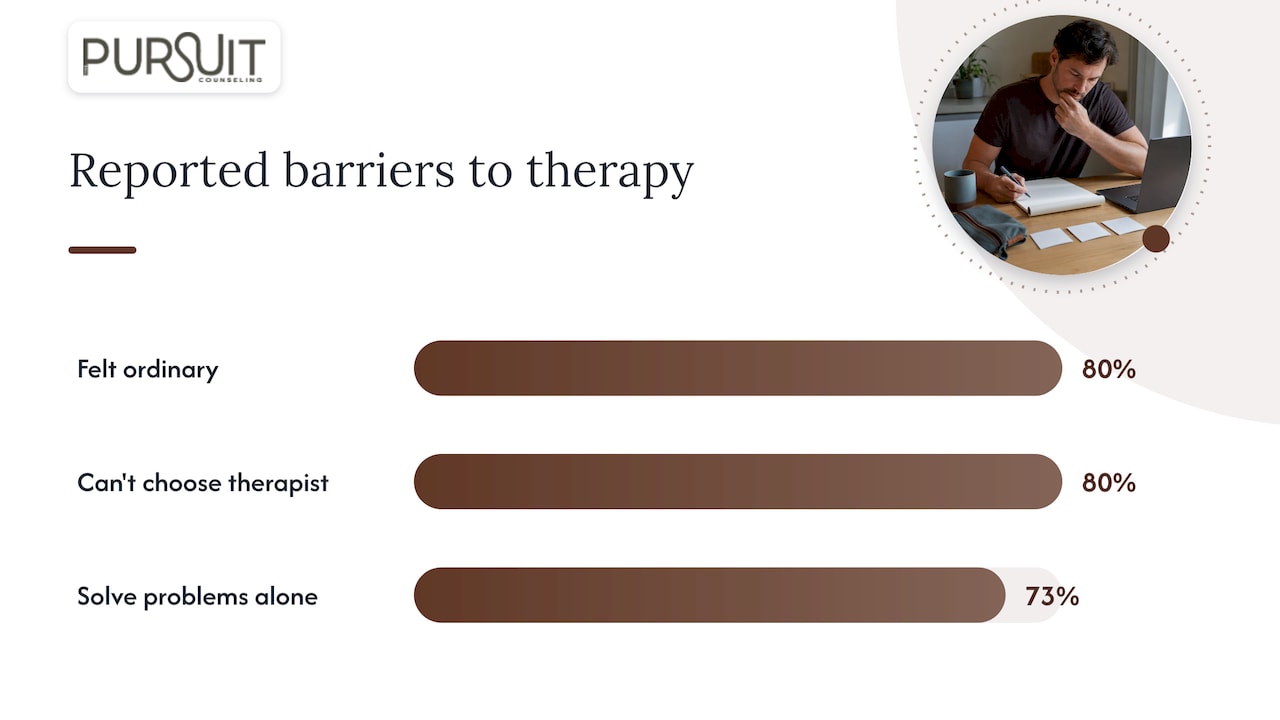
The reasons rarely sound like “I am afraid.” They sound practical. A 2020 survey of 778 men with a mental health concern found that 65% wanted treatment and 35% did not. Among the barriers men endorsed often:
- 80% said many people feel sad and down, so what they feel seemed ordinary.
- 80% did not know what to look for in a psychotherapist.
- 73% felt they needed to solve their own problems.
Take these one at a time, because each has a reasonable answer.
“Everyone feels like this.” Plenty of people do carry stress. The question is not whether others feel it. The question is whether it is costing you sleep, patience, focus, or people you love, and whether you have been white-knuckling it for months.
“I would not know who to pick.” This one is fair, and it is a real obstacle. Therapists differ in style, training, and how directly they talk. Later in this article you will find what to look for.
“I should be able to fix this myself.” You probably have fixed a lot yourself. Therapy is not a replacement for that capacity. It is a place to work on the one problem you cannot solve from inside it.
“It is not for guys like me.” A 2026 narrative review of men’s mental health names attitudinal barriers such as self-stigma, shame, minimizing symptoms, and mistrust. It also names structural ones: too few services tailored to men, trouble finding care, and cost. Those barriers delay recognition of distress and raise dropout, especially when therapy feels impersonal.
Sometimes the system misses men too
Here is the part that rarely gets said: some men avoid therapy partly because it has failed men like them.
The Association of American Medical Colleges reports that providers can miss or misdiagnose problems in men. Some carry their own gender bias, a “man up” attitude. Some rely on diagnostic tools that do not account for how men experience and show symptoms. Their analysis calls men’s avoidance of care “far from illogical” given those added barriers.
The numbers are sobering. According to the same analysis, only 40% of US men with a recent mental illness received treatment in 2021, versus 52% of women. It also found that more than 60% of men who died by suicide in the US and Canada had used mental health services in the prior year. Care that does not fit is care that can fall short even when a man shows up.
That is not an argument against therapy. It is an argument for choosing it carefully and for expecting to be understood.
What distress looks like in men
Men often do not say “I feel depressed.” The APA guidelines describe covert symptoms: irritability, pulling away from people, physical complaints, and trouble with motivation. Because these do not match stereotypes of male emotion, men are less likely to be diagnosed with depression or anxiety, even though men are four times more likely than women to die by suicide.
A Men’s Health Network report citing CDC data says 83% of male suicide victims had no diagnosed mental health condition. It attributes that largely to men’s reluctance to talk about emotional issues and to weak screening tools for males in primary care.
So what might you be experiencing, without a label for it?
- A short fuse at home or at work that surprises you.
- Drinking, working, or training harder than the situation calls for.
- Going quiet with your partner, then wondering why the distance grew.
- Back pain, headaches, or sleep trouble with no clear cause.
- Feeling flat on a day that should feel good.
None of that diagnoses anything. It is a list of reasons to have a real conversation with a clinician. We have written more about how men and women can experience depression differently, and about anger that is really something else underneath.
Grief is another one that men carry quietly. If a loss is the weight, putting words on paper can be a first step, and grief support for men offers one way to start that does not require saying anything aloud yet.

The high performer’s version of the silence
For pilots, executives, founders, and business owners, the silence has its own shape. You are the person others lean on. Admitting strain feels like handing someone the keys to your credibility.
We hear a version of this often enough that we wrote about it: why successful men privately ask for help but publicly stay silent. The private asking is real. The public silence is a habit, and habits can be worked with.
It can help to reframe the task. You are not going to therapy to confess. You are doing the same thing you do with any high-stakes system: looking at what is under load before it fails. We call that mental fitness, and it is closer to how you already think about performance than to what you imagine a therapy office to be.

What makes therapy workable for men
The research on this is more encouraging than the avoidance statistics. A 2018 scoping review on engaging men in psychological treatment found that clinicians do better when they consider masculine socialization, use skills such as self-disclosure and normalizing, adapt their language with male-oriented metaphors, and use treatment that is collaborative, transparent, action-oriented, and goal-focused.
A 2019 review of ways to improve men’s use of mental health services adds role models, psychoeducation, help recognizing and managing symptoms, active problem-solving, behavior-change techniques, and content that builds on positive male traits. The 2026 narrative review notes that compassion-focused therapy and acceptance and commitment therapy can legitimize men’s emotional experiences and gently question rigid ideas of masculinity.
Translate that into what you should look for:
- A clear plan. You should know what you are working on and how you will tell it is moving.
- Plain talk. A therapist who can explain what they are doing, without jargon and without treating you as fragile.
- Something to do. Skills, practice, and experiments between sessions, not only talking.
- A person, not a script. Someone who shows up as human and responds to you specifically.
- A format that fits your week. Online or in person, built around a schedule that is already full.
Starting smaller than you think
You do not have to open with your worst day. A first session can be about one situation: the argument you keep replaying, the stress you cannot shut off at night, the sense that the person you are at work is not the person you are at home. A good clinician will meet you there and will not force more than you offer.
If the idea of a first appointment feels like too much, our piece on why your barber is not your therapist looks at the casual conversations many men rely on, and at what a more structured one can add.
What it costs
Costs depend on the clinician, the type and length of session, and your insurance or out-of-network benefits. Contact us for current rates and what your plan may cover, or ask during a free 15-minute consult.
Cost is one of the structural barriers the research names, so here are our published rates. We are a private-pay practice.
See the details on our intensives page.
Our perspective
We have sat with a lot of men who said some version of the same thing in the first ten minutes: “I do not usually do this.” We believe that sentence deserves respect, not correction.
Most of the men we meet are not avoiding help because they are weak. They are avoiding it because they have spent years being the one who holds things together, and nobody showed them where to set the weight down. The pain cave is real, and many men have learned to live in it quietly. We would rather help you look at the cracks than keep you polishing the surface.
That is why our work is collaborative and tailored to the person in front of us. We use evidence-based approaches, including EMDR for trauma and neurofeedback for focus, and we offer adventure and equine work for men who think better on their feet than on a couch. We offer sessions in person in Fayetteville and online, so that a full schedule is not the reason you wait another year.
We do not promise outcomes, and we will not hand you a diagnosis in the first meeting. What we offer is a conversation with someone who understands complicated people, and a plan built around what you actually want to change.
Adam Glendye LPC, CPCS
A next step that matches where you are
If you read this far, something here landed. You do not need to resolve it today. You need a next step that is accurate to where you are: not a leap, not a confession, just a first conversation with someone who will take you seriously.
We work with men and high performers across Georgia: executives, pilots, business owners, and founders in Fayetteville, Peachtree City, Senoia, Tyrone, and South Atlanta, in person or online. You can look at the ways to work with us on our services and specialties page and reach out from there.

If anger is what has been getting in the way, this piece by a male therapist is a good place to begin. If you are in the middle of a bigger shift, midlife crisis therapy for men explains what that work looks like.
FAQ
Why do men avoid therapy more than women?
Mostly because of what they were taught and what they expect. Early lessons in self-reliance, higher stigma about asking for help, and services built around the language of feelings all play a part, according to the APA’s guidelines. Some men have also met clinicians who missed or minimized what they were describing.
Does avoiding therapy mean a man is in denial?
Not necessarily. Many men know something is off and are weighing whether it counts as serious enough. In the 2020 survey above, the most common barriers were thinking many people feel this way and not knowing how to choose a therapist. Those are practical hurdles, not proof of denial.
What should I look for in a therapist if I have avoided therapy for years?
Look for someone who is collaborative, direct, and goal-focused, who explains what they are doing and gives you something to practice. Research on engaging men points to exactly those qualities. You can also ask about their approach and what a first session involves.
Do I need to be in crisis to start?
No. Many people begin because of a pattern: irritability, poor sleep, distance in a relationship, or a sense of running on empty. If you are in crisis or thinking about harming yourself, call or text 988 right away, or call 911 in an emergency.
Sources
- APA Guidelines for Psychological Practice with Boys and Men
- The role of masculinity in men’s help-seeking for depression: a systematic review
- What gets in the way? Men’s perspectives of barriers to mental health treatment
- A Narrative Review of Men’s Mental Health
- Men and mental health: What are we missing? (AAMC)
- Men’s Health Network report on depression and anxiety in males
- Engaging Men in Psychological Treatment: A Scoping Review
- Improving Mental Health Service Utilization Among Men