


If you are in your 40s or 50s, the life looks fine from the outside, and something underneath has gone quiet or sharp, therapy is a reasonable place to take it. Not because you are broken. Because “midlife crisis” is a label, and what sits under it (depression, anxiety, grief, a marriage on autopilot, an identity built on a role that has changed) can be named and worked on. At The Pursuit Counseling in Fayetteville, Georgia, we work with men in exactly this spot, in person or online.
This is education, not assessment. Nothing here diagnoses you. It explains what the research says, what therapy for men over 40 looks like, and what a sensible first step costs.
Key Takeaways
- “Midlife crisis” is not a clinical diagnosis. The distress behind it is real and treatable territory: depression, anxiety, grief, burnout, relationship strain.
- Men often show it as irritability, overwork, numbness or restlessness rather than sadness, which is why it goes unnamed for years.
- Therapy that works for men tends to be collaborative, direct and goal-focused, not a lecture from an expert across the room.
- You can start with weekly individual sessions, or compress the work into an intensive if your calendar is the obstacle.
- If you are thinking about ending your life, call or text 988 now, any hour.
Table of Contents
- Is a midlife crisis real?
- What it can look like in men
- What is usually underneath
- How therapy helps men over 40
- Starting over in your 40s or 50s
- How long does it last?
- When it is hitting your marriage
- What it costs at The Pursuit
- Where to start
- Our perspective
- FAQ
- Sources
Is a midlife crisis real?
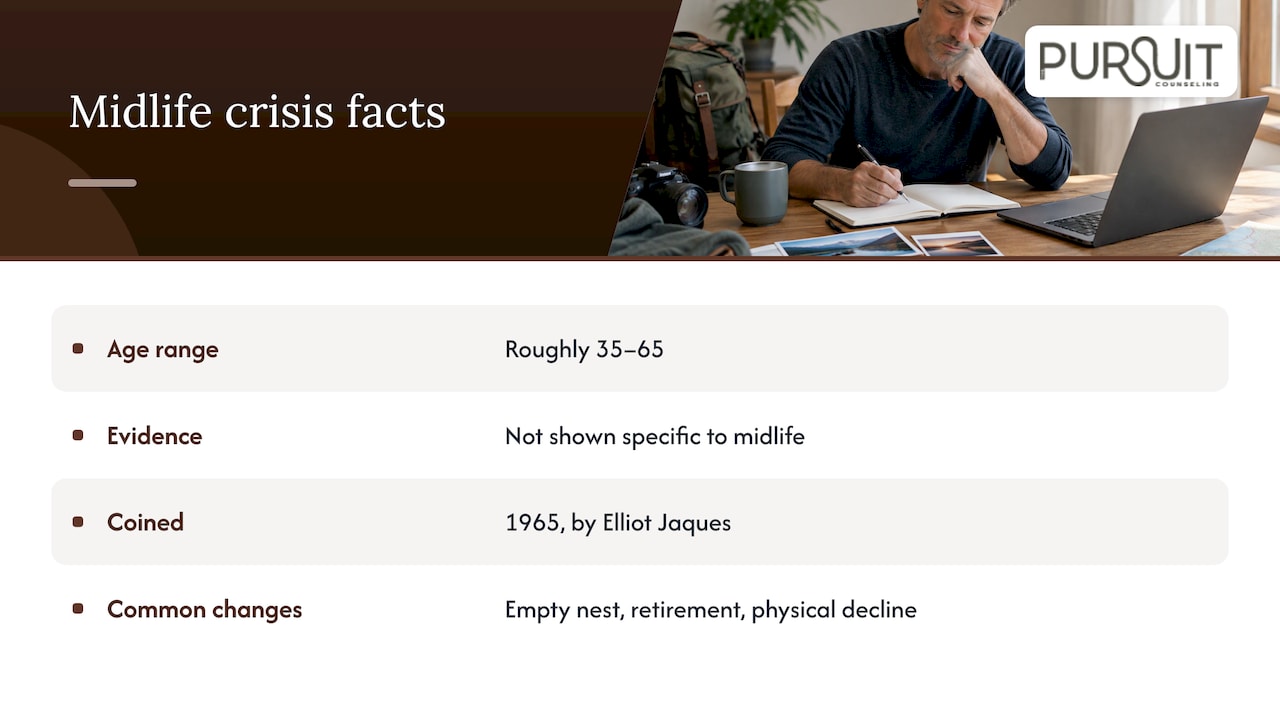
Honest answer: the phrase is popular, the science is more complicated. The APA Dictionary of Psychology describes it as a period of psychological distress that some people experience in the middle years, roughly ages 35 to 65, and notes that there is no empirical evidence the distress is specific to midlife. The term itself dates to 1965, coined by organizational psychologist Elliot Jaques.
That does not make your experience imaginary. A review in American Family Physician describes what many men face between 40 and 60: awareness that they are aging and that life is finite, plus family changes such as an empty nest, retirement, physical decline, unfinished plans, and the loss of parents or friends. Those are heavy things. You do not need a clinical term to justify taking them seriously.
So the useful question is not “am I having a midlife crisis?” It is “what, specifically, is wearing on me?”
What it can look like in men
Most men we meet do not arrive saying they are sad. They say they are tired, short-tempered, bored by things they used to love, or quietly planning an exit from something: the job, the marriage, the town. You may recognize some of this:
- Irritability that seems out of proportion to what set it off
- Working harder to avoid being home, or being still
- Drinking a little more, or needing it to switch off
- A flat, “is this it?” feeling after a promotion, a sale, or a milestone
- Poor sleep, low energy, trouble concentrating
- Sudden urges to change everything: a car, a career, a relationship
- Pulling away from friends until you realize you have none you call
The NHS describes mood swings, irritability, low energy, insomnia, poor concentration and low sex drive in men in their late 40s to early 50s, and says anxiety about what you have accomplished so far can lead to a period of depression. Notice how much of that overlaps with ordinary depression and anxiety. That overlap is the point: what feels like one big crisis is usually several smaller, nameable problems stacked together.
Check the body too
Some of this can have a physical side. Sleep problems, low energy and low libido deserve a conversation with your primary care doctor, who can check things like thyroid, sleep apnea and testosterone. If you are exploring that route, this overview of hormone therapy for men explains who it is for and how it is monitored. Therapy and medical care are not rivals. Many men need both, and a good counselor will ask whether you have been checked.
What is usually underneath
The research points less at a single event and more at accumulated strain. Sociologist Deborah Carr’s paper on midlife and mental health lists common midlife pressures: caregiving, an unfulfilling job, monthly money stress. She notes that chronic strains are often more distressing than single events, because they are persistent and hard to change or avoid.
A University of Wisconsin analysis of the national MIDUS study makes a related point: midlife brings shifting relationship demands, such as supporting adult children and caring for aging parents, which require recalibrating goals and roles while stretching the resources you would use to cope.
In practice, here is what we hear from men in Fayette County and South Atlanta:
- The role outgrew the man. You built a career, a company or a flight path around a goal you reached. Now what?
- The sandwich. Teenagers who need you, parents who need you more, a spouse who feels like a logistics partner.
- Old pain, finally quiet enough to hear. When you slow down, the things you outran catch up. Trauma and loss often surface here, and EMDR is one of the approaches we use for that work.
- A body that reminds you. You cannot train through everything anymore.
- Loneliness dressed up as busyness.
Naming which of these is yours is half the work.
How therapy helps men over 40
Therapy does not hand you a new life. It gives you a place to say the accurate thing out loud, sort what is urgent from what is only loud, and make decisions from something steadier than panic.
Carr’s paper notes that cognitive-behavioral therapy and interpersonal therapy are the two main approaches consistently shown to be effective for depression, anxiety and relationship problems. She also reports that in 2020 only 9.2% of US adults aged 45 to 64 had seen a mental health professional in the past year. Most men your age are handling this alone.
And how the therapist works matters as much as the method. A scoping review of engaging men in treatment found that treatment styles men tend to respond to are collaborative, transparent, action-oriented and goal-focused, with a relationship that closes the gap between clinician and client rather than setting up an expert and a patient. A separate 2023 counseling paper argues for a strengths-based approach for the same reason.
That matches how we like to work: collaborative, direct, no performance. You are an intelligent adult. We will not talk down to you or hide behind jargon.
What a first few sessions look like
- Mapping. What is happening, since when, and what have you already tried? Work, marriage, sleep, drinking, mood, body.
- Naming. Is this depression, anxiety, burnout, grief, a transition, or several? A licensed counselor can assess this with you. Reading an article cannot.
- Choosing a target. One or two things you want different in 90 days. Concrete beats abstract.
- Practice between sessions. Skills, conversations, small experiments with how you spend your week.
The approaches we draw on include individual psychotherapy, EMDR for trauma, DBT skills for emotional regulation, and, for some men, experiential work such as adventure therapy, which gets the conversation moving when sitting across from someone feels like too much. Our page on transitions counseling in Fayetteville covers the major-change side of this in more depth.

Starting over in your 40s or 50s
Many men searching this are not asking whether the feeling is a diagnosis. They are asking whether it is too late to change something big. Divorce, a sold business, a layoff, retirement from the cockpit, kids leaving, a parent’s death: these are real restarts, and they are stressful even when you chose them.
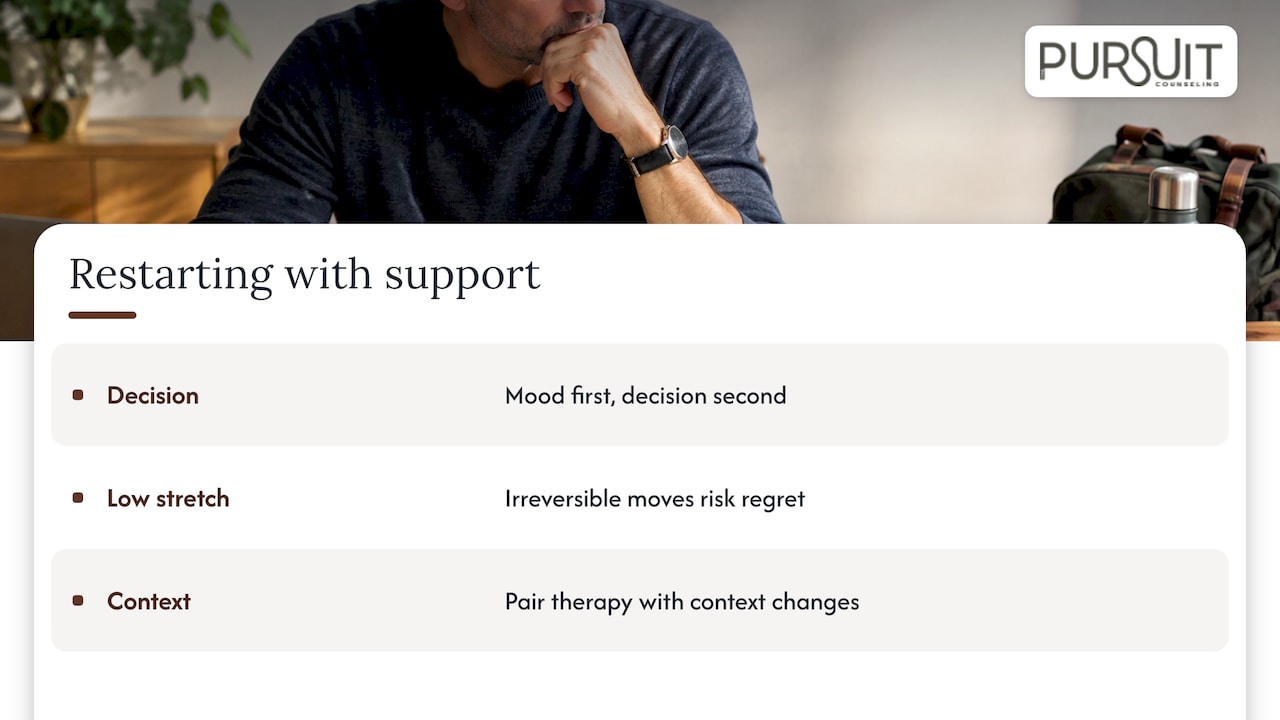
Two things help. First, separate the decision from the mood. Big, irreversible moves made at the bottom of a low stretch tend to be regretted, so it helps to treat the mood first and the decision second. Second, remember that Carr’s paper observes therapy treats symptoms and not necessarily the underlying circumstances. So a good plan pairs therapy with changes to the context: the workload, the caregiving load, the money pressure, the calendar.
Our article on life transitions and the benefits of therapy and the piece on embracing change go further on that ground.
How long does it last?
Nobody can give you a number, and we will not pretend to. What the research offers is context. In a US study using national midlife data, Walker and Druss report that around two-thirds of people with major depression recover within one to two years, while 37% of those depressed in 1995 to 1996 were still depressed in 2004 to 2006. Factors tied to persistence included multiple chronic medical conditions, never having married, activity limitations and less contact with family.
Read that without fear. It says two practical things: unaddressed distress can stick around for years, and connection and physical health are levers you can pull. The same study found that being married and having family and partner support improved the odds of recovery.
When it is hitting your marriage
A man in distress often changes how he behaves at home before he can explain why. His partner sees withdrawal, anger, or sudden decisions, and neither of you has words for it. Individual work helps you understand your own side. Couples work helps the two of you stop fighting the symptoms.
If the calendar is your obstacle, an intensive can compress weeks of sessions into one focused block. Both are listed on our intensives page.
What it costs at The Pursuit
Costs depend on the clinician, the type and length of session, and your insurance or out-of-network benefits. Contact us for current rates and what your plan may cover, or ask during a free 15-minute consult.
Prices come from our services page and can change, so confirm there.
Where to start
Men often wait because they assume therapy means weeks of paperwork and a stranger asking about their mother. It does not have to feel like that.
We offer in-person sessions in Fayetteville and online sessions for men across Georgia, including Peachtree City, Tyrone, Senoia and South Atlanta. For men carrying heavy responsibility, our executive therapist work and therapy for high-performing men are built around demanding schedules.
If you want to book, see our services and reach out here. Tell us what is going on in a sentence or two. That is enough.

Our perspective
Men come to us carrying a quiet question: is this all there is? We do not treat that as a defect to fix. We treat it as information.
What we have seen to matter most is the relationship in the room. A man who feels judged or managed will perform his way through an hour and change nothing. A man who feels understood will say the true thing, and the work starts there. That is why we stay collaborative and direct, and why we offer formats that fit complicated lives: weekly sessions, intensives, experiential work outdoors, online sessions when the schedule is brutal.
We also believe the pain cave is not the enemy. The cracks that appear in the 40s and 50s are often where the real questions come through. We cannot promise an outcome. We can promise to take you seriously, to be straight with you, and to work on what you actually want different.
Adam Glendye LPC, CPCS
FAQ
Can a marriage survive a man’s midlife crisis?
Many do. What helps is naming what is underneath the behavior, whether depression, anxiety, grief or burnout, and avoiding irreversible decisions while the distress is at its worst. Research on depression finds that family and partner support improves recovery odds, so keeping the connection open matters. Individual and couples counseling can both help.
Should I see a therapist or my doctor first?
If you have trouble sleeping, low energy or a low sex drive, it is sensible to see your primary care doctor to rule out medical causes. You can also start therapy at the same time. Counseling can look at stress, mood and relationships, while your doctor looks at the body.
Is therapy for men over 40 different from regular therapy?
The tools are similar: CBT, EMDR, DBT skills and others. The style differs. Research on engaging men points to collaborative, goal-focused work with a transparent therapist. We build sessions that way.
What if I am having thoughts of ending my life?
Call or text 988, the Suicide and Crisis Lifeline, any time, or call 911 if you are in immediate danger. Tell someone close to you where you are. Thoughts like these are a medical and emotional emergency, not a character flaw, and they deserve immediate help.
Sources
- APA Dictionary of Psychology: midlife crisis
- Health Issues in Men: Part II, American Family Physician
- The male menopause, NHS
- Midlife and mental health, Deborah Carr
- Daily Stress Processes, MIDUS, University of Wisconsin
- Engaging Men in Psychological Treatment: A Scoping Review
- Counseling With Male Clients: The Case for Relational Resilience
- Rate and predictors of persistent Major Depressive Disorder