


A values clarification exercise is a structured way to figure out what matters most to you and why, then test whether your calendar, your work and your relationships say the same thing. You can do one in about an hour with a pen and some honesty. Below are four methods drawn from university, government and clinical sources, a template to work through, and a plain account of what to do with the answers.
If you are a high performer, you may already be good at goals. Values are a different question: not what you are chasing, but why, and at what cost.
Key Takeaways
- A values clarification exercise means naming your top values and reflecting on why they matter and how they could guide daily actions or future goals.
- Start with lived experience (peak moments, pride, what you would want said about you) before you reach for a list of value words.
- Narrow to a short list, then force-rank it. Ranking is what helps when two good values pull against each other.
- A value only counts once it shows up in behavior. Turn each one into a goal, an action and a named obstacle.
- Your values can shift. Treat the result as an honest read of what matters now, not a verdict on who you should be.
Table of Contents
- What a values clarification exercise is, and what it is not
- Ground rules before you start
- Exercise 1: Peak experiences
- Exercise 2: The card sort or core values list
- Exercise 3: The 90th birthday
- Exercise 4: Force-rank your top ten
- A one-page template you can copy
- Turning values into everyday choices
- When your values change, or when they will not come
- Perspective: Why we start with values
- When you want a guide for this work
- FAQ
- Sources
What a values clarification exercise is, and what it is not
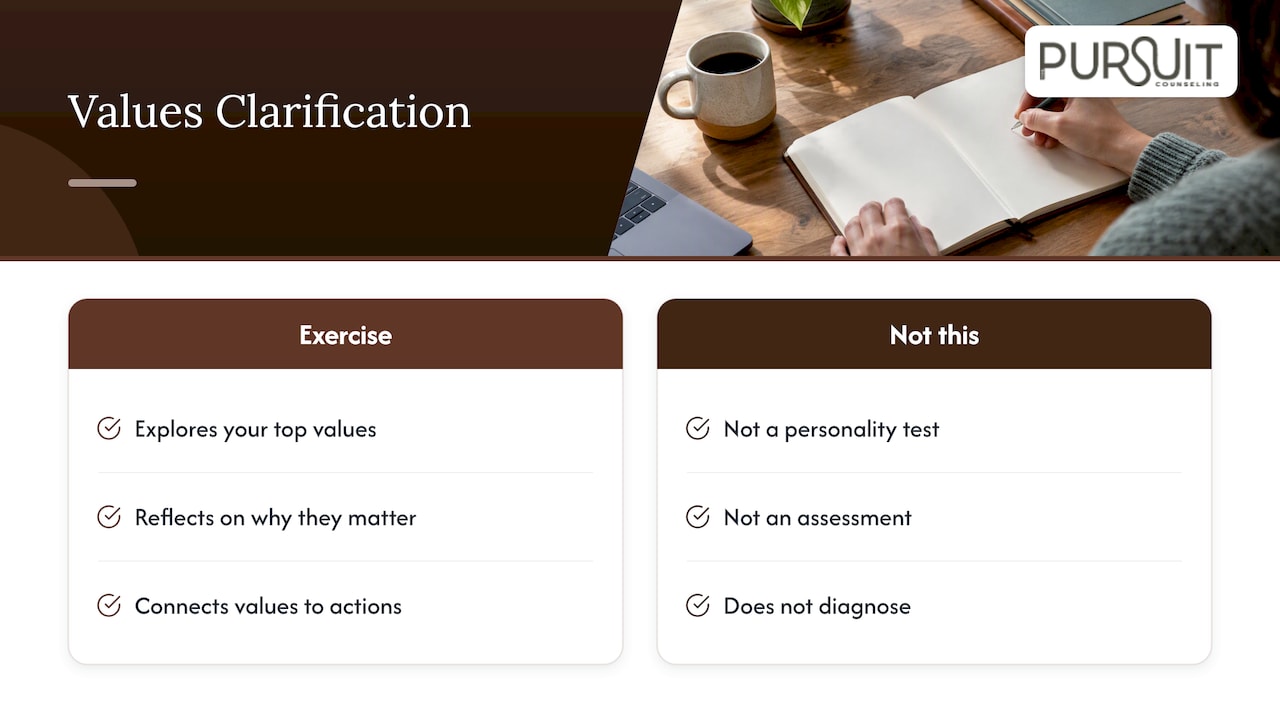
A recent peer-reviewed review defines a values-clarification exercise as one that explicitly explores your top values and reflects on why they matter and how they may guide daily actions or future goals. That is the whole idea. You are not taking a personality test. You are doing the reflecting yourself, with prompts to keep you honest.
The U.S. Department of Veterans Affairs Whole Health program frames values as directions rather than destinations. You never finish being a person who values honesty or adventure. You keep moving toward it, and you can check each day whether you faced that way.
The peer-reviewed literature on values work makes a similar point: values are most useful when treated as directions you can test in behavior rather than as labels you must pick perfectly. Note that the research link here is to the published overview; the practical upshot is that you do not need the perfect word. You need a direction you can act on this week.
One distinction matters. An exercise like this is education and reflection. It is not an assessment, and it does not diagnose anything or tell you what is wrong with you. If what comes up is heavy, such as grief, a marriage that has gone quiet, or exhaustion you cannot explain, that is information worth bringing to a licensed clinician rather than solving alone on a worksheet.
Ground rules before you start
Six small decisions make the difference between an exercise that sticks and one that produces a tidy list of words you forget by Friday.
- Write it down. Thinking in circles is not the same as choosing. Use paper or a blank document.
- Answer for now. MIT’s career office describes clarification as an honest assessment of current priorities, not a moral test and not a chance to adopt someone else’s shoulds.
- Skip the right answers. California’s Department of Social Services notes that values are personal statements of meaning and are not inherently right or wrong. Nobody grades yours.
- Silence the inbox. Phone in another room, 45 to 60 minutes.
- Notice the borrowed ones. If a value sounds impressive but leaves you flat, it may be your parents’, your industry’s or your board’s. Mark it and keep going.
- Expect some discomfort. Many capable people feel a pang when they see how little of their week touches what they said matters most. That pang is useful data, not a failure.
Exercise 1: Peak experiences
This is the best starting point if lists of words make your eyes glaze over. The MIT workbook recommends identifying values through peak experiences: times you felt alive, thriving or fully yourself. Then you look at what those moments had in common, and the values that surface might be perseverance, challenge, teamwork, creativity or adventure.
Try this:
- Write down three moments from any part of your life. A race you finished when quitting made sense. A project that absorbed you. A night you were fully present with your kids.
- For each, answer: What was I doing? Who was there? What made it matter?
- Underline the repeating themes. Two or three will keep returning.
California’s worksheet uses a close cousin of this, asking you to reflect on times of happiness, pride and fulfillment, including what you were doing, who was with you and what contributed. Use whichever frame gets you writing.
Pain counts too. Some of the clearest values show up in the hardest stretches. What did you refuse to give up when everything was stripped down? That refusal is often a value in disguise.

Exercise 2: The card sort or core values list
Now bring in vocabulary. If you have a deck of value cards, or a printed list of 50 to 100 words (honesty, family, mastery, freedom, faith, service, security, curiosity), you can sort.
The California worksheet has you sort into three piles: Very Important To Me, Important To Me, and Not Important to Me, then write down your top values. Keep the first pile honest. If everything is very important, nothing is.
The University of Wisconsin Extension version works as a paper exercise. It asks you to circle eight important value words, narrow to three to five, add any that are missing, rank them, and write outcome statements and behavior indicators for each. The missing-words step is worth taking seriously. No list contains every word, and the one you add yourself is often the one that lands.
OpenLearn, the Open University’s free learning platform, takes a wider net. It suggests listing at least ten very important values and another ten quite important ones, reconsidering both lists, and trimming to about six that feel most significant to how you want to live and work.
A practical tip: define each word in your own sentence. “Freedom” means very different things to a pilot, a founder and a mother of three. “Freedom: I decide when I work and when I stop” is a value you can act on. “Freedom” alone is a poster.

Exercise 3: The 90th birthday
This one moves fast and tends to cut through status and habit. The VA worksheet asks you to imagine your 90th birthday and what people would say about you and what you would want to be remembered for. The same worksheet includes the Sweet Spot exercise and the Values Top Ten and Top Three Domains exercises, if you want more than one angle.
Write the toast you hope someone gives. Then ask two harder questions:
- Which parts of that toast am I currently making true?
- Which parts would surprise the people who see me most?
Executives often find that the toast has almost nothing about revenue and a lot about presence, character and the people who stayed. That does not mean the work is meaningless. It means the work needs to answer to something.
Exercise 4: Force-rank your top ten
By now you have a pile of candidates from the first three exercises. Combine them, cut duplicates and get to ten. Then rank them, one through ten, with no ties.
MIT’s workbook instructs you to force-rank your ten values and suggests asking which value or values you would be most miserable without. That question beats “which do I like best,” because it tests what you cannot live without rather than what sounds nice.
Ranking matters because values collide. The Wisconsin worksheet gives an example: when money would come from an unethical source, a higher-priority value such as integrity can guide the decision over financial gain. If you have never ranked yours, you will decide those moments under pressure, tired and on the fly.
When you finish, you should have three to six values that are yours, in order, each with a one-sentence definition.
A one-page template you can copy
| Step | What you write | Time |
|---|---|---|
| 1. Peak moments | Three moments, with what you were doing and who was there | 15 min |
| 2. Pattern | Repeating themes, circled | 5 min |
| 3. Word sort | Very important, important, not important | 10 min |
| 4. 90th birthday | The toast you hope for | 10 min |
| 5. Rank | Ten values force-ranked, then cut to your top three to six | 10 min |
| 6. Define | One sentence per value, in your words | 10 min |
Keep the page. You will use it again in the next section.
Turning values into everyday choices
This is the step most worksheets rush, and it is the one that changes your week. The Association for Contextual Behavioral Science describes a sequence: clarify values, define concrete goals that express them, specify actions, and identify barriers.
Here is how that looks for a value like “presence with my family”:
- Goal: Be home and mentally off by 6:30 p.m. on four weeknights.
- Action: Close the laptop at 6:00, put the phone in a kitchen drawer until the kids are in bed.
- Barrier: Late client calls, and the feeling that stopping means falling behind.
- Plan for the barrier: Tell the team your cutoff and name one person who covers emergencies.
The peer-reviewed review on working with values describes a method called trying on a value: choose a value, specify behaviors consistent with it, practice them briefly, and keep a diary of what happens. A one-week trial is enough to learn whether the value is real for you and what it costs.
Two habits from OpenLearn are also worth stealing. Read your priority values each morning and think about small decisions that could express them. And treat the discomfort of acting against a value, which psychologists call cognitive dissonance, as a signal that either your behavior or your list needs another look.
The Wisconsin worksheet closes with three questions you can ask yourself monthly: does my behavior align with my stated values, where are the gaps, and how will I address them?
A word on expectations. The 2026 review found that values clarification can benefit well-being, and that benefits were more consistent when paired with value-based action or goals, while anxiety and depression were the outcomes least likely to improve. In plain terms: the exercise works best when you act on it, and if anxiety or low mood is driving your days, a clinician can work on that directly alongside it. If you suspect that is you, our piece on signs you need therapy even when life seems fine may help you name it.
When your values change, or when they will not come
They change. MIT’s guidance says values can shift in relative importance and expression over time, and California’s department says they may be chosen, changed or reprioritized as you and your circumstances change. A new baby, a sale of the business, a diagnosis, a divorce, a move: each is a reason to run the exercise again. Many people put it on the calendar once a year.
If the exercise stalls, these are the usual reasons:
- Everything feels equally important. Use the miserable-without question from exercise 4.
- Your list reads like a resume. Go back to peak moments and write what you felt, not what you achieved.
- You feel nothing. Numbness is common after long stretches of overwork. That is worth telling someone about. Our article on feeling stuck in life covers when therapy helps.
- Your values conflict with your partner’s. That is normal, and it is often where a conversation with a counselor does more than a worksheet can.
Perspective: Why we start with values
When someone arrives at our office exhausted, the problem is rarely that they lack discipline. More often they have been running hard toward things they never chose. Pilots, founders, executives and parents who carry everyone else tend to be very good at endurance. They know how to stay in the pain cave. What they have not always asked is what the effort is for.
That is why we begin with values. Not as a slogan, and not as a worksheet that gets filed away, but as a direction we can test together. We look at the cracks, the places where life and values do not line up, because that is where the real work shows itself. Sometimes the answer is a boundary. Sometimes it is a hard conversation, or grief that never got its turn.
We do not promise outcomes, and a values exercise is not an assessment or a diagnosis. What it can do is give you language and a next step that is accurate to you. Our work is to sit with complicated people, collaborate on what matters, and use evidence-based approaches to help you act on it.
Adam Glendye LPC, CPCS
When you want a guide for this work
Plenty of people finish the exercise and know exactly what to do. Others find that the list opens something larger: a marriage that needs attention, burnout, a trauma that keeps taking the wheel, or a life transition that no worksheet can hold.
The Pursuit Counseling works with adults in Fayetteville, Peachtree City, Senoia, Tyrone and across South Atlanta, in person and online. Individual therapy runs from 5 to 0 per hour, and our individual counseling for anxiety and life transitions is a good place to begin if you are in a season of change.

If you would rather go deep in a short time, our intensive programs are built for that, and you can see every service and specialty in one place. If you are weighing a first session, our guide to questions to ask your therapist will help you walk in prepared.
FAQ
How long does a values clarification exercise take?
A first pass takes 45 to 90 minutes if you do several of the steps above. The ranking and the definitions take the most thought, so do not rush them. Plan a short follow-up a week later, once you have tried acting on one value.
How many core values should I have?
Fewer than you think. OpenLearn suggests narrowing to about six, and the Wisconsin worksheet narrows to three to five. A short list is easier to remember and easier to rank when two values collide.
What is the difference between values and goals?
A goal can be completed; a value cannot. The VA describes values as directions rather than destinations. “Run a marathon” is a goal. “Take on hard things with people I trust” is a value that could produce that goal and many others.
Can a values exercise replace therapy?
No, and it does not claim to. It is reflection and education, not an assessment or a diagnosis. It can be a good first step, and it can make therapy more focused. If you are dealing with trauma, persistent anxiety or low mood, or a relationship in trouble, a licensed counselor can work on that directly.
What if my values conflict with my partner’s or my job’s?
That is common, and it is exactly why ranking matters. Start by naming the conflict in plain terms: which value is being asked to give way, and for what. Then decide, deliberately, what you will protect. A counselor can help you have that conversation without it turning into a fight.
Sources
- The well-being and ill-being impacts of values clarification (2026 review)
- Working With Values: An Overview of Approaches
- U.S. Department of Veterans Affairs, Whole Health: Values
- University of Wisconsin Extension: Core Values Clarification Exercise
- MIT Career Advising: Values Clarification and Exercises
- OpenLearn: Identifying Values
- California Department of Social Services: Clarifying Your Values
- Association for Contextual Behavioral Science: Valuing as a Choice