


Therapy is worth considering when feeling stuck has stopped being a passing mood and started shaping your days: your sleep, your focus, your work, the way you show up at home. You don’t need a crisis to qualify. Many of the people who sit down with us are capable, high-functioning adults who look fine from the outside and feel flat, restless or lost on the inside. This article covers what stuck can mean, what you can try on your own, the signs that it’s time to talk to someone, and what the first few sessions look like.
Key Takeaways
- Feeling stuck is common and is not a character flaw. It often points to burnout, an unspoken loss, anxiety, depression or a life that has outgrown its old shape.
- Small, specific moves beat big resolutions. One message sent or one hour protected is real movement.
- Severe or distressing symptoms lasting two weeks or more, such as changes in sleep or appetite, trouble concentrating, or loss of interest, are a reason to seek professional help.
- Therapy is a partnership. You should agree on goals early and be able to say so if it isn’t working.
- If you are in crisis or having thoughts of suicide, call or text 988 any time.
Table of Contents
- What “stuck” actually feels like
- What can cause it
- What to try on your own this week
- How to tell stuck from something that needs treatment
- How therapy helps when you feel lost or unmotivated
- Perspective: stuck is often the pain cave, not the finish line
- What to expect from your first sessions
- Different kinds of stuck, different starting points
- Working with us in Fayetteville and online
- A next step that fits where you are
- FAQ
- Sources
What “stuck” actually feels like
Stuck rarely announces itself. It shows up as Sunday dread that starts on Friday. It’s the project you keep circling and never begin. It’s a calendar full of obligations and no sense that any of them is yours. You may be doing everything right by the standards of your industry, your family or your faith, and still feel like you’re running in sand.
People describe it in different words: lost, numb, trapped, behind, bored, tired in a way sleep doesn’t fix. Some feel it as restlessness and some as heaviness. Both are information, not verdicts.
There’s also a quieter version. You’re not miserable. You’re just not moving. Nothing is wrong enough to justify asking for help, so you keep waiting for a clearer signal.
What can cause it
Stuck is a description, not a diagnosis. Underneath it, there are usually one or more of these:
- Overload and burnout. Burnout, cognitive overload and overwhelm can leave you feeling as though you’ve lost your sense of direction. When you’ve been pushing for years, the engine that used to generate drive can go quiet.
- Self-limiting patterns. Perfectionism, fear of failing publicly, and the habit of talking yourself out of the next step can keep you in place while looking like caution.
- Anxiety. Anxious minds often stall at decisions because every option carries a threat. That can read as laziness from the outside. It usually isn’t.
- Depression. Low motivation, loss of interest and difficulty finishing ordinary tasks can be symptoms of depression, which is a treatable condition. We’ll come back to this below.
- Unprocessed loss or trauma. Sometimes a person is stuck because part of them is still back at an earlier event, a divorce, a death, a job loss, a season of being unsafe.
- A transition without a map. A new role, an empty nest, a sold business, a career that has plateaued. The old identity no longer fits and the new one hasn’t formed.
- Attention and executive function. For some adults, especially women who went undiagnosed for years, what feels like a motivation problem is a focus and follow-through problem. That deserves a proper assessment, not a pep talk.
A blog post can’t tell you which of these is yours. That takes a conversation with a licensed professional, and we’ll be clear about that difference: this article is education, not assessment.
What to try on your own this week
You don’t have to wait for therapy to start moving. None of these will fix a deep pattern, but they make the next step easier to see.
Shrink the step. Guidance on getting unstuck consistently points to breaking a large goal into one manageable task, such as updating one section of a resume or sending one message. If the step doesn’t feel almost too small, shrink it again.
Run a low-stakes experiment. Instead of deciding who you want to be, try something for two weeks. Take a class, have coffee with someone in a field you’re curious about, say no to one obligation. Treat the result as data, not as a commitment.
Cover the basics. The National Institute of Mental Health lists regular exercise, regular healthy meals, a sleep schedule, setting priorities and making time for activities you enjoy among its self-care strategies, and notes that for some people, cutting back on caffeine and alcohol helps. It sounds unglamorous. A body running on four hours of sleep and three coffees can’t tell you what it wants.
Anchor your mornings. A steady start to the day gives your attention somewhere to land. If you want a structure to borrow, this morning focus routine lays out a six-step order you can adapt to your own schedule.
Soften the inner voice. Psychologist Dr. Fatoumata Jatta suggests in a BBC piece on feeling stuck that many people feel exhausted because they push hard against themselves, and that accepting and helping yourself with compassion works better than trying to avoid parts of who you are. For driven people, that can feel counterintuitive. Try it anyway for a week and see what changes.
Write it down specifically. “I hate my job” is a fog. “I dread the Tuesday budget meeting and I haven’t made anything in six months” is a map. The more specific you get about what isn’t working, the more useful the information.
How to tell stuck from something that needs treatment
Everyone has flat seasons. The question is how long it lasts and how much it costs you.
NIMH advises considering professional help when severe or distressing symptoms last two weeks or more. The examples it gives include changes in sleep or appetite, difficulty concentrating, loss of interest, and not being able to complete your usual tasks.
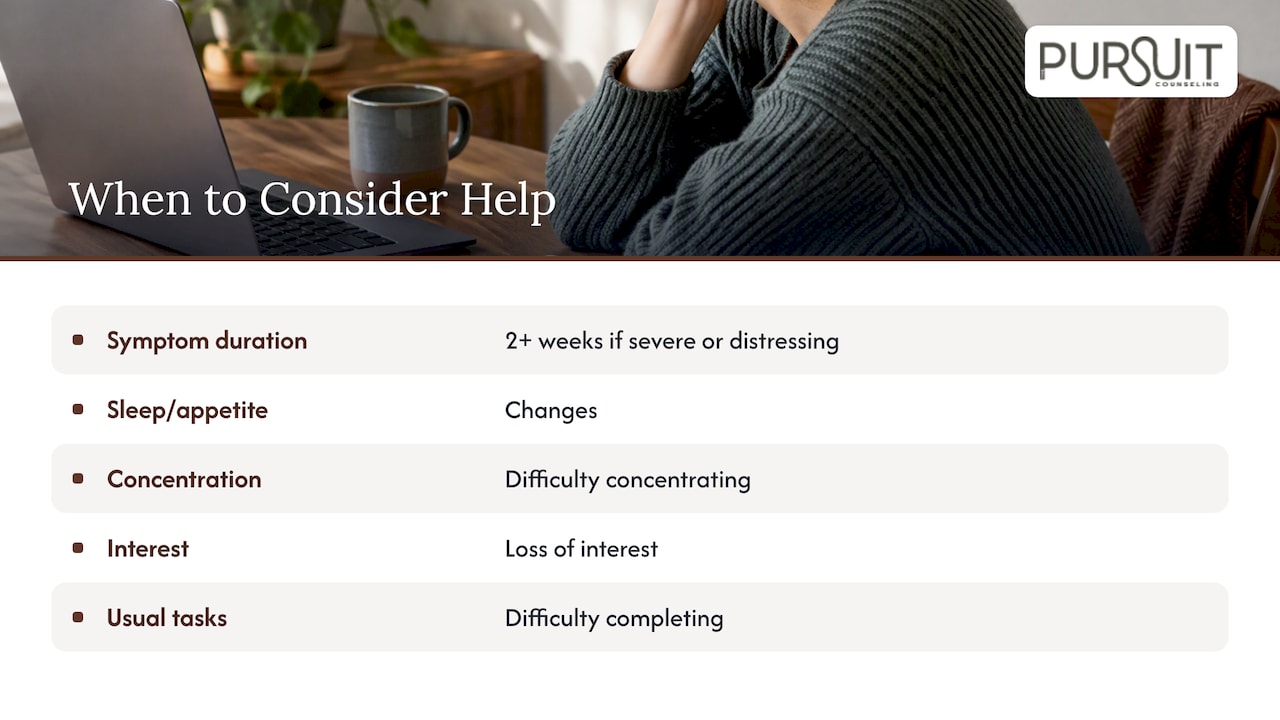
If that list sounds familiar, take it seriously. SAMHSA says that most people with major depression never seek the right treatment, even though it is one of the most treatable mental health conditions and early, continuous treatment can help people control symptoms. Waiting for it to pass is a common choice. It isn’t a requirement.
If you are in crisis or having thoughts of suicide, call or text 988 or visit 988lifeline.org. Support is confidential and available 24/7 in the U.S. Don’t wait for a scheduled appointment.
How therapy helps when you feel lost or unmotivated
Mental Health America describes psychotherapy as a way to change behaviors and ways of thinking, clarify your goals, build coping skills and strengthen relationships and your sense of yourself. For someone who feels lost, that list matters. A good therapist doesn’t hand you a purpose. They help you notice what you already know, what you’ve been avoiding, and what’s in the way.
In practice, that can look like several different things depending on what’s underneath:
- Talk therapy for patterns and meaning. Tracing where “I should” came from, and what you’d choose if no one were watching.
- Anxiety-focused work. Learning to tolerate uncertainty long enough to make a decision.
- Trauma therapy such as EMDR. When an old event is still driving present-day shutdown.
- Attention-focused treatment. When the real issue is executive function, not willpower.
- Experiential work. Some people think better moving than sitting. Being outdoors, on a trail or with horses, can loosen what a conversation across a room can’t.
Therapy also isn’t only talk. We pair deep therapeutic work with small actions, because insight without movement leaves people exactly where they started, just better informed about it.
Perspective: stuck is often the pain cave, not the finish line
We work with people who are used to being the strong one: executives, pilots, business owners, mothers carrying a household, creatives whose work has gone quiet. When they arrive, they rarely say they’re depressed or anxious. They say something closer to, “I should be fine, and I’m not.”
Our view is that stuck is not a failure of discipline. More often it’s the cracks showing. A person has been holding a lot together for a long time, and the thing that held it together has stopped working. That’s painful, and it’s also useful. The cracks tell you where the load has been sitting.
We don’t treat that as a problem to be fixed in six sessions. We treat it as information to be understood, then acted on. We won’t promise an outcome, and we won’t diagnose you from a blog post or a first email. What we can offer is a collaborative room where you do the thinking and we bring training, evidence-based methods and honest feedback. You’re not a case file to us. You’re a complicated person, and complicated people deserve more than a script.
If you want to think about life as something you pursue instead of something that happens to you, we’ve written about that here.
— Adam Glendye LPC, CPCS
What to expect from your first sessions
The American Psychological Association frames starting therapy as a two-way process: you and your clinician agree early on the problems and how therapy can help, and you set clear goals together.
That usually means the first session is mostly conversation. Expect questions about what brought you in, what has been hard, your history, your work, your sleep, your relationships, and what you hope will be different. You’re also interviewing the therapist. Fit matters. We’ve written about the therapeutic relationship because the research and our experience agree that the relationship carries a lot of the work.
A few questions worth bringing:
- How do you approach someone who feels lost rather than clearly anxious or depressed?
- What will we do between sessions?
- How will we know if this is working?
- What happens if I feel it isn’t?
Our guide to questions to ask your therapist in the first session goes further. And if progress feels stalled at any point, Mental Health America encourages clients to discuss their goals and feelings openly with the provider or find another professional if they don’t feel comfortable. A good therapist will welcome that conversation.
How to find a licensed clinician
The APA notes that you can find qualified psychologists through primary-care referrals, state psychological association referral services and the APA Psychologist Locator. Check licensure whichever route you take.

Different kinds of stuck, different starting points
Not everyone needs the same door. Here is how we tend to think about it.
| What it feels like | What may be underneath | Where we might start |
|---|---|---|
| Exhausted, cynical, going through the motions | Burnout, chronic overload | Individual therapy focused on pace, boundaries and what you actually want |
| Spinning on decisions, tense, can’t settle | Anxiety | Anxiety therapy, skills work, sometimes neurofeedback |
| Haunted by one chapter, shut down since | Unprocessed trauma | Trauma therapy with EMDR |
| Changed role, ended relationship, new season | Life transition | Life transitions therapy or a Next Chapter Intensive |
| Can’t start, can’t finish, always behind | Possible attention or executive function difficulties | An evaluation-informed conversation with a clinician, ADHD-focused treatment if appropriate |
| Stuck together as a couple | Relationship pattern | Couples therapy or a Couples Intensive |
This table is education, not assessment. It shows how we think about starting points. It can’t tell you what’s true for you. That’s what the first few sessions are for.
Working with us in Fayetteville and online
The Pursuit Counseling is in Fayetteville, Georgia, and we serve Peachtree City, Senoia, Brooks, Tyrone and South Atlanta, in person and online. We are private-pay, so you’ll see our rates before you book.

The most direct starting point is individual therapy. Sessions are 5 to 0 per hour depending on the service and clinician, and you can see the full list on our services and specialties page. A few of the paths most relevant to feeling stuck:
- Anxiety therapy: 5 per hour.
- Life Transitions therapy: 0 per hour.
- Trauma therapy with EMDR: 5 per hour.
- Adventure Therapy: 0 per hour, for people who think better outside than across from a desk.
If what you need is concentrated time, our intensives compress months of weekly work into focused blocks. The Next Chapter Intensive is 0 per hour and is built for people at a hinge point in life or career. The Executive Experience is ,950 per seat for leaders who want a deeper, structured program.
If you’re not sure where you fit, start with a conversation. Tell us what stuck looks like for you, and we’ll tell you honestly whether we’re the right people to help. You can reach us through thepursuitcounseling.com.
If you were drawn to this because of a major life change, you might also read our piece on embracing life transitions. If you’re a creative or leader who has lost momentum, Daniel Bashta’s page describes how he works with that.

A next step that fits where you are
You don’t have to decide what your life is for before you make an appointment. That’s one of the things therapy is for.
If you’re not ready to book, do one thing today. Write down, specifically, what isn’t working. Then tell one person. Then, if the symptoms have lasted two weeks or longer, or you’re losing sleep, concentration or interest in things that used to matter, make the call. Not because something is wrong with you, but because you deserve better than white-knuckling through it.
FAQ
Can therapy help if I don’t know what’s wrong?
Yes. Many people start therapy with a vague sense that something is off, not a clear problem. Part of the early work is figuring out what’s underneath, whether that’s burnout, anxiety, depression, a transition or something else. A good clinician will help you name it and will tell you if something calls for a formal evaluation.
Is feeling stuck a sign of depression?
Sometimes, but not always. Persistent low motivation, loss of interest, and trouble completing usual tasks can be symptoms of depression, particularly if they last two weeks or more. They can also come from burnout, anxiety, grief or a life transition. Only a licensed professional can tell you which, so get an evaluation if symptoms are persistent or distressing.
How long does therapy for feeling stuck take?
It depends on what’s underneath and what you want. Some people find clarity in a handful of sessions, especially with a focused intensive. Others need longer, particularly where trauma or long-standing patterns are involved. We won’t promise a timeline or an outcome. We’ll review progress with you regularly so you always know where you stand.
What if I feel stuck in therapy itself?
Say so. Therapy is meant to be a partnership, and Mental Health America encourages clients to raise stalled progress openly with their provider. Often a change in approach, pace or focus gets things moving. If it doesn’t, finding a better fit is a reasonable choice, not a failure.
Do you offer online sessions?
Yes. We offer both in-person sessions in Fayetteville, Georgia, and online sessions, so you can start from wherever you are.
Sources
- Caring for Your Mental Health, National Institute of Mental Health
- Get professional help if you need it, Mental Health America
- How to find help through seeing a psychologist, American Psychological Association
- What is Depression? SAMHSA
- Feeling Stuck? How to Remove Those Roadblocks, Psych Central
- Feeling stuck in life? A simple guide to getting back on track, BBC
- Feeling Stuck: How to Start Moving Forward, Mental Health 360
- Morning Focus Routine: Six Steps in Order, Einstein Energy