


You answer every email, hit the deadline, show up for your family, and nobody suspects a thing. Inside, it feels flat, heavy, or like you are running on fumes with no finish line. Therapy for high-functioning depression is real, effective treatment for exactly this: depression that hides behind competence. The most useful kind is built around how you cope (over-control, perfectionism, self-criticism), not just around your mood, and it starts with a clinician who does not get fooled by how well you perform.
Key Takeaways
- “High-functioning depression” is not a formal diagnosis. It is a popular term, and what sits underneath it can be major depression or persistent depressive disorder. A licensed clinician makes that call, not an article.
- Success and suffering can coexist. Masking can lead clinicians to mistake distress for job stress or personality, which delays care until something breaks.
- Established talk therapies for depression include CBT, interpersonal therapy, psychodynamic therapy and supportive therapy. For driven people, the fit matters as much as the label.
- Good therapy rests on agreed goals, a therapist who understands your feelings, and regular check-ins on progress.
- If you are thinking about ending your life, call or text 988 now. Do not wait for a better week.
Table of Contents
- What high-functioning depression actually is
- Signs that are easy to explain away
- Why it goes unnoticed for years
- How therapy helps when you are already “doing fine”
- Which types of therapy are used
- What to expect in the first sessions
- When to reach out, and when it is urgent
- Choosing an approach that fits how you work
- Working with us
- A next step that fits where you are
- FAQ
- Sources
What high-functioning depression actually is
The phrase describes someone who meets obligations while carrying a low mood, numbness, exhaustion or a constant sense of not being enough. You may be promoted, praised, and quietly miserable.
To be precise: this is a description, not a diagnosis. Medical News Today notes that high-functioning depression is not a formal clinical diagnosis, and that a person may instead have persistent depressive disorder (PDD), a longer-lasting form of depression with symptoms that tend to be milder than major depression but stick around for years. Others in the same situation meet criteria for major depressive disorder and simply hide it well.
That distinction matters for two reasons. First, the label “functioning” can talk you out of getting help. A 2025 piece from the British Psychological Society argues that the term may reinforce the belief that your distress is not serious enough for therapy, which feeds shame and hides the cost of keeping performance up. Second, an article can educate you, but it cannot assess you. Only a clinician who sits with you, asks questions and looks at your history can tell you what you are dealing with.
If you want to read more about the pattern from our side, we wrote about getting help for anxiety and depression when you appear fine to everyone.
Signs that are easy to explain away
High performers rarely say “I’m depressed.” They say “I’m tired,” “I’m just busy,” or “I’m not a feelings person.” Some patterns we hear often:
- Emotional numbness. Wins land with a shrug. You achieve the thing and feel nothing, or relief at best.
- Perfectionism as armor. Mistakes feel like verdicts. Rest feels like falling behind.
- Running on obligation. You do things because you should, not because anything pulls you toward them.
- Collapse after hours. You hold it together at work, then lie on the couch for the whole evening, or scroll, drink or work late to avoid sitting still.
- Sleep and appetite shifts. Waking at 3 a.m., or sleeping a lot and still feeling spent.
- A harsh inner voice. The same standard you would never hold a colleague to, you hold yourself to daily.
- Irritability. Less sadness, more short temper with people you love.
Researchers writing in 2025 suggest screening in high-performing groups should include emotional numbing and perfectionistic coping, not only sadness. That fits what we see in the room.
These signs also overlap with other things: burnout, anxiety, ADHD, thyroid problems, sleep disorders, hormonal changes. Executive function and emotional regulation struggles in ADHD, for example, can look like low mood or stress. If that sounds familiar, these emotional flooding steps for ADHD show how closely they can resemble each other. This is exactly why assessment comes before treatment, and why we do not diagnose from a checklist.
Why it goes unnoticed for years
The mask works. That is the problem. Colleagues see output. Family sees someone dependable. You may even see yourself that way, and use the evidence of your functioning as proof there is nothing wrong.
Clinicians can fall for it too. The BPS piece makes a pointed observation: a therapist who feels reassured or impressed by a client’s competence may be tempted to collude with the client’s mask. A good therapist notices that pull and works against it.
The cost of waiting is not abstract. The same 2025 paper notes that delayed recognition carries risks, including progression to major depressive episodes and increased suicidality. Many of the people we meet did not come in at the first sign. They came in when sleep failed, a marriage strained, or a day arrived when the mask would not stay on.
If your story reads more like depletion from overwork than low mood, our piece on why high-functioning people burn out quietly may sound closer to home. The two often travel together.
How therapy helps when you are already “doing fine”
The aim is not to make you more productive. It is to make your inner life as honest as your outer one.
The BPS describes therapy as a place where clients can validate their experiences, challenge unhelpful beliefs about productivity and worth, and make room for honesty, rest and self-compassion. In practice, that tends to look like:
- Naming what is actually happening. Saying out loud, to someone who does not flinch, that you are not okay. For many people this alone is the hardest part.
- Looking at the rules you live by. “If I stop, everything falls apart.” “My worth is what I deliver.” Where did those come from, and what are they costing you?
- Loosening over-control. Driven people often manage feelings the way they manage projects. Therapy practices letting some things be felt before they are fixed.
- Building rest that is not collapse. Recovery that is deliberate, not what is left over when you crash.
- Repairing connection. Isolation is common among people who never let anyone see the strain.
No one can promise how this goes for you. Therapy is work, and progress is uneven. What we can say is that people who have spent years performing often find real relief in being known accurately.

Which types of therapy are used
There is no single “high-functioning depression therapy.” You are choosing among treatments for depression and then adapting them to the way you cope.
The American Psychological Association’s clinical practice guideline for adults with depression recommends that initial treatment offer either psychotherapy or a second-generation antidepressant. The evidence-based psychotherapies recognized across APA, Royal College of Psychiatrists and NIMH sources include cognitive behavioral therapy (CBT), interpersonal therapy (IPT), psychodynamic therapies, behavioral therapy and supportive therapy.
| Approach | What it focuses on | Often a fit when |
|---|---|---|
| CBT | How thoughts, behaviors and mood feed each other | You want structure, tools and homework |
| Interpersonal therapy | Relationships, role changes, grief | Depression is tied to conflict, loss or transitions |
| Psychodynamic therapy | Patterns from earlier life that still drive you | You keep repeating the same cycle despite insight |
| Supportive therapy | Steady, warm, problem-focused support | You need steadiness during a heavy stretch (see our page on supportive therapy for depression and low mood) |
| Trauma-focused work such as EMDR | Past experiences that keep the nervous system on guard | Depression sits alongside trauma history |
Here is the part that matters for people like you. Researchers note that for high-functioning individuals, CBT and compassion-focused therapies may need adaptation to address autonomy, self-criticism and over-control. A therapist who hands a perfectionist a thought log and a schedule may simply give them another thing to excel at. The adaptation is the work.
Therapy, medication, or both
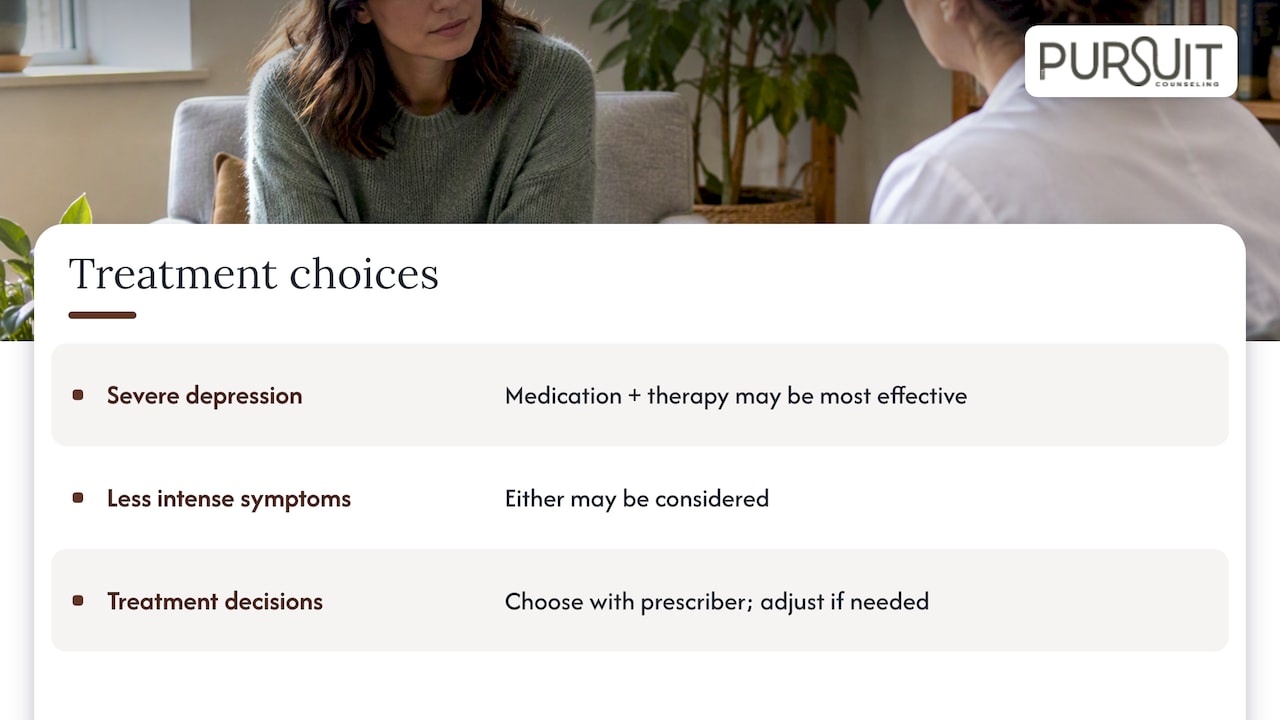
This is a question for you and a prescriber, such as your primary care physician or a psychiatrist. The Canadian CHOICE-D guide notes that combined medication and psychotherapy may be most effective, especially for severe depression, while for less intense symptoms either may be considered. It also advises working with a health care provider to choose, since the provider may change or add a treatment if the first does not help. As counselors, we do not prescribe. We do help you think through the question and coordinate with your prescriber when that serves you.
What to expect in the first sessions
Expect questions, not a fix. The first few sessions usually cover your history, current symptoms, sleep, work, relationships, substance use and safety. This is assessment, and it is separate from the educational material you may have read beforehand.
The CHOICE-D guide says psychological treatment works best when you and your therapist agree on goals, the therapist understands your feelings, monitors progress and genuinely cares about your needs. Use that as a checklist:
- Do you set the goals together? “Sleep through the night” and “stop dreading Sundays” count.
- Do you feel understood, not managed?
- Does anyone check whether it is working? Progress should be named, not assumed.
- Does the therapist push past your polish? You can be articulate and still not be okay. A good clinician will not mistake one for the other.
It is also normal to test a therapist early. Many driven people over-prepare, narrate their feelings like a case study, or apologize for taking up time. Say so. That is useful material.
If you are choosing between providers, our guide on how to find a therapist who understands high achievers walks through the questions worth asking.
When to reach out, and when it is urgent
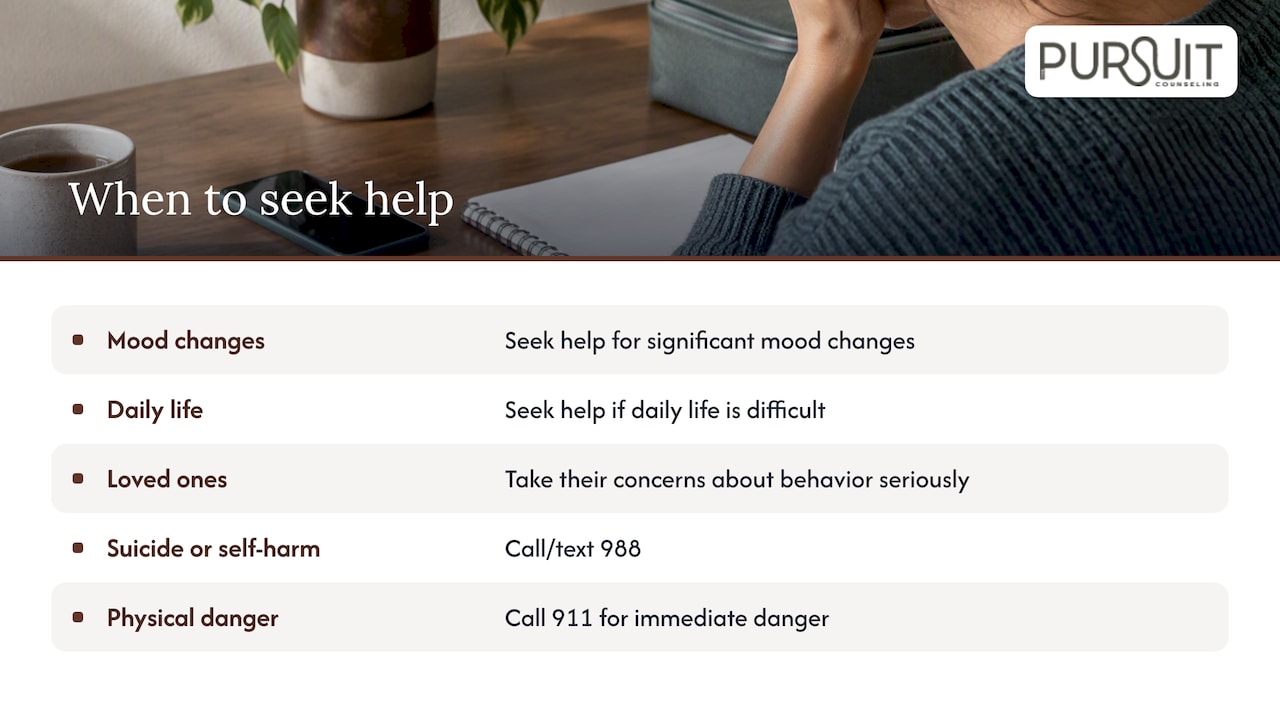
You do not need to be falling apart. Psychiatry.org advises seeking help if there are significant changes in mood, difficulty managing daily life, or concern from loved ones about changes in your behavior. If a spouse, partner or colleague has said “I’m worried about you,” take it seriously, even when you can still do your job.
Some moments are not for waiting. If you are thinking about suicide or about hurting yourself, or you are afraid you are in immediate danger, call or text 988 to reach the 988 Suicide & Crisis Lifeline through SAMHSA, available around the clock in the US. If you are in immediate physical danger, call 911. Tell someone near you what is happening. This is not a failure of performance. It is a medical situation that deserves a fast response.
What we see in the room
We work with a lot of people who are excellent at carrying things: pilots, executives, founders, physicians, lawyers, mothers who run entire households. Many arrive saying some version of “nothing is wrong, exactly.” Then we sit with them for an hour and the picture changes.
Here is what we believe. The strength that got you here is real, and it is also the thing hiding your pain. You learned to push through, to be the steady one. Pushing through works until it doesn’t, and by then the cost has usually been accumulating in your sleep, your relationships and your sense that nothing quite lands.
So we do not treat you as a symptom list. We start with connection, because people who have been performing for years need to be met by someone who is not impressed by the performance. Then we use evidence-based tools matched to you: talk therapy for depression, EMDR when trauma sits underneath, neurofeedback when attention and regulation are part of the picture, and experiential work like adventure therapy when sitting in a chair is not where you open up.
We will not promise an outcome. We will promise to take you seriously, to tell you the truth, and to work with you, not on you. The cracks are not the end of your story. For many of the people we know, they are where the real work begins.
Adam Glendye LPC, CPCS
Choosing an approach that fits how you work
A few practical filters help when you are comparing options.
Look for someone who knows your world. A pilot who fears losing a medical certificate, an executive who cannot show weakness to a board, a founder whose identity is the company: each carries stakes that a generic intake may miss. Our page on therapy for high performers in Georgia describes how we approach that.
Ask how they adapt. “What do you do differently with someone who is very self-critical and controlled?” is a fair question. You want an answer that goes beyond “homework.”
Think about format. Weekly sessions suit many people. Others, especially those whose calendars are brutal, do better with concentrated time. We offer intensives for that reason, and in-person or online sessions.
Notice what else is present. Perfectionism that has tipped into exhaustion may call for a different emphasis, as in our article on perfectionism burnout in high achievers. Anxiety alongside low mood is common too, and anxiety therapy often runs in parallel.
Be honest about substances. Many high performers use alcohol or prescription drugs to get through. Say it early; it changes the plan, and it is not a reason to be judged.
Working with us
The Pursuit Counseling is in Fayetteville, Georgia, serving Peachtree City, Senoia, Brooks, Tyrone and the rest of South Atlanta, with in-person and online sessions. We are a private-pay practice. Published rates for individual therapy run from 5 to 0 per hour depending on the service, and anxiety therapy is listed at 5 per hour. You can see the full list on our services and specialties page.
We are not the right fit for everyone, and a free consult is a fair way to find out. We would rather you leave the first call knowing whether we are a match than book a seat out of politeness.

If you are ready to talk with someone who understands why you look fine and feel otherwise, read about our depression therapy for high-achieving professionals in Georgia and reach out through our site. Educational reading is a good start. A conversation with a licensed clinician is how an assessment actually happens.
A next step that fits where you are
You do not have to decide you are depressed to make the call. Try this instead.
- Write down three specifics. Not “I’m sad.” Something like “I haven’t enjoyed anything in months” or “I snap at my kids and then hate myself.”
- Note how long. Weeks, or years? Duration helps a clinician sort between possibilities.
- Rule out the body. A primary care visit can check for medical contributors to fatigue and low mood.
- Book one session. One. You can decide afterward whether the fit is right.
- Tell one person. Someone who knows you outside work.
If you are reading this at 2 a.m. and it feels too heavy, 988 is there. Otherwise, the next step can be small and still count.
FAQ
Is high-functioning depression a real diagnosis?
Not as a formal term. The label is common in everyday use, but clinicians diagnose conditions such as major depressive disorder or persistent depressive disorder. What you experience is real either way, and a licensed professional can assess which description fits you.
Can I really be depressed if I’m succeeding at work?
Yes. Performance and inner state are different things, and masking is common among high performers. Researchers describe how competence can lead to distress being mistaken for job stress or personality, which delays care. If your success feels hollow, that is worth bringing to a therapist.
What kind of therapist should I look for?
Look for a licensed clinician with experience in depression who adapts the approach to your coping style, especially perfectionism and self-criticism. Ask how they set goals and track progress. Trust matters as much as technique, so a first session is a fair test.
Do I need medication?
That depends on your symptoms and history, and it is a decision to make with a prescriber. Guidelines describe psychotherapy, medication, or a combination as options, with combined treatment often considered for more severe depression. Counselors do not prescribe, but can help you prepare for that conversation.
How do I know it is time to get help?
If your mood has shifted, daily life takes more effort than it should, or people close to you are worried, it is time. You do not need a crisis first. If you have thoughts of ending your life, call or text 988 immediately.
Sources
- High-functioning depression: a hidden burden demanding clinical attention (PMC)
- ‘Everyone thinks I’m fine’: Making sense of high-functioning depression in therapy (British Psychological Society)
- APA Clinical Practice Guideline for the Treatment of Depression
- CHOICE-D: a guide to depression treatment choices (CANMAT)
- Expert Q&A: Depression (Psychiatry.org)
- High-functioning depression: Definition and symptoms (Medical News Today)
- SAMHSA, 988 Suicide & Crisis Lifeline information
- Stop Emotional Flooding in 3 Moves: ADHD Steps