


You did what you set out to do. The title, the income, the business, the license, the respect. And somehow the feeling you expected never showed up, or it showed up for a week and left. Being successful but unhappy is common, it is not a character flaw, and it is not proof that you made the wrong choices. It is information. This article helps you read it: what usually sits underneath, how to tell burnout from depression from plain misalignment, and what a useful next step looks like.
Key Takeaways
- Yes, you can be successful and still feel empty. Research on high achievers suggests success alone rarely delivers lasting satisfaction, and also that success itself does not make people unwell.
- The flat feeling can come from several places: burnout, depression, values that no longer match your work, or a life built around performance. These call for different responses.
- Reading about this is education. Only a licensed clinician who sits with you can assess what is going on.
- Pressure to stay tough and self-reliant keeps many capable men from asking for help. Naming it is a legitimate first step.
- A good next step is small and specific: one honest conversation, one consult, one change you can actually keep.
Table of Contents
- What this feels like from the inside
- Why achievement does not always deliver what you expected
- Four things that often sit underneath
- Education is not assessment
- What to try before you book anything
- What therapy actually looks like for someone like you
- If you are ready to talk to someone
- What a good next step looks like
- FAQ
- Sources
What this feels like from the inside
Most people who search this are not dramatic about it. They are functioning. They answer email, show up to the board meeting, coach the kid’s team, land the plane, close the deal. From the outside, nothing is wrong.
Inside, it may sound like this:
- Wins register for about an hour, then you are on to the next target.
- You feel numb, irritable, or quietly resentful of the people who depend on you.
- You catch yourself running the numbers on your own life, wondering what it was all for.
- You feel guilty for being unhappy, because you know how many people would trade places with you.
That guilt is its own weight. It keeps people quiet. If you have been carrying this alone, you have probably been carrying it with a straight face too.
Why achievement does not always deliver what you expected
Many driven people work from an unspoken sequence: succeed first, then be happy. A 2025 Harvard Business Review piece calls this the success-then-happiness fallacy and argues that success alone rarely produces lasting satisfaction. The finish line keeps moving, and the feeling you were chasing stays one promotion, one exit, one milestone away.
Psychologists have a name for part of this: the hedonic treadmill. The classic 1978 study by Brickman, Coates and Janoff-Bulman compared lottery winners and people with serious injuries to a control group and found that happiness tended to drift back toward a baseline after the initial shock of the event. Big changes in circumstance, good or bad, moved people less than they predicted. That is one reason a hard-won result can feel strangely small once you have it.
Here is the part that surprises people. Success does not appear to be what makes people unwell. A 2022 paper in Perspectives on Psychological Science tested the idea that exceptional achievement damages well-being. Across three cohorts of 1,826 intellectually gifted people and 496 elite STEM doctoral students followed for 25 years, the most successful participants were similar to or healthier than their peers on well-being, flourishing and self-evaluation measures.
What does that mean for you? Your unhappiness is probably not a tax on your achievements. It is more likely coming from something specific, and specific things can be looked at: how you work, what you carry, what you stopped doing, what you never said out loud.

Four things that often sit underneath
These overlap. Most people recognize themselves in more than one.
Burnout that looks like competence
The American Psychiatric Association describes burnout through three patterns: exhaustion, cynicism and a diminished sense of effectiveness. Cynicism is the one high performers miss. It sounds like “what’s the point” and “nobody else will do it right,” and it can pass for realism.
The Cleveland Clinic, drawing on APA guidance, lists contributors including heavier workloads, unsupportive cultures, thin support systems and a mismatch between your values and your workplace’s. Signs include feeling more drained, becoming less efficient, becoming more irritable, losing confidence that you can hit your goals, and avoiding work tasks. If you are still performing while running on fumes, our piece on recovering from high-functioning burnout when you still have to show up speaks to that directly.
Depression that hides behind productivity
Harvard Health states that depression is the most common reason men should seek professional help. Jobs and relationships can trigger its signature symptoms: prolonged sadness, low energy and a constant sense of stress. Left alone, it can show up as insomnia, changes in memory, declining libido, or leaning harder on alcohol or other substances.
It also does not always look like sadness. In many people it looks like anger, restlessness or shutting down. We wrote about how men and women can experience depression differently, and it is worth a read if “I’m not sad, I’m just done” sounds familiar.
Distress rarely announces itself in obvious ways, in anyone. Even a topic far from your life, such as postpartum mental health signs, shows how much of the picture is changes in sleep, mood and energy that people explain away for months.
Values that no longer match the life
Sometimes nothing is broken. You are simply living inside a plan you made at 25 or 30 with the information you had then. The business became something you do not like running. The career asked for the version of you that suited it, and you complied for a decade. The unhappiness is a signal that the map and the territory have drifted apart.
Rules you never chose
Brown University’s School of Public Health, discussing a 2024 Rhode Island survey, quotes researcher Samantha Rosenthal locating young men’s distress in restrictive masculinity norms: expectations to be tough, dominant and self-reliant while hiding sadness, fear or vulnerability. That study looks at young men, but the pattern will be familiar to many older ones. If your whole identity is being the one who handles it, you may have no place to put what you feel.
Education is not assessment
Everything above is general information. It can help you recognize a pattern. It cannot tell you what is happening in your life, and we would be doing you a disservice if we let a blog post stand in for an evaluation.
An assessment is a conversation with a licensed clinician who asks about your sleep, mood, history, work, relationships and substance use, then tells you what they see and what they recommend. Burnout, depression, anxiety, trauma, ADHD and a values mismatch can feel almost identical from the inside and need different treatment. Guessing wrong costs you time.
If you are having thoughts of ending your life, do not wait for an appointment. In the United States, you can call or text 988 to reach the Suicide and Crisis Lifeline at any hour.
What to try before you book anything
None of this replaces professional help. These are ways to get clearer, and they cost you a few weeks and no money.
- Track it for two weeks. Each evening, note energy, mood and one moment you felt something real. Patterns show up faster on paper than in your head.
- Separate the job from the life. Ask whether the flatness follows you to the weekend and to vacation. If it lifts when you are away from work, look at work. If it does not, look wider.
- Audit your recovery. Sleep, alcohol, movement, time with people who ask nothing from you. High performers often protect their calendar and neglect their basics.
- Say one true sentence to one person. Not a confession. Something like “I’ve been off lately and I don’t know why.” Notice what happens.
- Name the thing you gave up. Many people discover they stopped something years ago, such as flying for fun, building something with their hands, or being outdoors, that once made them feel like themselves.
If two weeks of this leaves you with more questions, or if your sleep, appetite, concentration or mood are visibly slipping, that is the moment to talk to a professional. Our post on taking ownership of stress covers what many high-performing men get wrong about resilience.
What therapy actually looks like for someone like you
People who excel at things tend to worry that therapy will be vague, slow or a waste of an already full week. Here is what the research and the practice look like.
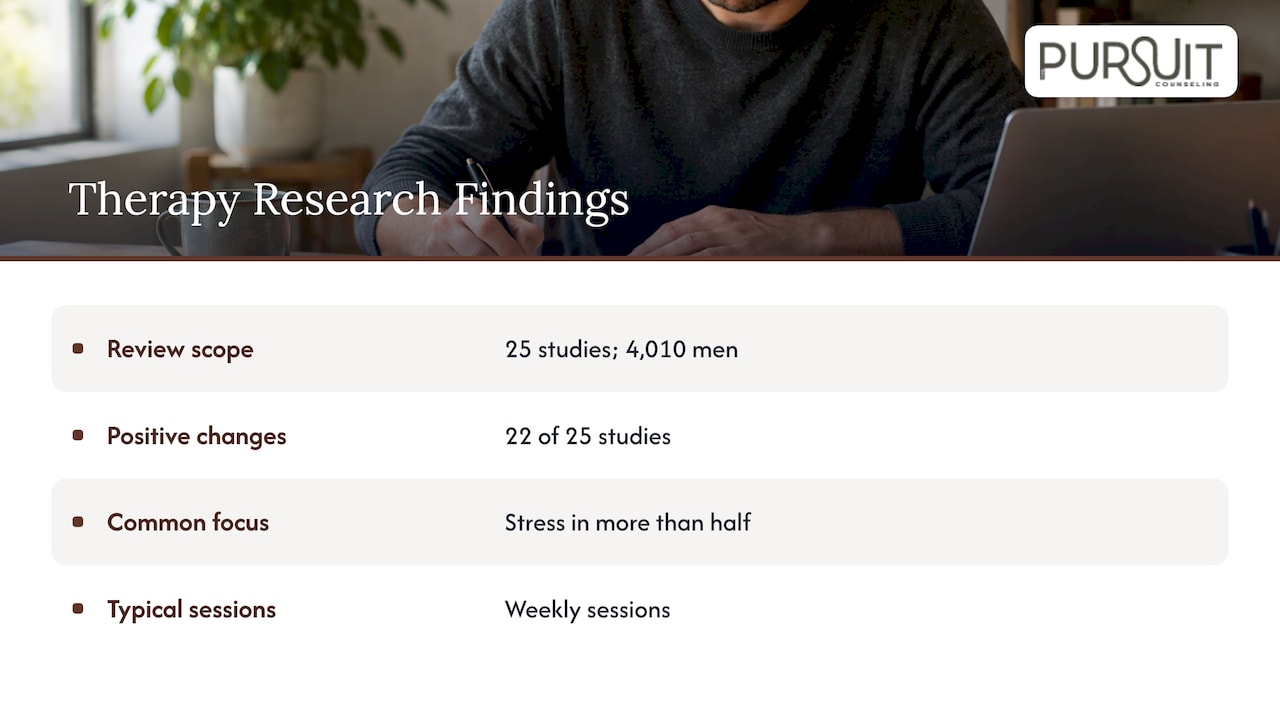
Harvard Health notes that a therapist can help identify the source of your problems and then help resolve them, setting goals with you and outlining a strategy that may combine regular sessions with “homework” between visits, with weekly sessions being typical. The same piece quotes psychiatrist Dr. Mehta saying that once men connect with a therapist, they are quite receptive to therapy.
A 2017 scoping review of 25 studies covering 4,010 men found that 22 of the 25 reported significant positive changes in men’s mental wellness. Stress was a common focus in more than half, and the authors noted that many men find it more acceptable to join a program framed around stress than one framed around anxiety or depression. That is worth sitting with. You do not need the perfect diagnosis or the right vocabulary to begin. “I’m under a lot of pressure and I don’t feel like myself” is a legitimate reason to call.
No one can promise you a result, and we will not. What a good therapist can offer is a skilled, unhurried look at what is under the surface, with someone who does not need you to perform.
How the work can be shaped around your life
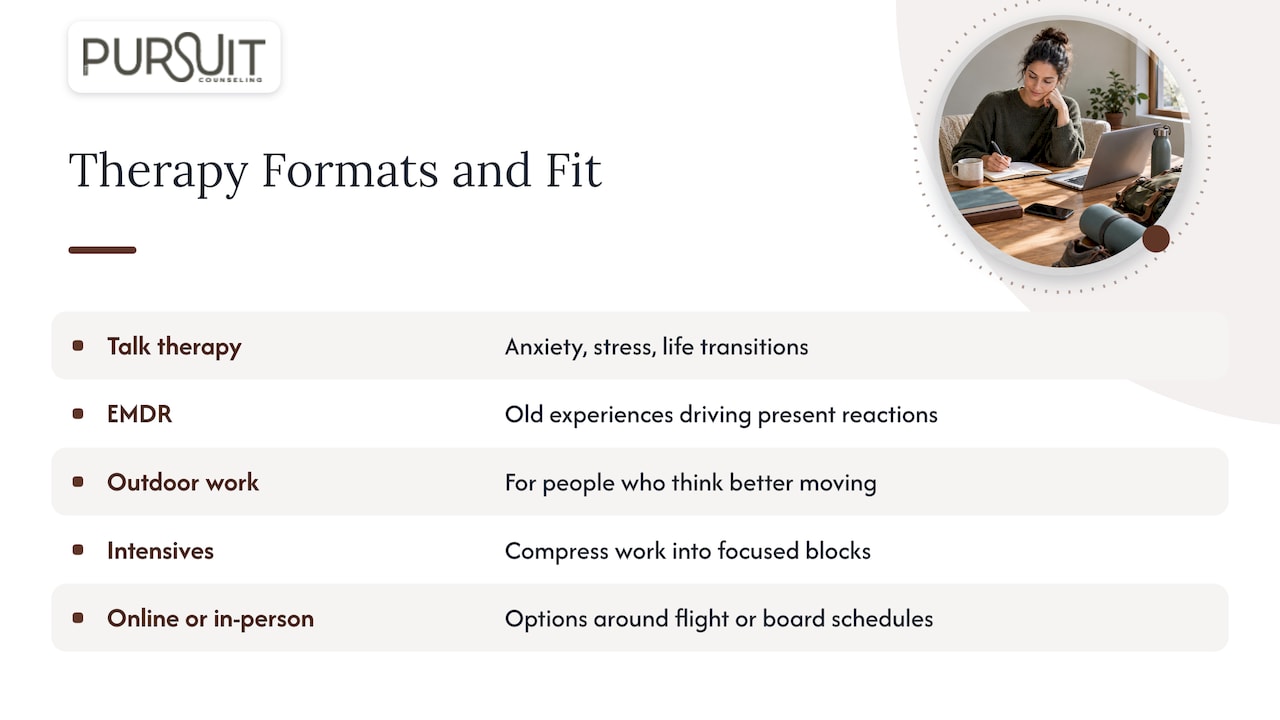
Different problems call for different tools. Depending on what comes out of an initial assessment, work might include talk therapy for anxiety, stress or life transitions, EMDR when old experiences are still driving present reactions, or experiential sessions outdoors for people who think better when they are moving. For people who cannot spare a weekly hour for months, concentrated intensives compress the work into focused blocks.
We also hear the same practical questions from busy professionals: Will anyone know? Can I do this from a hotel room? Can it fit around a flight schedule or a board calendar? Online and in-person sessions exist for that reason.
Our perspective
We meet a lot of people who are good at things. They are good at their jobs, good in a crisis, good at holding other people up. When they finally sit down with us, many say some version of the same sentence: “I don’t have a reason to feel this way.”
We would push back on that. Pain does not need a reason that satisfies a spreadsheet. The cracks you are noticing, the flatness, the short fuse, the 3 a.m. replay, are not evidence that you are weak. They are what happens when someone has been running at pace in the pain cave for years and has never been asked what it costs.
Our work is built around personal connection first, because without it nothing else holds. We use evidence-based methods, including EMDR, neurofeedback and experiential work such as adventure and equine therapy, and we adapt them to you instead of handing you a template. You take an active part in it. We do not treat you like a case file or a billing code. We treat you like a complicated person with a complicated life, because that is what you are.
If you are successful and unhappy, you do not have to decide what is wrong before you reach out. You only have to be willing to have an honest conversation with someone who will not flinch.
Adam Glendye LPC, CPCS
If you are ready to talk to someone
The Pursuit Counseling is based in Fayetteville, Georgia, and serves Peachtree City, Senoia, Brooks, Tyrone and the rest of South Atlanta, in person and online. We work with executives, business owners, pilots and other high performers who are tired of carrying everything alone. You can see how we approach this on our page on therapy for high performers in Georgia, our human flourishing counseling page, or read about therapy for high-performing men in Peachtree City and across Georgia.

Our practice is private-pay. If you need something more concentrated than weekly sessions, the Executive Experience is a $9,950 one-off program for leaders who want to step back and look at the whole picture.
A first conversation is not a commitment. It is a way to find out whether we are the right people to help you think this through.
What a good next step looks like
An emotionally accurate next step is not “fix my life.” It is smaller and more honest than that.
- If you are exhausted, cynical and still performing, start by looking at burnout and your recovery habits.
- If your mood, sleep or interest in things you used to enjoy have dropped for weeks, get evaluated for depression.
- If the work itself no longer fits who you are, treat that as a real question worth working on with someone, not a lapse in gratitude.
- If you cannot tell which of these is yours, that is exactly what an initial session is for.
You have been decisive about everything else. This is one more decision, and it is allowed to be a quiet one.
Who can help: Daniel Bashta, CIT, supervised by Adam Glendye, LPC, CPCS, works with artists, musicians, and other creatives, along with leaders and anyone who feels stuck, burned out, or anxious about their work. He sees clients in person at our Fayetteville, Georgia office. Book a session with Daniel or learn more about counseling for artists, musicians, and creatives.
FAQ
Why am I successful but still unhappy?
There is rarely a single cause. Common ones include burnout, depression, a life that has drifted from your values, and a habit of chasing the next target without letting any win land. A licensed clinician can help sort out which applies to you, which a blog post cannot do.
Is feeling empty after success a sign of depression?
It can be, but it is not automatically. Prolonged sadness, low energy, sleep changes and a constant sense of stress are signs worth taking seriously, and Harvard Health names depression as the most common reason men should seek professional help. Only an assessment can tell you whether depression, burnout or something else is behind it.
Do successful men really go to therapy?
Yes, and many say they wish they had gone sooner. Research reviewing 25 studies of men’s mental health programs found most reported positive changes in wellness. Many men find it easier to start with a goal like managing stress or pressure, and that is a perfectly good place to begin.
Should I quit my job if I am unhappy?
Not before you know what is driving the unhappiness. If it lifts when you are away from work, the job may be part of the picture, and if it follows you everywhere, a job change alone may not touch it. Talking it through with a therapist before making a large decision can keep you from solving the wrong problem.
Sources
- The Success-Then-Happiness Fallacy, Harvard Business Review
- Wrecked by Success? Not to Worry, Perspectives on Psychological Science (2022)
- Preventing Burnout: A Guide to Protecting Your Well-Being, American Psychiatric Association
- Signs of Job Burnout and 5 Ways To Beat It, Cleveland Clinic
- Men, masculinity and mental health, Brown University School of Public Health
- What men can gain from therapy, Harvard Health
- Men’s Mental Health Promotion Interventions: A Scoping Review, PubMed Central