


Leadership coaching and counseling for burnout works by restoring decision clarity, rebuilding regulation, and redesigning how leaders delegate and protect their time. Most executives experience meaningful stabilization within a few weeks and observe durable shifts in boundaries and energy over time. When exhaustion comes with suicidal thoughts, unmanaged substance use, or medical symptoms, clinical treatment should come first, alongside or before coaching.
- Most executives experience notable stabilization within two to four weeks of coaching, with decision clarity and emotional regulation improving significantly by three to six months.
- Coaching focuses on rebuilding boundaries, delegation, and system redesign, progressing through assessment, mapping, redesign, and ongoing reinforcement.
- Severe burnout with suicidal thoughts, unmanaged substance use, or medical symptoms requires prior clinical treatment before coaching can be effective.
- Recovery involves specific techniques like nervous-system regulation, systems redesign, and cognitive work, often supplemented with clinical tools such as neurofeedback or EMDR if needed.
- Leaders with persistent exhaustion despite rest should consider coaching to address systemic issues, but those with deep trauma or mental health crises need clinical care first.
Table of Contents
- What Is Leadership Coaching for Burnout, and How Is It Different From Therapy?
- How the Coaching Process Unfolds: Assessment, Redesign, and a Realistic Timeline
- The Warning Signs Leaders Usually Ignore Until It’s Too Late
- What Progress Actually Looks Like, and How Long Recovery Takes
- The Techniques That Actually Move the Needle
- Coaching, Therapy, or Both: How to Decide
- How The Pursuit Counseling Treats Burnout Differently
- Burnout Is a System Failure, Not a Character Flaw
- Ready to Rebuild? Here’s Where to Start
- Sources
- FAQ
What Is Leadership Coaching for Burnout, and How Is It Different From Therapy?
Leadership coaching for burnout is a structured process built around four goals: restoring nervous-system regulation, rebuilding recovery capacity, sharpening focus, and repairing connection to people and purpose. It’s not therapy, and it’s not generic executive coaching either. The World Health Organization classifies burnout as an occupational phenomenon marked by exhaustion, mental distance from work, and reduced professional efficacy, which means the intervention has to address both the person and the system they operate inside.
Generic executive coaching tends to optimize performance that’s already functioning. Burnout coaching starts from depletion and works backward, stabilizing a leader before asking them to grow. Therapy, by contrast, often digs into the psychological roots of distress, sometimes across years. Coaching moves faster and stays focused on functioning at work.
Coaching fits leaders who are:
- Still performing but running on fumes, with visible cracks in patience, sleep, or decision speed
- Struggling with delegation, boundaries, or role design rather than deep psychological trauma
- Motivated to rebuild systems, not just survive the next quarter
It’s not designed to treat depression, PTSD, or active suicidal ideation. Those need clinical counseling for burnout or psychiatric care first.
How the Coaching Process Unfolds: Assessment, Redesign, and a Realistic Timeline
Most engagements follow a predictable arc, whether delivered virtually or in person, and executive burnout coaching programs commonly structure this as a confidential assessment followed by root-cause mapping and systems redesign.
- Sessions 1 to 2: Assessment. The coach measures baseline regulation (how quickly you recover from stress spikes), recovery capacity (sleep, rest, physical reserves), focus (attention span, decision fatigue), and connection (relationships at work and home).
- Sessions 3 to 4: Mapping. You and the coach trace which specific patterns, meetings, decisions, or relationships are draining capacity fastest, and which parts of the role are non-negotiable versus optional. One helpful part of the assessment can be a Brain Map to develop understanding of natural tendencies of your functioning.
- Sessions 5 to 12 and beyond: Redesign. This is where delegation gets rebuilt, boundaries get set, and new decision rules replace old habits that no longer serve you.
- Ongoing: Sustain. Spaced check-ins, often monthly, reinforce the new system before it erodes under pressure.
Timelines vary by format. An accelerated intensive might compress the assessment and mapping phases into two or three consecutive days, useful for leaders who can’t take weekly time off but need a hard reset. A standard multi-month engagement runs weekly or biweekly sessions over three to six months, which gives redesign work time to actually stick under real workplace pressure.
The Warning Signs Leaders Usually Ignore Until It’s Too Late
Burnout rarely announces itself. It shows up as chronic exhaustion that doesn’t lift after a weekend off, cognitive fog that makes routine decisions feel heavier, and a creeping cynicism about work that used to matter to you.
Pro Tip: If your identity has quietly fused with your output, notice how you answer “how are you?” If the honest answer is always tied to a metric or a deadline, that’s worth examining before it becomes a crisis.
Watch for these signals:
- Physical symptoms with no clear medical cause: headaches, gut issues, disrupted sleep
- Irritability or detachment from people you used to enjoy working with
- A sense that rest doesn’t actually restore you anymore
- Difficulty concentrating on tasks that once felt automatic
The distinction that matters most: performance dips from a bad quarter usually resolve with rest. Burnout persists despite rest, and that persistence is the signal coaching is built to address. Occupational-health research links chronic stress with measurable cognitive and physiological effects, which is one reason exhaustion alone can’t always be solved by sleeping in on Saturday.
What Progress Actually Looks Like, and How Long Recovery Takes
Recovery from leadership burnout isn’t linear, but it does follow a rough pattern. Early sessions typically bring stabilization: better sleep, fewer reactive outbursts, and a renewed sense of stability, often apparent within a few weeks.
Midway through the engagement, leaders commonly report sharper decision clarity and less emotional reactivity in stressful meetings. Over the longer term, new boundaries and delegation habits often hold steady, even during times of crisis.
Common measurable outcomes include:
- Faster, less agonized decision making
- Lower reactivity under pressure (fewer snapped emails, calmer meetings)
- Restored energy that lasts beyond a single good night’s sleep
- A workable, repeatable boundary system instead of constant renegotiation
Recovery speed depends on factors such as the severity of burnout, the presence of co-occurring conditions like anxiety or depression, and the ongoing demands of the role. A leader coaching through a hiring freeze and a reorg will move slower than one with room to actually implement changes.
The Techniques That Actually Move the Needle
Burnout recovery coaching isn’t a pep talk. It uses specific, repeatable techniques, several with real physiological grounding.
Nervous-system regulation comes first, often through paced breathing, brief physical resets between meetings, or deliberate transitions that signal to your body the crisis has passed. When regulation alone isn’t enough, and chronic stress has produced real physiological depletion, escalation to clinical treatment, including options like neurofeedback or EMDR, becomes appropriate.
Systems redesign is where most of the durable change happens. This means building actual delegation frameworks, not vague intentions to “delegate more,” along with boundary protocols and firm calendar rules that protect recovery time the same way they protect a client meeting.
Cognitive and narrative work helps leaders separate their values from their job title, which is often where burnout quietly took root in the first place. Coaching for resilience frequently applies strategies like decreasing loneliness, clarifying what’s actually within your control, and resisting the urge to draw conclusions before the data is in.
- Micro-rests inserted between high-stakes decisions, not just at day’s end
- Decision rules that reduce the number of choices requiring full deliberation
- Role audits that separate what only you can do from what you’ve been hoarding
Pro Tip: Build a two-minute reset into your calendar before any decision that involves people’s livelihoods or major budget. That tiny buffer prevents the kind of reactive call you’ll spend a week walking back.
Coaching, Therapy, or Both: How to Decide
The honest answer is that severity determines the path, not preference.
- Assess functional impairment first. Can you still show up, think clearly, and make decisions most days, even if it’s exhausting? If yes, coaching is likely appropriate. If work, sleep, or relationships have broken down entirely, clinical care should come first.
- Check for trauma history. If burnout has stirred up older trauma, EMDR therapy or trauma-informed counseling addresses the root in a way coaching alone can’t.
- Ask a prospective coach direct questions: what’s their training background, how do they measure progress, and what’s their protocol if a client discloses something beyond coaching’s scope?
- Watch for red flags that require immediate clinical attention: suicidal thoughts, severe substance use, or unmanaged medical symptoms like chest pain or fainting. These need a licensed clinician, not a coaching session, as the next call you make.
Many leaders benefit most from a combined approach: coaching for systems and performance, counseling for the psychological weight underneath it. The emotional intelligence coaching work that helps you regulate reactions in real time pairs naturally with deeper clinical support when trauma or chronic anxiety is part of the picture.
How The Pursuit Counseling Treats Burnout Differently
The Pursuit Counseling built its model around neuroscience, not just conversation. Clinicians pair coaching frameworks with evidence-based treatments, including EMDR for trauma that’s fueling exhaustion and neurofeedback for leaders whose nervous systems need direct retraining, not just insight.
Engagement options include:
- One-on-one executive coaching and counseling for leaders navigating chronic overload
- Intensive formats for leaders who need concentrated progress without a months-long weekly commitment
- Neuroscience-informed adjuncts like neurofeedback and EMDR when regulation work alone isn’t enough
Clients typically start with an intake process that maps severity before recommending a track, coaching, clinical treatment, or both, run by a team trained specifically in high performer psychology.
Burnout Is a System Failure, Not a Character Flaw
Burnout tells you the system you built to survive your role has stopped working. It doesn’t mean you’re weak, and it doesn’t mean you chose the wrong career. It means the architecture underneath your performance needs rebuilding, and that’s a solvable problem, not a permanent diagnosis.
Start today with one thing: block fifteen minutes before your next high-stakes decision and do nothing but breathe and think. That single pause interrupts the reactive loop that keeps most leaders stuck.
If the exhaustion has outlasted every vacation you’ve taken, a consultation is worth the hour.
— Adam
Ready to Rebuild? Here’s Where to Start
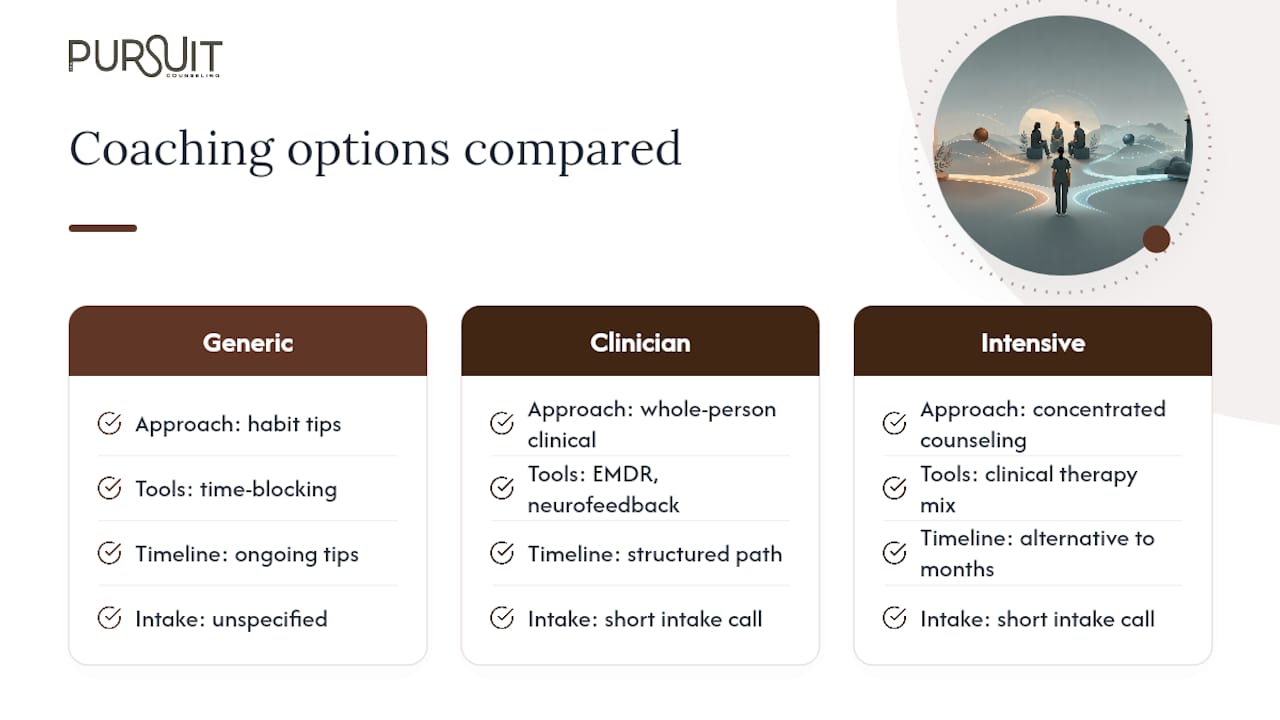
Unlike a generic productivity coach who hands you time-blocking tips and calls it resilience, The Pursuit Counseling treats burnout as a whole-person problem, pairing coaching with clinical tools like EMDR and neurofeedback when the depletion runs deeper than habits alone.
If chronic overload has you stuck, coaching and counseling for leaders is designed exactly for this: a structured path that stabilizes regulation, rebuilds delegation, and restores the energy your role has been quietly draining. Executives working with Adam Glendye get a clinician who understands both the neuroscience of chronic stress and the operational reality of running a team. For leaders whose exhaustion is tangled up with deeper stress patterns, counseling intensives offer a concentrated alternative to months of weekly sessions.
Booking a discovery call starts with a short intake conversation about severity and goals, no long forms, no waiting weeks for a first appointment. If reducing organizational burnout risk across your team is also on your radar, pairing individual coaching with broader staffing burnout strategies tends to produce more durable results than either alone.
Reach out and book your first session at The Pursuit Counseling.
Sources
Claims in this article draw on the WHO’s ICD-11 burnout classification, Harvard Business Review’s reporting on workplace-driven burnout, and the APA’s research on chronic stress.
- Burn-out an occupational phenomenon: international classification of diseases
- PubMed: relevant burnout/stress study
- How to coach resilience in leaders — ASCD
FAQ
How Long Does It Take to Recover From Burnout Through Coaching?
Most leaders see initial stabilization within two to four weeks, decision clarity and lower reactivity by two to three months, and durable habit change over three to six months, depending on severity and role demands.
Can You Overcome Burnout Without Quitting Your Job?
Yes, in most cases. Coaching that redesigns delegation, boundaries, and decision workflows often resolves burnout without requiring a career change, though severe or trauma-linked burnout may need clinical treatment alongside coaching.
What Are the Core Focus Areas of Burnout Recovery Coaching?
Effective coaching centers on restoring regulation, recovery capacity, focus, and connection, the four areas most disrupted by chronic occupational stress.
Is There a Rule for How Much of Burnout Comes From the Workplace?
There’s no single agreed-upon percentage, but research from Harvard Business Review indicates workplace factors, not individual traits, are the primary driver, which is why coaching that only targets personal habits often falls short.
When Should I Choose Therapy Instead of Coaching?
Choose therapy first if you’re experiencing suicidal thoughts, unmanaged substance use, trauma symptoms, or a functional breakdown that affects daily life; coaching works best once you’re stable enough to focus on systems and performance.