

If you’re searching for failure to launch therapy, you’re probably in one of two chairs. You’re a young adult who is 22, 26 or 31, still at home, and tired of the quiet verdict you hear in your own head. Or you’re the parent watching it, loving someone you can’t seem to move and no longer sure what helping looks like. Either way, the useful move is the same: stop treating “failure to launch” as a character flaw and find out what is holding the launch in place. Anxiety, ADHD, depression, a family pattern, a hard loss. Those are treatable, and that is the work we do at The Pursuit Counseling, in person in Fayetteville, Georgia and online.
Key Takeaways
- “Failure to launch” is an everyday label, not a formal diagnosis. Therapy works on what sits underneath it: anxiety, ADHD, depression, avoidance, family dynamics.
- Research on young adults living at home points to a pattern: anxiety and dependence feed each other, and change often comes from both the young adult and the parents changing what they do.
- Education is not assessment. Reading about the topic can name a pattern; only a clinician who meets you can tell you what is driving it.
- A good first step is one honest conversation with a therapist, not a plan for fixing your whole life.
Table of Contents
- What “failure to launch” actually means
- What you may be feeling, on both sides
- Why the pattern holds in place
- Signs the underlying issue deserves a clinician
- What therapy for a young adult at home looks like
- How parents can help without carrying it all
- What to expect when you start with us
- Where to start
- Our perspective
- Frequently asked questions
- Sources
What “failure to launch” actually means
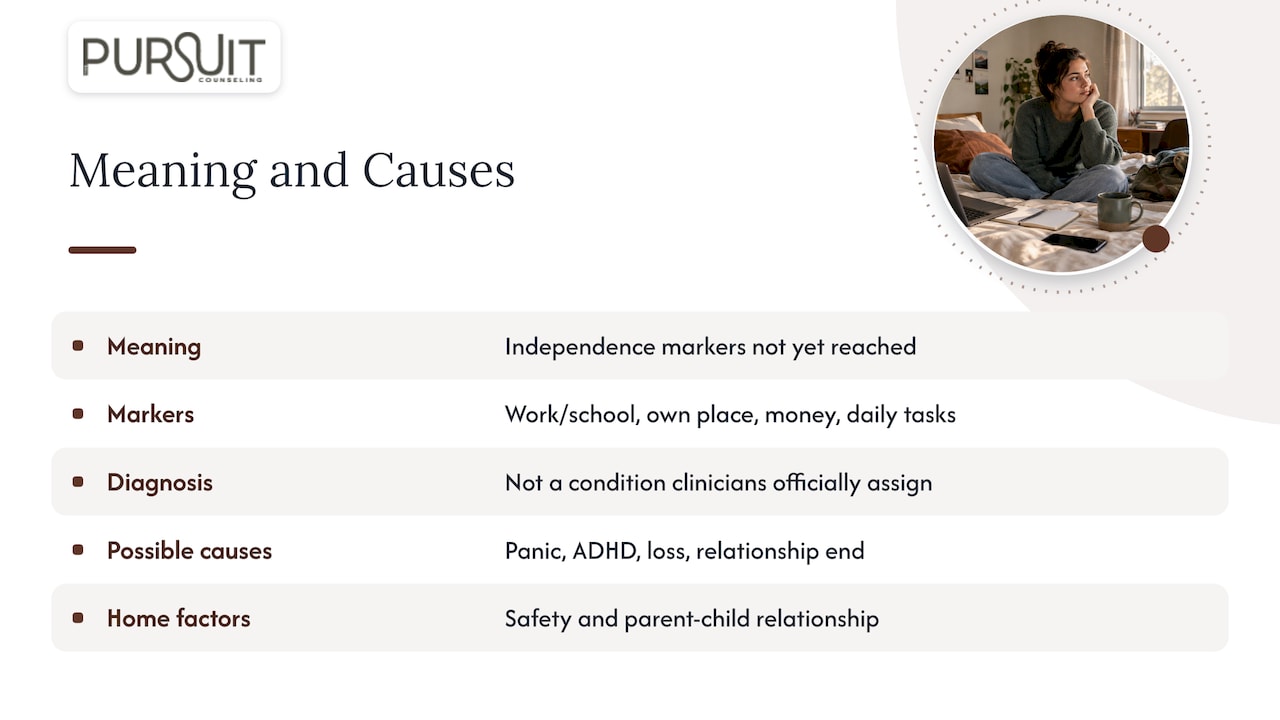
The phrase describes a young adult who has not moved into the markers of independence: steady work or school, their own place, a social life, managing money and daily tasks. It is shorthand, and it is not a clinical diagnosis. You won’t find it as a condition a clinician can officially assign, which is part of why two people using the phrase can mean very different things.
That matters because the label tends to hide the cause. A 24-year-old who freezes at job applications because of panic is in a different situation than one who is undiagnosed ADHD and can’t hold a routine, and both differ from someone who stopped functioning after a breakup or a death. CHADD, the national ADHD association, lists personal factors such as developmental readiness, emotional resilience, problem-solving skills, and ADHD and anxiety, along with life events like an injury, a loss or the end of a relationship. It also notes that the comfort and safety of home, and the parent-child relationship, are among the main reasons young adults come back.
Some researchers dislike the word “failure” for good reason. A 2017 editorial in the Journal of the American Academy of Child and Adolescent Psychiatry points out that the word denotes acceptance of defeat, and argues for a clinician approach built on a clear formulation and practical tools instead. We agree with the spirit of that. Nobody is a failure. Someone is stuck, and stuck has causes.
What you may be feeling, on both sides
Name it plainly, because both sides tend to carry it in silence.
If you’re the young adult: you may feel shame that gets louder each time a peer posts a promotion or a move. You may avoid the conversation entirely because every version of it ends in the same place. You may want to change and also be unable to start, which looks like laziness from the outside and feels like dread from the inside. The Lebowitz editorial describes this: shame and alienation as same-aged peers accumulate accomplishments while the gap widens.
If you’re the parent: you may be exhausted, resentful, scared, and guilty about all three. CHADD’s article describes parents feeling shame, a sense of failing as a parent, anger, depression and resentment, while young adults may experience social withdrawal, anxiety, depression, substance use or deep isolation. None of that is a verdict on your family. It is what prolonged stuckness does to people who care about each other.
Shame is also not reserved for 20-somethings. Leaders in midlife can find themselves in a similar place of feeling stalled and ashamed of it, and a piece on a midlife crisis as a Christian leader speaks to that experience for parents who recognize themselves in it.
Why the pattern holds in place
Most stuck situations are held by a loop. A young adult feels overwhelmed or afraid. Avoiding the task brings relief. Parents, wanting to ease the distress, step in: they make the call, cover the bill, lower the expectation. The relief teaches the brain that avoidance works, and the loop tightens.

Researchers call that stepping in “accommodation.” Eli Lebowitz’s editorial argues that this is exactly why the systemic nature of the problem can become an asset: because the young person’s vulnerability pulls parents into more accommodation, reducing it can restart the launch. In the work he describes, parents of 27 adults living at home were trained to reduce accommodation gradually while acknowledging their child’s distress with empathy. After treatment, the adults made meaningful gains in employment, living arrangements, social behavior and engagement with the adult world.
Two things in that finding deserve attention. First, the parents were not told to push harder or cut anyone off. They were taught to stay warm while changing their own behavior. Second, the focus on what parents themselves can do differently frees them from trying to force change in someone else.
Signs the underlying issue deserves a clinician
The label is vague, so look at the specifics. A clinical reason to seek help is more likely when you see:
- Panic, social anxiety, obsessive thoughts or avoidance that shrinks daily life. A 2017 school-system presentation by clinician Johanna Kaplan lists anxiety, depression, ADHD, learning disorders, developmental disorders and medical issues among the reasons a young adult doesn’t launch.
- Trouble starting, organizing and finishing tasks that has followed you since school, which can point toward ADHD and executive function.
- Low mood, sleeping through the day, loss of interest, or withdrawing from friends.
- Increased substance use as a way of coping.
- A major loss or event after which life never restarted.
- Family conflict that spikes whenever independence comes up.
If anyone is talking about harming themselves or feels unsafe, call or text 988, the Suicide & Crisis Lifeline, or go to the nearest emergency room. That comes before everything else in this article.
A note on education versus assessment. A checklist like the one above can help you notice patterns. It cannot tell you what you have. Anxiety and ADHD, for instance, can look alike from the outside, and the right treatment differs. That sorting is what a first clinical conversation is for.
What therapy for a young adult at home looks like
Therapy here is not a lecture about adulthood. It usually works on three layers at once.
1. Treating what is driving the avoidance
The Kaplan presentation recommends cognitive-behavioral treatment, exposure work and skill building, covering social and independent-living skills, and says any pre-existing mental illness should be treated first. In plain terms: if panic is the reason you can’t leave the house, we treat the panic. If ADHD is why you’ve never kept a routine, we address focus and executive function. Our individual therapy covers anxiety, trauma through EMDR, and ADHD-focused treatment. If your twenties have felt like one long wave of worry, our page on anxiety in your 20s describes what that can look like.
For people with ADHD, the practical side matters. Our guides on executive function skills for adults and an ADHD procrastination reset show the kind of concrete, small-step work involved. If you want to understand the brain side, we also offer neurofeedback, which starts with a Neurofeedback Brain Map.
2. Rebuilding small, real evidence of capability
Exposure and skill building both come down to the same idea: do the feared or avoided thing in steps small enough to complete, then let the experience, not a pep talk, change the belief. A first target might be one phone call, one application, one week of a fixed wake time. Momentum is built on finished things.
Some people find it easier to start moving when they are not sitting in an office chair. Our adventure therapy takes the work outside, which can suit someone for whom talking face to face feels like an interrogation.
3. Changing the family pattern
The strongest research in the area looks at parents and the young adult together. A 2020 case study describes an 18-year-old with agoraphobia and panic disorder who received individual cognitive-behavioral therapy for anxiety while her parents took part in a program called SPACE (Supportive Parenting for Anxious Childhood Emotions). She showed clinically significant improvement, and the authors suggest the combination may have worked better than the sum of its parts at preventing failure to launch. SPACE begins by explaining anxiety and accommodation to parents, teaches responses that convey both acceptance and confidence, then picks one target accommodation and builds a plan to reduce it step by step, with support for handling the young person’s reaction.
We offer that kind of single-case detail as research context, not as a promise of what any one family will experience. For families who want to work on communication, our article on how family therapy can help parents and teens explains how we think about it.
How parents can help without carrying it all
Parents often ask what to do between sessions. A few principles from the research and from clinical practice:
- Get a current picture first. Kaplan recommends starting with an assessment and treating existing anxiety, depression, ADHD or autism before planning a launch.
- Look at the roles in your house. Is your adult child treated as a child, a student, a roommate? What do the household expectations actually say?
- Remember your own launch. What did leaving home require of you, and what is different for them?
- Change one accommodation at a time. Choose something specific, tell your child what you’ll do differently and why, and respond to the distress with warmth rather than argument.
- Don’t do it alone. The Lebowitz editorial advises parents to enlist support from people outside the home, and notes that the presence of others in the house during early stages can inhibit severe escalation.
The tone matters as much as the plan. “I believe you can do this, and I’m going to stop doing it for you” lands differently than “you need to get your life together.”
What to expect when you start with us
We work with complicated people, not with a script. A first session is a conversation about what’s happening, what you’ve tried, and what you want your days to look like. From there, we match the approach to the cause: individual therapy for anxiety or ADHD, EMDR when past experiences are driving present fear, skills work such as DBT, and, where it suits you, in-person or online sessions. We serve Fayetteville, Peachtree City, Senoia, Brooks, Tyrone and the wider South Atlanta area.
For those who feel they’ve circled the same loop for years, our piece on feeling stuck in life and what therapy offers describes what to expect. If your stuckness centers on career and early adulthood, the young professionals page is a good next read.
What it costs
Costs depend on the clinician, the type and length of session, and your insurance or out-of-network benefits. Contact us for current rates and what your plan may cover, or ask during a free 15-minute consult.
The Next Chapter Intensive is built for concentrated work when weekly sessions feel too slow. You can see the details on our intensives page.
Where to start
Start with the smallest honest step. If you’re the young adult, that might be sending one message to a therapist saying, “I’ve been stuck and I don’t know why.” If you’re the parent, it might be a consult for yourself first, so you have support before you change anything at home.
We’d be glad to talk it through. You can see every service and rate on our services and specialties page and book from there.

No one at our practice will promise you a result, and nobody should. What we can offer is a thoughtful assessment, an approach built around you and the people who love you, and a clear next step.
Our perspective
Most of the people who come to us feeling stuck are not unmotivated. They’re carrying more than anyone sees. Behind a stalled launch there is usually a person who tried, hit a wall, and decided it was safer to stop trying than to hit it again.
We think of those walls as the cracks, and the pain cave that comes with them. Ultramarathoners know that the hardest miles aren’t the ones that break you, they’re the ones where you decide whether to keep moving. Young adults at home are often in that stretch, and parents are often in it right beside them.
That is why we don’t treat the label. We look for the anxiety, the attention difficulty, the old injury, the family loop. We use evidence-based tools like EMDR, skills-based work, neurofeedback and experiential sessions, and we ask the people who love each other to take part in the change rather than watch it happen.
We also respect that a person living at home is an adult. Collaboration means you help set the target. We don’t mass-produce appointments, and we don’t hand out timelines. We stay with the complicated parts until the next step is clear.
Adam Glendye LPC, CPCS
Frequently asked questions
Is failure to launch a mental health diagnosis?
No. It is a common label for a young adult who has had trouble reaching independence, not a formal diagnosis. Therapists look for what is underneath it, such as anxiety, depression or ADHD, and treat that.
Can therapy help if the young adult doesn’t want to go?
Often, yes, and the parents can start. Research on parent-based treatment, described in the Lebowitz editorial, shows young adults making gains after their parents changed how they responded, even though the focus was on the parents. A young adult who sees the household shifting may be more willing to join later.
Is it a problem that my adult child lives at home?
Living at home is not the problem on its own. The concern is when it comes with withdrawal, avoidance, worsening mood or no movement toward anything. If daily life is shrinking, or anyone is suffering, a conversation with a licensed therapist is a reasonable next step.
How is therapy different from coaching or a program?
Therapy begins with understanding what is driving the stuckness, including anxiety or attention difficulties, and treats it. A program that only teaches life skills may miss that. If you’re unsure which you need, an initial session can help sort it out.
Do you offer online sessions?
Yes. We offer both in-person sessions in Fayetteville, Georgia and online sessions, so a young adult who finds leaving the house hard can still begin.
Sources
- CHADD: Failure to Launch, Addressing the Needs of Transition-Age Young Adults (2017)
- Lebowitz, “Failure to Launch”: Shaping Intervention for Highly Dependent Adults, JAACAP editorial (2017)
- Kaplan, Failure to Launch: How to help your child avoid pitfalls (2017 presentation)
- Raila et al., Separating From the Mothership: A Coordinated Individual and Parent-Based Treatment (2020)