


Do one tiny, specific first physical action for ten minutes while someone watches, in person or on a video call. That combination of a micro-step and outside presence beats most advice about willpower, because it works around the exact wiring that makes starting hard for adults with ADHD. A clinician describes this as a fast reset technique. For a ready-to-use version, skip to the ten-minute kit below.
Key Takeaways
Implementing a focused, microaction-based approach with external support effectively reduces procrastination in adults with ADHD by targeting starting friction.
| Point | Details |
|---|---|
| Start with micro-actions | Begin tasks with a simple, specific physical action for ten minutes to overcome initiation barriers. |
| Use external accountability | Work alongside others or use timers and cues to support task start and sustain focus. |
| Break tasks into manageable steps | Apply the 1/3/5 rule to limit daily tasks, reducing overwhelm and avoidance. |
| Apply therapeutic strategies | Use tools like CBT and structured homework to address underlying executive function challenges. |
| Explore clinician-guided support | Seek personalized help through ADHD programs or therapy for sustained improvement. |
Table of Contents
- Why procrastination looks different with ADHD
- Seven prioritized strategies to start and finish tasks
- Your 10-minute portable kit for stuck moments
- How therapy and evidence-based tools reduce procrastination
- How we shape therapy homework into measurable ADHD skills
- What we want you to know if this feels familiar
- The Pursuit Counseling: a direct option for clinician-guided support
- FAQ
- Sources
Why procrastination looks different with ADHD
For many adults with ADHD, procrastination is not a scheduling problem; understanding different approaches to microdosing for ADHD may offer alternative perspectives on managing focus and motivation. It is friction at the exact moment of starting. Time blindness, a well-documented feature of ADHD time blindness, makes future deadlines feel abstract until they collapse into urgency. Add delayed executive control, which governs the brain’s ability to plan, sequence, and initiate, and a task that looks simple on paper can feel physically impossible to begin.
Then there is the emotional layer. Clinicians sometimes call it the “ugh factor”: a task carries a small dread, boredom, or fear of doing it wrong, and the brain avoids that discomfort by avoiding the task itself. This is not laziness. It is a nervous system protecting itself from an unpleasant feeling, even at the cost of a missed deadline.
This pattern is common. According to the CDC, over half of adults with ADHD received their diagnosis during adulthood, often after years of being told they just needed to try harder.
- Time blindness distorts how distant a deadline feels until it is almost too late.
- Delayed executive control makes the first move the hardest part of any task.
- Emotional avoidance protects against discomfort, not against effort itself.
Seven prioritized strategies to start and finish tasks
These are ordered by how much initiation friction they remove, starting with the highest-leverage options.
- Body doubling. Working alongside another person, in silence or on a shared call, measurably supports starting, focusing, and finishing tasks for people with ADHD, according to CHADD. A simple ask works: “Can you be on a call with me for twenty minutes while I do this? You don’t have to talk.”
- Micro-start phrasing. Replace “write the report” with “open the document and type one sentence.” Specificity removes the ambiguity that stalls the brain before it moves.
- Visual and buffer timers. CHADD’s Four As framework, which stands for Adapt, Adjust, Ask, and Accommodate, recommends visual timers and built-in buffer time to make time visible instead of guessed at.
- Task breakdown with the 1/3/5 rule. Pick one big task, three medium tasks, and five small tasks for the day. This caps the list at a size the brain can actually hold.
- Environment and pre-commit cues. Lay out the one item you need the night before, or close every tab except the one you’re working in. Removing a decision removes a stall point.
- Emotion-aware tactics. Name the feeling out loud (“this feels boring, not hard”), schedule a short break before you start so it feels less open-ended, and attach a small reward to the finish line.
- Accountability check-ins. A five-minute text exchange, therapy homework review, or light coaching check-in keeps a plan from quietly dissolving.
Pro Tip: Pick one tactic from this list for one task today instead of trying to install all seven at once; stacking too many new systems is its own form of avoidance.
Your 10-minute portable kit for stuck moments
This routine is built to be used the moment you notice yourself stalling, not planned for later.
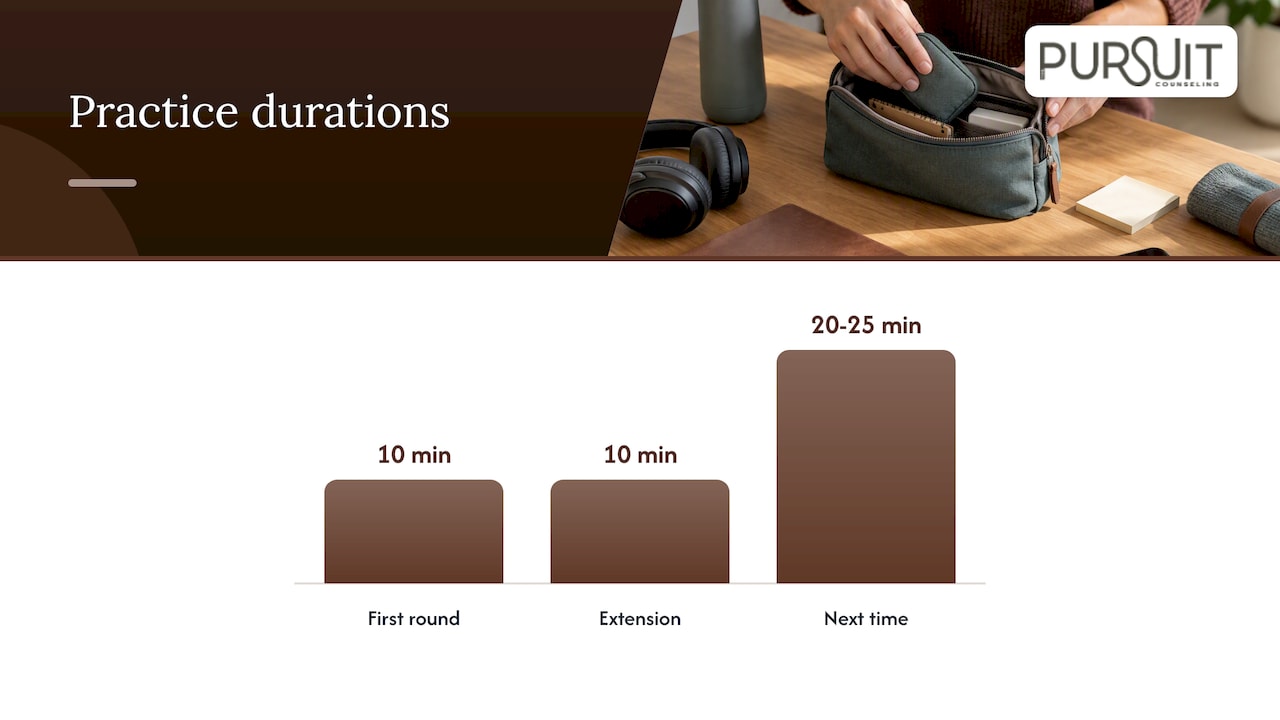
- Set a timer for ten minutes, visible and audible.
- Say your first physical action out loud or type it: “I am opening the file” or “I am putting on my shoes.”
- Start a body-doubling call, or use a self-check script: “I said I’d work for ten minutes. I’m starting now.”
- When the timer ends, decide in one breath: stop, or extend for another ten.
- Log the win in one line, even just a checkmark, to build evidence that starting works.
Two scripts to copy:
- “For the next ten minutes, I am only doing [one small physical action]. Nothing else counts.”
- “I don’t have to finish. I just have to start and see what happens.”
If the first round goes well, scale to twenty or twenty-five minutes next time rather than jumping straight to a full Pomodoro cycle. Repeat this kit at the first sign of stalling, not after an hour of avoidance has already set in.
Pro Tip: Keep the timer and scripts somewhere you’ll actually see them, a sticky note or phone widget works better than a buried app.
How therapy and evidence-based tools reduce procrastination
Cognitive behavioral therapy adapted for adult ADHD, often called CBT-ADHD, is built in modules: psychoeducation and organizing and planning skills, managing distractibility, and adaptive thinking. Some versions add an optional module specifically on procrastination, according to a detailed description of CBT for ADHD in adults. The distractibility module teaches a technique called distractibility delay: jotting down an intruding thought instead of chasing it, then returning to the original task.
A recent network meta-analysis found that CBT adapted for adult ADHD is an evidence-supported approach for executive dysfunctions including procrastination, time management, and organization, with modular, homework-heavy formats that directly target the gap between knowing what to do and doing it.
Professional support is worth exploring when:
- Procrastination is affecting work performance, income, or relationships in a repeated, pattern-like way.
- Anxiety or low mood regularly shows up alongside the avoidance.
- Self-help strategies have been tried consistently and still are not sticking.
The CDC reports that about one third of adults with ADHD receive no treatment, while a similar proportion are engaged in combined treatment, meaning medication paired with counseling.
How we shape therapy homework into measurable ADHD skills
The strategies presented are grounded in therapeutic frameworks rather than general productivity advice. In practice, that looks like modular homework: a client might track one micro-start attempt per day for a week, pair it with a short accountability check-in, and review what worked at the start of the next session.
A short, structured program can organize this kind of skills practice instead of leaving it to chance:
- Weekly tracking of specific initiation attempts, not vague intentions.
- Paired accountability between sessions, whether with a therapist, partner, or body double.
- Troubleshooting pivot points, the exact moment a task stalls, rather than repeating general advice to try harder.
Our ADHD program and related guidance on meeting deadlines walk through how this structure holds up over several weeks.
What we want you to know if this feels familiar
If you recognize yourself here, you may also recognize the shame that tends to come with it: the all-or-nothing thinking, the sense that everyone else just does things, the quiet dread before a task even starts. None of that means something is wrong with your character. It means the regulation and implementation systems ADHD affects are doing exactly what the research describes, and that is a solvable problem, not a verdict.
If you’re ready to test something small, try the ten-minute kit today. If the pattern feels bigger than a kit can hold, a consult is a reasonable next step, not an admission of failure.
— Adam Glendye LPC, CPCS
The Pursuit Counseling: a direct option for clinician-guided support
When procrastination has become a pattern that self-help tools haven’t shifted, our ADHD program and individual therapy sessions give you a structured, clinician-guided way to work on task initiation. This approach tends to fit busy professionals, parents, and anyone whose procrastination now affects work or home life in ways a timer alone hasn’t resolved.

Sessions can be accessed online or in person, allowing for consultations that focus on individual challenges rather than generic checklists.
This article is general information, not a substitute for advice from a qualified doctor. Consult a qualified healthcare professional about your own circumstances before acting on anything here.
FAQ
What is the 1/3/5 rule for ADHD?
The 1/3/5 rule is a daily planning method: pick one large task, three medium tasks, and five small tasks to complete. It caps the day’s list at a manageable size, which reduces the overwhelm that often triggers ADHD-related avoidance.
Why can’t I stop procrastinating?
Procrastination with ADHD usually stems from delayed executive control and time blindness rather than a lack of willpower, according to CHADD’s work on time blindness. Emotional avoidance of a task’s discomfort, sometimes called the “ugh factor,” also plays a major role in why starting feels harder than it should.
What is extreme procrastination disorder?
“Extreme procrastination disorder” is not a recognized clinical diagnosis. Chronic, severe procrastination is more often a symptom of underlying executive function difficulties, such as those seen in ADHD, and is best evaluated by a licensed clinician rather than self-diagnosed.
What is the 24 hour rule for ADHD?
There is no single standardized “24 hour rule” in the clinical literature on ADHD. Some informal strategies suggest waiting a brief period before making an impulsive decision or, alternatively, committing to start a task soon after it is assigned to prevent avoidance from setting in.
How is procrastination different from ADHD-related motivation problems?
Everyday procrastination is often a choice to delay despite being able to start. ADHD-related task initiation difficulty is a harder stop rooted in executive function, where the intention to begin exists but the brain struggles to translate it into action, as described in research on CBT for adult ADHD.
Sources
- CDC MMWR — Prevalence and Treatment of Adult ADHD
- CHADD — The benefits of body doubling when you have ADHD
- Description and Demonstration of CBT for ADHD in Adults
- CHADD — Time Unbound: Managing Time Blindness at Work