

The right therapy for men is not the closest office or the first name on a list. It is a licensed clinician who works the way you work: directly, with a clear goal, and without treating you like a case file. If you live in Fayette County, Peachtree City, or anywhere in South Atlanta, our men’s therapy page describes how we work with high-performing men, in person in Fayetteville or online.
You may be here because something has stopped working. The temper is shorter. Sleep is bad. Focus is slipping at work, or the pressure of carrying a company, a cockpit, a team, or a family has begun to feel like a weight you can’t set down. You are not looking for a lecture. You want to know who to call and what to ask.
Key Takeaways
- Start with the license. Every state licenses therapists, and in Georgia you can look up a counselor, social worker, or marriage and family therapist through the Secretary of State’s licensing board.
- Men often show distress differently: irritability, anger, poor sleep, and substance use can be the signal, not just sadness.
- Research on engaging men points to a style that is collaborative, goal-focused, and action-oriented. Ask a therapist how they work before you book.
- Cost and insurance shape your options. Many therapists who practice evidence-based care don’t take insurance, so ask about fees, cancellation, and out-of-network reimbursement up front.
- If you are in crisis or having thoughts of suicide, call or text 988 now.
Table of Contents
- What men often notice before they call anyone
- Why “near me” is only half the question
- How to find a licensed therapist, step by step
- What the first session looks like
- Signs the fit is wrong
- Different men, different kinds of work
- Perspective
- Where to start with us
- If you need help right now
- FAQ
- Sources
What men often notice before they call anyone
Men and women can develop most of the same mental disorders, but the symptoms can look different. The National Institute of Mental Health lists common signs in men that include anger or irritability, changes in energy or appetite, trouble sleeping or concentrating, increased worry, misuse of alcohol or drugs, risky behavior, and unexplained aches or digestive trouble. Persistent sadness is on the list too, but it is rarely the first thing a man mentions.
That matters because many capable men wait. They read the signs as stress, a bad quarter, a hard season of parenting, or a personality flaw. Then they handle it the way they handle everything: alone, with more effort.
Here is a quick way to tell whether it might be time to talk to someone:
- You are snapping at people you love and you can’t explain why.
- You are working more and enjoying it less.
- You are drinking, scrolling, or staying busy to avoid being still.
- You are physically exhausted but your mind won’t stop.
- You have been through something heavy (a loss, an accident, a career blow, years of high-stakes work) and it hasn’t settled.
None of that is a diagnosis, and a blog post can’t give you one. Reading about symptoms is education. A diagnosis comes from an assessment by a licensed clinician who has talked with you, asked about your history, and weighed what they find. If work is part of the picture, it also helps to know that workplace protections for mental health conditions exist under the ADA, so asking for help does not have to mean putting your job at risk.
Why “near me” is only half the question
Proximity helps. A weekly session you can reach in twenty minutes is easier to keep than one across the Perimeter in traffic. But fit decides whether you stay.
A 2018 scoping review of the research on engaging men in psychological treatment, published by Seidler and colleagues, found that clinicians need to consider masculine socialization and gender norms. It also found that treatment styles that are collaborative, transparent, action-oriented, and goal-focused tend to engage men best, and that language adapted with male-oriented metaphors can help.
In plain terms, many men don’t want to sit and be nodded at for fifty minutes. They want to know what is happening, what the plan is, and what they are doing between sessions. They also want a clinician who can hear something hard without flinching and without turning it into a script.
This is where we put our attention. We built our practice around people who are complicated: leaders, pilots, founders, athletes’ fathers, men who carry a lot and show little. Therapy with us is collaborative. You take an active part in it, and the work adapts to you rather than the other way around.

How to find a licensed therapist, step by step
1. Check the license first
The American Psychological Association tells patients to confirm that a therapist is licensed, since each state does its own licensing. In Georgia, counselors, social workers, and marriage and family therapists are overseen by the Board of Professional Counselors, Social Workers, and Marriage & Family Therapists, which offers a license search on the Secretary of State’s site. Takes two minutes. Do it before you book.
The credentials behind a name vary. The Association for Behavioral and Cognitive Therapies explains that clinicians with the most graduate training hold a doctoral degree in clinical psychology, while master’s-level clinicians hold degrees such as an MSW or a counseling or marriage and family therapy degree. Both can be excellent. What matters is that the license is current and the training matches what you are dealing with.
2. Ask where the referrals come from
The APA suggests asking a trusted friend or a physician, and using professional locators. A primary care doctor is also a sensible first stop if you have physical symptoms such as poor sleep, fatigue, or aches, because NIMH describes the primary care provider as an accessible entry point who can refer you onward. If you don’t have a doctor you trust yet, this guide on choosing a primary care doctor covers what to weigh, including how comfortable you feel talking to them.
3. Ask about training and experience with your issue
ABCT advises asking about training for your specific problem and years of practice. Be specific. “I’m a pilot and the medical certificate worries me” is a better opening than “I’m stressed.” “I run a company and I haven’t slept properly in a year” tells a clinician where to start.
We publish a list of questions to ask a therapist in the first session, and a broader guide to choosing a therapist in your area. Use them as a script if the phone call feels awkward.
4. Decide between in person and online
In person works well when you want a room that is separate from your office and your home, or when the work involves movement, as in adventure therapy. Online works when your schedule is the obstacle: travel, shifts, a sixty-hour week. We offer both, so the format can follow your life instead of dictating it.
5. Settle the money question early
ABCT recommends asking about the cost per session, fees for an initial session, sliding scales, cancellation policy, whether the therapist takes insurance, and whether they provide superbills for out-of-network reimbursement. It also notes that many therapists who practice evidence-based therapy do not accept insurance.
We are private-pay. Our reasoning is laid out in why we don’t take insurance, and our Georgia guide to out-of-network reimbursement explains how to approach your insurer for reimbursement. The APA also advises checking whether your plan limits the number of sessions, which is worth knowing whichever route you choose.
What the first session looks like
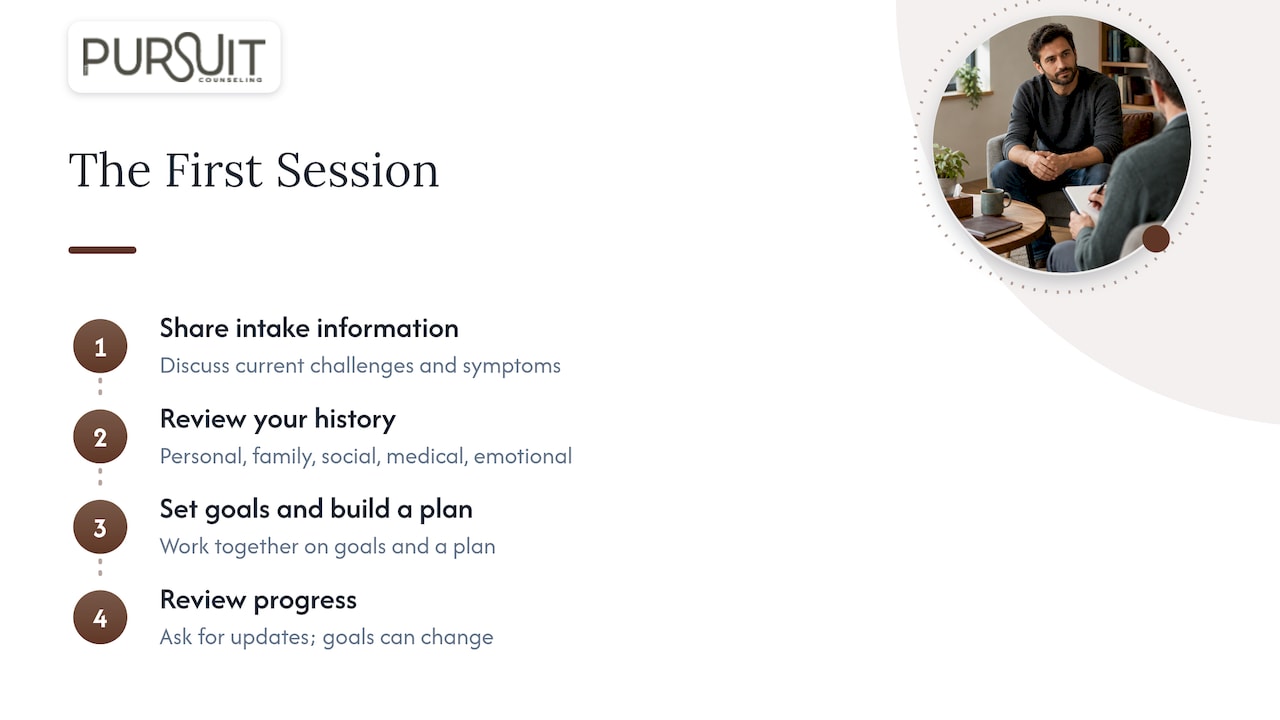
Expect questions. The California Board of Psychology’s consumer guide says the psychologist uses your intake information to learn about current challenges and symptoms, and asks about your personal, family, social, developmental, medical, and emotional history. Then you set goals together and build a plan around them. Those goals can change as you go, and you can ask for updates on progress toward them.
That is a good template for what a first meeting should feel like in any licensed practice. You are interviewing the therapist as much as they are assessing you. You should leave knowing what they think the work is, how often you will meet, and what the first few weeks will focus on.
Signs the fit is wrong
The same California guide says the basis of good psychotherapy is trust, and that if you would not feel safe sharing personal details after initial contact, it may be a sign to keep looking. A useful exercise: before the first call, write down what helps you feel secure enough to be honest. Then use it as a checklist.
For many men, that list looks like this:
- The therapist explains what they are doing and why.
- You are not rushed or talked over.
- Your goals, not a template, drive the sessions.
- You can say “that didn’t land” and the answer is adjustment, not defensiveness.
One mismatch is not failure. It’s information. Trying a second clinician is a normal part of finding the right one.
Different men, different kinds of work
A man who is burned out at 45 needs something different from a man with a decade of unprocessed trauma, a father of a teen athlete, or a founder who can’t switch off. We work with several of these directly.
It’s a fit for the founder whose mind runs the numbers at 3 a.m., or the executive who looks calm and feels like a wire.
Our pages on what EMDR is explain the process.
Focus and ADHD. If attention is the issue, we offer ADHD-focused treatment and neurofeedback, which starts with a brain map. A brain map is an assessment tool, not a diagnosis on its own. Our page on what the research says about neurofeedback goes into the details.
Anger. Many men find that anger is the emotion with permission to show up while everything else stays buried. We wrote about transforming anger into fulfillment from a male therapist’s perspective.
It takes the conversation outside the office. Read more about adventure therapy.

Our couples intensives compress months of weekly sessions into a focused block.
Perspective
Most men who walk into our office have spent years being the person others lean on. Pilots, executives, owners, coaches, fathers. They are good at carrying weight, and that’s the very reason they come to us late.
We don’t treat the cracks as proof that something is wrong with you. We treat them as information about what you have been carrying and for how long. That is why we work the way we do: personal connection first, evidence-based methods second, and a plan that is built with you, not handed to you.
Some men need weekly sessions. Some need EMDR for something that happened a long time ago. Some need to get out of the chair and walk a trail. Some need a concentrated block of time, like an intensive, because their schedule doesn’t allow for anything else. We offer all of these, in person in Fayetteville or online, because complicated people rarely fit one format.
We can’t promise an outcome, and no honest clinician can. What we can promise is that you will be treated as an intelligent adult, and that the work will be aimed at what matters to you.
Adam Glendye LPC, CPCS
Where to start with us
If you are in Fayette County, Peachtree City, Senoia, Tyrone, Brooks, or elsewhere in South Atlanta, you can book individual therapy with us in person or online.

If you are not sure which door is yours, start with the conversation. Tell us what you’ve been noticing, and we will help you work out which kind of support fits, and whether it is us.
If you need help right now
Therapy is not a crisis service. If you are having thoughts of suicide or are in emotional crisis, call or text 988, the Suicide & Crisis Lifeline. Veterans can press 1 after dialing 988 to reach the Veterans Crisis Line. If you are in immediate danger, call 911.
FAQ
What is the best way to find a therapist for men near me?
Start with a state license check, then narrow by experience with your specific concern and by how the therapist works. The APA recommends asking friends or a physician for referrals and calling to ask about evidence-based treatment. In Georgia, the Secretary of State’s licensing board has a search tool for counselors, social workers, and marriage and family therapists.
What issues do men bring to counseling?
Common ones include anger or irritability, anxiety and constant worry, trouble sleeping or concentrating, burnout, substance use, relationship strain, and the aftermath of trauma. NIMH notes that men may show different symptoms than women. You don’t need a diagnosis to start, and you don’t need to be in crisis.
Does therapy for men have to be in person?
No. Online sessions suit travel-heavy or unpredictable schedules, and in-person sessions suit men who want separation from work and home. We offer both. Some of our work, such as adventure therapy, is in person by nature.
How do I know if a therapist is a good fit?
Pay attention to how you feel in the first few contacts. If you wouldn’t feel able to share personal details, the California Board of Psychology says that may be a sign to keep looking. A good fit means clear goals, a plan you helped shape, and a clinician who explains their approach.
Will insurance cover therapy?
That depends on your plan and the provider. Ask about session limits, out-of-network benefits, and whether the therapist can provide a superbill for reimbursement. We are private-pay, and our Georgia guide explains how reimbursement requests typically work.
Sources
- Men and Mental Health, National Institute of Mental Health
- Engaging Men in Psychological Treatment: A Scoping Review
- How Do I Find a Good Therapist? American Psychological Association
- How Do I Choose a Therapist? ABCT
- A Consumer Guide to Psychological Services, California Board of Psychology
- Georgia Board of Professional Counselors, Social Workers, and Marriage & Family Therapists
- 988 Suicide & Crisis Lifeline, FCC
- How to Choose a Primary Care Doctor
- Mental Health Accommodations at Work: Your Rights Under the ADA