

Neuroscience-based coaching is regular coaching, with one difference: the coach deliberately uses research on stress, attention, habits and brain plasticity to shape the questions, the explanations and the experiments you try between sessions. It is also called brain-based coaching. It is education and structure, not assessment and not treatment. If you are exhausted, scattered or stuck in a pattern you can name but not break, it can give you a clearer map. If what you are carrying is clinical, it is the wrong tool, and knowing the difference saves you months.
Key Takeaways
- Neuroscience-based coaching applies findings on learning, stress, attention and habit formation to goal-focused coaching. It is still coaching, not a clinical service.
- A session follows a familiar structure: goals, reality, options, action. The brain science shapes how each step is handled.
- The research is promising but young. Some scholars argue that much of what is labeled neuroscience is older behavioral science in new language.
- Coaching does not diagnose or treat. Anxiety, trauma, suspected ADHD, or a life that is coming apart call for a licensed clinician.
- Our work at The Pursuit Counseling is licensed therapy that uses brain science directly, including EMDR and neurofeedback.
Table of Contents
- What neuroscience-based coaching actually is
- What happens in a session
- The brain science coaches draw on
- Techniques that carry over into real life
- What the evidence supports, and where it is thin
- Coaching, therapy and neurofeedback are different things
- How we bring neuroscience into care
- Choosing well if you are weighing your options
- FAQ
- Sources
What neuroscience-based coaching actually is
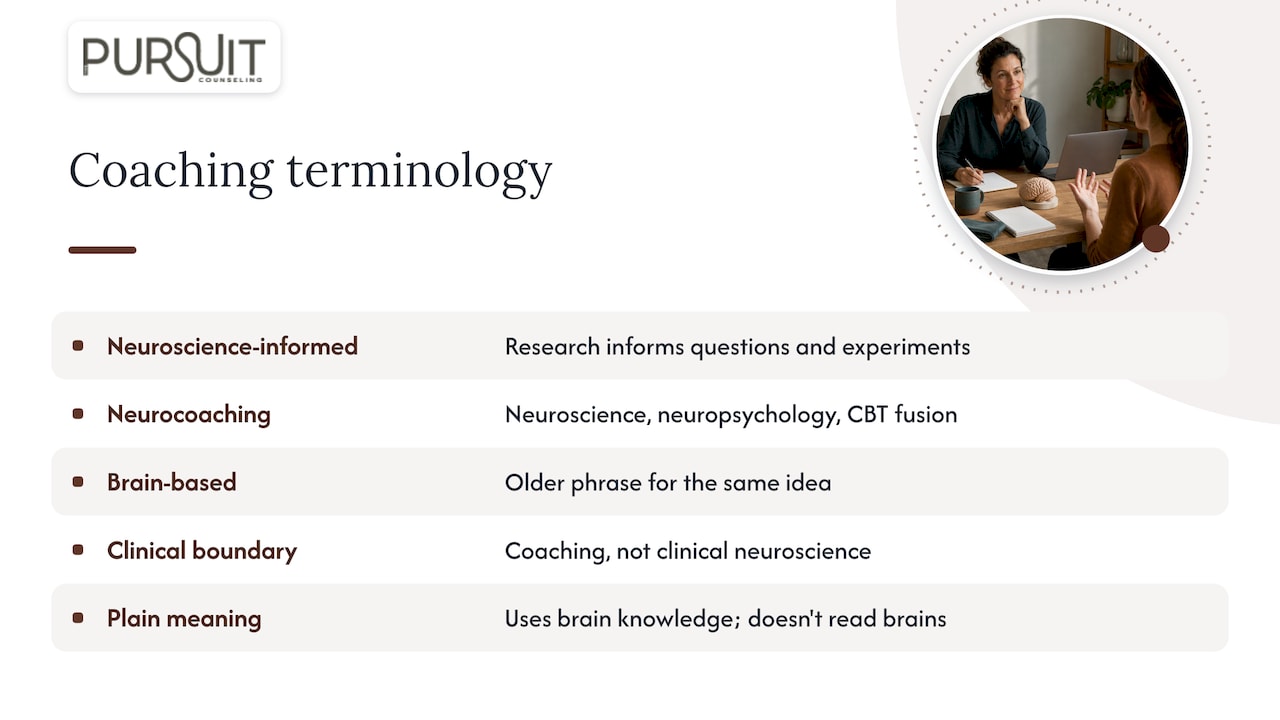
The label covers a few overlapping ideas. A coach who is neuroscience-informed uses research on learning, habits, stress, attention, motivation and brain plasticity to design questions and behavior-change experiments. One coaching education provider puts it this way: it is still coaching, not a clinical neuroscience service.
The academic definition is wider. A 2023 peer-reviewed paper notes that the International Coaching Council describes neurocoaching as a fusion of cognitive neuroscience, neuropsychology, cognitive neuroplasticity and cognitive behavioral techniques. The same paper describes it as using knowledge about the brain and human psychophysiology to support the diagnosis, intervention and evaluation of coaching practice.
“Brain-based coaching” is the older phrase, and the same idea. David Rock argued in 2006 that a brain-based approach could explain why coaching works, because every event in a coaching conversation is tied to activity in someone’s head, and emotions have correlates in the brain as well. A 2022 Springer chapter proposes a brain-focused model and notes that coaching’s evidence base has mostly rested on social and behavioral observation.
In plain terms: the coach is not reading your brain. The coach is using what is known about how brains learn, protect themselves and form habits to help you change something specific.
What happens in a session
It looks less exotic than the name suggests. Patricia Riddell of the University of Reading explains that a neuroscience coaching session has the same structure as other coaching sessions: you set a goal, look at the reality of where you are, generate options, then commit to a plan. The neuroscience shows up in how each phase is run.
- Goals. Framing matters. Riddell describes goals that move you toward something and goals that steer you away from something as engaging different prefrontal regions, which is one reason a coach pushes you to state what you want rather than only what you want to stop.
- Reality. The coach asks what evidence you actually have, which slows down the story your stress response is telling.
- Options. You generate possibilities without judging them in the first pass.
- Will. You build an action plan and, per the same chapter, imagine carrying it out, which is thought to make follow-through more likely.
The Coaching Federation describes a neuroscientific approach mapped onto the stages of change. Early on, the work is about lowering the sense of threat. Then it moves to critical thinking, well-formed goals, action that engages reward, and finally consolidating what worked.
If you have ever been told to “just be more disciplined,” you will notice what is different here. The starting question is not why you are failing. It is what your nervous system is doing while you try.
The brain science coaches draw on
Stress and threat
A brain that reads a situation as dangerous narrows attention and defaults to familiar behavior. Coaches who work this way begin by lowering the threat, because new thinking is hard to reach from a braced body. The 2023 neurocoaching paper reports fMRI research suggesting that a coaching style oriented toward vision and compassion is linked to regions tied to social engagement and parasympathetic activity, while a more problem-and-pressure style engaged stress-related activity. Treat that as suggestive, not settled.
Executive function and habit
Elliot Berkman’s review explains that executive function covers attention, working memory and inhibitory control. It handles novel problems, while habits automate routine behavior through repeated, rewarded actions tied to cues. That is why willpower runs out on day nine and a well-placed cue does not.
Plasticity
Riddell notes that research on epigenetics and neuroplasticity shows we have tended to underestimate our ability to change behavior at any age. Knowing that the processes behind change continue across a lifetime can dissolve some of the excuses people carry.
The wider toolkit
IMD’s research on executive coaching names seven areas coaches draw on: plasticity, mindfulness and self-awareness, emotional self-regulation, motivation and goal-setting, habit formation, cognitive biases and social neuroscience. Self-regulation is the thread through all of them. It is a skill families practice too: caregivers helping a child settle can find sensory processing strategies for regulation that rest on the same principle, that a regulated body makes better decisions possible.
Techniques that carry over into real life
The most useful methods are almost boring, which is the point.
- Start small and reward the small step. Berkman’s advice from the motivation and reinforcement literature is to begin behavior change with modest goals and reward even the smallest steps. Ambitious plans tend to fail at the first missed day.
- Train the specific skill. Coaches are advised to focus on the skills relevant to the goal, not on general self-improvement.
- Label the feeling. The Coaching Federation describes affect labeling, naming an emotion to connect the reasoning part of the brain with the emotional center. “I’m anxious about this decision” is a different internal event than anxiety running unnamed.
- Probe what has worked before. Asking about past success draws on long-term memory instead of leaving you to invent a plan from scratch.
- Surface conflicting priorities. Much “procrastination” is two legitimate commitments pulling against each other.
- Repeat, with feeling. One insight rarely rewires a default. Repetition tied to something that matters to you does the work.
None of these requires a coach. A good one makes you do them on schedule, with someone watching who is paying attention to you rather than to the clock.
What the evidence supports, and where it is thin
This is a young field, and the honest summary is that it is useful and still being tested.
Anthony Grant of the Institute of Coaching has argued that many insights credited to neuroscience are long-established in the behavioral sciences, and that the link between neuroscience and coaching practice is still loose. The same piece suggests the traffic may run the other way: coaching could serve neuroscience, as a method for inducing specific changes whose effects on brain activity can then be studied.
There is also a practical limit. Researchers point out that it is not yet possible to scan a coachee’s brain during a typical session, because speech and head movement distort neuroimaging and EEG readings. They also note that coaching clients may have baseline brain functioning similar to healthy controls.
What this means for you: use the brain science as a lens that organizes good questions, not as proof that your coach has seen inside your head. A coach who says they can read your brain from a conversation is promising something nobody can deliver.
Coaching, therapy and neurofeedback are different things
| Neuroscience-based coaching | Psychotherapy | Neurofeedback | |
|---|---|---|---|
| Main purpose | Goals, habits, accountability, performance | Assessment and treatment of mental health conditions | Training brain activity patterns, guided by measurement |
| Diagnoses? | No | Yes, by a licensed clinician | No, it is used alongside clinical care |
| Regulation | Largely unregulated | Licensed profession | Provided within a clinical setting |
| Best fit | A working person with a clear goal and stable footing | Anxiety, trauma, depression, substance use, suspected ADHD | Brain-based concerns such as attention, stress and sleep, after a brain map |
The National Counseling and Psychological Services (NCPS) draws the line clearly: psychotherapy is a regulated, evidence-based profession centered on diagnosing and treating mental health conditions, while coaching operates in a largely unregulated space with varying levels of training. It adds that coaching should not serve as a substitute for psychotherapy when serious mental health concerns arise.
A 2026 explainer on nervous system coaching says the same from the coaching side: coaching credentials are not healthcare licensure, and coaching may complement therapy by supporting routines and accountability but should not replace it when clinical treatment is needed.
The counseling profession has been moving in this direction itself. Counseling Today reports that Lori Russell-Chapin coined the term “neurocounseling” in 2014, and that neuroscience-informed counseling includes neurocounseling and neurofeedback. That is the territory where brain science sits inside licensed care.
When to see a licensed clinician first
See a licensed therapist or physician, not a coach, if any of these is true:
- You are having thoughts of suicide or self-harm. In the US, call or text 988 right now.
- Your ability to function at work or in your relationships is collapsing.
- You suspect ADHD, anxiety or trauma but have never been assessed. Coaching can build systems around attention. It cannot tell you what is causing the problem.
- You think medication might be part of the answer.
Seeking a clinician is not a step down from coaching. For many high performers it is the faster route, because the pattern is addressed at its source instead of managed around.
Our Perspective: Brain Science Belongs Inside Real Care
Most of the people who find us are not short on drive. They are pilots, executives, founders and parents who have been running hard for years and have started to notice the cost: the short fuse, the 3 a.m. thinking loop, the focus that will not hold. They often come after trying a coach, a planner and a better morning routine.
We like the brain science. We use it. EMDR, neurofeedback with a brain map, and skills-based work all rest on how the nervous system learns and stores experience. What we have seen is that the science does the most good when someone licensed is also asking what happened to you, not just what you want to achieve.
That is why we pair deep work with small, practical actions. Insight without a next step stays an idea. A next step without understanding tends to collapse under pressure. You need both, and you need someone who treats you as a complicated person, not a case to be moved through.
If you want the brain-informed approach and you want it held inside clinical care, that is what we do. We do not promise outcomes. We promise that the work will be built around you.
Adam Glendye LPC, CPCS
How we bring neuroscience into care
At The Pursuit Counseling in Fayetteville, Georgia, we serve Peachtree City, Senoia, Tyrone, Brooks and South Atlanta, in person and online. Our work is private-pay, and it is built for people who want depth without wasted sessions.
- Neurofeedback and brain mapping. If attention, stress or sleep is the question, a Neurofeedback Brain Map is where we begin. You can read how we think about the research on neurofeedback and what qEEG brain mapping does and does not tell us.
- Skills for regulation. Our DBT-based emotional regulation therapy teaches the practical side of what coaching calls self-regulation.
If you are not sure which of these fits, the first conversation is for that. Start at our services page or reach us through thepursuitcounseling.com.

The emotionally accurate next step is usually small: describe what is happening in plain words, and let us tell you honestly whether therapy, neurofeedback or an intensive is the right door.
Choosing well if you are weighing your options
A few questions cut through the marketing, whatever kind of help you are considering.
- What exactly do I want to change? If the answer is a habit, a schedule or a leadership skill, coaching may be enough. If it is a feeling you cannot shake, start with a clinician.
- Who is this person licensed or credentialed as? Ask what training stands behind the word “neuroscience.” Licensure and credentials are different things.
- Will there be a plan between sessions? Change happens in the week, not in the hour.
- Is anything being measured, and by whom? Brain maps and scores belong to clinical settings.
- Do I feel understood in the first conversation? Fit matters as much as method.
We wrote more on the pattern of getting counseling first in why young entrepreneurs need counseling before business coaching, and on how mental fitness strengthens relationships and leadership.
FAQ
Is neuroscience-based coaching the same as brain-based coaching?
In practice, yes. Both phrases describe coaching that uses research on stress, attention, habits and plasticity to shape questions and experiments. Some practitioners prefer “neuroscience-informed” because it is more modest about what the science can claim.
Can a neuroscience coach treat anxiety, trauma or ADHD?
No. Coaching does not diagnose or treat mental health conditions, and coaches are not licensed to. If you suspect anxiety, trauma or ADHD, an assessment by a licensed clinician comes first. Coaching can then support routines and accountability alongside treatment.
Does neuroscience-based coaching have scientific proof?
The underlying brain science on habits, stress and plasticity is well studied. Whether adding that framing to coaching produces better results than good coaching without it is still an open research question. Treat any promise of guaranteed results with caution.
What is the difference between neurofeedback and neuroscience coaching?
Neurofeedback is a clinical technique that trains brain activity patterns, usually guided by measurement such as a brain map. Neuroscience coaching uses brain research as a framework for conversation and behavior change, with no brain measurement involved.
How much does it cost to work with us?
Costs depend on the clinician, the type and length of session, and your insurance or out-of-network benefits. Contact us for current rates and what your plan may cover, or ask during a free 15-minute consult.
Sources
- From Coaching to Neurocoaching: A Neuroscientific Approach (PMC, 2023)
- Brain-Focused Coaching (Springer, 2022)
- Traditional Coaching vs Neuroscience-Based Coaching (Brain Academy)
- A Brain-Based Approach to Coaching (David Rock, 2006)
- Neuroscience coaching (Patricia Riddell, University of Reading)
- A Neuroscientific Approach to Change (Coaching Federation, 2024)
- The Neuroscience of Goals and Behavior Change (Berkman, PMC, 2018)
- The implications of neuroscience for coaching (IMD, 2024)
- Coaching the brain: Neuro-science or Neuro-nonsense? (Institute of Coaching)
- Perspectives and challenges for the study of brain and coaching (Dias et al., 2015)
- Coaching and Psychotherapy: Not Quite the Same (NCPS)
- Is Nervous System Regulation Coaching Worth It? (2026)
- 9 Future Trends in Neuroscience-Informed Counseling (Counseling Today, 2025)
- Sensory Processing Strategies That Help Your Child Regulate