


Leaders talk to their teams using a handful of recognizable styles, from Goleman’s six emotional leadership approaches to the four DiSC profiles, but no single style wins by itself. The leaders who actually move teams forward switch between styles based on the moment, the stakes, and the person in front of them. Start there: assess who you’re talking to and what the situation demands, then pick one skill from this article to practice this week.
- Effective leaders switch between communication styles based on urgency, complexity, and team capability to prevent burnout, indecision, or team disengagement.
- Matching high-urgency or crisis situations with commanding or pacesetting styles ensures quick action, while developing talent benefits from coaching or democratic approaches.
- Core skills like active listening, clarity, empathy, and timely feedback are essential across all styles to maintain trust and understanding.
- Overusing pacesetting or commanding styles without assessment can silently erode trust, so leaders must recognize and adjust when they notice signs of fatigue or silence.
- Practicing small habits, such as paraphrasing and clear messaging, over a week can reinforce flexible communication, supported by coaching to sustain behavior change.
Table of Contents
- What Are the Main Leadership Communication Styles?
- When to Use Each Leadership Communication Style
- Core Skills Every Leadership Communication Style Depends On
- Common Leadership Communication Pitfalls and How to Fix Them
- A Repeatable Framework for High-Stakes Leadership Messages
- How The Pursuit Counseling Builds Communication Flexibility
- A 7-Day Practice Plan for Flexible Leadership Communication
- Ready to Build Communication Flexibility That Sticks
- Sources
- FAQ
What Are the Main Leadership Communication Styles?
Every leader defaults to a comfortable groove. Some bark orders under pressure. Others ask endless questions before deciding anything. Neither approach is wrong on its own, but relying on just one is where good leaders start losing their teams.
Psychologist Daniel Goleman, along with Richard Boyatzis and Annie McKee, mapped out six emotional leadership styles that remain the clearest framework for understanding this. Each one works, but only in the right dose:
- Visionary: Paints the big picture and connects daily work to purpose. “Here’s where we’re headed and why it matters” is the core message. Works well during change or when morale needs a lift.
- Coaching: Focuses on an individual’s long-term growth over quick fixes. “What do you think the next step should be?” replaces “Here’s what to do.” Best for developing talent, not putting out fires.
- Affiliative: Prioritizes relationships and emotional connection. “How are you holding up?” comes before the task list. Effective after conflict or loss, less useful when a decision needs to happen fast.
- Democratic: Builds buy-in through participation. “What’s everyone’s take before we commit?” This style earns trust but slows decisions when time is short.
- Pacesetting: Sets a high bar and expects the team to keep pace. “I need this by end of day, here’s the standard.” Effective in short sprints with a skilled team, corrosive when sustained.
- Commanding: Direct and unambiguous. “Do this now” with no debate. Necessary in a genuine crisis, damaging almost everywhere else.
Goleman’s research found pacesetting and commanding are the two styles most likely to create tension when a leader defaults to them constantly, even though both have legitimate, narrow uses.
The DiSC framework approaches the same problem from the listener’s side rather than the leader’s. It sorts people into four profiles: Dominant, Influencer, Steady, and Conscientious. A Dominant team member wants the bottom line first and the reasoning later, if at all. An Influencer responds to relational framing and enthusiasm. A Steady profile needs reassurance and time to process change. A Conscientious listener wants data, specifics, and a clear rationale before they’ll commit.
Layer coaching, directive, and storytelling approaches on top of these two frameworks and a pattern emerges: coaching overlaps with Goleman’s coaching style and appeals most to Steady and Conscientious listeners who want to think things through. Directive communication mirrors commanding and pacesetting, landing best with Dominant profiles who want speed over discussion. Storytelling, meanwhile, is really visionary communication in narrative form. It’s how affiliative and democratic leaders make abstract goals feel personal, and it tends to resonate strongest with Influencer types.
When to Use Each Leadership Communication Style
Matching style to moment is the actual skill here, and it comes down to three variables: how urgent the situation is, how complex the problem is, and how capable the team already is at solving it without you.
- High urgency, low complexity: Use commanding or pacesetting. A server outage or safety incident needs clear direction, not a debate. Script: “Here’s what we’re doing in the next ten minutes. I’ll explain the why afterward.”
- Performance correction: Blend coaching with direct feedback. Avoid pure commanding, which breeds resentment, and avoid pure affiliative, which avoids the hard message entirely. Script: “I’ve noticed X. Walk me through what happened, and let’s figure out the fix together.”
- Developing a team member: Lean coaching and democratic. Ask more than you tell. Script: “What’s your read on the best path here?”
- Driving innovation: Democratic and visionary work together. Give the team the destination, then let them find the route. Script: “Here’s the outcome we need. How would you approach it?”
- Leading through organizational change: Visionary carries the message, affiliative carries the emotional weight. People need both the destination and acknowledgment that change is hard. Script: “This is why we’re changing course, and I know it’s disruptive. Here’s how we’ll support you through it.”
Watch for warning signs that a style has outlived its usefulness. If pacesetting drags on past the sprint that justified it, expect burnout and turnover. If commanding becomes your default outside emergencies, expect silence in meetings, not agreement. If democratic discussion never converges on a decision, the team starts reading it as indecision rather than inclusion. Great leaders are distinguished less by which style they favor and more by how quickly they notice it’s stopped working.
Core Skills Every Leadership Communication Style Depends On
Style only carries a message so far. Underneath every framework sit five skills that make any style land, and none of them require a personality overhaul to build.
Active listening means more than staying quiet while someone else talks. Paraphrase what you heard before responding: “So what you’re saying is the timeline is the real problem, not the scope, is that right?” That one habit catches more misunderstandings than any other single technique.
Clarity benefits from a simple filter before you send anything important: is it Correct, Concise, Clear, Complete, Coherent, Courteous, and does it reach the right Channel? That’s the classic 7 Cs, and running a message through even three or four of them before hitting send catches most avoidable confusion.
Empathy matters most in high-emotion conversations, where the instinct is to fix rather than acknowledge. Naming the emotion out loud, “This clearly feels unfair to you,” often defuses more tension than any solution you could offer.
Feedback works best structured and timely: what happened, what impact it had, what you’d like to see instead. Delayed feedback loses its power; feedback delivered a month after the fact reads as an ambush, not coaching.
- Active listening: paraphrase, then ask one clarifying question before responding.
- Clarity: run high-stakes messages through the 7 Cs checklist before sending.
- Empathy: name the emotion in the room before offering a solution.
Coaching for emotional intelligence builds this kind of adaptability over time, rather than in a single conversation, and it’s where a lot of leaders find the fastest improvement.
Pro Tip: Pick one skill and drill it in five minute increments. Before your next three meetings, commit to paraphrasing the first thing someone says to you before you reply. That single habit trains active listening faster than any workshop.
Common Leadership Communication Pitfalls and How to Fix Them
Overusing pacesetting or commanding is the most common failure mode, and it doesn’t announce itself. Trust erodes quietly, one clipped conversation at a time, until a team stops volunteering ideas because it’s learned the leader isn’t really asking.
Repair starts with checking whether your message actually landed the way you intended, not assuming it did. Ask directly: “What did you take away from that conversation?” The gap between what you meant and what someone heard is often wider than leaders expect.
Jargon and message overload cause a quieter version of the same problem. Stacking five priorities into one email guarantees none of them get done. Cut every message to the single action you actually need.
- Check comprehension by asking what the listener took away, not whether they have questions.
- Trim every message to one clear ask instead of several buried priorities.
- Open a difficult conversation with the issue stated plainly: “I want to talk about X, and I want us both to leave this clear on next steps.”
- Repair trust after a commanding streak by naming it: “I’ve been directive lately because of the deadline. Let’s talk about how that’s landed.”
The Pursuit Counseling’s guide to difficult conversations walks through more of these repair scripts in detail.
A Repeatable Framework for High-Stakes Leadership Messages
Winging a high-stakes message is how good intentions turn into confused teams. The SIGNAL framework gives leaders a six-part checklist that keeps the important pieces from getting lost.
- Situation: What’s actually happening right now.
- Intent: What you want the audience to think, feel, or do.
- Non-negotiables: Constraints that aren’t up for debate.
- Rationale: The reasoning behind the decision.
- Actions: What happens next, and who owns it.
- Logistics: Timing, channel, and follow-up.
Running a message through SIGNAL before sending it prevents the audience from filling in missing logic with their own assumptions, usually the worst-case version.
Three quick templates:
- Announcement: “We’re [situation]. The goal is [intent]. [Non-negotiable] isn’t changing. Here’s why: [rationale]. Next steps: [actions], by [logistics].”
- Feedback: “In [situation], I noticed [specific behavior]. I need [intent] going forward because [rationale]. Let’s agree on [action] by [logistics].”
- Crisis update: “Here’s what we know: [situation]. Priority right now: [intent]. What won’t change: [non-negotiable]. Next update: [logistics].”
A short example: a team lead announcing a deadline pull forward might write, “The client moved launch to Friday [situation]. I need the team focused on the checkout flow only [intent]. QA time isn’t getting cut [non-negotiable]. The client’s board meets Monday, so this isn’t negotiable [rationale]. Design freezes Wednesday, dev wraps Thursday [actions], update at 9am daily until launch [logistics].” Match the channel to the weight of the message. Save video or in-person delivery for anything involving bad news or major change, and reserve email for updates that don’t need real-time reaction.
How The Pursuit Counseling Builds Communication Flexibility
Adaptable communication is trainable, not innate, and that’s the premise behind coaching and counseling for leaders at The Pursuit Counseling. Sessions work through the same gap most executives hit: knowing the right style in theory and defaulting to the wrong one under pressure anyway.
The leadership resilience workshop focuses specifically on communicating under strain, when pacesetting or commanding tends to take over by default. Leaders coming out of coaching typically report catching themselves mid-pattern sooner, before a clipped tone turns into a week of team silence.
- Executives and pilots often start with pacesetting or commanding defaults that served them well operationally but cost them team trust.
- Coaching works best when a leader already has self-awareness but struggles to change behavior under pressure.
- Self-directed practice, like the drills in this article, fits well for leaders early in noticing a pattern, before it’s cost them anything measurable.
A 7-Day Practice Plan for Flexible Leadership Communication
Reading about styles won’t change how you lead by Friday. Doing something small and specific three times this week will.
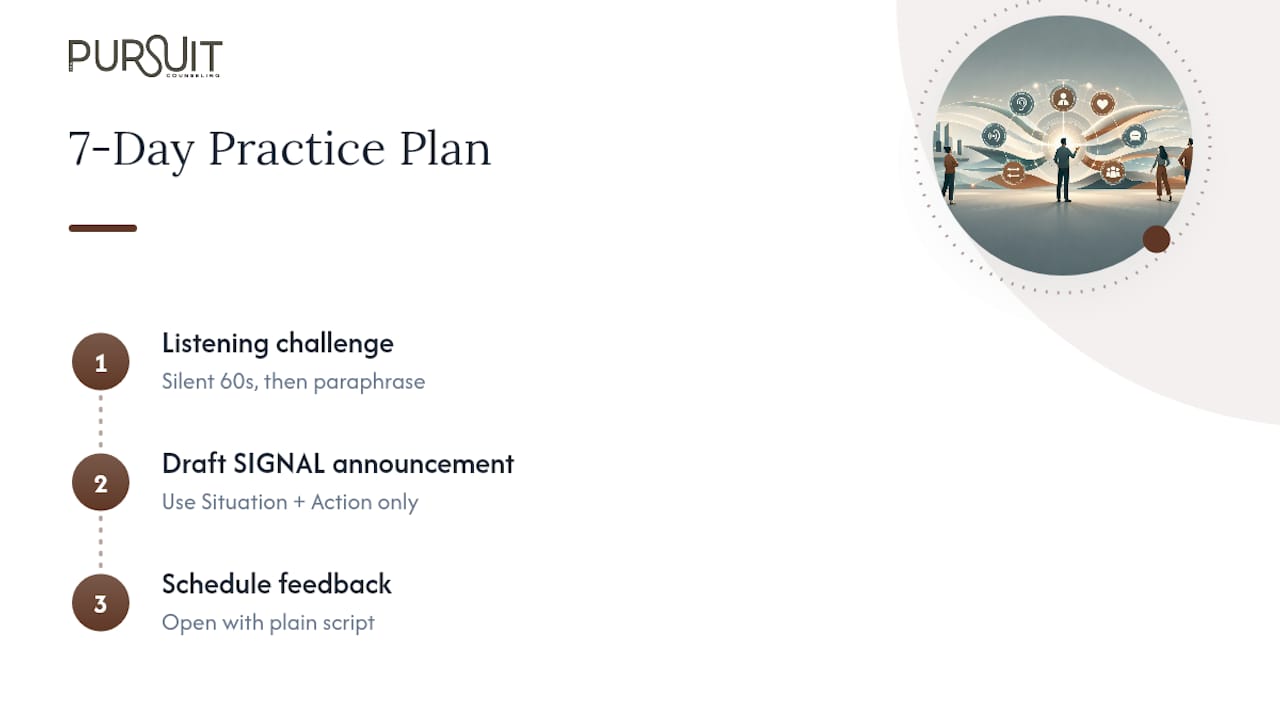
For your next three meetings, run a listening challenge: say nothing for the first sixty seconds, then paraphrase before responding. Draft one announcement this week using a two-sentence version of SIGNAL, situation and action only, and notice how much clearer it lands than your usual version. Finally, schedule one piece of feedback you’ve been putting off, and open it with the plain script from this article instead of easing in sideways.
None of these take more than a few minutes. All three together start rewiring the default you reach for under pressure, which is the entire game.
— Adam
Ready to Build Communication Flexibility That Sticks
Reading a framework and actually shifting your default style under pressure are two different things, and most leaders need real feedback to close that gap. Professional coaching and counseling services often work with executives, pilots, and high performers who already know the theory but keep reverting to pacesetting or commanding when the stakes rise.

Coaching and counseling for leaders pairs practical communication drills with the emotional intelligence work that makes them stick, so a new script doesn’t collapse the first time a deadline gets tight. If you’re weighing the investment, the executive coaching cost guide breaks down what sessions typically involve before you commit. The next step is simple: book a consult and walk through which communication pattern is costing you the most with your team right now.
Looking for a therapist or counselor in Fayetteville or Peachtree City, GA? The Pursuit Counseling provides personalized therapy, couples counseling, anxiety treatment, trauma therapy, EMDR, ADHD support, and neurofeedback Brain Mapping for adults, teens, couples, professionals, and families throughout Fayette County and South Atlanta. With a convenient office in Fayetteville, GA, near Peachtree City, Trilith, Tyrone, Senoia, and Newnan, our experienced counselors help clients improve mental health, strengthen relationships, manage stress, and pursue meaningful growth. Schedule a counseling consultation with The Pursuit Counseling today and find the right therapist for you in Fayetteville or Peachtree City, Georgia.
Sources
- The Six Leadership Styles (MindTools summary of Goleman)
- How to navigate diverse communication styles at work (Atlassian)
FAQ
What are the four types of leadership communication styles?
The four most commonly referenced profiles come from the DiSC framework: Dominant, Influencer, Steady, and Conscientious, each responding to different message content and delivery.
What are the 4 types of communication styles?
Beyond DiSC, communication research often groups styles into directive, expressive, analytical, and relational patterns, which map closely onto Dominant, Influencer, Conscientious, and Steady profiles respectively.
What are the 7 C’s of leadership communication?
The 7 Cs are a clarity checklist: Correct, Concise, Clear, Complete, Coherent, Courteous, and Channel, and running a message through them catches most confusion before it starts.
What is a leadership communication style?
A leadership communication style is the pattern a leader defaults to when directing, motivating, or informing a team, ranging from Goleman’s visionary and coaching styles to more directive commanding and pacesetting approaches, with adaptability across styles marking the most effective leaders.