

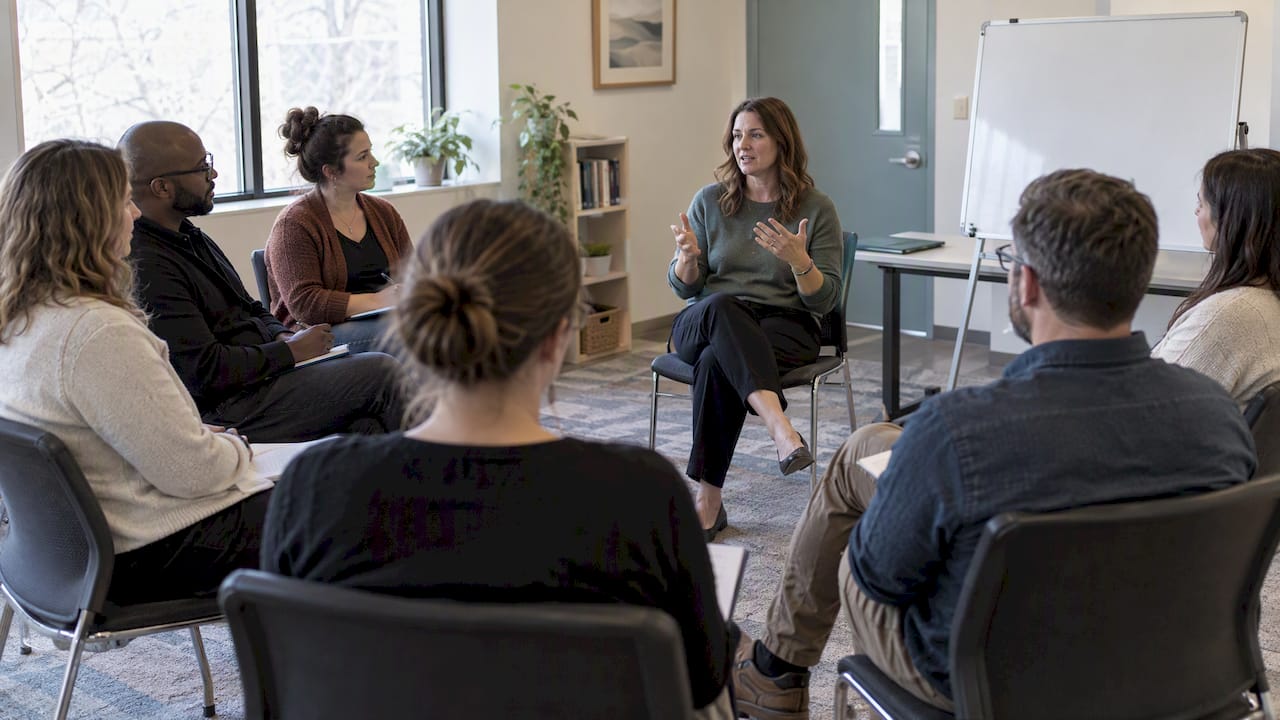
A well-run DBT workshop for teams gives staff practical skills across all four DBT modules, mindfulness, distress tolerance, emotion regulation, and interpersonal effectiveness, adapted to real workplace moments rather than clinical scenarios. We design ours this way at The Pursuit Counseling, drawing on benchmarks like the DBT STEPS-A curriculum. Educators, clinical teams, and leadership groups each benefit, though the right format depends on whether you need a brief introduction or a full competency series.
TL;DR:
- Short workshops can increase staff knowledge and reduce burnout modestly, but lasting skill development requires longer series or ongoing coaching.
- Facilitators must be licensed clinicians trained in DBT, with co-teaching recommended if the trainer lacks clinical credentials to ensure safety and clinical judgment.
- Planning should include clear goals, workplace-specific scenarios, logistics, and measurement of practical skill application to maximize retention.
- Reinforcement through follow-up sessions, brief check-ins, and practice recordings is essential to sustain improvements over time.
- A full competency curriculum, like DBT STEPS-A, requires extensive training and multiple sessions, making it suitable for teams committed to deep skill acquisition.
Table of Contents
- What a team DBT workshop actually teaches
- How long it takes: from a short intro to a full curriculum
- Who should lead your workshop
- How to plan a DBT workshop for your team
- Setting safety rules before anyone disclosures
- What the research actually shows about staff training
- Keeping the gains after the workshop ends
- A clinician’s take on what actually works
- Booking a team DBT workshop with The Pursuit Counseling
- FAQ
- Sources
What a team DBT workshop actually teaches
Each module shows up differently once you put it in a conference room instead of a therapy office. Mindfulness becomes a 90-second grounding exercise before a tense staff meeting. Distress tolerance becomes the pause a teacher takes before responding to a disruptive classroom, using something like the IMPROVE skills rather than reacting on impulse. Emotion regulation becomes naming the frustration behind a snapped email before sending it. Interpersonal effectiveness becomes a script for asking a manager for something difficult without over-apologizing or shutting down.
A solid lesson follows a predictable rhythm, which is part of why it works.
- Open with a short mindfulness practice to settle the group.
- Teach one skill with a concrete, work-specific example.
- Run a role-play so people practice the language out loud.
- Assign light homework: noticing one moment to apply the skill.
- Review what worked and what felt awkward at the next session.
This is skills education, not individualized clinical care. A workshop can change how a team talks to each other. It is not a substitute for therapy when someone is struggling with something deeper, and good facilitators say so plainly at the start.
How long it takes: from a short intro to a full curriculum
Teams usually choose from three shapes, and each one asks something different of your calendar.
- A single introductory session, often two to three hours, covering one or two skills with practice time built in.
- A multi-session series, typically four to eight sessions, that moves through all four modules with homework between meetings.
- A full competency-style training, modeled on benchmarks like DBT STEPS-A, which uses a 30-lesson curriculum and recommends a three-day instructor training for anyone delivering the material long-term.
That three-day instructor benchmark matters because it shows how much preparation real fluency requires. A two-hour workshop can build awareness and shared vocabulary. It will not make your staff into skilled facilitators. Teams adapting STEPS-A content for adults typically keep the module structure but compress lesson count and lean harder on workplace scenarios instead of classroom ones. The trade-off is straightforward: shorter formats fit tighter budgets and calendars, while longer series build skills that actually stick.
Who should lead your workshop
The facilitator matters as much as the curriculum. Training delivered by someone without clinical grounding in DBT tends to stay surface-level and struggles when a participant shares something heavier than expected.
- Look for a licensed clinician with specific DBT training, not just general facilitation experience.
- If a non-clinical trainer leads sessions, pair them with a clinician in a co-teaching model so clinical judgment is always in the room.
- Confirm the facilitator has access to supervision or consultation, since even experienced clinicians benefit from case review when training groups.
- Ask directly: What happens if someone discloses a safety concern mid-session? A vague answer is a warning sign.
- Ask how many times they have delivered this specific training and to what kind of audience, clinical staff versus general employees are not interchangeable groups.
Co-teaching also has a practical upside beyond safety. Pairing a clinician with an in-house staff member who knows the team’s culture tends to improve how material lands, since one person speaks fluent DBT and the other speaks fluent “how this office actually works.”
How to plan a DBT workshop for your team
Planning well in advance prevents the most common failure mode: a vague, one-off session nobody remembers by Friday.
- Define the goal first: general awareness, a specific skill set, or training people who will later coach others.
- Identify the audience and whether clinical and non-clinical staff need separate tracks.
- Confirm logistics: group size (smaller groups role-play better), a private space, printed or digital handouts, and any pre-work.
- Build two or three scenarios specific to your workplace rather than generic examples.
- Decide upfront how you will measure whether it worked, not just whether people enjoyed it.
Pro Tip: Write your workplace scenarios before you book the facilitator. It forces clarity on what skill gap you’re actually training for.
Scheduling around a predictable cadence, not a single squeezed-in afternoon, makes the difference between information and a skill people actually use three months later.
Setting safety rules before anyone disclosures
Skills training is education, not therapy, and that line has to be explicit before the first session starts. People will sometimes share more than a workshop is built to hold, and a plan that exists only in someone’s head is not a plan.
- State clearly, out loud, that this is skills education, not individual counseling or crisis intervention.
- Give facilitators a simple script for pausing a disclosure and following up privately.
- Document any safety-related disclosure according to your organization’s existing protocols, not an improvised one.
- Share limits of confidentiality in plain language before training begins: what stays in the room, and what must be reported.
- Have a named point of contact, ideally a mental health professional, for anything beyond the scope of the session.
A sample line facilitators can use: “This training is about building skills together. If something comes up that needs more individual support, we’ll pause and connect you with the right person afterward, privately.” That sentence alone resolves most of the awkwardness around disclosures before they happen.
What the research actually shows about staff training
Short, structured DBT trainings produce real but modest effects, and knowing the size of that effect helps you set expectations correctly.
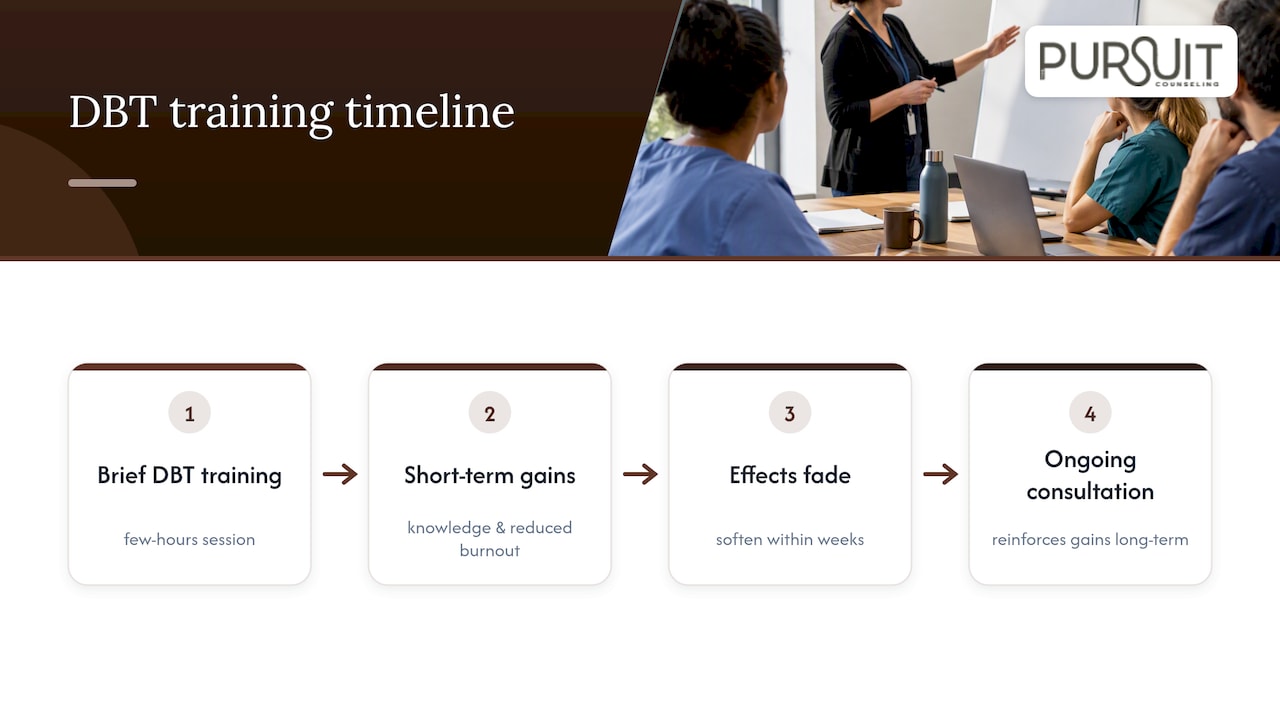
A study of mental health staff found that brief DBT training increased DBT knowledge and reduced burnout and stigma in a residential treatment setting, with similar patterns reported in school-based samples using multi-session formats. That is a meaningful outcome for a few hours of training time.
The limit is durability. A single session moves knowledge and attitudes in the short term, but structured implementation guidance points to ongoing consultation as the piece that keeps gains from fading. For a team, the realistic takeaway is this: expect a genuine bump in shared vocabulary, more staff willing to name their own stress out loud, and a modest dip in how burned out people report feeling. Expect those gains to soften within weeks unless something reinforces them. Addressing staff burnout directly, rather than treating it as background noise, is its own argument for why pushing through burnout rarely works.
Keeping the gains after the workshop ends
The follow-up plan is where most workplace trainings quietly fail, not the initial session itself.
- Run a short knowledge check before and 6 to 8 weeks after training to see what actually stuck.
- Track one or two behavior indicators, like whether staff report using a specific skill during a stressful week.
- Schedule monthly supervision or a brief refresher, even 30 minutes, rather than assuming the one-time session will hold.
- Build a two-minute skill check-in into an existing team meeting instead of creating a new obligation.
- Offer a short guided practice recording or handout people can return to on their own, like a practical distress tolerance plan.
Consultation does not need to be elaborate. Thirty minutes a month of structured conversation about what is and isn’t working beats an unused binder of handouts every time.
A clinician’s take on what actually works
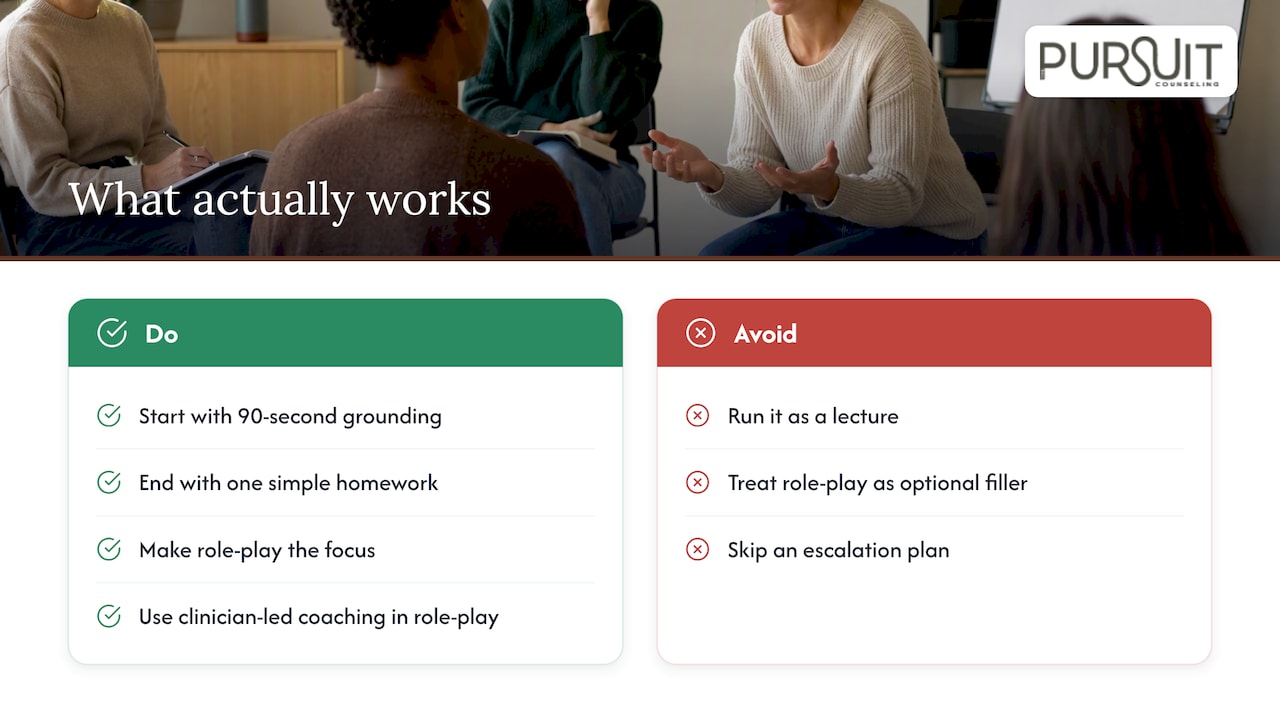
The biggest mistake we see is treating a DBT workshop like a lecture: slides, definitions, polite nodding, and nothing anyone remembers by Monday. Skills only become skills through repetition, which means the role-play is not optional filler, it is the point. The second mistake is no escalation plan. If a facilitator can’t answer what happens when someone discloses something serious, that is not a training gap, it is a liability.
Two fast wins: open every session with a 90-second grounding practice, and end every session with one specific, low-effort homework task. Clinician-led practice changes the ceiling on what a workshop can actually deliver, because real-time coaching during a role-play catches mistakes a slide deck never will.
— Adam Glendye LPC, CPCS
Booking a team DBT workshop with The Pursuit Counseling
We run our team workshops the way the research above suggests they should run: clinician-led, built around live practice rather than lecture, and paired with follow-up coaching so the skills don’t fade after one session.

Our Organizational Workshops for Teams & Leadership fit groups wanting a focused introduction or a longer series, structured so staff leave with language they’ll actually use under pressure, not just a handout. Teams that benefit most are ones willing to commit to at least a few sessions, since a single afternoon builds awareness but rarely builds habit.
- Sessions are led by clinicians.
- Practice and role-play are built into every session, matching the structure research supports.
- Follow-up coaching options exist for teams that want reinforcement beyond the initial workshop.
| Workshop format | What it includes | Price |
|---|---|---|
| Organizational Workshop for Teams & Leadership | One 3-hour session, clinician-led, practice-focused | Current prices are on the workshops page |
If your team is weighing options, this is one direct route to a clinician-led session rather than a generic facilitator booking. Reach out through the workshops page to check availability and talk through what format fits your group.
FAQ
What is a DBT workshop for teams?
A DBT workshop for teams teaches practical skills from dialectical behavior therapy’s four modules, mindfulness, distress tolerance, emotion regulation, and interpersonal effectiveness, adapted to workplace situations. It is skills education delivered to groups, not individual clinical treatment.
How long should a team DBT training be?
Formats range from a single two to three hour introduction to a multi-session series covering all four modules. Programs modeled on DBT STEPS-A benchmarks use a 30-lesson curriculum, showing that full competency takes considerably longer than a single session.
Who is qualified to lead a DBT workshop for staff?
A licensed clinician with specific DBT training should lead or directly oversee the session. A co-teaching model, pairing a clinician with in-house staff, works well when a full clinical team isn’t available.
Does a DBT workshop replace therapy for staff who are struggling?
No. Skills training builds shared language and coping tools for a group, but it is not individualized clinical care. Anyone disclosing a serious concern should be connected privately to appropriate support, as implementation guidance recommends.
What does The Pursuit Counseling charge for a team workshop?
Our Organizational Workshop for Teams & Leadership is priced as listed on the workshops page, typically for a 3-hour, clinician-led session.
Sources
- DBT Skills Training for Emotional Problem Solving for Adolescents (DBT STEPS-A)
- Effects of dialectical behavior therapy skills training on outcomes for mental health staff in a child and adolescent residential setting