


Contempt in marriage is treating your partner as beneath you, an attack on who they are rather than what they did. It is the most corrosive force a relationship can carry, and the Gottman Institute identifies it as the single greatest predictor of divorce among the patterns researchers can measure. It also does not stay confined to the relationship. Chronic contempt has been linked to weakened immune function and a higher likelihood of the kind of illness that keeps showing up when stress never lets go of the body.
Here is the part that matters most: contempt can be interrupted. It usually does not vanish on its own, but couples who name it early, change how they start hard conversations, and rebuild a habit of respect can turn the pattern around. The path generally includes a few concrete moves:
- Naming the behavior honestly, without minimizing it
- Replacing harsh openings with a soft start-up
- Rebuilding a foundation of appreciation instead of criticism
- Bringing in professional support when the pattern feels stuck
The rest of this guide walks through each of those steps, along with the research behind them.
Key Takeaways
Contempt in marriage predicts divorce more strongly than any other communication pattern researchers have measured, and reversing it requires naming the behavior, rebuilding appreciation, and getting professional support when the pattern feels entrenched.
| Point | Details |
|---|---|
| Contempt attacks identity | Unlike criticism, contempt communicates superiority and disdain toward who a partner is, not just what they did. |
| It’s the top divorce predictor | Gottman’s research identifies contempt as the strongest predictor of divorce among the patterns studied. |
| Health effects are physical | Contemptuous communication has been linked to weakened immune response and greater illness vulnerability. |
| Repair starts with small shifts | Soft start-ups, “I” statements, and daily appreciation habits interrupt the pattern before it hardens further. |
| Entrenched contempt needs support | Once contempt is chronic, evidence-based couples therapy typically works better than self-directed fixes alone. |
Table of Contents
- Understanding Contempt in Marriage vs. Criticism
- Signs of Contempt: A Quick Self-Check
- What Causes Contempt to Develop in a Relationship
- The Real Cost of Letting Contempt Go Unchecked
- How to Repair a Marriage After Contempt Takes Hold
- When to Seek Professional Help for Contempt
- How The Pursuit Counseling Approaches Contempt
- Contempt Looks Different Across Cultures and Backgrounds
- The Lasting Toll Contempt Takes on Both Partners
- Preventing Contempt Before It Ever Takes Root
- How Contempt Between Parents Affects Children at Home
- What Actually Moves the Needle on Contempt
- Sources
- FAQ
Understanding Contempt in Marriage vs. Criticism
Contempt is communication that says, “I am better than you.” Criticism says, “You did something wrong.” That distinction sounds subtle until you feel the difference from the receiving end. Criticism attacks a behavior. Contempt attacks a person’s worth, dignity, or character, and it comes from a place of superiority rather than frustration.
John Gottman’s research team named contempt one of the “Four Horsemen,” the communication patterns most linked to relationship breakdown, alongside criticism, defensiveness, and stonewalling. Contempt is the one Gottman’s team treats as the most dangerous of the four, because it signals something criticism alone does not: disgust and disrespect that have hardened into a settled judgment about who your partner is.
Contempt shows up in ways that are easy to miss until you know what to look for.
Verbal contempt often sounds like:
- Sarcasm delivered as a weapon rather than a joke
- Name-calling (“you’re pathetic,” “you’re so lazy”)
- Mockery of a partner’s opinions, fears, or mistakes
- Hostile humor aimed at humiliating rather than connecting
Nonverbal contempt often looks like:
- Eye-rolling during a conversation
- Sneering or curling the lip
- A dismissive scoff or exhale
- Mimicking a partner’s tone or words in a mocking way
Contempt rarely appears overnight. It develops gradually, usually after months or years of unspoken frustration hardening into a fixed, negative story about a partner’s character. That story becomes a lens. Once someone starts viewing a partner through it, even neutral behavior gets reinterpreted as further proof of the flaw they’ve already decided is there.
Contempt is fueled by long-simmering negative thoughts about a partner, and it comes across in the form of an attack on someone’s sense of self. It’s the greatest predictor of divorce, and it must be eliminated.
That framing from Gottman’s research team is worth sitting with, because it reframes contempt not as a bad moment but as an accumulated mindset, one that shows up in small gestures long before it shows up in a blowout fight.
Signs of Contempt: A Quick Self-Check
Some signs are loud. Most are quiet enough that couples miss them for years. Run through this checklist honestly, thinking about the last month of your relationship rather than just your worst fight.
- You mock or imitate your partner, even in a “joking” tone, when you disagree with them.
- You roll your eyes or sneer during conversations, especially when they’re talking about something that matters to them.
- You call them names under your breath or out loud, even ones that feel minor (“idiot,” “useless,” “pathetic”).
- You compare them unfavorably to other people, exes, or an idealized version of who they “should” be.
- You dismiss their feelings as dramatic, oversensitive, or beneath a serious response.
- You feel a flicker of superiority when they make a mistake, rather than empathy or frustration.
- You’ve stopped explaining yourself to them because you’ve decided they won’t understand anyway.
If three or more of these feel familiar, contempt has likely taken root, even if you have never used that word for it.
Here’s what contempt sounds like in real conversation, and what a healthier version looks like instead:
Contemptuous: “Wow, you actually remembered something for once. Impressive.”
Healthier: “Thanks for remembering that, it helped me out today.”
Contemptuous: (eye roll) “Sure, because your way always works out so well.”
Healthier: “I see it differently. Can we figure out a plan together?”
Contemptuous: “You’re being so dramatic right now.”
Healthier: “I can tell this is really bothering you. Tell me more.”
Beyond the checklist, ask yourself three questions. How often does this happen, daily, weekly, or only during major conflicts? Is it getting worse over time, or has it stayed at the same level? And is it changing how you behave day to day, are you avoiding conversations, withdrawing affection, or dreading time together?

Keeping a simple log for two weeks, even a few notes on your phone after tense moments, can reveal patterns that are invisible in the moment. Most couples underestimate frequency until they actually track it.
What Causes Contempt to Develop in a Relationship
Contempt rarely starts as contempt. It starts as resentment, and resentment starts as an unresolved grievance that never gets a real conversation. One unaddressed hurt becomes two, then a dozen, and the accumulation eventually curdles into something harder and more permanent: a settled belief that your partner is fundamentally selfish, lazy, or uncaring.
Structural imbalance accelerates that process. When one partner consistently carries more of the household labor, more of the parenting load, or more of the emotional management in the relationship, perceived unfairness builds quietly in the background. It does not need to be dramatic to be corrosive. It just needs to be constant.
Individual vulnerabilities matter too. A few common amplifiers:
- Unprocessed trauma, which can make a partner’s ordinary flaws feel like proof of danger or abandonment
- Chronic stress, from work, finances, or health, that shrinks a person’s tolerance for minor friction
- Insecure attachment patterns, which can turn normal conflict into evidence that a partner is unreliable or unloving
- Unmet emotional needs, particularly around feeling seen, appreciated, or prioritized
The typical arc runs something like this: a specific hurt goes unspoken, it repeats without resolution, resentment sets in as background noise, and somewhere between six months and several years later, that resentment calcifies into a fixed, disdainful view of the partner’s character. By the time contempt shows up in the room, the resentment driving it has usually been building far longer than either partner realizes. Recognizing that timeline matters, because it means the fix has to address the underlying resentment, not just the sharp comments sitting on top of it.
The Real Cost of Letting Contempt Go Unchecked
The starkest finding in Gottman’s longitudinal research is that contempt predicts divorce more reliably than any other communication pattern his team measured, including outright hostility or frequent conflict. That does not mean contempt guarantees divorce, or that its absence guarantees a lasting marriage. It means that of the patterns researchers tracked over years of watching couples interact, contempt carried the strongest association with relationships that eventually ended.
The health toll is real and measurable. Couples research connects contemptuous communication to physical strain on the body, including weakened immune response and greater vulnerability to infectious illness. Chronic disrespect keeps the nervous system on alert, and a body that stays on alert for years pays a price beyond the relationship itself.
Contempt also breaks something subtler: the ability to repair after conflict. Every couple fights. Healthy couples recover through what Gottman calls repair attempts, small gestures, a joke, an apology, a hand on the arm, that de-escalate tension before it hardens. Contempt poisons that mechanism. When one partner has decided the other is beneath them, repair attempts get rejected or ignored, because accepting them would mean treating the partner as an equal again.
That rejection tends to trigger a predictable next step: stonewalling. The partner on the receiving end of contempt often shuts down entirely, withdrawing from conversation rather than engaging with someone who has made their disdain clear. What looks like indifference from the outside is frequently self-protection from the inside, a nervous system opting out of a conversation it has learned will not go well.
How to Repair a Marriage After Contempt Takes Hold
Repair happens in layers. Some moves work in the next conversation. Others take months of consistent practice to rebuild what contempt wore down.
Start here, today:
- Name it out loud, to yourself first. Call the behavior what it is: “That was contempt, not just frustration.” Naming it breaks the autopilot that lets it repeat unchecked.
- Use a soft start-up. Gottman’s research shows that how a conversation begins predicts how it ends. Instead of “You never help with anything,” try “I’m feeling overwhelmed with the house, can we figure out a plan together?”
- Swap “you” statements for “I” statements. “You’re so inconsiderate” becomes “I felt hurt when I was left to handle that alone.” The second version invites a conversation. The first invites a wall.
- Make repair attempts, and accept them when your partner makes one. A joke that breaks tension, an early apology, a moment of physical affection, these are lifelines. Reaching for one, or taking one your partner offers, interrupts the spiral before it escalates further.
Build these over weeks and months:
- Create a ritual of appreciation. Naming one specific thing you appreciate about your partner daily, out loud, retrains attention away from the negative narrative contempt runs on.
- Aim for a 5:1 ratio. Gottman’s research on stable couples found roughly five positive interactions for every negative one during conflict. You do not need to track it obsessively, but the ratio is a useful gut check for whether appreciation is outweighing criticism in your daily life.
- Schedule real check-ins. A weekly fifteen-minute conversation about how you’re both doing, separate from logistics and chores, keeps small grievances from silently compounding into resentment.
For the long haul:
Fondness and admiration are the actual antidote to contempt, not just its opposite. Gottman’s research describes rebuilding a “culture of appreciation” as central to reversing contempt once it has taken root, and that culture has to be built deliberately. It rarely comes back on its own once it has faded.
Structural change often has to happen alongside the emotional work. If resentment grew out of an unequal division of household labor or parenting, renegotiating that division is not a side issue, it is often the root fix. Couples sometimes treat communication tools as a patch over a structural wound that needs its own repair. Reworking those roles, along with practicing better conflict resolution during disagreements, tends to hold up better than communication scripts alone.
When contempt is tangled up with deeper wounds, an affair, childhood trauma, a betrayal that never fully healed, communication tools alone usually will not be enough. That is often where trauma-focused work like EMDR becomes part of the process, addressing the wound underneath the contemptuous behavior rather than just the behavior itself.
Pro Tip: The next time you feel contempt rising, before you speak, silently finish this sentence: “What I actually need right now is ___.” Contempt often masks an unmet need that feels too vulnerable to say out loud. Naming the need, even just to yourself, makes it far easier to say something honest instead of something cutting.
When to Seek Professional Help for Contempt
Some situations call for outside support sooner rather than later. A few red flags worth taking seriously:
- Contempt shows up in most disagreements, not just the occasional bad moment
- One or both partners have withdrawn into consistent silence or stonewalling
- Attempts to talk it through at home keep dissolving into the same hostile pattern
- There are safety concerns of any kind, emotional or physical
Once contempt is entrenched, self-help conversations at the kitchen table often are not enough to shift it. Practitioner guidance on marriage resentment consistently notes that late-stage contempt typically needs an intentional therapeutic process to interrupt, rather than resolving through willpower alone.
What effective couples therapy generally does:
- Interrupts the cycle in real time, so a therapist can catch and name contempt as it happens rather than reconstructing it secondhand
- Surfaces the unmet needs underneath the disdain, which are rarely obvious to either partner without guided reflection
- Teaches repair skills that hold up outside the therapy room, not just in a controlled setting
The Gottman Method is built specifically around interrupting these four patterns and replacing them with the antidotes research has shown to work. When contempt is intertwined with past trauma, EMDR (Eye Movement Desensitization and Reprocessing) can help process the underlying wound driving the reactivity. For couples who need faster momentum, a couples intensive, several concentrated hours or days of focused work, can accomplish in a short window what might otherwise take months of weekly sessions.
Before booking, ask a prospective therapist about their specific training in couples and relationship counseling, how they structure early sessions, and whether they use an evidence-based model rather than general talk therapy. Those questions tell you more about fit than a website ever will.
How The Pursuit Counseling Approaches Contempt
Adam Glendye, founder of The Pursuit Counseling, brings a background in evidence-based couples work grounded in neuroscience and Gottman-informed methods, treating contempt as a pattern that can be interrupted with the right tools, not a character flaw either partner is stuck with.
The Pursuit Counseling’s approach draws on:
- Gottman Method couples therapy, targeting the Four Horsemen directly
- EMDR for trauma that fuels reactive, contemptuous patterns
- Neurofeedback, when nervous system regulation is part of the picture
Couples can start with standard weekly sessions or a concentrated couples intensive for faster momentum. Both options begin with the same first step, getting started with an initial consultation to map out what’s actually driving the disconnect.
Contempt Looks Different Across Cultures and Backgrounds
Contempt does not always sound the same from one household to the next. In cultures where indirect communication is the norm, contempt often shows up as cold withdrawal or pointed silence rather than an overt insult, disdain communicated through what is withheld rather than what is said. In cultures with more expressive communication styles, contempt might be louder and more direct, sharp words delivered in front of family members without much hesitation.
Family involvement changes the picture too. In collectivist cultures, extended family often weighs in on marital conflict, and contempt can flow through in-laws or relatives as much as between spouses, one partner’s family openly criticizing the other in ways that reinforce a contemptuous dynamic instead of resolving it.
Gender norms also shape how contempt gets expressed and tolerated. In some households, traditional expectations about who manages the home or earns income create fertile ground for contempt when those roles feel unfulfilled or unfairly distributed, and the resulting resentment can be voiced very differently depending on which partner feels shortchanged.
None of this changes the underlying mechanism Gottman’s research describes: contempt as an attack on identity, layered with a sense of superiority. What changes is the vocabulary, the volume, and who else gets pulled into the pattern. A therapist working with couples from different backgrounds has to recognize contemptuous behavior even when it doesn’t match the sarcastic, eye-rolling stereotype most people picture. Sometimes it looks like silence. Sometimes it looks like a raised voice. The disdain underneath is the same.
The Lasting Toll Contempt Takes on Both Partners
Contempt does damage long after a marriage ends, or long before anyone considers ending it. The partner on the receiving end often carries the effects into future relationships, an internalized belief that they are not good enough, that their opinions do not matter, or that love always comes with a side of disdain. That belief does not stay contained to the marriage where it formed.
The partner delivering the contempt is not unaffected either, even though it can look that way from outside. Chronic contempt correlates with the deliverer’s own dissatisfaction and disconnection, since expressing ongoing disdain toward someone you share a life with tends to erode a person’s own capacity for warmth and closeness over time. Contempt corrodes both directions, even when only one person appears to be doing the damage.
Anxiety and depression show up more frequently in people who have lived inside chronically contemptuous relationships, whether they were giving or receiving the contempt. Self-esteem takes a measurable hit, particularly for partners who absorbed years of subtle putdowns before ever naming what was happening to them.
There is a quieter cost too: a diminished capacity for trust in future relationships. Someone who spent years being mocked or dismissed by a spouse often enters the next relationship braced for the same treatment, seeing warning signs in gestures that mean nothing at all. Undoing that hypervigilance usually takes real therapeutic work, not just a healthier partner and the passage of time.
Preventing Contempt Before It Ever Takes Root
The best time to address contempt is before it exists. Couples who never let resentment calcify have usually built a few habits early, often without naming them as prevention strategies at all.
Talk about grievances while they’re still small. The instinct to let a minor annoyance slide feels generous in the moment. Repeated over months, it becomes the raw material contempt is made of. Addressing friction early, while it still feels manageable, keeps it from compounding into something bitter.
Build appreciation as a daily habit, not an occasional gesture. Couples who name what they value in each other regularly are harder to knock off course later, because the foundation of fondness and admiration is already established before conflict tests it.
Revisit fairness in the relationship regularly. Household labor, parenting responsibilities, and emotional management shift over time, and what felt balanced during dating rarely stays balanced without ongoing conversation. Checking in on this every few months prevents quiet resentment from building in the background.
Protect your own sense of self within the relationship. Gottman-informed work often points to differentiation, the ability to stay grounded in your own values and identity while staying close to your partner, as a buffer against resentment. Couples who lose themselves entirely in each other often struggle more when disappointment inevitably shows up.
None of this requires perfection. It requires catching small ruptures before they become a settled story about who your partner is.
How Contempt Between Parents Affects Children at Home
Children absorb far more of their parents’ conflict style than most parents realize, and contempt is one of the patterns they pick up fastest. Kids do not need to understand the content of an argument to register the tone. Sneering, eye-rolling, and mocking speech register as danger signals to a child’s nervous system, even when the words themselves go over their head.

Kids raised around chronic parental contempt often internalize a template for what intimate relationships look like, one where disrespect is normal background noise rather than a serious problem. That template tends to follow them into their own future relationships, sometimes as a pattern they repeat and sometimes as a pattern they fear without fully understanding why.
Anxiety and behavioral changes are common in children exposed to ongoing contemptuous conflict between parents, ranging from difficulty concentrating in school to increased irritability at home. Some children become anxious peacemakers, constantly monitoring the emotional temperature of the house. Others withdraw entirely, learning that staying invisible feels safer than getting pulled into tension between parents.
The family system itself often reorganizes around the conflict. One parent may pull a child into an alliance against the other, whether consciously or not, which places the child in a loyalty bind no child should have to navigate. Siblings sometimes split along the same lines, replicating the household’s contempt in their relationships with each other.
None of this means occasional conflict harms children. Kids can handle disagreement, and healthy repair after conflict actually teaches them something valuable. What harms them is watching one parent consistently treat the other with disdain, and never seeing that pattern repaired.
What Actually Moves the Needle on Contempt
The conventional advice on contempt treats it like a communication problem you can solve with better scripts. Scripts help. They are not the fix. Contempt is a verdict one partner has quietly reached about the other’s character, and no soft start-up undoes a verdict that took two years to form.
What the research actually supports is less tidy than a communication tip: contempt reverses only when the underlying resentment gets addressed, structurally and emotionally, alongside the communication work. That means renegotiating unfair labor splits, not just apologizing for the tone used to complain about them. It means rebuilding fondness deliberately, because it does not return on its own once contempt has displaced it.
If you take one thing from this guide, let it be this: stop trying to win the argument where contempt shows up, and start asking what unmet need is underneath it. That question, asked honestly, does more than any script.
This article is general information, not a substitute for advice from a qualified doctor. Consult a qualified healthcare professional about your own circumstances before acting on anything here.
Sources
- What is Contempt? Understand one of the Gottman four horsemen
FAQ
What are examples of contempt in a marriage?
Common examples include eye-rolling, sneering, mocking a partner’s opinions, sarcastic put-downs, name-calling, and comparing a partner unfavorably to others. All share a common thread: communicating superiority rather than disagreement.
Can marriages recover from contempt?
Yes, though recovery generally requires naming the pattern honestly, replacing criticism with appreciation, and often professional support once contempt has become entrenched. Couples who address it early tend to have an easier path than those who wait years.
What are the stages of a marriage breaking down?
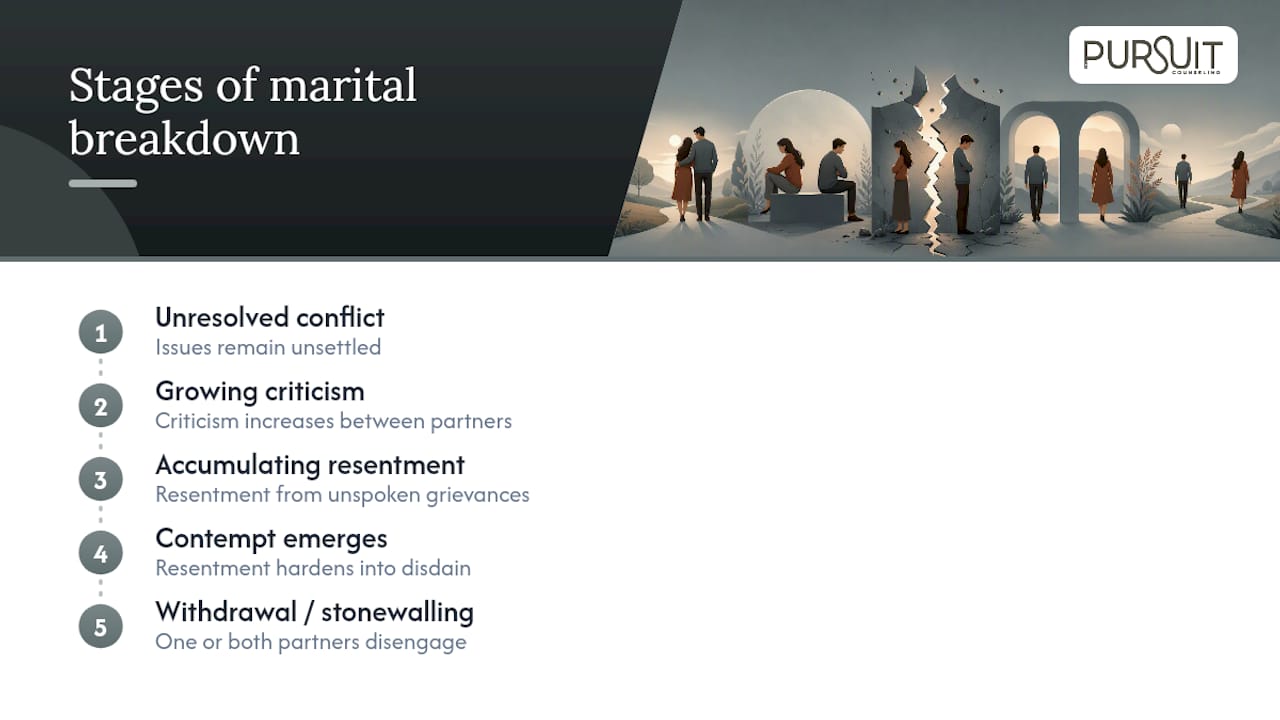
Marriages typically decline through a recognizable sequence: unresolved conflict, growing criticism, resentment that accumulates from unspoken grievances, contempt as that resentment hardens into disdain, and finally withdrawal or stonewalling as one or both partners disengage.
What is the root cause of contempt in a relationship?
Contempt usually grows out of long-term, unresolved resentment, often fueled by perceived unfairness in household labor, unmet emotional needs, or personal vulnerabilities like stress and unprocessed trauma that make ordinary friction feel like a bigger threat.
Recommended
- How to Stay Married – The Pursuit Counseling
- Affair Discovery: A Guide for Couples – The Pursuit Counseling
- Why Working with a Family Law Attorney and a Professional Counselor Can Make Divorce More Manageable – The Pursuit Counseling
- Intimacy in Relationships: Marriage Counseling Fayetteville, GA – The Pursuit Counseling