


A boundary in marriage is a line about what you will do, not a rule about what your spouse must do. It says where you end and the relationship begins, and it lets two separate people stay close without one of them disappearing. If you are reading this, you may be tired, resentful, or quietly keeping score. You may love your spouse and still feel like you have no room of your own. That is a common place to land, and it is workable.
Key Takeaways
- A healthy boundary describes your own action (“I will leave the conversation if we start yelling”), not a demand that your spouse change.
- Say it calmly, briefly, and outside the heat of an argument. You are responsible for how you say it, not for how it is received.
- Boundaries cover more than sex and in-laws: time, money, privacy, digital life, and emotional load all count.
- Repeated crossing, refusing to talk about limits, or guilt-tripping you for having them is a pattern worth taking seriously, and sometimes a safety issue.
- This article is education, not an assessment of your marriage. A counselor can look at your specific dynamic.
Table of Contents
- What a boundary in marriage actually is
- Why boundaries and closeness are not opposites
- Examples of reasonable boundaries in a marriage
- How to know what your boundaries are
- How to talk about it without starting a fight
- What to do when a boundary is crossed
- When it is more than a communication problem
- What a counselor adds
- Working on this with us
- A short plan for this week
- FAQ
- Sources
What a boundary in marriage actually is
Most couples hear “boundaries” and picture walls. Walls keep people out. A boundary is closer to a property line: it tells your spouse where you stand so they do not have to guess.
The distinction that matters most is between a boundary and a control tactic. Love Is Respect separates the two: healthy boundaries protect and respect you, while unhealthy ones try to control or harm the other person. Their example is a partner demanding you stop seeing friends because of jealousy. That is not a boundary. It is a rule about someone else’s life.
A quick test:
| Sounds like a boundary | Sounds like control |
|---|---|
| “I’m going to step out if we start shouting. I’ll come back in twenty minutes.” | “You need to stop raising your voice.” |
| “I’m not comfortable with joint accounts being used for gifts to family without a conversation first.” | “You can’t send your mother money.” |
| “I need an hour after work before we talk about the kids’ schedules.” | “Don’t talk to me when I get home.” |
| “I won’t read your texts, and I’d like the same trust in return.” | “Hand me your phone.” |
The left column names what the speaker will do. The right column tries to manage another adult. If you want a longer way to picture this, our house analogy for healthy boundaries walks through doors, windows, and walls.
Why boundaries and closeness are not opposites
Many high-performing people we work with assume that a boundary means distance. They are the ones who say yes to everyone, absorb everyone’s stress, and arrive home with nothing left. Then the marriage gets what is left, and resentment fills the gap.
It usually works the other way. When there are no limits, one spouse becomes the shock absorber and the other becomes the thing being absorbed into. Closeness starts to feel like losing yourself, so people pull away or blow up. Clear limits make closeness possible because each person knows they can stay without being swallowed. We write more about this in differentiation in marriage, the ability to stay connected while remaining a whole person.
Examples of reasonable boundaries in a marriage
There is no universal list. Couples differ by culture, faith, family history, and season of life. But the categories are consistent. Utah State University’s Utah Marriage Commission names several types, and we have added the kind of everyday example each tends to look like.
Time and energy
This covers running late, work hours, and who carries the mental load. Example: “If you’re going to be more than thirty minutes late, I need a text so I can plan dinner and the kids.” For executives, pilots, and business owners, it can also mean agreeing on a real off switch, such as no email at the table.
Emotional
This is about privacy and emotional labor. Example: “I want to support you, but I can’t be your only outlet for work stress every night. I’d like us to find other places for some of it too.” It also includes the right to feel differently than your spouse and not be talked out of it.
Physical and sexual
Personal space, touch, and intimacy all belong here. A point worth keeping in mind: comfort levels and desires change, so a past yes is not a future yes, and everyone has the right to say no at any time. Marriage does not cancel that. Couples who hold this well tend to have more honest intimacy, not less. Our piece on intimacy and passion in marriage goes deeper.
Material and money
Lending items, spending thresholds, and who pays for what are all material boundaries. Example: “Anything over 0 we decide together.” Money limits work best when they are mutual agreements, not one person’s verdict.
Intellectual
This is the boundary against having your thoughts dismissed. Example: “You can disagree with me, but I won’t keep talking if my views are mocked.”
Digital
Phones, social media, and messaging with others are now their own category. The Massachusetts guidance on healthy relationships lists physical, emotional, and digital comfort as things to notice in yourself. Agreements here are most durable when both people helped write them.
Family, in-laws, and children
This is where many couples feel the most friction. Your spouse comes first in the pecking order of loyalties, and parenting decisions are made as a team. If you are split on discipline or on how involved grandparents get, our article on attachment-informed parenting protocols addresses how to keep a united front.
How to know what your boundaries are
Some people cannot answer “what do you need?” because they have spent years answering “what does everyone else need?” If that is you, start with your body and your reactions rather than a list.
The Massachusetts guidance suggests noticing how you feel around someone, what makes you nervous or uncomfortable, and what you are okay with physically, emotionally, and digitally. New York State’s version describes a boundary as a line between what you are okay with and what you are not okay with, are not ready for, or find uncomfortable, and notes that it teaches your partner about your needs.
Some questions to sit with, ideally on paper:
- When do I feel dread walking through the front door?
- What do I agree to and then resent an hour later?
- What do I keep rehearsing in the shower or the car?
- Where do I feel my chest tighten when my spouse asks for something?
- What would I need to feel less like a manager and more like a partner?
Resentment is information. It often marks a boundary you have not yet named.
The Healthy Relationships Initiative (2025) recommends self-reflection to identify your needs before a difficult conversation, and suggests that process matters more than content when managing conflict. Knowing what you want to say matters less than how you say it.
How to talk about it without starting a fight
Timing and tone carry most of the weight. The HRI e-book suggests using I statements and avoiding both heated moments and text messages for important boundary discussions. A hard topic over text reads colder than you mean it, and a hard topic at 11 p.m. after a fight rarely goes well.
When you are ready:
- Pick a calm window. Ask first: “Can we talk about something that matters to me this weekend?”
- Open with your need, not their failing. Massachusetts suggests phrases such as “It’s important to me when…” or “I need you to know I feel strongly about…”
- Keep it short. The UC Davis CARE toolkit advises stating a boundary clearly, calmly, firmly, respectfully, and in as few words as possible.
- State what you will do. “If the conversation turns into name-calling, I’m going to take a break and come back to it.”
- Let their reaction be theirs. The same toolkit says you are responsible for communicating respectfully, not for the other person’s reaction.
- Take your time. UC Davis also notes that setting healthy boundaries takes time and should happen on your own timeline, not when someone else tells you to.
A worked example. Dana and Marcus, a composite of the patterns we often see, both work long hours. Dana used to say, “You never help at home.” Marcus heard an attack and went quiet. Dana tried a new line: “I’m hitting a wall by 8 p.m. I need us to split the evening routine, and I’d like to figure out how together. Can we sit down Sunday?” Same need. Different door. Marcus had something to respond to instead of something to defend against.
If your talks keep turning into the same fight, our guide on how to argue effectively covers the mechanics of repair.
What to do when a boundary is crossed
Here is where most advice falls apart. You cannot force a spouse to honor a limit. You can decide what you do next.
Utah State University describes scaffolding: designing your own responses to boundary violations so they depend on your behavior, not on controlling your partner. Mayo Clinic (2024) similarly suggests having an action plan, which might include practicing firm, kind refusal or limiting interaction with people who will not respect established limits. It also frames what it calls the law of relationships: you cannot control other people’s thoughts or feelings, only your own reactions.
A simple ladder looks like this:
- Restate it once, calmly. “I mentioned I need a heads-up before you invite people over. I’d like that.”
- Name the consequence that is yours to carry out. “If it happens again, I’ll make other plans for the evening.”
- Follow through without a speech. A consequence you do not carry out teaches both of you that the boundary is optional.
- Check in later. After things are calm, ask what got in the way. Sometimes the limit was unclear, or it collided with a need your spouse never voiced.
Notice that none of these steps are punishments. They are the natural result of what you said you would do. If you find yourself wanting to punish, that is a good signal to talk with someone before acting.
Not every crossing is the same
A forgetful spouse who misses a text is not the same as a spouse who dismisses your limits. Look for patterns: does the same line get crossed over and over, and what happens when you bring it up?

When it is more than a communication problem
We want to be plain about this. Love Is Respect lists repeatedly crossing boundaries, refusing to discuss them, and guilt-tripping a partner for having boundaries as examples of boundaries not being respected. Their guidance is that this pattern suggests a very unhealthy relationship that could become abusive if it continues and escalates.
If raising a boundary feels unsafe, do not rely on a couples conversation to fix it. The same page advises seeking support from a trusted person or advocate and considering a safety plan for leaving or staying safe, along with prioritizing your safety and documenting harmful behavior in case you seek a protective order or legal help. Domestic violence advocates are the right professionals for that planning, and the Love Is Respect page is a good place to start finding them.
Couples counseling is not the right first step when one partner is afraid of the other. Individual support comes first. If you are unsure which category you are in, say so to a licensed counselor in a one-on-one session.
What a counselor adds
Boundaries are simple to describe and hard to live. Part of the reason is history. You may have learned early that having needs makes you a burden, or that keeping the peace is your job. You may be married to someone who learned the opposite. Those patterns do not respond well to willpower or a list of scripts.
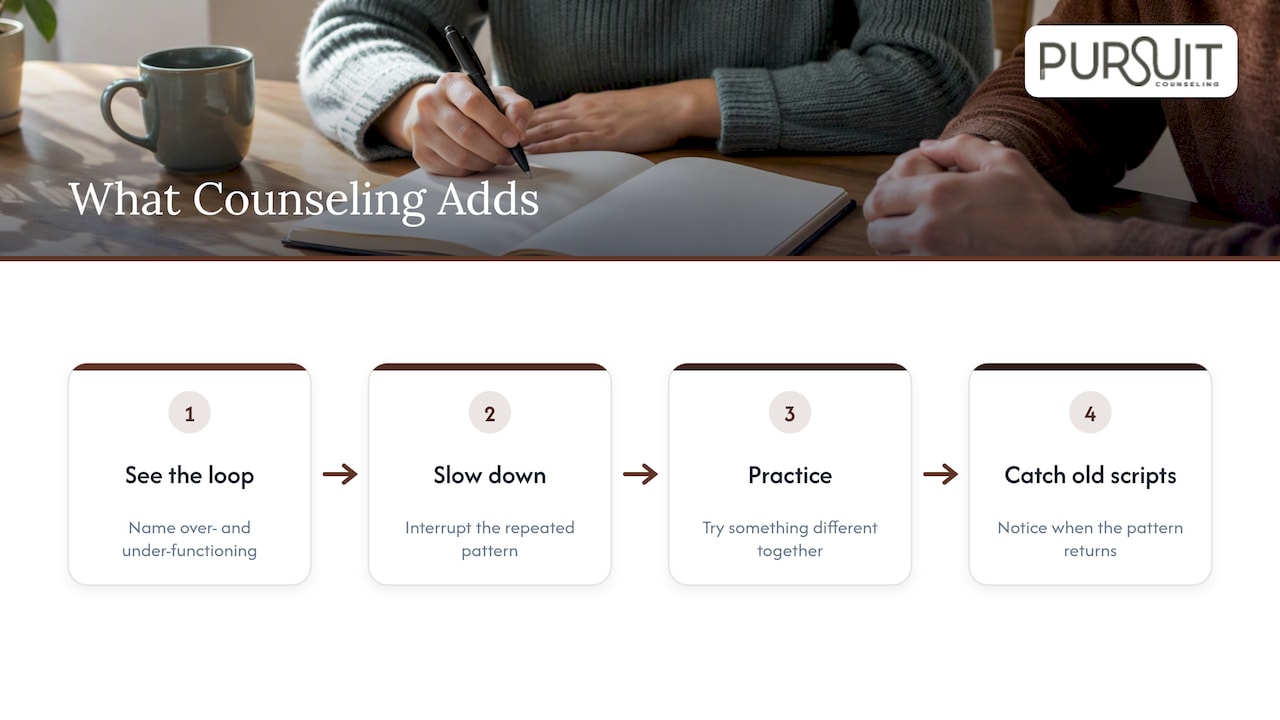
In our work with couples, the pattern often looks like this: one person over-functions and quietly resents it, the other under-functions and feels criticized. Both are exhausted. Both are trying. A counselor helps you see the loop, slow it down, and practice something different in the room, with someone to catch it when the old script returns.
If your boundary struggles center on affairs or broken trust, see our page on infidelity recovery counseling for couples. If you feel emotionally stuck and cannot name why, identifying barriers to connection may help. And if you are wondering whether the marriage can hold, how to stay married takes that question head on.
Our perspective
We rarely meet couples who have no boundaries because they do not care. More often, they care so much, and for so long, that they stopped checking what it cost them. The pain cave of a marriage is usually not one big betrayal. It is a thousand small yeses that were not yes.
When we sit with couples, we are not refereeing who is right. We are looking at the cracks: where one person went missing, where the other got loud, where the same argument keeps starting from the same place. Those cracks are not proof the marriage is failing. They are where the real conversation lives.
We do not believe in scripts that fix people. We believe in specific, honest limits, said by a person who can tolerate the discomfort of saying them. That takes support. It often takes a structured block of time with a therapist who will not let the conversation slide away, which is why we offer both weekly sessions and couples intensives. Nothing here is a promise of an outcome. It is a commitment to do careful work with you, at your pace, with evidence-based methods and a real person across from you.
Adam Glendye LPC, CPCS
Working on this with us
We offer couples therapy in Fayetteville, Georgia, serving Peachtree City, Senoia, Tyrone, and South Atlanta, both in person and online. If weekly sessions have not given you room to get below the surface, a couples intensive concentrates the work into a longer block. Our Couples Intensive is listed at ,500 per 3-hour intensive on our services page, and individual therapy runs 5 to 0 per hour. We are a private-pay practice. You can read what to expect from a couples intensive before deciding.

To start with the basics, see our couples and relationship counseling services or reach us through our site. A first conversation is the next step that matches where most people are: curious, uncertain, and not yet sure the marriage needs more than a good talk.
A short plan for this week
You do not need to fix everything. Try this sequence:
- Write down two moments this week when you felt resentful. Name the need under each.
- Pick one need that is small and specific.
- Choose a calm time and say it in two sentences using your own words.
- Decide in advance what you will do if it is not honored, and keep that plan modest.
- After a week, tell your spouse what you noticed, including what they did well.
If this process surfaces something bigger than a conversation can handle, that is useful information too, not a failure.
FAQ
What are reasonable boundaries in a marriage?
Reasonable boundaries protect your wellbeing without controlling your spouse. Common ones involve time, money, privacy, intimacy, digital habits, and family involvement. A good test: does it describe what you will do, or does it dictate what your spouse can do?
How do I know what my boundaries are?
Pay attention to what makes you uncomfortable, anxious, or resentful. Public health guidance suggests noticing how you feel around a person and what you are okay with physically, emotionally, and digitally. Writing down the moments you wanted to say no but said yes is a practical place to start.
What happens when a spouse keeps breaking a boundary?
Restate it calmly once, then act on the consequence that belongs to you, such as leaving a conversation or making other plans. You cannot control your spouse, but you can control your response. If the crossing is constant, comes with guilt-tripping, or you fear raising it, talk to a counselor or an advocate.
Are boundaries selfish in a marriage?
No. A clear limit gives your spouse accurate information about you, and it keeps resentment from building. The difference between a boundary and selfishness is that a boundary does not require your spouse to lose something essential. It asks for honesty and mutual respect.
Should we see a counselor about boundaries?
It can help when the same conflict keeps repeating, when one of you feels unheard, or when you cannot tell your own needs from your spouse’s. A counselor offers perspective, not a diagnosis of your marriage. If you feel unsafe, start with individual support and a domestic violence advocate.
Sources
- What are my boundaries? Love Is Respect
- When boundaries aren’t respected, Love Is Respect
- What does a healthy relationship look like? Mass.gov
- What Does a Healthy Relationship Look Like? New York State
- Boundary Setting Toolkit, UC Davis CARE
- Managing Conflict in Close Relationships, Healthy Relationships Initiative (2025)
- How do I Set Boundaries? Utah State University Extension (2023)
- Healthy relationships: setting boundaries
- Setting boundaries for your well-being, Mayo Clinic Q and A (2024)