


A Love Map is your continuously updated mental file of your partner’s inner world — their stressors, dreams, fears, and daily joys. According to the Gottman Institute, the single most direct way to start building yours is to ask one open-ended question tonight and listen without interrupting. That’s it. No workbook required, no perfect moment needed. If you want ready-to-use questions right now, skip ahead to the exercises section below.
Key Takeaways
Love Maps are the foundation of Gottman’s Sound Relationship House, and building them through regular, curious conversation is one of the most direct paths to lasting emotional intimacy.
| Point | Details |
|---|---|
| Start with one question | Ask one open-ended question tonight and listen without judgment — no workbook needed. |
| Update after life shifts | Re-interview your partner during parenthood, job changes, or any major transition to keep the map current. |
| Use structured prompts | Gottman Love Map card decks reduce pressure and help couples cover topics they’d otherwise avoid. |
| Seek therapy when stuck | Persistent disconnection, escalation, or trauma patterns are signs that a Gottman-informed clinician can help. |
| The Pursuit Counseling | Offers Gottman-aligned couples therapy and intensives in Georgia for partners ready for professional support. |
Table of Contents
- What are Gottman Love Maps and where do they come from?
- Why Love Maps matter for intimacy and resilience
- How do you build and keep a Love Map updated?
- Ready-to-use Love Map exercises and question sets
- Common obstacles and how to handle them
- When should you bring Love Map work to a therapist?
- What Love Map work actually looks like over time
- The Pursuit Counseling offers Gottman-aligned couples work in Georgia
- Sources
- FAQ
What are Gottman Love Maps and where do they come from?
Dr. John Gottman developed the Love Map concept as part of his Sound Relationship House framework, a research-based model of what makes relationships last. Love Maps sit on the very first floor of that house — meaning they are the foundation everything else is built on. Without them, the upper floors (shared meaning, trust, commitment) rest on unstable ground.
The term itself describes a mental repository you carry of your partner’s inner life. Not just their favorite restaurant, but the worry that keeps them up at night, the childhood memory that still shapes how they handle conflict, the dream they haven’t said out loud yet. Practitioners at Verywell Mind describe Love Maps as built through communication, curiosity, vulnerability, and trust — four things that don’t happen by accident.
A well-developed Love Map holds details like:
- Current stressors at work or with family
- Long-term goals and personal ambitions
- Emotional triggers and sensitivities
- Core values and spiritual beliefs
- Everyday preferences, rituals, and small pleasures
The map is never finished. People change, and the couples who stay close are the ones who keep asking.
Why Love Maps matter for intimacy and resilience
Couples with rich Love Maps handle life’s disruptions better. Think about what happens when a baby arrives, a job disappears, or a parent gets sick. Partners who know each other deeply can lean on that knowledge. Those who stopped asking questions years ago often find themselves strangers at the exact moment they need each other most.
The Gottman Institute’s Art and Science of Love workshop — a structured two-day couples program built around the Sound Relationship House — reports that 86% of attending couples show positive relationship outcomes. Love Map work is a core component of that program.
86% of couples who attended the Art and Science of Love workshop reported positive relationship outcomes — and Love Map exercises are built into the program’s foundation.
| Benefit | What the research and practice show |
|---|---|
| Deeper emotional intimacy | Knowing your partner’s inner world creates felt closeness, not just surface familiarity |
| Stronger marital friendship | Gottman’s research ties Love Map richness directly to the quality of the friendship layer |
| Better conflict resilience | Couples who understand each other’s stressors de-escalate faster during disagreements |
| Smoother life transitions | Updated Love Maps help partners support each other through parenthood, career shifts, and loss |
The friendship layer matters more than most couples realize. Gottman’s decades of research found that the quality of marital friendship — not passion, not communication technique — is the strongest predictor of long-term satisfaction. Love Maps are how that friendship stays alive.
How do you build and keep a Love Map updated?
The process is simpler than most people expect, and more forgiving. You don’t need a therapist in the room to start. What you need is time, a willingness to be curious, and a commitment to listen without turning the conversation into a debate.
Setting up the conversation
- Choose a low-stakes moment. Not during a conflict, not right before bed when you’re exhausted. A walk, a quiet dinner, or a weekend morning works well.
- Set a ground rule: no judgment. Whatever your partner shares, your job is to understand it, not evaluate it.
- Take turns. One person asks, the other answers. Then switch. This prevents the exercise from feeling like an interview.
- Use open-ended questions. “What’s been weighing on you lately?” gets you further than “Did you have a good day?”
- Follow up with curiosity. “Tell me more about that” is one of the most powerful phrases in this work.
Keeping it current
Forbes contributor and psychologist Mark Travers recommends a layered approach: brief daily check-ins (two to three minutes), a slightly deeper weekly conversation, and a full re-interview during major life transitions. Most couples stop asking new questions after the early relationship phase. Successful couples treat re-interviewing as a habit, not an event.
Tools that help:
- Gottman Love Map card decks for structured, low-pressure prompts
- Shared notes apps (Apple Notes, Google Keep) to log things your partner mentions
- Weekly rituals like a Sunday morning coffee check-in
Pro Tip: Never use Love Map questions as a test. The goal is curiosity, not a score. If your partner answers differently than you expected, get interested — don’t get defensive. Therapists consistently flag the “gotcha” dynamic as the fastest way to shut the exercise down.
Ready-to-use Love Map exercises and question sets
These formats come directly from Gottman Institute materials and are designed for turn-taking at home. Start with the 10-question set if you’re new to this. Move to the 25-question version when you want to go deeper.
10-question starter set (one sitting, 20–30 minutes)
- What’s one thing stressing you out right now that I might not know about?
- What’s something you’re looking forward to in the next few months?
- Who in your life do you feel most supported by right now?
- What’s a personal goal you’ve been thinking about lately?
- What does a perfect Saturday look like for you these days?
- What’s something you wish I understood better about you?
- What’s a fear you carry that you don’t talk about often?
- What’s something small I do that means a lot to you?
- What’s a memory from your childhood that still shapes how you see the world?
- What’s one thing you’d love us to do together that we haven’t tried yet?
25-question deeper set (two or more sessions)
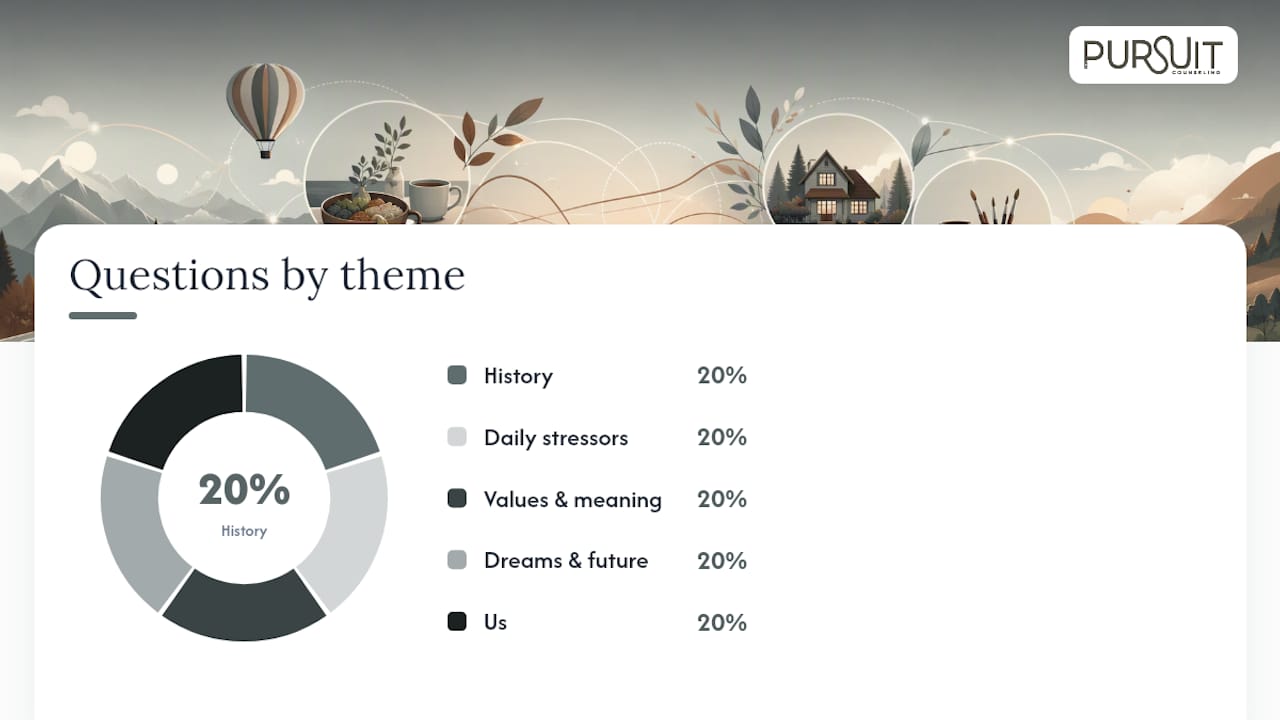
History and background:
- What’s the hardest thing you’ve ever gotten through?
- Who was the most influential person in your childhood?
- What did your family teach you about love — spoken or unspoken?
- What’s a belief you held ten years ago that you’ve since changed?
- What’s a moment in your life you’d go back and do differently?
Current stressors and daily life:
6. What part of your week drains you the most?
7. What do you need from me when you’re overwhelmed?
8. What’s something at work (or home) that feels unresolved right now?
9. How do you know when you need alone time?
10. What’s something you’ve been avoiding that you know you need to face?
Values and meaning:
11. What does success look like to you right now — not five years ago, now?
12. What role does spirituality or faith play in your life?
13. What’s a cause or issue you care deeply about?
14. What do you want our relationship to stand for?
15. What’s something you believe that most people around you don’t?
Dreams and the future:
16. What’s a dream you’ve put on hold?
17. Where do you see yourself in ten years?
18. What kind of old person do you want to become?
19. What legacy do you want to leave?
20. What would you do if you knew you couldn’t fail?
Us:
21. What’s your favorite memory of us together?
22. What do I do that makes you feel most loved?
23. What’s something you wish we talked about more?
24. What’s a ritual or tradition you’d love for us to create?
25. What’s one thing you need more of from me right now?
The Love Map game
The Gottman Institute’s game format uses 20 questions in a turn-taking structure. Rules are simple:
- Draw or select a card (or question) at random.
- Each partner answers the same question before moving to the next.
- No scoring. No “right” answers.
- If a question sparks a longer conversation, let it. The game is a starting point, not a finish line.
The Gottman Love Map card decks are designed specifically for this format — open-ended prompts that cover light topics and harder ones. Practitioners note that including difficult or emotionally charged questions builds the empathy couples need during conflict, not just during calm moments.
Common obstacles and how to handle them
Most couples hit at least one of these walls. Knowing they’re normal makes them easier to move through.
- “This feels awkward.” Start lighter. Ask about their current favorite podcast or what they’ve been thinking about at work. Depth comes after comfort.
- “My partner shuts down.” Don’t push. Invite. “I’d love to know more about that when you’re ready” is more effective than pressing for an answer in the moment.
- “I feel like I’m being tested.” This is one of the most common reactions, and it’s worth naming out loud. Remind each other: there are no wrong answers, and you’re not keeping score.
- “We already know each other.” That assumption is the biggest obstacle Gottman practitioners identify. People change constantly. The partner you knew three years ago has new stressors, new dreams, and new fears you may not have asked about yet.
- “We keep getting derailed into arguments.” If a question triggers conflict, pause the exercise. Agree to return to it when you’re both calm. The goal is connection, not resolution.
Pro Tip: If emotions spike during a Love Map conversation, call a 20-minute break before continuing. Physiological flooding — the state where your heart rate climbs and rational thinking narrows — makes genuine curiosity impossible. Step away, breathe, and come back when you’re both regulated.
When should you bring Love Map work to a therapist?
DIY Love Map exercises work well for couples who feel basically safe with each other and are looking to deepen connection. But some situations call for a trained clinician in the room.
Consider professional support when:
- Attempts to connect consistently end in conflict or withdrawal
- One or both partners feel chronically unseen or misunderstood
- There’s a history of trauma, attachment wounds, or infidelity recovery that makes vulnerability feel unsafe
- One partner refuses to engage and the distance has been growing for months
- You’ve tried exercises at home and they feel hollow or performative
A Gottman-informed therapist uses Love Maps as an assessment and intervention tool. In early sessions, they often guide a structured re-interview to identify gaps in each partner’s map and to surface the emotional themes that matter most. From there, they assign specific card prompts as between-session practice, track progress, and integrate Love Map work with other Gottman Method skills — like managing conflict and building shared meaning.
The Gottman Relationship Adviser is an online assessment tool couples can complete before or between sessions to give their therapist a clearer picture of where the relationship stands. The American Association for Marriage and Family Therapy (AAMFT) maintains a therapist directory for couples looking for a licensed clinician trained in evidence-based couples work.
For couples dealing with deeper differentiation challenges — where maintaining a sense of self inside the relationship feels threatening — Love Map work in therapy becomes especially powerful. A skilled clinician holds space for both partners to be known without either one losing ground.
What a Gottman-informed session looks like
Expect the first session to focus on your relationship history and current strengths, not just problems. Your therapist will likely introduce Love Map concepts early, assign a card deck or question set as homework, and use your responses to guide the next session. Intensives — concentrated multi-day programs — compress this work significantly for couples who need faster progress or can’t commit to weekly sessions.
What Love Map work actually looks like over time
The couples who get the most from this practice aren’t the ones who do it perfectly. They’re the ones who keep showing up — asking one more question, listening a little longer, updating their map after a hard week. Growth here is cumulative. Small, consistent moments of curiosity compound into a relationship where both partners feel genuinely known.
One thing worth saying plainly: this work is not only for couples in crisis. It’s a proactive practice that works at any stage of a relationship. Starting when things are good makes it far easier to sustain when things get hard.
The Pursuit Counseling offers Gottman-aligned couples work in Georgia
Couples who want professional support for this kind of work don’t have to figure it out alone. The Pursuit Counseling offers Gottman-informed couples therapy and couples intensives for partners ready to do focused, structured work on their relationship — whether that means a weekly session or a concentrated multi-day intensive.
The difference between reading about Love Maps and actually rebuilding emotional closeness with your partner is often a skilled clinician who can hold the space, guide the re-interview, and help you both stay regulated when the conversation gets hard. The Pursuit Counseling’s therapists are trained in Gottman Method approaches and work with high-performing adults, couples navigating major life transitions, and partners rebuilding after disconnection. Sessions are available in person in Georgia and online. To take the next step, book a couples intensive or reach out to schedule an intake call.
Sources
- Build Love Maps
- How a Love Map Can Help Your Relationship Thrive
- 3 Ways To Build A True ‘Love Map’ Of Your Partner, From A Psychologist
This article is general information, not a substitute for advice from a qualified doctor. Consult a qualified healthcare professional about your own circumstances before acting on anything here.
FAQ
What are the 10 questions in the Gottman Love Map exercise?
The Gottman Institute’s exercise materials include question sets ranging from 10 to 25 prompts covering stressors, dreams, values, and relationship history. The 10-question starter set in this article follows that format and can be completed in a single 20–30 minute sitting.
What is the Gottman 777 rule for marriage?
The 777 rule is a popular relationship habit focusing on regular time together, but it is not a formal Gottman Institute framework. It circulates widely in relationship media as a practical rhythm for staying connected, and it pairs naturally with Love Map check-ins.
What are red flags in the Gottman method?
Gottman’s research identifies four communication patterns as the strongest predictors of relationship breakdown: criticism, contempt, defensiveness, and stonewalling (the “Four Horsemen”). Contempt is consistently the most damaging. Love Map work builds the goodwill and knowledge that help couples avoid these patterns under stress.
When should a couple see a therapist instead of doing Love Map exercises at home?
Seek professional help when attempts to connect consistently end in conflict, when one partner withdraws entirely, or when trauma or attachment wounds make vulnerability feel unsafe. A Gottman-informed therapist at a practice like The Pursuit Counseling can guide structured re-interviewing and integrate Love Map work with clinical skill-building.